2026 Patient Air Transport Financing Guide
- 6 days ago
- 12 min read
Most families assume that a safe medical relocation requires a $50,000 private jet, but that assumption often leads to unnecessary financial hardship. We understand the sticker shock that follows a private medevac quote, especially when you're already managing the emotional weight of a loved one's illness. It's overwhelming to parse through insurance fine print while trying to ensure a patient's safety. You shouldn't have to choose between your financial future and your family's health. Finding viable financing options for patient air transport starts with understanding that high-level clinical care doesn't always require a private aircraft.
This guide provides a clear roadmap to help you fund a safe, nurse-led relocation. We'll show you how to navigate the complexities of insurance claims, identify charitable resources, and utilize cost-effective commercial medical escorts. You'll learn exactly which documents your insurer needs to see, how to access veteran-specific aid, and why choosing a clinically-led model can significantly reduce your total expenses. Our goal is to replace your anxiety with a concrete, sequential plan for bringing your loved one home without compromising their medical security.
Table of Contents
Understanding the Costs of Patient Air Transport in 2026
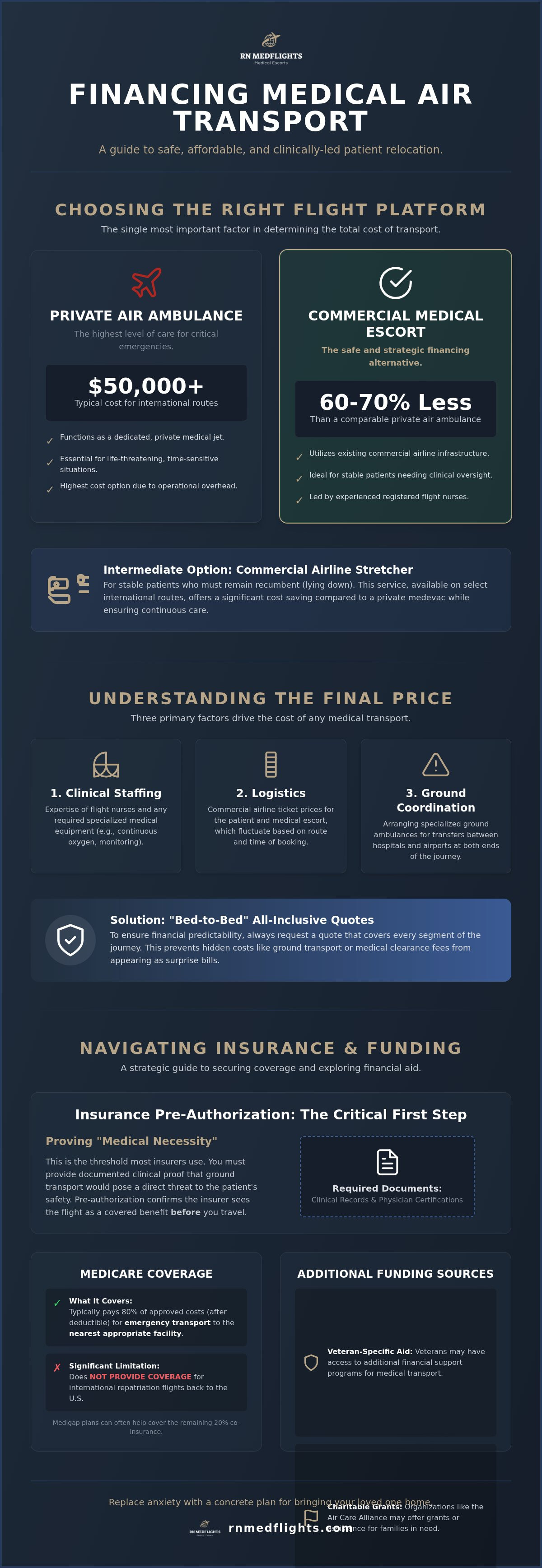
Patient air transport encompasses a broad range of services within global air medical services. It includes high-cost private air ambulances designed for critical emergencies and nurse-led commercial escorts for stable patients. When families begin researching financing options for patient air transport, they often encounter significant "sticker shock." This usually happens because they don't realize the flight platform they choose dictates the majority of the cost. By matching the level of care to the patient's actual clinical needs, families can often find more manageable solutions.
Costs fluctuate based on clinical acuity, distance, and the required equipment. A patient requiring continuous oxygen or specialized monitoring needs a different level of staffing than an elderly individual with dementia who needs a travel companion. Beyond the flight itself, "hidden costs" like airline medical clearance fees and ground ambulance transfers can add thousands to a bill if they aren't accounted for early. We prioritize a "bed-to-bed" pricing model. This approach ensures every segment of the journey is covered in one transparent quote, preventing surprise bills during an already stressful medical crisis.
Primary Drivers of Medical Flight Pricing
Clinical staffing remains the most significant driver of the final price. This includes the expertise of licensed registered flight nurses and the specific medical equipment required for the journey. Logistics also play a major role, as ticket prices for the patient and the medical team fluctuate based on airline rates. Finally, ground coordination involves securing specialized ambulances to move the patient from the hospital to the airport, and then from the arrival airport to the receiving facility. Managing these moving parts requires precision to ensure patient safety and cost efficiency.
Cost Comparison: Private Jet vs. Commercial Medical Escort
Choosing the right platform is the most effective way to manage your budget. Private air ambulances operate as dedicated medical jets. They are essential for life-threatening emergencies but often exceed $50,000 for international routes. In contrast, a commercial medical escort utilizes existing airline infrastructure. This model is typically 60 to 70 percent less expensive than a private jet because you aren't paying for the entire aircraft's operational overhead. For patients who cannot sit upright but remain stable, a commercial airline stretcher service provides an intermediate option. This setup allows for recumbent transport on select international flights at a fraction of the cost of a private medevac. Understanding these distinctions is vital when evaluating your financing options for patient air transport.
Navigating Insurance and Government Coverage Limitations
Securing coverage for medical flights requires a strategic approach to documentation and policy interpretation. When exploring financing options for patient air transport, families often find that commercial insurance providers prioritize the concept of "medical necessity." This clinical threshold requires documented proof that ground transportation would pose a direct threat to the patient's safety. To avoid unexpected out of pocket expenses, obtaining pre-authorization is an essential step. This process involves submitting clinical records and physician certifications before the transport begins to ensure the insurer recognizes the flight as a covered benefit.
Does Medicare Pay for Air Medical Transport?
Medicare offers specific, narrow protections for medical flights. Under Medicare coverage for air ambulance guidelines, Part B typically pays 80 percent of the approved cost after the annual deductible is met. For 2025, that deductible is $257. Coverage is usually restricted to emergency situations where the patient must be moved to the nearest appropriate facility that can provide necessary care. A significant limitation is that Medicare does not provide coverage for international repatriation. If a claim is denied, families can appeal by submitting evidence that a nurse led commercial flight was the most medically appropriate and cost effective choice. Supplemental Medigap plans are also valuable here, as they often cover the 20 percent co-insurance gap that Medicare leaves behind.
VA Benefits and Support for Veterans
Veterans may have access to additional financial support through the Department of Veterans Affairs. For those with service connected conditions, the VA often provides Beneficiary Travel pay to assist with the costs of non emergency medical relocation. This benefit is coordinated through local VA Travel Offices and requires specific eligibility verification. Navigating these federal requirements can be complex during a family crisis. Because RN MEDflights is veteran owned and operated, we have a deep understanding of VA protocols and administrative workflows. We assist families in coordinating these specialized logistics to ensure veterans receive the full support they earned through their service. Travel insurance policies can also supplement these benefits, provided the "Medical Evacuation" clause specifically includes repatriation to a home facility rather than just the nearest local hospital.
Commercial Medical Escort: The Strategic Financing Alternative
Many families believe a private air ambulance is the only way to move a patient safely. This misconception often limits their financing options for patient air transport by steering them toward the most expensive service available. By utilizing existing airline infrastructure, commercial medical escorts offer a sophisticated alternative that maintains clinical integrity while slashing overhead. This model is ideal for non-emergency patients, including elderly travelers or those living with dementia, who require professional supervision but not a dedicated ICU jet.
Consider a recent repatriation from Europe to the United States. A private jet quote reached well over $50,000. By choosing a nurse-led commercial escort, the family saved $30,000. The patient received continuous care from a highly trained flight nurse, ensuring safety throughout the journey at a fraction of the cost. The clinical supervision remains the same; the only difference is the flight platform itself.
Why Commercial Escorts Cost Significantly Less
Airline travel is inherently more efficient because costs like fuel and crew salaries are distributed across hundreds of passengers. When we secure tickets for a patient and their medical team, you aren't paying for the positioning or fuel of an entire private aircraft. Commercial flights also operate under established FAA Part 121 rules, which provide a framework of safety and reliability without the specialized maintenance costs of a private medevac fleet. Coordination is often faster. We can frequently secure airline medical clearance and book flights while a private jet is still waiting for a crew to become available.
Bed-to-Bed Coordination as a Cost-Control Measure
True cost transparency comes from managing the entire journey from start to finish. Our international medical repatriation services utilize a bed-to-bed model to eliminate third-party ground ambulance markups. We provide a single invoice price that covers everything from the initial bedside assessment to the final handover at the destination facility. This approach reduces expensive "wait and see" days in a hospital. Our experts handle the complex airline medical clearance process immediately, moving the patient as soon as they're clinically stable. This efficiency is a cornerstone of effective financing options for patient air transport, as it prevents the compounding costs of extended hospital stays and uncoordinated logistics.
Grants, Charitable Assistance, and Tax Considerations
Alternative financing options for patient air transport often exist beyond the scope of traditional insurance policies. For families facing significant financial barriers, charitable organizations and tax strategies can provide essential relief. These resources require careful navigation and specific documentation, but they serve as vital components of a comprehensive funding plan. Exploring these avenues early in the planning process helps ensure that cost doesn't become a barrier to safe, professional medical relocation.
Finding Free or Discounted Transport Through Charities
Charitable organizations like the Air Care Alliance and Patient Airlift Services (PALS) provide a critical safety net. These groups typically coordinate with volunteer pilots to offer free or low cost flights for patients who need to travel for specialized treatment. However, eligibility is often strict. Most "gap" charities require patients to be ambulatory, meaning they can board a small aircraft with minimal assistance. They also generally require proof of financial need and a physician's statement confirming the patient is stable for flight in a non-pressurized or smaller cabin. It's important to recognize that these organizations rarely have the equipment or staffing to handle stretcher cases or patients requiring ICU-level supervision. For those more complex clinical needs, charitable assistance may be better utilized as a supplement to other funding sources.
Other community-based resources include:
Crowdfunding: Platforms like GoFundMe allow families to share their stories. Success usually depends on transparent communication about the specific medical need and the clinical qualifications of the transport team.
Employer Benefits: Some large corporations offer medical relocation assistance as part of their HR or wellness packages. It's always worth checking your current policy for "emergency assistance" or "repatriation" clauses.
State Programs: While Medicaid's role is primarily focused on emergency ground transport, some state-specific programs offer limited support for essential medical travel if the care is unavailable locally.
Are Medical Transport Expenses Tax Deductible?
One of the most overlooked financing options for patient air transport is the potential for tax deductions. According to IRS Publication 502, transportation expenses primarily for, and essential to, medical care are often deductible. This can include the cost of airline tickets for the patient and the necessary medical staff. For a 2026 tax return, you may be able to deduct the travel expenses of a licensed flight nurse if their presence is medically required for the patient's safety. To qualify, the transport must be for the prevention or alleviation of a physical or mental defect or illness.
Maintaining meticulous records is the only way to secure these benefits. You should save every invoice, clinical assessment, and physician recommendation that justifies the transport. If you're coordinating an international repatriation, keep records of the currency exchange rates at the time of payment. These documented costs, combined with the standard medical mileage rates, can significantly lower your overall financial burden. If you're unsure which funding source applies to your situation, our team can help you evaluate your financial and clinical options today.
Securing Your Quote and Moving Forward with RN MEDflights
Taking the final step toward a medical relocation requires a clear understanding of the clinical and financial requirements. Once you've explored various financing options for patient air transport, the focus shifts to the logistics of the journey itself. Our process begins with a comprehensive clinical assessment to determine if your loved one is "fit to fly." This isn't a simple check-mark; it's a deep review conducted by our clinical leadership to ensure the patient's stability matches the requirements of a commercial flight environment. We prioritize safety above all else, ensuring that the chosen platform is appropriate for the patient's specific medical needs.
How to Request a Comprehensive Quote
To provide an accurate and transparent quote, we need specific details about the current medical facility, the destination, and the patient's current clinical status. We don't just provide a flight price; we coordinate the entire journey. This includes verifying the inclusion of non-emergency ambulance service for ground transfers at both ends of the trip. By comparing a medical escort service quote to air ambulance alternatives, you'll see how using commercial infrastructure provides a safer, more affordable path home.
Transparency is our standard. Every quote includes all necessary medical equipment, airline tickets, and nurse fees. We also recognize that families may need flexible ways to manage these costs. We can discuss credit-based medical financing options that allow you to secure care immediately while distributing the payments over time. Most commercial escort missions can be launched within 48 to 72 hours. This timeline depends on the speed of airline medical desk approvals and the patient's readiness for discharge from their current facility.
Preparing for the Journey Home
The role of our licensed flight nurse begins long before the wheels leave the tarmac. They manage the complex communication between the sending and receiving physicians, ensuring a seamless continuity of care. This pre-flight planning includes securing formal approvals from airline medical desks, which is a specialized process that requires precise clinical data and documentation. We handle these administrative burdens so you can focus on your family's emotional needs.
The journey concludes with a meticulous hand-off. We manage the transition from the current hospital bed, through the airport, and directly into the destination facility. This bed-to-bed responsibility ensures that the patient is never without expert supervision. Our veteran-owned team provides a steady, organized presence throughout this high-stress event. By choosing a model that maximizes safety while exploring all financing options for patient air transport, you're making a responsible decision for both your loved one's health and your family's financial security.
Planning Your Loved One's Safe Return Home
Managing the complexities of medical relocation is easier when you understand the full range of financing options for patient air transport. By choosing a nurse led commercial escort, you can access safe, professional care at a fraction of the cost of a private jet. Whether you're coordinating with insurance, seeking charitable assistance, or leveraging tax deductions, a strategic approach ensures you don't have to sacrifice medical security for financial stability.
Our veteran owned team provides the clinical expertise and comprehensive bed-to-bed coordination required for a seamless transition. We utilize licensed registered flight nurses on every mission to maintain a high standard of care from bedside to bedside. This end-to-end responsibility removes the logistical burden from your family, allowing you to focus on recovery and healing. You don't have to handle these complex logistics alone. Request a Transparent Medical Transport Quote from RN MEDflights today to begin the journey home with confidence and peace of mind.
Frequently Asked Questions
Does Medicare cover the cost of a commercial medical escort?
Medicare Part B typically does not cover the cost of a non-emergency commercial medical escort. Its coverage is restricted to emergency air ambulance transport to the nearest appropriate facility when ground transport is medically impossible. While Medicare may pay 80 percent of an emergency flight after the deductible is met, commercial nurse led services are usually viewed as a non-covered benefit. You should check your specific Medigap or supplemental policy for secondary coverage possibilities.
What is the cheapest way to transport a bedridden patient long-distance?
The most cost effective method for a stable, bedridden patient is often a commercial airline stretcher service on international routes or a specialized ground ambulance for shorter domestic distances. These services utilize existing infrastructure to provide recumbent care at a much lower price than a private jet. This approach ensures patient safety through continuous nurse supervision while avoiding the high operational overhead of a dedicated medical aircraft.
Are medical flight costs tax deductible in 2026?
Medical flight expenses are generally tax deductible if the transport is primarily for and essential to medical care. Under IRS Publication 502, you can deduct the cost of airline tickets for the patient and the necessary medical staff. It's vital to maintain meticulous records of all clinical assessments and invoices for your 2026 tax return. We recommend consulting a tax professional to ensure the journey meets the specific "medical necessity" criteria for your filing.
Can I use VA benefits for private medical air transport?
Veterans may be eligible for Beneficiary Travel pay if they have a service connected condition or meet specific income thresholds. While the VA usually coordinates transport through its own network, they may reimburse costs for non-emergency relocation in certain clinical scenarios. You should contact your local VA Travel Office to verify your specific eligibility. As a veteran owned organization, we understand the administrative workflows required to coordinate with VA offices effectively.
How much does a commercial medical stretcher service cost compared to an air ambulance?
A commercial airline stretcher service typically costs significantly less than a private air ambulance, often representing a 50 to 70 percent savings. While a private international medevac can frequently exceed $100,000, the commercial model leverages scheduled airline routes to reduce fuel and crew expenses. This makes it a strategic choice when evaluating financing options for patient air transport for patients who must remain recumbent but are clinically stable for commercial travel.
What should I do if my insurance denies a medical necessity claim for transport?
If your insurance denies a claim, you should immediately file a formal appeal supported by comprehensive clinical documentation. Provide a letter from the attending physician explaining why ground transport was unsafe and why the chosen flight was the most cost effective safe option. Insurance providers often deny initial claims due to a lack of specific medical data. We assist families by providing detailed bed-to-bed records to help strengthen these appeals.
Is there financial assistance available for international medical repatriation?
Financial assistance for international repatriation is often limited to specialized grants, travel insurance policies, or employer sponsored benefits. Some non profit organizations offer partial subsidies, though they frequently prioritize domestic travel for ambulatory patients. Many families successfully manage these costs by combining different financing options for patient air transport, such as medical loans, crowdfunding, or selecting a commercial medical escort model to reduce the total financial burden.
How can I find charities that help with medical flight costs?
The Air Care Alliance and Patient Airlift Services (PALS) are excellent primary resources for finding charitable medical transport. These organizations maintain extensive databases of volunteer pilot networks and non profit flight providers. You must typically demonstrate financial need and have a stable medical status to qualify for these services. While many charities focus on ambulatory patients, they can often provide guidance on other philanthropic resources for patients with more complex clinical needs.
