Booking a Multi-Leg International Medical Transport: A Step-by-Step Guide
Updated: 1 hour ago
What if a long international medical journey could be planned as one coordinated care plan rather than a chain of separate bookings? When booking a multi-leg international medical transport, it’s natural to worry that a flight connection, delay, or ground transfer could interrupt care. Each segment matters, and the details can feel difficult to manage while you’re focused on a loved one.
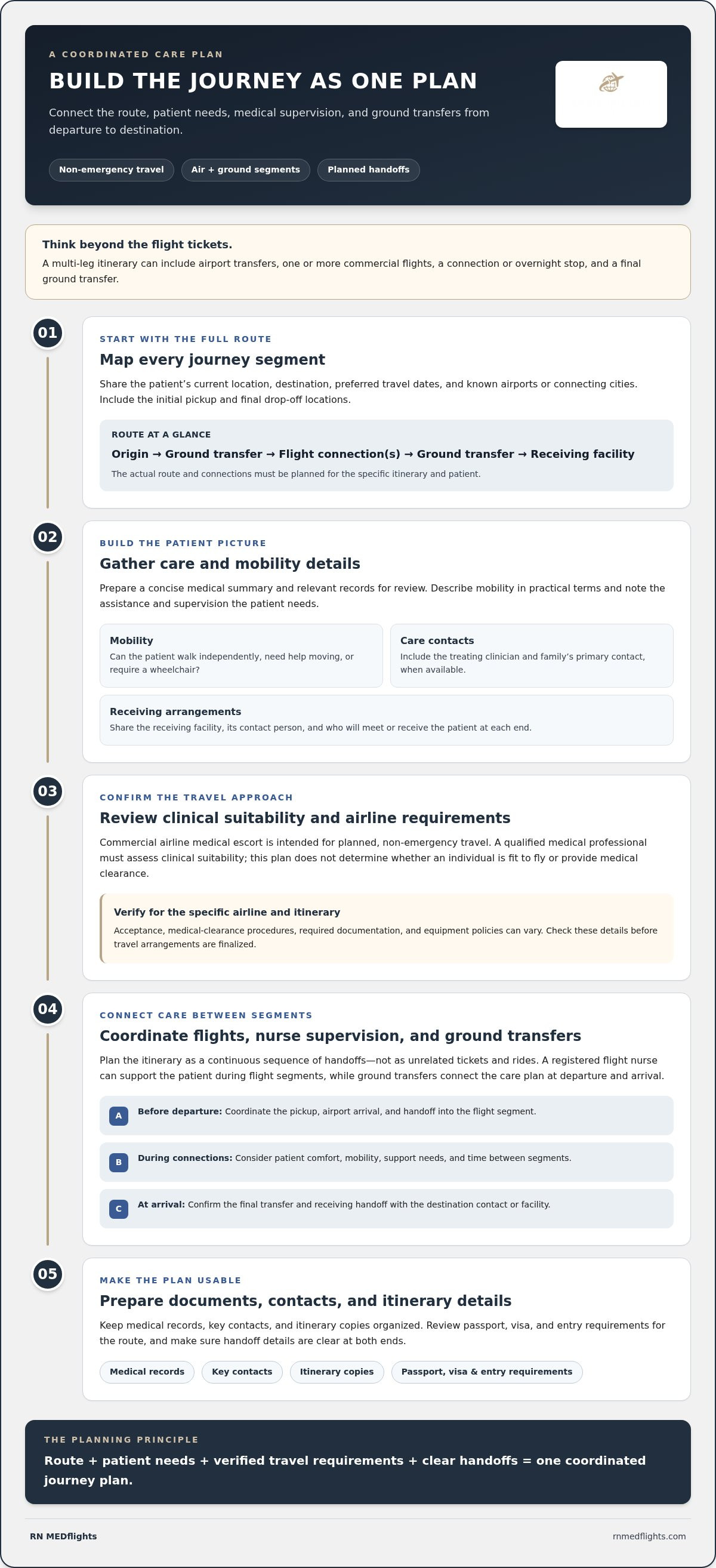
A clear plan brings the itinerary, medical supervision, and transfers together. This guide explains what information helps organize the journey, how commercial flights and ground ambulance transfers fit into a bed-to-bed plan, and how a licensed registered flight nurse can support the patient during flight segments. RN MEDflights coordinates non-emergency medical transport across air and ground segments, helping connect care from origin to destination.
You’ll learn how to prepare medical and travel details, plan connections and handoffs, and understand the arrangements that bring the journey together. With a coordinated approach, you can take the next step with a clearer picture of what the patient’s trip will involve.
Table of Contents
When can multi-leg international medical transport use commercial flights?
A multi-leg medical journey connects several travel segments in one planned itinerary, with timing and patient support coordinated from departure to arrival. It may include a ground transfer to an airport, one or more commercial flights, a connection or overnight stop, and another ground transfer to the receiving facility. Each handoff matters. The patient’s needs must be considered in the air and while moving between vehicles, terminals, and care settings.
Commercial airline medical escort is for planned, non-emergency travel. A medical escort accompanies a patient and provides support suited to their needs; Medical escort services may involve a qualified medical professional. This service is different from emergency stabilization or emergency transport. If someone needs immediate emergency care, contact local emergency services rather than arranging a planned commercial flight.
What makes a medical transport journey multi-leg?
Connecting flights are only part of the itinerary. Ground transfers before the first flight and after the final arrival are separate segments that also need coordination. Additional planning may be needed when a route uses different airports, includes a long transfer, or requires an overnight stop. The patient’s comfort, mobility, care needs, and time between segments all affect how the full route is arranged.
For example, a hypothetical trip might begin with an ambulance transfer from a care facility to an airport, continue on a commercial flight to a connecting city, then proceed on another flight before a final ground transfer to a receiving facility. This is an illustration, not a promise of a specific connection. When booking a multi-leg international medical transport, plan around the complete journey rather than treating each ticket or ride as unrelated.
Is commercial-airline transport appropriate for every patient?
No single travel arrangement fits every patient. Clinical status, mobility, support needs, and the ability to tolerate the planned journey inform the care plan. A qualified medical professional must assess clinical suitability. This article cannot determine whether an individual is fit to fly or provide medical clearance. A commercial medical escort may be considered for planned non-emergency travel when the patient’s condition and support needs make that option appropriate.
Airline acceptance, medical-clearance procedures, required documentation, and equipment policies can vary by airline and itinerary. These details need to be verified for the specific route before travel arrangements are finalized. A connection that works on paper may not suit the patient if there isn’t enough time or support for the transfer. Coordinating clinical planning with airline requirements and ground arrangements helps families understand the journey before departure and plan for continuous, non-emergency care.
What information is needed to book multi-leg international medical transport?
A useful plan starts with the full route, then adds the patient and care details needed to coordinate each handoff. You don’t need every answer before beginning, but clear, accurate information helps the team understand the journey and identify what remains to be arranged. Booking a multi-leg international medical transport involves more than naming two cities. Connecting flights, ground transfers, timing, and receiving arrangements all shape the plan.
Build the route and identify every journey segment
Begin with the departure location, destination, and preferred travel dates. Then list the airports, connecting points, and ground-transfer locations you know. Include practical constraints, such as a preferred date range or a location the patient must reach, without assuming a particular flight schedule will work.
Origin and destination: Provide the patient’s current location and the intended receiving address or facility.
Air route: Note known departure and destination airports, possible connecting cities, and preferred dates.
Ground segments: Identify where transfers may be needed, including the initial pickup and final drop-off.
Handoffs: Share who will meet or receive the patient at each end, with their contact details when available.
This route map makes gaps visible early. For example, a family may know the destination country but still need to identify the receiving facility or the person meeting the patient after arrival. Clear handoff information links travel planning with care at both ends.
Gather patient and care information before planning
Next, assemble a concise medical summary and relevant records for review by the care team. Describe the patient’s mobility in practical terms, such as whether they can walk independently, need help moving, or require a wheelchair. Include current care needs and the level of supervision being provided. Leave clinical suitability decisions to a qualified medical professional.
Patient details: Share the current location, mobility, assistance needs, and relevant care information.
Care contacts: Provide the treating clinician’s name and contact information, when applicable.
Receiving arrangements: Include the receiving facility and its contact person, if known.
Family contacts: Identify a primary contact and provide reliable phone numbers and email addresses.
Accurate contact details help family members, care teams, and transport coordinators stay aligned as arrangements develop. Medical travel planning may involve record review and preparation across the journey, as discussed in Medical travel coordination and patient safety. The information you provide supports coordination, but it doesn’t replace clinical assessment or airline approval. Airline-specific clearance and documentation requirements must be reviewed for the itinerary.
Once you’ve gathered what’s available, you can discuss a coordinated medical transport plan and organize the remaining details around the full journey.
How are flights, nurse supervision, and ground transfers coordinated?
A coordinated itinerary connects the patient’s care plan with the practical demands of each travel segment. Flight arrangements, medical supervision, and ground transfers must fit together, with clear handoffs at departure and arrival. RN MEDflights arranges non-emergency commercial airline medical escort with licensed registered flight nurses and coordinates ground ambulance services at both ends of bed-to-bed journeys.
Coordinate commercial flight segments around the patient
Route planning considers the patient’s care needs alongside the airline’s medical-clearance, documentation, and equipment requirements. Connections and airport changes add handoffs, so they must be considered as part of the complete itinerary, not just as booking details. Clinical and airline considerations are addressed before travel arrangements are finalized. Specific airlines, routes, connection times, and equipment acceptance depend on the itinerary and cannot be assumed in advance.
During commercial airline travel, the flight nurse provides medical supervision and support appropriate to the patient’s assessed needs. The nurse accompanies the patient through the flight segments, helping connect the care arrangements at departure and arrival. This is a non-emergency escort model on a commercial flight, not private air ambulance transport. Private air ambulance transport uses a different aircraft and operating model. The appropriate option depends on the patient’s clinical needs and travel circumstances.
Connect ground transfers with continuous journey planning
The journey begins before boarding. At the origin, the ground transfer links the sending location to the departure airport. At the destination, another transfer carries the patient from the arrival airport to the receiving location. RN MEDflights coordinates ground ambulance services at both ends, connecting those movements with the flight itinerary and planned handoffs.
Timing matters because the patient needs suitable support moving between segments, and the receiving team needs clear arrival information. The itinerary should identify who is handing over care, who is accepting the patient, and how those contacts can be reached. If a delay or schedule change affects a segment, clear communication helps everyone respond to updated timing rather than relying on assumptions. For accompanying family members who must travel between airports and facilities independently, booking a professional chauffeur driver can help ensure ground transit remains reliable and aligned with the care schedule.
Booking a multi-leg international medical transport as one coordinated plan brings these moving parts into view together. For more detail on the service and its role in commercial travel, explore this commercial medical escort guide.
How should families prepare for documents, connections, and changes?
Good preparation gives the patient’s care team and travel coordinators a shared, current picture of the journey. Before departure, organize essential records, confirm key contacts, and keep itinerary details easy to access. For booking a multi-leg international medical transport, preparation should cover flight paperwork and the ground handoffs that connect each segment.
Prepare medical and travel information for the itinerary
Medical information: Gather current records and a concise summary of the patient’s condition and care needs. Include contact details for the treating clinician and receiving facility where available.
Travel documents: Check passport validity, visa requirements, and entry rules with the appropriate official authorities for each country on the route.
Airline requirements: Verify medical forms, clearance steps, supporting documentation, and submission timing with each airline involved. Requirements may differ between carriers.
Copies and contacts: Keep accessible copies of the itinerary, essential records, and key phone numbers for family, the care team, and receiving contacts.
Organizing these details early helps the team identify missing information while there is time to address it. Requirements can change with the route or the patient’s circumstances, so don’t rely on documents or instructions from an unrelated trip.
Plan for connections and itinerary changes
Build a communication plan before travel begins. Identify who will update the family and receiving team if a flight time changes, and make sure transfer contacts at each endpoint can be reached. Connected services may need updated timing after a delay. A change to one flight can affect a ground pickup, a connection, or the planned handoff at arrival.
Allow for the practical demands of moving between segments. A transfer that looks workable on a schedule may not account for airport layout, patient mobility, or the support needed during a handoff. Feasible timing depends on the itinerary and individual circumstances, so don’t assume a tight connection or fixed contingency will work for every patient.
Keep an accessible itinerary copy with the family contact and the people receiving the patient. Include flight details, transfer locations, and contact information in one place, then share updates when arrangements change. This gives everyone a consistent reference without assuming that rebooking or other changes will happen in a particular way.
Cross-border journeys also involve coordination beyond the flight itself. For broader context on planning international repatriation, see the international medical repatriation guide. If you’re organizing a non-emergency journey, discuss a coordinated transport plan with RN MEDflights.
How to book a coordinated journey with RN MEDflights
Booking a multi-leg international medical transport can feel like a large task, especially when your family is also supporting a patient through a change in care. A clear sequence helps: share the route, provide the patient’s information, coordinate the travel plan, then prepare for departure. RN MEDflights arranges non-emergency commercial airline medical escort and bed-to-bed coordination, bringing flight planning and ground transfers into one journey plan.
Start with the route, patient needs, and care contacts
Begin with the details you already have. Share the patient’s current location, intended destination, preferred travel dates, and any known airports or connection points. Add a practical description of mobility and assistance needs, along with relevant medical information and contact details for the treating clinician, family representative, and receiving facility when available.
You don’t need every travel detail settled before starting the conversation. A clear outline helps RN MEDflights understand the journey and coordinate planning around the patient’s circumstances. The itinerary depends on individual care needs and applicable airline and travel requirements, including medical clearance and documentation. These details are addressed during planning rather than assumed from a standard route.
Share the route: Provide the origin, destination, known airports, and preferred dates.
Describe the patient’s needs: Include mobility, assistance, and relevant care information.
Provide key contacts: Identify family, care-team, and receiving-facility contacts where available.
Move from planning to a coordinated transport plan
Once the journey details are available, connect the flight segments with transfers at each end. RN MEDflights coordinates ground ambulance services for bed-to-bed journeys, while a licensed registered flight nurse provides professional medical supervision during commercial airline travel. This model is designed for non-emergency transport when commercial travel is appropriate for the patient. It is distinct from private air ambulance transport, which uses a different aircraft and service model.
As planning progresses, keep medical and travel records organized, follow the itinerary-specific airline requirements, and make sure family and receiving contacts know how information will be shared. A coordinated plan gives everyone a clearer view of the journey and its handoffs. It also helps identify remaining details without treating a connection or transfer as automatic.
RN MEDflights has arranged medical transport since its founding in 2010. Each journey requires planning around the individual patient, route, and travel requirements. With the route and care information in hand, families can discuss how commercial airline medical escort and bed-to-bed coordination may fit the journey.
Take the Next Step Toward a Clear Travel Plan
You don’t need every detail settled before moving forward. Start with the route you’re considering, the patient’s current situation, and the care contacts already involved. From there, planning can focus on the questions that matter for this journey, helping your family understand the next decisions without treating each transfer as a separate problem.
Booking a multi-leg international medical transport is a significant undertaking, but a coordinated conversation can make the process more manageable. Share what you know, including any uncertainties, and use the discussion to shape a practical plan around the patient’s circumstances and travel requirements.
When you’re ready to talk through the journey, Speak with RN MEDflights about a coordinated medical transport plan. Take this clear next step toward planning the journey with support.
Frequently Asked Questions
Can a patient travel internationally with more than one flight connection?
Yes, a patient may travel with multiple connections if the route is appropriate for their clinical needs and the airlines accept the arrangements. Each connection adds a transfer to plan, which may involve changing terminals or airports and navigating another country’s travel requirements. The itinerary should account for the patient’s mobility, support needs, and time between flights. A qualified professional should assess the patient’s suitability for travel.
How far in advance should I arrange multi-leg medical transport?
Start planning as early as practical. There isn’t one lead time that fits every itinerary. Booking a multi-leg international medical transport may involve medical review, airline-specific clearance and forms, travel documents, and ground transfers at both ends. Starting early gives the planning team time to identify requirements and coordinate the people involved. The final timing depends on the patient’s circumstances, route, airline processes, and travel-document needs.
What medical information is needed to plan a commercial airline medical escort?
Provide a current medical summary, relevant records, and contact information for the treating clinician. Include practical details about the patient’s current condition, mobility, assistance needs, and any care or equipment considerations that may affect travel. For example, note whether the patient can transfer with help or needs additional support. These details help the care team assess the transport plan. They don’t replace a clinical assessment or airline clearance.
Does a flight nurse accompany the patient between every journey segment?
A flight nurse provides medical supervision during the commercial-flight portions of the journey. That doesn’t automatically mean the nurse handles every ground transfer or accompanies the patient through every segment in the same way. The itinerary should make clear where the nurse’s support applies and how handoffs connect with ground ambulance teams. Families can use the planned handoff points to understand who is supporting the patient at each stage.
What happens if a connecting flight is delayed or cancelled?
A delay or cancellation can affect onward flights, ground transfers, and the expected arrival time at the receiving facility. The family should share schedule updates with the transport coordinator so affected contacts can receive current information. Airline rebooking processes and next steps depend on the circumstances. A revised itinerary may require renewed review of medical and travel requirements. Keep key contact details and itinerary information accessible throughout the journey.
Can a family member arrange international medical transport for someone else?
Yes, a family member can begin organizing transport for a patient. It helps to have the patient’s current location, intended destination, preferred dates, and contact details for the treating clinician and receiving facility. Involving the patient and care team in planning, whenever possible, can help ensure medical details and travel preferences are represented accurately. The care team can provide information needed to assess clinical suitability.
Are ground ambulance transfers included in bed-to-bed medical transport?
Ground ambulance coordination supports bed-to-bed transport planning, including transfers at the origin and destination. The plan connects the pickup location to the departure airport and the arrival airport to the receiving facility, with handoffs arranged around the itinerary. Specific transfer arrangements depend on the patient’s route and circumstances. Review the journey plan to understand the locations and handoffs covered by the coordinated transport.


