Can a Family Member Fly with the Patient and Medical Escort? 2026 Logistics Guide
- 11 hours ago
- 12 min read
Imagine standing at a terminal gate, watching your vulnerable loved one being prepared for a long flight, and feeling the heavy weight of uncertainty about whether you can stay by their side. It's a common source of anxiety during medical relocations, but you don't have to face this journey apart. One of the most vital questions families ask our team is: can a family member fly with the patient and escort? The answer is a reassuring yes. We believe that your presence isn't just a comfort; it's a strategic part of the healing process that bridges the gap between clinical care and emotional security.
We understand the stress of managing your own travel logistics while worrying about a family member's medical needs. In this 2026 guide, you'll discover how we coordinate joint travel to keep your family together. We'll outline exactly how seating is booked in Business and Economy cabins, explain the profound emotional benefits of staying connected, and provide a clear checklist for your own preparation. At RN MEDflights, our registered nurses handle the complex airline coordination so you can focus entirely on being a supportive relative while we maintain clinical excellence.
Table of Contents
Can a Family Member Accompany the Patient and Medical Escort?
One of the most frequent concerns families voice when planning a medical relocation is the fear of separation. You might wonder, can a family member fly with the patient and escort during a long-distance journey? At RN MEDflights, we don't just permit family accompaniment; we actively encourage it. Our mission is to move families, not just patients, because we recognize that your presence is a powerful clinical asset. Having a familiar face nearby reduces "transfer trauma" and provides a sense of security that no amount of medical equipment can replicate.
A medical escort is a professional registered nurse who manages all clinical needs and logistics during transit while allowing family members to focus on providing emotional comfort.
Understanding the Trio: Patient, Nurse, and Companion
During the flight, the registered flight nurse maintains a constant, vigilant presence. They monitor vital signs, manage medications, and coordinate with airline staff to ensure a seamless experience. This professional oversight creates a safe environment where you can simply be a spouse, child, or sibling again. To qualify for this type of travel, the patient must be in a "non-emergency" status. This means they're medically stable enough for a commercial cabin, even if they require supplemental oxygen or a commercial stretcher. The nurse acts as the clinical lead, while you act as the "historian," helping the nurse understand the patient's long-term nuances and preferences. You're never in the way; you're a vital part of the care team.
Commercial Travel vs. Private Air Ambulance for Families
Choosing a commercial airline medical escort offers distinct advantages for families. Private air ambulances are often small, specialized aircraft where space is at a premium. Due to strict weight limits and the volume of medical equipment, these flights frequently limit passengers to just one person, or sometimes none at all. This forces families to book separate flights, which increases stress and complicates the arrival process.
In contrast, commercial aircraft provide the flexibility to book a block of seats. Whether you're traveling domestically or through international medical repatriation, we can arrange for adjacent seating in Economy, Business, or First Class. When families ask can a family member fly with the patient and escort, we explain that commercial infrastructure makes it far more cost-effective to keep multiple relatives together. By utilizing these flights, we ensure the patient remains surrounded by their support system throughout the entire bed-to-bed journey.
Seating Logistics: How We Keep Families Together on Commercial Flights
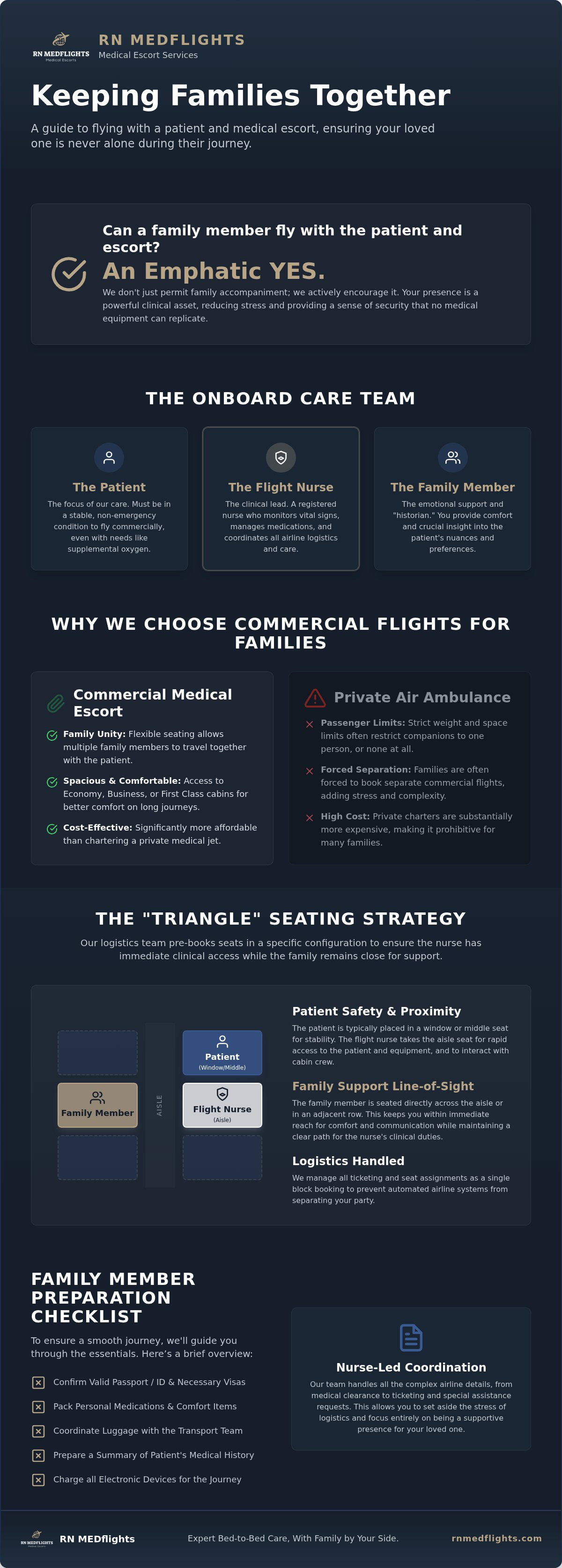
When families ask can a family member fly with the patient and escort, their concern often shifts from "if" to "where." Simply being on the same plane isn't enough; you need to be close enough to offer comfort without obstructing clinical care. To manage this, we utilize a "Triangle Seating Strategy." This configuration ensures our registered nurse has immediate, unobstructed access to the patient's airway and medical equipment while placing the family member in an adjacent seat. Usually, the patient occupies a window or middle seat, the nurse takes the aisle seat for rapid movement, and the family member is positioned directly across the aisle or in the row behind. This layout maintains a clear line of sight between everyone involved.
Our logistics team handles the entire ticketing and seat selection process. We don't leave your proximity to chance or airline algorithms. By booking seats as a single block, we prevent the separation that often occurs during automated reassignments. This proactive approach highlights the benefits of a medical escort, as we manage the technicalities of airline seating charts to protect your family's unity. If the mission requires a Commercial Airline Stretcher Service, the layout changes slightly. The stretcher typically occupies a block of six to nine seats in the rear of the aircraft. In these cases, we secure the row immediately in front of the stretcher for the nurse and family, ensuring you're only inches away from your loved one.
Booking the Right Cabin for Comfort and Care
In 2026, many airlines have updated their premium cabin configurations. We evaluate whether Business Class is a clinical necessity or a comfort preference. For patients who must remain supine, lie-flat Business Class seats provide a cost-effective alternative to a stretcher. We navigate these airline-specific rules to ensure the nurse's equipment doesn't interfere with cabin safety protocols. Booking early is essential to secure these specific seat blocks, especially on high-demand international routes where cabin space fills quickly. If you're unsure which cabin fits your needs, our team can provide a customized flight plan that balances clinical requirements with your family's budget.
Ground Transport Logistics for the Whole Group
The journey doesn't begin or end at the airport gate. Our "bed-to-bed" promise extends to the accompanying family member. We coordinate ground ambulance transfers that accommodate both the patient's medical gear and your personal luggage. It's a common oversight in medical travel, but we ensure the vehicles we dispatch have the capacity for your suitcases alongside our clinical kits. This creates a seamless journey home, where you stay with the patient from the moment they leave the hospital bed until they're safely admitted to their destination facility.
The Clinical and Emotional Benefits of Flying Together
A medical relocation is more than a logistical challenge; it's an emotional marathon for the patient. When we address the question, can a family member fly with the patient and escort, we look beyond the seating chart to the specific clinical outcomes. Research into patient relocation shows that "transfer trauma"—the acute stress and confusion associated with moving between facilities—is significantly reduced when a familiar face is present. This is especially true during long-haul international repatriation, where the environment is unfamiliar and potentially overwhelming. Your presence acts as an emotional anchor, keeping the patient's heart rate and anxiety levels stable during the complexities of air travel.
While our registered nurses bring clinical expertise, you bring the patient's "biographical" history. You know the subtle signs of pain, the specific ways to communicate, and the nuances of their medical history that might not be fully captured in a transfer summary. This partnership improves patient cooperation and allows the nurse to anticipate needs before they become crises. For patients with dementia, the "Sundowning" effect—increased confusion and agitation in the late afternoon or evening—can be exacerbated by the cabin environment. A combined approach, where the nurse manages clinical stability and the family member provides familiar reorientation, creates a safer, more predictable environment for everyone on board.
Emotional Security and Patient Advocacy
You serve as the patient's primary advocate, ensuring their comfort preferences are respected throughout the journey. Our flight nurses are specifically trained to support your emotional well-being as well, recognizing that your stress levels directly impact the patient's physiological state. We provide clear, real-time updates on clinical progress so you can remain focused on your role as a supportive relative. A calm family member is a flight nurse's best ally in maintaining a stable environment.
Continuity of Care: From Bedside to Bedside
The "bedside-to-bedside" model relies on a seamless handoff at both ends of the journey. You play a critical role at the receiving facility by helping the new medical team understand the patient’s immediate journey and long-term habits. This continuity ensures the patient never feels alone with strangers, bridging the gap between the aircraft and the new clinical setting. By staying together, you ensure that the patient’s transition is not just a change of location, but a continuous arc of supportive, compassionate care.
Preparation Checklist for the Accompanying Family Member
While our medical team manages the clinical complexities of the mission, your personal preparation is vital to the journey's success. When families ask can a family member fly with the patient and escort, we explain that while the answer is yes, the companion also has a specific "mission" to prepare for. We handle the heavy lifting of airline clearances and medical equipment, but you must ensure your own travel readiness to remain a steady, supportive presence. This involves a coordinated approach to documentation, luggage management, and self-care during what can be a 24 hour or longer journey.
Essential Documents for International Travel
Documentation is the most common hurdle in international medical repatriation. You must ensure your passport is valid for at least six months beyond your travel date; airlines are strict about this in 2026. If the destination requires a visa, we'll guide you on the expedited process, but the application remains your responsibility. You should also carry a copy of the patient's "Fit to Fly" letter, which our team secures, as it often lists you as the designated companion. Don't forget your own medications. Since you'll be focused on your loved one, it's easy to overlook your personal health needs. Pack a 48 hour supply of your own prescriptions in your carry-on bag to account for any unforeseen travel delays.
Navigating the Airport with a Medical Team
The airport experience is different when you're part of a medical transport group. At the security checkpoint, our registered flight nurse handles the technical communication with TSA regarding medical liquids, monitors, and medications. This allows you to stay with the patient and provide emotional reassurance. We utilize non-emergency ambulance service providers who are experienced in terminal transfers, ensuring you and the patient move through the airport with minimal physical strain. Our nurses manage the logistics so you can focus on being a family member.
Luggage management requires a strategic balance. While we maximize space for medical supplies, we coordinate ground transport that accommodates your suitcases as well. We recommend limiting your personal luggage to one checked bag and one small carry-on to ensure everything fits comfortably in the ground ambulance at both ends of the trip. During the flight, stay in constant communication with the nurse. They'll provide updates on the patient's status and the arrival timeline, allowing you to stay informed without the stress of managing the clock yourself. If you're ready to start planning your joint journey, you can consult with our flight coordinators to review your specific documentation needs.
Self-care is not a luxury during medical travel; it's a necessity. You must stay hydrated and eat at regular intervals to maintain the energy required to support the patient upon arrival. Our nurses are trained to look out for you, too, ensuring you get moments of rest while they maintain their vigilant clinical watch. By following this checklist, you ensure that the entire team, including you, remains focused on a safe and comfortable relocation.
Why RN MEDflights is the Choice for Families Flying Together
Choosing a partner for medical relocation involves more than just selecting a transport service. It requires finding a team that respects the family unit as an essential component of the patient's recovery. When you ask can a family member fly with the patient and escort, you're looking for more than a logistical "yes." You're seeking a protector who understands the emotional weight of your responsibility as a caregiver. At RN MEDflights, our "Family-First" philosophy ensures that we don't just transport patients; we move families with the dignity and security they deserve.
Our veteran-owned foundation provides a level of logistical precision that is unmatched in the industry. Managing multi-person international travel requires a methodical approach to timing, ticketing, and ground coordination. We handle every detail, from securing adjacent seating blocks to ensuring ground ambulances are ready for the entire group. This operational excellence allows our registered flight nurses to focus on what they do best: maintaining clinical stability while expertly managing the high-stress dynamics that naturally occur during a medical crisis. We maintain transparent communication at every stage, so you're never left wondering about the next step in the process.
A Personalized Approach to Medical Relocation
We recognize that no two families are the same. Every mission we lead is customized to the specific medical needs of the patient and the logistical requirements of their companion. Families who have successfully relocated with our nurses often highlight the peace of mind they felt knowing a professional was managing the clinical burden. This allows the relative to focus on being a supportive presence rather than a medical coordinator. We remain committed to around-the-clock availability, ensuring that your questions are answered and your concerns are addressed at any hour of the day or night.
Next Steps: Getting a Quote for Your Joint Journey
Starting the process is straightforward and designed to minimize your cognitive load. During our initial intake, we'll need basic information about the family companion, including passport status for international routes and any specific mobility or luggage needs. This information allows us to build a comprehensive flight plan that accounts for the entire group. We provide a single, transparent quote that covers all aspects of the journey, including the flight nurse, airline tickets, and bed-to-bed ground transport. There are no hidden fees or surprise costs; we believe in absolute clarity during these difficult times. If you're ready to bring your loved one home, you can request a personalized quote for your family's medical relocation and take the first step toward a safe, unified journey.
Bringing Your Family Together During Medical Relocation
Staying connected during a medical crisis is essential for the patient's recovery and your own peace of mind. By choosing a commercial medical escort, you ensure that clinical expertise and emotional support travel in the same cabin. Our licensed registered flight nurses manage the complex seating arrangements and airline clearances; this allows you to focus entirely on your role as a supportive relative. This unified approach reduces the risk of transfer trauma and ensures a smoother transition between facilities at both ends of the journey.
If you've been wondering can a family member fly with the patient and escort, the answer is a definitive yes. As a veteran-owned and operated small business, we specialize in bed-to-bed international coordination that keeps families united. Our team handles every logistical detail with precision and empathy, ensuring that both you and your loved one are protected throughout the mission. You don't have to face this transition alone. Request a Quote for Your Family's Medical Relocation today and let our experts guide you home with care and confidence.
Frequently Asked Questions
Can I sit directly next to the patient during the flight?
Yes, we prioritize keeping families in adjacent seats whenever airline availability allows. Through our "Triangle Seating Strategy," our registered nurse secures an aisle seat for immediate clinical access while you sit in the neighboring seat or the row directly behind. This configuration ensures you maintain a constant line of sight with your loved one without ever obstructing the nurse's ability to provide essential care.
Is there an extra fee for a family member to fly with the medical escort?
RN MEDflights does not charge an additional professional service fee for a family companion to join the mission. You are only responsible for the actual cost of your own airline ticket and any required travel documents. We include these specific costs in our single, transparent quote so you understand the total financial commitment for the entire group before the journey begins.
What happens if the family member gets sick or tired during the transport?
While the flight nurse's primary clinical responsibility is the patient, they are trained to monitor the well-being of the entire traveling party. If you feel fatigued or unwell during a long-haul flight, the nurse will encourage you to rest while they maintain their vigilant watch over the patient. Our goal is to ensure you arrive at your destination healthy and ready to resume your role as a caregiver.
Can more than one family member fly with the patient and the nurse?
Yes, multiple family members can often accompany the patient on a commercial flight. This is a significant advantage over private air ambulances, which often limit passengers to one person due to weight and space constraints. We can coordinate the booking of a larger block of seats to ensure that several relatives stay together during the relocation process, provided the airline has the capacity.
Do I need to book my own airline tickets, or does RN MEDflights handle it?
We handle all airline ticketing and seat selections for the entire group to prevent the family from being separated by automated airline systems. This end-to-end coordination ensures that the patient, the nurse, and any companions are booked on the same itinerary with confirmed adjacent seating. You won't need to navigate complex airline desks or seating charts yourself during this stressful time.
What are the luggage limits for family members on a medical escort flight?
Luggage limits typically follow standard airline policies for your chosen cabin class, such as Economy or Business. However, we recommend limiting personal items to one checked bag and one carry-on per person to ensure everything fits into the ground ambulance. We must balance your personal belongings with the essential medical equipment and supplies the nurse carries for the patient's clinical safety.
Will the flight nurse also help me with my luggage and check-in?
The flight nurse manages the logistical "heavy lifting," including the check-in process and direct communication with airport security. While their physical focus remains on the patient's immediate safety, our coordinated ground teams assist with the movement of bags between the ambulance and the terminal. This allows you to stay by the patient's side without worrying about the technical mechanics of the airport.
Can I stay with the patient in the ground ambulance to and from the airport?
Yes, our bed-to-bed service ensures you remain with the patient during all ground ambulance transfers. We coordinate with vehicles that have an extra seat available specifically for a companion. This continuity is a core part of our mission, ensuring you never have to wonder if a family member can fly with the patient and escort from the initial bedside to the final destination.