Commercial Airline Stretcher Service Cost: 2026 Comprehensive Price Guide
Securing a safe medical flight home shouldn't require the $50,000 price tag typically associated with private air ambulances. For families managing a crisis, the commercial airline stretcher service cost represents a sophisticated, nurse-led alternative that prioritizes clinical integrity without the prohibitive expense of a dedicated jet. We know you're likely facing an exhausting logistical maze right now. It's natural to feel overwhelmed by the fear of hidden fees or the worry that choosing a more affordable option might compromise the specialized care your loved one deserves.
You deserve a transparent partner who views the patient as a person rather than a case. This guide removes the confusion by detailing exactly how we provide seamless, bedside-to-bedside transport while maintaining uncompromising standards of safety and dignity. We'll outline the specific factors driving costs in 2026 and explain how our 24/7/365 flight coordinators manage every detail to ensure a predictable, all-inclusive experience. You'll gain a clear understanding of the price components and the confidence that your family member is in the hands of a vigilant, highly capable protector.
Key Takeaways
Learn how specialized medical bays are configured on scheduled flights to provide a safe, high-quality alternative to private air ambulances.
Identify the four primary components that dictate the commercial airline stretcher service cost to ensure complete transparency and peace of mind for your family.
Discover how to achieve significant financial savings by comparing the price floor of commercial stretchers against the high entry costs of private jets.
Identify the logistical factors, such as flight distance and lead time, that can help you secure the most competitive and efficient quote.
Understand the RN Medflights "bed-to-bed" philosophy, which prioritizes nurse-led clinical precision and a seamless transition for every patient.
Table of Contents What is a Commercial Airline Stretcher Service and Why Does it Cost More than a Standard Flight? Decoding the Price: The 4 Primary Components of Your Quote Commercial Stretcher vs. Private Air Ambulance: A Cost-Benefit Analysis Factors That Can Inflate or Reduce Your Final Quote The RN MEDflights Advantage: Transparent, Nurse-Led Logistics
What is a Commercial Airline Stretcher Service and Why Does it Cost More than a Standard Flight?
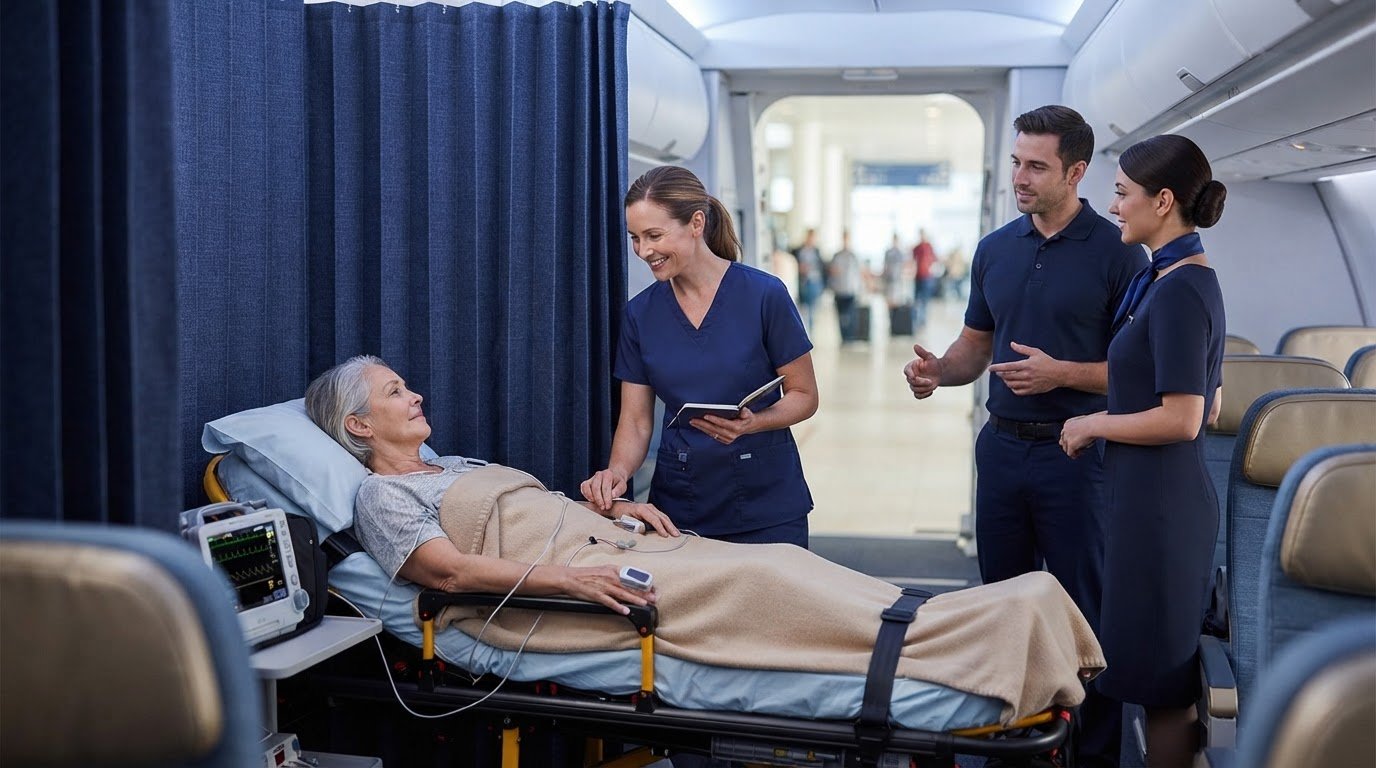
A commercial airline stretcher service is a specialized medical transport configuration where a section of a scheduled international flight is transformed into a mobile clinical environment. This process requires the physical removal of 6 to 12 economy seats to accommodate a medical bay. This significant modification of the aircraft's interior is the primary reason the commercial airline stretcher service cost exceeds a standard passenger fare. Families must view this as a complex logistical undertaking rather than a simple flight booking.
Unlike a medical escort service, where a patient travels in a standard business class seat with a nurse, a stretcher installation supports patients who must remain in a supine position. The setup includes a certified stretcher, a privacy curtain, and a dedicated oxygen supply. Air medical services have evolved to provide these sophisticated solutions for patients who require continuous clinical monitoring but do not need the immediate speed of a private jet. For families, the mindset shifts from price to value; the cost covers the specialized equipment, the clinical expertise of the RN, and the rigorous coordination required with airline medical departments.
The Clinical Necessity of Stretcher Transport
Bedridden patients cannot maintain the physiological requirements for standard or first-class seating. Sitting upright for extended periods can compromise respiratory function or lead to skin breakdown. Our flight nurses are responsible for maintaining hemodynamic stability, monitoring vitals, and administering medications throughout the transit. To secure airline approval, a patient must meet specific stability criteria, ensuring their condition will not deteriorate during the flight. This clinical screening process is a non-negotiable safety standard for every mission we undertake.
A Cost-Effective Alternative to Private Air Ambulances
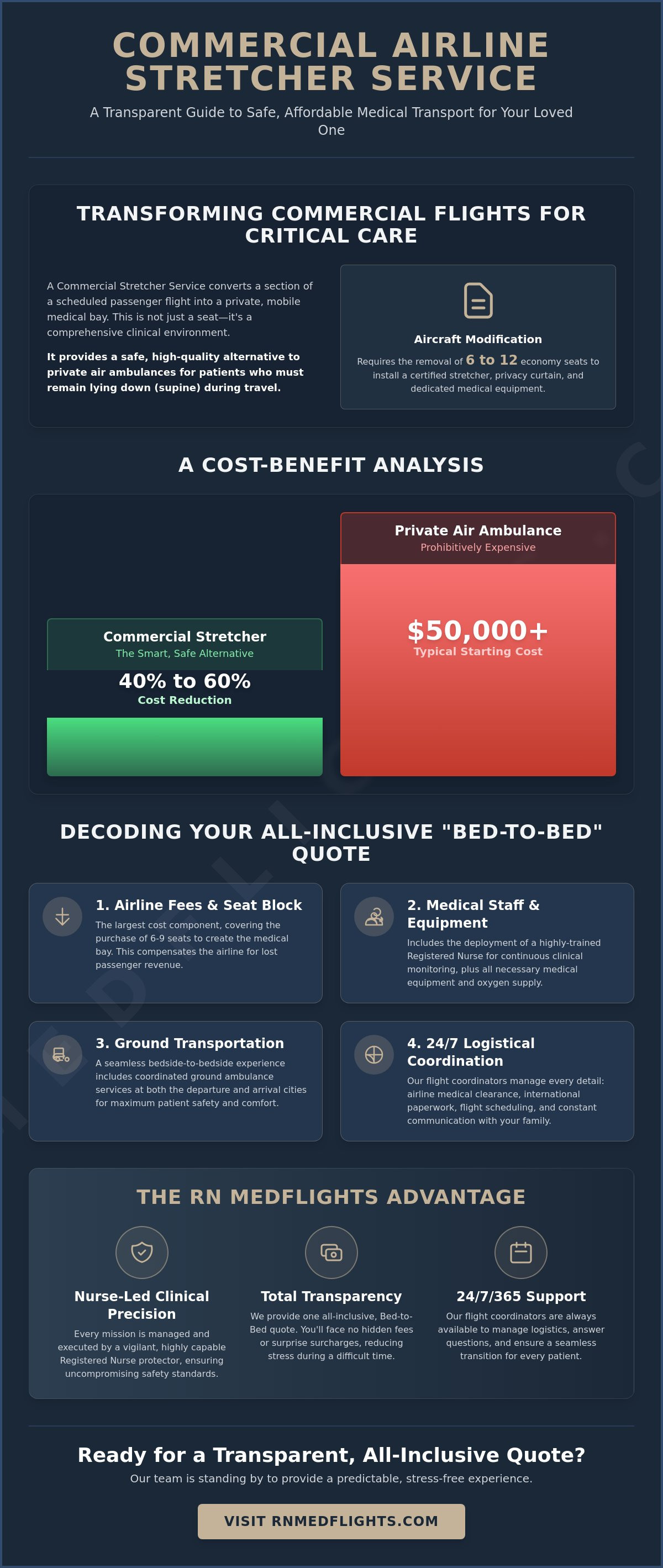
Choosing a commercial stretcher configuration often results in a 40% to 60% cost reduction compared to private medical jets. Major international carriers facilitate this service because it utilizes existing flight paths while providing a necessary clinical solution. This model functions as a hybrid of commercial aviation efficiency and hospital-grade medical care. It provides a seamless, bedside-to-bedside solution for families who need to balance uncompromising medical standards with financial reality. Our nurse-led team coordinates these details 24/7/365 to ensure a stress-free transition for the patient and their loved ones.
Decoding the Price: The 4 Primary Components of Your Quote
Transparency in pricing is a clinical priority for our team because it directly reduces the emotional burden on families during a medical crisis. When a loved one requires relocation for specialized care, a fragmented bill with unexpected surcharges only adds to the distress. We utilize a comprehensive Bed-to-Bed pricing model to provide a single, all-inclusive figure. This approach ensures that the commercial airline stretcher service cost you see at the start is the final amount you pay. Whether the patient is moving across the country or between continents, understanding the variables that drive these costs is the first step toward a successful mission.
Airline Fees and Seat Block Purchases
The most significant portion of the quote involves the airline's physical space. A medical stretcher isn't a single seat; it typically requires the removal or blocking of six to nine passenger seats depending on the aircraft configuration. You're effectively compensating the airline for that lost inventory. Booking lead time is a critical variable here. A mission coordinated 14 days in advance often yields lower base fares than an emergency request handled within 48 hours. Our flight coordinators work directly with international carriers to negotiate these blocks, ensuring the patient is positioned in a way that allows for maximum clinical access while managing the airline's technical requirements.
Specialized Medical Staffing and Equipment
Safety is the cornerstone of every flight we manage. The cost includes the deployment of highly trained Registered Nurses who provide continuous monitoring and intervention. This flight nurse role is essential for maintaining stability in the pressurized environment of a commercial cabin. Beyond staffing, the quote covers the use of specialized, FAA-approved medical equipment. This includes portable oxygen concentrators, cardiac monitors, and suction units that must be certified for aviation use. We don't compromise on these standards because nurse-led care ensures that the patient's dignity and clinical safety remain the top priorities throughout the transit.
Ground Logistics and Bed-to-Bed Coordination
A medical flight is only as successful as its ground transitions. We integrate the cost of ground ambulance transport at both the origin and destination to ensure a seamless handoff. We often consult the Ambulance Fee Schedule to align with regional standards, though private medical transport involves higher levels of coordination. This bed-to-bed medical transport model also accounts for the administrative work required for medical clearances and doctor-to-doctor notes. Our team manages the "invisible" logistics, such as timing the ambulance arrival with the aircraft's wheels-down time, to prevent any delays in care. If you have questions about specific route logistics, you can speak with a flight coordinator to receive a detailed breakdown for your specific situation.
Commercial Stretcher vs. Private Air Ambulance: A Cost-Benefit Analysis
Families often face a stark choice between two distinct tiers of air transport. A private air ambulance functions as a flying intensive care unit, but the entry cost often starts around $25,000 for short domestic hops and can exceed $200,000 for transcontinental routes. In contrast, the commercial airline stretcher service cost typically represents a 40% to 70% reduction in total expense. This lower price floor exists because the service leverages existing airline infrastructure, which removes the heavy overhead of private jet fuel, maintenance, and positioning fees.
The trade-off involves a balance between speed and financial sustainability. While a private jet offers immediate departure and direct routing to any airport, it's often an unnecessary expense for stable patients. Commercial flights require a lead time of 7 to 10 days for airline medical clearance, yet they provide a level of comfort and space that small private cabins sometimes lack. Our flight coordinators manage every detail of this timeline, ensuring that the commercial airline stretcher service cost includes all necessary permits and logistical coordination.
When the Commercial Stretcher is the Right Choice
A commercial stretcher is the optimal solution for patients who are medically stable but cannot remain upright for extended periods. This includes individuals recovering from major orthopedic surgeries, patients with chronic neurological conditions, or elderly relatives relocating to specialized care facilities. It's the most effective strategy for long-distance international moves where a private jet would be financially prohibitive. Choosing this path provides a crucial "Peace of Mind" factor; you receive the expertise of a dedicated medical team without the $50,000 plus price tag associated with private charters. For families managing a complex move across borders, our guide on international medical repatriation services provides deeper context on these specialized logistics.
When a Private Air Ambulance is Unavoidable
Specific clinical thresholds exist where a private air ambulance becomes the only safe option. If a patient is critically unstable, requires continuous ventilator support, or needs an immediate "life or limb" surgical intervention, the speed and isolation of a private jet are mandatory. Commercial airlines also maintain strict regulations regarding certain infectious diseases or behavioral health concerns that might impact the safety of other passengers.
RN Medflights focuses exclusively on the non-emergency commercial niche. By specializing in this area, we keep the commercial airline stretcher service cost manageable for families while maintaining uncompromising clinical standards. We provide bedside-to-bedside care 24/7/365, ensuring that while the financial burden is reduced, the level of medical vigilance remains at a premium professional level. Our nurses monitor vitals and manage medications throughout the journey, treating every patient with the dignity they deserve.
Factors That Can Inflate or Reduce Your Final Quote
The commercial airline stretcher service cost isn't a fixed price because every patient's clinical and logistical needs are unique. Distance is the most obvious variable. A transoceanic flight from London to New York requires significantly more coordination and seat-blocking than a shorter journey. On long-haul international routes, airlines typically remove six to nine seats to accommodate the stretcher apparatus and medical equipment. You pay for the lost revenue of those seats, making the airline's specific seat-blocking policy a major factor in your final bill.
Timing determines your financial flexibility. Booking at least 7 to 10 days in advance allows our flight coordinators to secure the most cost-effective seat blocks. Airlines require this lead time to schedule the engineering teams responsible for installing the stretcher equipment. Last-minute requests often incur premium surcharges or are simply unavailable due to high cabin occupancy levels. In 2026, air travel demand remains high, so early planning is the most effective way to keep costs manageable.
Patient acuity dictates the size and specialization of your medical team. A stable patient might only require one specialized nurse to manage their care. However, a patient requiring advanced life support or continuous monitoring often needs a two-person medical team, such as a nurse and a paramedic. While this increases the commercial airline stretcher service cost, it's a necessary investment in patient safety and clinical integrity. We also see price variations based on the airline carrier. Some international airlines maintain "stretcher-friendly" configurations with pre-approved engineering protocols, while others treat these requests as complex, one-off projects that carry higher administrative fees.
Navigating International Border Costs
Moving a bedridden patient across borders involves complex customs and immigration logistics. In 2026, securing medical visas or special entry permits requires precise documentation to avoid tarmac delays. Our bedside-to-bedside service manages these hurdles by coordinating with a non-emergency ambulance service in the destination country. This ensures the "last mile" of the journey is as seamless as the flight itself, preventing unexpected fees from local ground providers who aren't familiar with international medical transfers.
How to Avoid Common Hidden Fees
Transparency is essential for your peace of mind during a medical crisis. You should always ask if your initial quote includes "airport taxes" and "ground standby" fees, which can add thousands to the final bill if omitted. Be cautious of non-medical transport brokers who offer "bait and switch" pricing by excluding the cost of the medical team's return travel or specialized equipment rentals. You must verify that the quote includes all medical supplies and oxygen to avoid unexpected invoices after the flight. To ensure total clarity, look for quotes that detail:
Ground ambulance transfers at both the departure and arrival cities.
In-flight meals and hydration for the patient and medical staff.
All necessary medications and disposable clinical supplies.
Airline ticketing and administrative engineering fees.
If you need a transparent, all-inclusive estimate for your family's needs, contact our clinical coordinators for a detailed quote. We are available 24/7/365 to provide the clarity you need during this transition.
The RN MEDflights Advantage: Transparent, Nurse-Led Logistics
RN MEDflights operates with a veteran-owned, nurse-centric philosophy. We believe that medical transport should prioritize clinical needs above all else. Our leadership consists of experienced Registered Nurses who understand the nuances of critical care in high-altitude environments. This expertise allows us to serve as a steady hand during what is often a family's most stressful moment. We don't just move people; we provide a clinical bridge between facilities.
When families inquire about the commercial airline stretcher service cost, we provide a "No-Surprise" pricing guarantee. This means the quote you receive is comprehensive. It covers every variable: airline tickets for the patient and medical team, ground ambulance transfers on both ends, specialized medical equipment, and 24/7 monitoring. We don't believe in hidden fees. Our pricing reflects our integrity and our commitment to your peace of mind.
Our team maintains deep relationships with major international airlines. These connections help us navigate the complex approval processes required for stretcher installations. By streamlining these logistics, we often find ways to minimize the overall commercial airline stretcher service cost while maintaining uncompromising safety standards. Having a licensed RN manage the entire journey ensures that medical decisions are made by medical professionals, not dispatchers.
Our Seamless Bed-to-Bed Process
We manage every detail of the journey to ensure a stress-free experience. Our 24/7/365 flight coordinators act as your single point of contact, balancing your budget with the patient's safety requirements. Unlike logistics-only companies, our model is built on clinical oversight. This nurse-led approach ensures higher safety standards because our caregivers are trained to anticipate medical needs before they become emergencies.
Initial Assessment: Our clinical team reviews the patient's current medical status and oxygen requirements.
Logistical Planning: We coordinate with airline medical departments to secure the necessary seat blocks for the stretcher.
Bedside-to-Bedside Care: An RN meets the patient at their current facility and stays with them until they are safely handed off at the destination.
Requesting a Quote for Your Loved One
We provide rapid, transparent pricing so you can focus on your family's well-being. To get started, please have a recent medical report, the destination facility address, and a target travel date ready. Our team will analyze these details to provide a comprehensive solution tailored to your specific needs. Decisions are easier when you have clear, honest information at your fingertips. We are ready to help you bring your loved one home safely and with dignity.
Securing Your Loved One’s Journey Home
Navigating the logistics of medical transport requires a clear understanding of the variables that impact the commercial airline stretcher service cost. You’ve seen how regional airline regulations and the requirement for specialized medical equipment influence the final quote. By choosing a commercial stretcher over a private jet, families often find a more accessible path to high quality care without sacrificing safety. Our 24/7/365 global coordination center manages every detail to ensure a seamless transition between medical facilities. As a veteran owned and nurse operated organization, we prioritize clinical precision and patient dignity. We guarantee bed to bed medical continuity, providing you with the peace of mind that your family member is in expert hands throughout the 2026 travel season. You don’t have to manage this complex process alone. Our team is ready to provide the professional support and logistical expertise your situation demands. It’s our mission to bring your loved one home safely.
We’re here to guide you through every step of this journey with compassion and uncompromising excellence.
Frequently Asked Questions
How much does a commercial airline stretcher service cost on average?
The commercial airline stretcher service cost typically ranges between $15,000 and $45,000 for international routes. This price is significantly lower than private air ambulance fees, which often exceed $100,000 for similar distances. Total expenses depend on the specific airline seat-removal fees and the level of nursing care required. Our flight coordinators provide fixed-price quotes to ensure families have full financial clarity before the mission begins.
Does health insurance or Medicare cover the cost of a commercial stretcher?
Most insurance providers and Medicare don't cover commercial stretcher services because they're categorized as non-emergency medical transport. The 2025 Medicare Claims Processing Manual specifies that coverage only applies when other methods of transportation could endanger the patient's health during an acute emergency. We recommend contacting your provider to discuss "Letter of Medical Necessity" requirements. Our clinical team provides the detailed documentation needed to assist families with potential reimbursement efforts.
Can I fly with my family member on the same commercial flight?
One or two family members can typically fly on the same aircraft as the patient. We coordinate your seating to ensure you're close to your loved one throughout the journey. This proximity provides emotional support while our RN-led team manages the clinical aspects of the flight. If the aircraft configuration allows, we prioritize booking your tickets in the same cabin to maintain a seamless, reassuring connection.
How long does it take to arrange a commercial stretcher transfer?
Arranging a commercial stretcher transfer usually takes 7 to 10 business days. This timeline is necessary because airlines require 48 to 72 hours for medical department clearance and additional time for seat removal. We handle every detail, from securing physician "Fit to Fly" forms to coordinating ground ambulance arrivals. Our 24/7/365 operations center ensures the process moves as quickly as airline regulations and logistical requirements allow.
What medical equipment is included in the commercial stretcher service cost?
The commercial airline stretcher service cost encompasses all necessary Advanced Life Support (ALS) equipment. This includes FAA-approved oxygen delivery systems, multiparameter cardiac monitors, and infusion pumps. We also provide a comprehensive pharmacy kit tailored to the patient's clinical needs. Our bedside-to-bedside care model ensures that these medical resources are available during every phase of the transport, providing a seamless safety net for your loved one.
Is a commercial stretcher safe for an elderly patient with dementia?
Commercial stretcher transport is a safe, dignified option for patients with dementia or cognitive impairment. Our flight nurses use specialized communication techniques to reduce anxiety and "sundowning" symptoms in unfamiliar environments. We maintain a calm, methodical rhythm to prevent overstimulation during the 3 or 4 transitions involved in the journey. This clinical approach ensures the patient remains stable and comfortable from the initial pickup to the final destination.
Are medical transport costs tax-deductible in 2026?
Medical transport expenses are often tax-deductible if they exceed 7.5% of your adjusted gross income under current IRS Publication 502 guidelines. This deduction includes the cost of the patient's transport and the accompanying medical professional's fees. You should save all receipts and invoices provided by our team for your 2026 tax filings. Consult a tax professional to confirm how these specific medical travel costs apply to your unique financial situation.
What is the difference between a medical escort and a stretcher service?
A medical escort assists patients who can sit in a standard cabin seat, while a stretcher service is for those who must remain prone. Escorts provide clinical monitoring and medication administration in Business or First Class. A stretcher setup requires the airline to remove 6 to 9 seats to install a FAA-approved platform. We evaluate the patient's mobility and clinical stability to recommend the safest, most cost-effective transport method.