How to Move a Parent from a Nursing Home in Another State: A 2026 Guide
Last week, a family in Chicago realized that getting a parent home from a nursing home in another state involves far more than a long drive; it requires managing a complex web of $217 daily Medicare co-payments and state-specific Medicaid asset limits like the $17,500 threshold in Illinois. You're likely feeling the heavy weight of this responsibility, balancing the fear of a financial coverage gap with deep anxiety over your parent's physical stability during a long journey. It's a stressful position to be in, especially when you understand that Medicaid benefits do not simply transfer across state lines.
This clinical guide provides a step-by-step roadmap to navigate these legal and medical hurdles with precision. We'll show you how to achieve a seamless, bedside-to-bedside transition that maintains continuous insurance coverage and prioritizes patient dignity. By following this 2026 protocol, you can coordinate between distant facilities and secure professional medical supervision, turning a high-stress crisis into a managed, successful relocation for your loved one. To help you prepare for the next steps in your care search, you can visit Assisted Living Real Estate Group for expert resources on senior care facilities. We will break down the essential logistics of interstate transport and the specific documentation required to ensure a safe arrival at the new facility.
Key Takeaways
Navigate the complexities of the "Medicaid Gap" by learning how to secure coverage in a new state without risking your parent’s asset protection.
Identify the specific clinical markers of medical stability required for safe travel, including the critical role of an RN-led pre-trip assessment.
Evaluate the most cost-effective transport options for getting a parent home from a nursing home in another state, from commercial medical escorts to ground coordination.
Experience the peace of mind that comes with a dedicated 24/7/365 flight coordinator managing every detail of a seamless bedside-to-bedside medical relocation.
Table of Contents
The Complexities of Moving a Parent Across State Lines
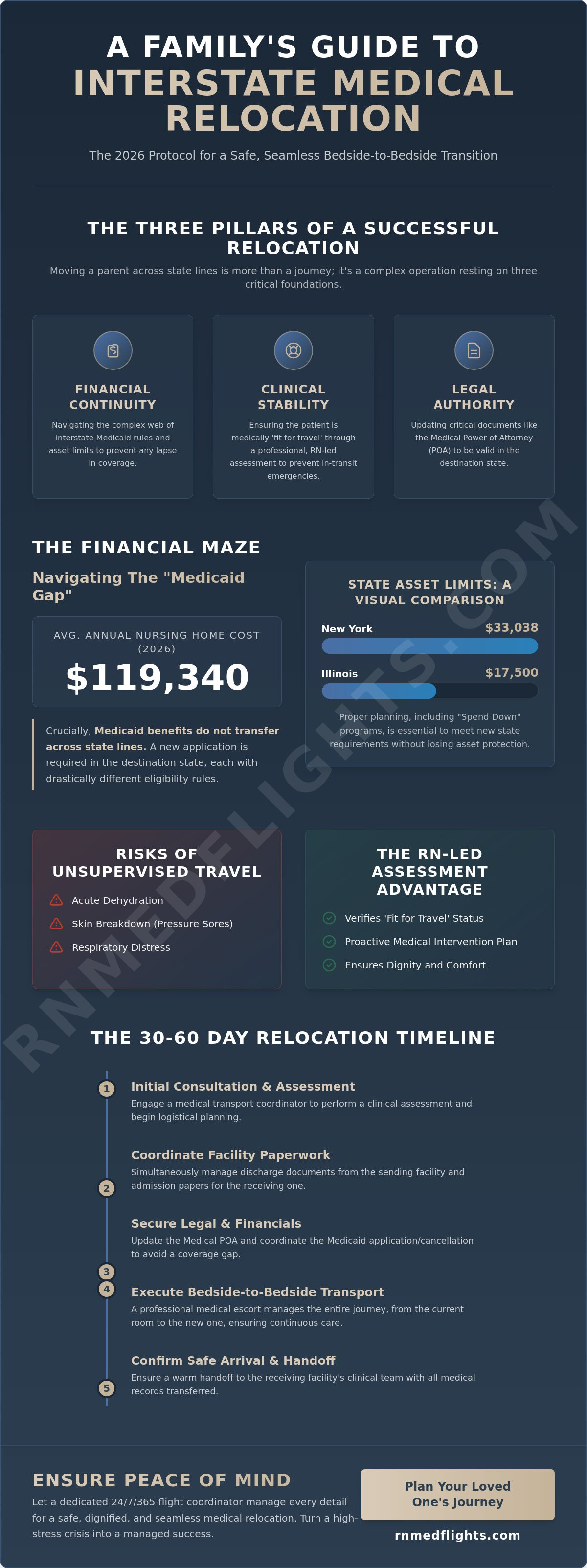
Members of the "Sandwich Generation" often find themselves managing their own children's needs while simultaneously overseeing long-distance care for aging parents. When getting a parent home from a nursing home in another state, the process is far more than a simple change of address. It rests on three critical pillars: legal authority, financial continuity, and clinical stability. Attempting to "just drive" a fragile senior across state lines is often the most dangerous choice. Without professional medical oversight, a simple road trip can lead to acute dehydration, skin breakdown, or respiratory distress. Understanding the regulatory environment of Nursing home care in the United States is essential, as state-level variations in staffing requirements and safety protocols can significantly impact your parent's transition.
To better understand the legal and financial protections involved in long-term care transitions, watch this helpful video:
Why Families Choose Interstate Relocation in 2026
In 2026, the primary driver for relocation is proximity to adult children for better oversight and emotional support. A 2024 study showed that 39% of adults who moved after age 65 relocated to a nursing home or assisted living facility. By moving a parent closer, you can ensure they receive the dignity and compassionate care they deserve. This move often allows families to access specialized memory care or higher-rated facilities that provide superior clinical outcomes. For an example of the professional environmental and cleaning standards that these top-tier facilities must uphold, you can visit RPS Building Services. Consolidating family resources also helps reduce the significant travel costs and emotional strain associated with frequent out-of-state visits.
The Logistical Timeline: From Decision to Bed-to-Bed
A safe transition requires a minimum 30 to 60 day window to manage the intricate details of getting a parent home from a nursing home in another state. This period allows for the simultaneous coordination of discharge paperwork from the sending facility and admission documents for the receiving facility. You must ensure the receiving facility is prepared for your parent's specific clinical needs the moment they arrive. A centralized medical point of contact, such as a specialized flight coordinator, ensures that no detail is missed. This professional oversight is vital for a seamless bedside-to-bedside move that maintains patient safety throughout the entire journey. Success depends on clear, active communication between all medical teams involved, and you can learn more about Assisted Living Real Estate Group for expert guidance on finding the right senior care facility in California.
Financial and Legal Preparation for Interstate Moves
Financial logistics often represent the steepest hurdle when getting a parent home from a nursing home in another state. As of March 25, 2026, nursing home care costs average $119,340 annually for a shared room. While Medicaid covers approximately 50% of these costs nationwide, these benefits do not automatically transfer between states. You must initiate a new application in the destination state, which carries its own specific eligibility rules. For example, New York permits a single beneficiary to hold $33,038 in countable assets, whereas Illinois limits assets to just $17,500. Medicaid portability is a myth in the US healthcare system, making it essential to consult experts like assistedlivingrealestategroup.com when evaluating facility options and regional costs.
To avoid a lapse in coverage, you must coordinate the cancellation of benefits in the sending state with the application in the receiving state. It's vital to avoid having active coverage in two states simultaneously, a situation regulators began flagging more aggressively in March 2026. Families often utilize "Spend Down" programs to meet the asset limits of their new home state while ensuring their loved one continues to receive a variety of long-term care services without interruption. Preserving asset protection during this window requires a methodical approach to legal and financial documentation.
Legal preparation is equally critical for a safe journey. You should update your parent's Medical Power of Attorney (POA) to ensure it complies with the statutes of the destination state. This document gives your medical escort or flight nurse the legal authority to act as an advocate during the bedside-to-bedside transition. Without a valid POA, clinical teams may face delays if an urgent medical decision is required during the journey. Ensuring these legal instruments are travel-ready provides an essential layer of security for both the patient and the family.
While you focus on the legal intricacies of your parent's care, ensuring your own professional interests remain compliant is equally vital. If you are managing a family business or need to establish a legal entity in a new state, you can discover Relay Registered Agent for expert registered agent and LLC formation services.
Essential Documentation Checklist
A successful clinical handoff relies on a complete medical dossier. Our flight coordinators recommend having the following documents organized and accessible before the transport begins:
Transfer Summary: This document is required by the receiving nursing home to justify the admission and outline the current care plan.
Medication Administration Record (MAR): A detailed list of all current prescriptions, dosages, and administration timings to maintain clinical continuity.
Physician Orders: Signed directives from the current doctor that authorize the transport and outline any necessary medical interventions during travel.
Identification and Insurance: Original government-issued ID and all current insurance cards must remain with the patient throughout the move.
If your family's needs extend beyond domestic borders, you can learn about international medical repatriation services to handle the added complexity of customs and international healthcare regulations. Whether moving across state lines or across the globe, professional coordination ensures that your parent's financial and legal protections remain intact.
Clinical Assessment: Is Your Parent 'Fit for Travel'?
Determining the physiological readiness for getting a parent home from a nursing home in another state requires more than a simple physician’s signature. In our clinical experience, "medical stability" for travel is defined as a patient’s ability to maintain baseline vital signs and cognitive orientation under the physical stressors of transit. These stressors include vibration, changes in cabin pressure, and the fatigue of a long-distance journey. Our flight nurses perform a comprehensive pre-trip assessment to ensure your loved one has the physiological reserve to handle these variables safely. We treat every patient as a person with unique needs, not just a case file.
A successful bedside-to-bedside transition depends on identifying clinical red flags before the journey begins. If a patient presents with a recent acute cardiac event, unstable respiratory status, or an active infection with a high fever, we may recommend delaying the move. It's our responsibility to prioritize safety above all else. Our 24/7/365 coordination team remains in constant contact with the sending facility to monitor these markers, ensuring that the window for relocation is clinically optimal. This vigilant approach provides the "peace of mind" families need during such a high-stakes transition.
This peace of mind also comes from knowing the destination facility has undergone a rigorous final cleaning, a standard often set by RPS Building Services when preparing new or renovated medical spaces for occupancy.
The Pre-Transport Medical Review
Our nurse-centric review focuses on the specific requirements of long-distance travel. We evaluate oxygen requirements, as altitude can impact respiratory efficiency. For patients with limited mobility or those who must remain supine, utilizing a commercial airline stretcher service ensures they stay physically stable throughout the flight. We also review recent laboratory work and cardiac history to anticipate how their body will respond to travel. This specialized attention to detail is why RN leadership is essential in medical relocation; it allows us to provide advanced life support if a situation changes mid-transit.
Managing Travel Anxiety and Sundowning
Cognitive decline, such as Alzheimer’s or dementia, introduces another layer of complexity. Patients may experience increased confusion or "sundowning" when their routine is disrupted. Our Registered Nurses are trained in both pharmacological and non-pharmacological interventions to manage travel-related anxiety. We focus on creating a familiar sensory environment and providing a calming, authoritative presence to soothe the patient. By maintaining a methodical and rhythmic pace, we lower the emotional temperature for both the patient and the family. This compassionate care ensures that the journey is as stress-free as possible, preserving the dignity of your loved one from departure to arrival.
Choosing the Right Transport: Comparative Analysis
Selecting the appropriate mode of transport is a clinical decision that directly impacts your parent's safety and your family's financial stability. For distances under 300 miles, ground transportation remains a viable option. However, when getting a parent home from a nursing home in another state, the logistical and financial burden of a long-distance ground ambulance increases significantly. As of January 2026, standard mileage fees for private-pay medical transport have reached $3.50 to $5.00 per mile. When you add "load fees" of $50 or more and oxygen administration charges of up to $40 per trip, a cross-country drive becomes both physically exhausting for the patient and cost-prohibitive for the family.
Private air ambulances are often perceived as the only alternative, but they are frequently unnecessary for stable seniors. These emergency-tier services can cost $50,000 or more, which is often overkill for a planned medical relocation. We focus on providing a more sophisticated, nurse-led solution that bridges the gap between basic ground transport and high-cost private jets. Our bedside-to-bedside promise ensures that the clinical standard remains uncompromising, regardless of the distance. If you are ready to explore a safer, more efficient way to move your loved one, contact our clinical coordination team for a personalized transport plan.
Why Commercial Medical Escorts are the 2026 Standard
Utilizing a commercial medical escort has become the preferred standard for interstate relocation in 2026. By securing first-class or business-class seating, we provide the patient with the physical comfort and space necessary for clinical monitoring. This approach offers significant cost savings compared to private medevac flights while maintaining a high level of specialized care. Our flight nurses manage every detail of the journey, from medication administration to sensory management. You can read our complete guide to medical escort services to see how this model prioritizes patient dignity and safety.
The Role of Ground Ambulance Coordination
The flight itself represents only 50% of the total journey. A successful bedside-to-bedside transition requires meticulous ground ambulance coordination at both the departure and arrival cities. We manage the "tarmac-to-facility" handoffs to ensure that a specialized vehicle is waiting the moment the plane lands. This level of synchronization is vital to avoid wait-time fees, which currently range from $25 to $45 per hour at many facilities. By maintaining continuity of care through every mile, we ensure your parent never feels abandoned during the transition between clinical teams. This seamless integration is what defines a professional medical relocation.
Executing the Move with RN MEDflights
Choosing a partner for getting a parent home from a nursing home in another state requires a team that understands the weight of medical responsibility. Our nurse-centric approach ensures that every decision made during the relocation is rooted in clinical expertise. Unlike purely logistical companies, we prioritize RN leadership because a Registered Nurse possesses the advanced life support training necessary to manage complex patient needs at 30,000 feet. This medical authority provides a steady hand in what is often a turbulent time for families. We operate as a vigilant protector; our team ensures that the clinical standards established at the sending facility are maintained without compromise until the final handoff is complete.
A dedicated flight coordinator manages the entire 24/7/365 process, serving as the vital bridge between two distant medical teams. This centralized communication is essential for a successful bedside-to-bedside transition. Our coordinators handle the exhaustive details of ground ambulance synchronization and airline medical clearances, which allows you to focus on your parent’s emotional well-being. By providing real-time updates throughout the journey, we lower the emotional temperature for the family. You'll never have to wonder about your loved one's status, and you can explore RCFE Sales (Residential Care Facilities for the Elderly) for additional guidance on facility standards and market options. Our clinical vigilance ensures they are cared for with the highest level of integrity and compassion.
What to Expect on Travel Day
The journey begins with a comprehensive morning assessment at the sending facility. Your flight nurse reviews the latest medication administration records and performs a final stability check to ensure the patient is ready for transit. We manage the entire transition through the airport, navigating TSA protocols and airline logistics with professional precision. Once in the air, the RN provides continuous monitoring of vital signs and comfort levels. Whether it's managing respiratory needs or providing pharmacological support for anxiety, our team is prepared for any clinical intervention required during the flight. We treat every patient as a person, not just a case file.
Securing Your Parent's Journey Home
Every interstate move is unique, requiring a tailored approach to patient care and logistics. We are deeply committed to ensuring that getting a parent home from a nursing home in another state is a process defined by dignity and uncompromising safety. Our team is ready to guide you through the financial and clinical hurdles, providing a clear path forward for your family. If you are ready to begin this transition, you can request a transparent price for your medical transport today. We are here to provide the specialized care and peace of mind your loved one deserves, 24 hours a day, 365 days a year.
Secure Your Parent’s Future with a Seamless Medical Relocation
Successfully getting a parent home from a nursing home in another state requires a methodical approach to clinical stability and financial continuity. You've discovered how to navigate complex state-specific Medicaid asset limits, such as California's $130,000 threshold established on January 1, 2026. For those interested in the senior housing market or looking to buy RCFE facility California, these financial benchmarks are essential for understanding the local regulatory environment. By prioritizing a nurse-led, bedside-to-bedside transition, you protect your parent from the physical stressors of long-distance travel while ensuring their legal and medical protections remain uninterrupted. This strategic preparation turns a daunting interstate move into a manageable, safe clinical handoff.
RN MEDflights stands ready as a vigilant protector for your family. As a veteran-owned organization, we provide clinical leadership and 24/7/365 dedicated flight coordination to manage every detail of the journey. Our team treats every patient with the heart of a caregiver and the precision of a senior medical professional. Speak with a Flight Coordinator about your parent's interstate move to secure a specialized transport plan today. You possess the tools to bring your loved one closer to home; we're here to ensure that journey is safe, dignified, and entirely stress-free.
Frequently Asked Questions
Does Medicare pay for moving a parent from one state to another?
Medicare does not cover the costs associated with getting a parent home from a nursing home in another state for non-emergency reasons. While Medicare Part A may cover 100% of the first 20 days of a skilled nursing stay, it views relocation as a personal choice rather than a medical necessity. Families should expect to pay out-of-pocket for medical escort services or ground ambulance coordination. Our flight coordinators provide transparent guidance to help you plan for these private-pay expenses.
Can a nursing home refuse to let a resident move to another state?
A nursing home cannot legally prevent a resident from moving to another state; however, they must follow federal discharge regulations to ensure patient safety. Under 42 CFR § 483.15, facilities must provide a 30 day written notice for involuntary discharges, but for voluntary moves, they simply require a safe discharge plan. Our flight coordinators work directly with the facility's social worker to ensure all clinical documentation is ready for a seamless, bedside-to-bedside transfer.
What happens to a senior's Medicaid if they move to a different state?
Medicaid benefits stop in the sending state and require a new application in the destination state because benefits are not portable. You must terminate coverage in the old state and reapply in the new one. In 2026, states like Florida maintain a $2,000 asset limit for long-term care, while California’s limit is $130,000. It's vital to coordinate these dates to avoid a lapse in coverage or "dual active" status, which can trigger regulatory audits. For families navigating the transition to California-based care, you can visit Assisted Living Real Estate Group to learn more about the local facility landscape and regulatory requirements.
Is a medical escort safer than a private air ambulance for a stable patient?
For clinically stable patients, a commercial medical escort is often safer and more comfortable than a private air ambulance. Private medevac flights are designed for emergency stabilization, whereas our nurse-led service focuses on dignity and stress-free travel in a first-class or business-class environment. Our Registered Nurses provide advanced life support capabilities throughout the journey, ensuring uncompromising safety without the clinical intensity of a private jet. This approach prioritizes the patient's emotional and physical well-being.
How long does it take to arrange an interstate nursing home transfer?
Arranging a safe interstate transfer typically requires a window of 30 to 60 days to coordinate medical records and facility admissions. This timeline allows for the necessary clinical assessments and financial preparations, such as Medicaid spend-downs. It is also the ideal time to verify that the destination facility meets high hygiene standards, which are often established by specialized providers like RPS Building Services during facility construction or renovation. Our flight coordinators are available 24/7/365 to manage these logistics, though we can often expedite the process for families facing urgent care transitions. Getting a parent home from a nursing home in another state is a methodical process that rewards thorough preparation.
What medical equipment can a flight nurse bring on a commercial flight?
Our flight nurses carry specialized, FAA-approved medical kits designed for in-flight clinical management. This equipment includes portable oxygen concentrators (POCs), automated external defibrillators (AEDs), and advanced monitoring tools for vitals. We also manage all necessary medication administration throughout the journey. These tools allow our RNs to maintain clinical stability and provide immediate interventions if the patient’s condition changes during the flight. Every piece of equipment is selected to ensure a seamless, safe relocation.
How do you coordinate the 'handoff' between two nursing homes?
We manage the handoff through a strict bedside-to-bedside protocol that includes direct communication between our RN and the facility staff. Our team coordinates ground ambulance transport to meet the patient at both the sending and receiving facilities. This process ensures that the medical report is delivered in person, preventing any gaps in care or medication errors during the transition. Every step is synchronized by our 24/7/365 flight coordinators to ensure the patient moves seamlessly between clinical teams. For families needing to transport sensitive documents or personal belongings, especially during moves within or to Canada, Sameday Express Inc. offers reliable courier solutions that complement these high-stakes transitions.
Can a parent with advanced dementia fly with a medical escort?
A parent with advanced dementia can fly safely with a commercial medical escort if they are clinically stable. Our Registered Nurses utilize non-pharmacological techniques and a calming, rhythmic presence to manage travel-related anxiety or sundowning. We focus on maintaining a quiet sensory environment and providing constant reassurance. This specialized care ensures that the move is handled with dignity, minimizing the cognitive load on the patient during the relocation. Additionally, ensuring a stable climate at the destination is vital for comfort, and you can learn more about RMI Heating and Air Conditioning for professional HVAC support. Our nurse-centric approach prioritizes the person behind the diagnosis.
