Insurance for Non-Emergency Medical Flights: 2026 Guide
- 2 minutes ago
- 12 min read
What if the transport service you consider a medical necessity is viewed by your insurance provider as an optional luxury? It's a distressing reality for many families who find themselves stranded in distant facilities, facing private air ambulance quotes that can climb toward $50,000. You likely feel the weight of this crisis, balancing the urgent need for a safe relocation with the confusion of complex insurance coverage for non-emergency medical flights. It's frustrating to realize that a standard policy might deny a private jet while your loved one remains miles away from the care they need.
We're here to provide clarity and a sense of security during this high-stress time. This guide explores how to secure the support you deserve and highlights why commercial airline medical escorts are becoming the preferred, cost-effective alternative in 2026. You'll learn the specific steps to document medical necessity and how a nurse-led journey home can provide clinical excellence at a fraction of the cost. We'll walk through the logistical requirements and insurance hurdles so you can focus on what matters most: your family's well-being.
Table of Contents
Does Insurance Cover Non-Emergency Medical Flights?
Non-emergency medical flights involve the scheduled transport of stable patients who still require professional clinical supervision. Unlike an emergency medevac, these journeys don't involve immediate life-or-limb crises. However, the patient's condition prevents them from traveling via standard means without significant risk to their health. Most insurance providers, including private carriers, Medicare, and Medicaid, prioritize medical necessity over convenience. If a patient simply wants to be closer to home, insurance usually views the travel as elective. Securing insurance coverage for non-emergency medical flights requires clear evidence that the patient's safety would be compromised without a medical professional present during the journey.
The Difference Between Emergency and Non-Emergency Coverage
The distinction between emergency and non-emergency care defines how your claim will be processed. Emergency coverage applies to critical threats where immediate intervention is vital. These situations usually involve dedicated air ambulance jets or helicopters equipped for intensive care. Non-emergency Patient transport focuses on stable individuals who need relocation for long-term care or family support. In 2026, insurers are scrutinizing non-emergency claims more heavily than ever before. They often require exhaustive documentation from the attending physician to prove that the patient cannot travel without specialized equipment or nurse-led monitoring, making the approval process rigorous and detail-oriented.
Common Scenarios for Non-Emergency Medical Travel
Families encounter several recurring scenarios where this specialized travel becomes essential. We frequently assist with these specific needs:
Dementia Relocation: Moving an elderly parent with cognitive decline to a memory care facility near their children to ensure better emotional support and oversight.
International Repatriation: Helping a patient return home for continued treatment after they have been stabilized following an injury or illness abroad.
Rehabilitation Transfers: Moving a patient to a specialized center for long-term recovery that offers advanced options not available at their current location.
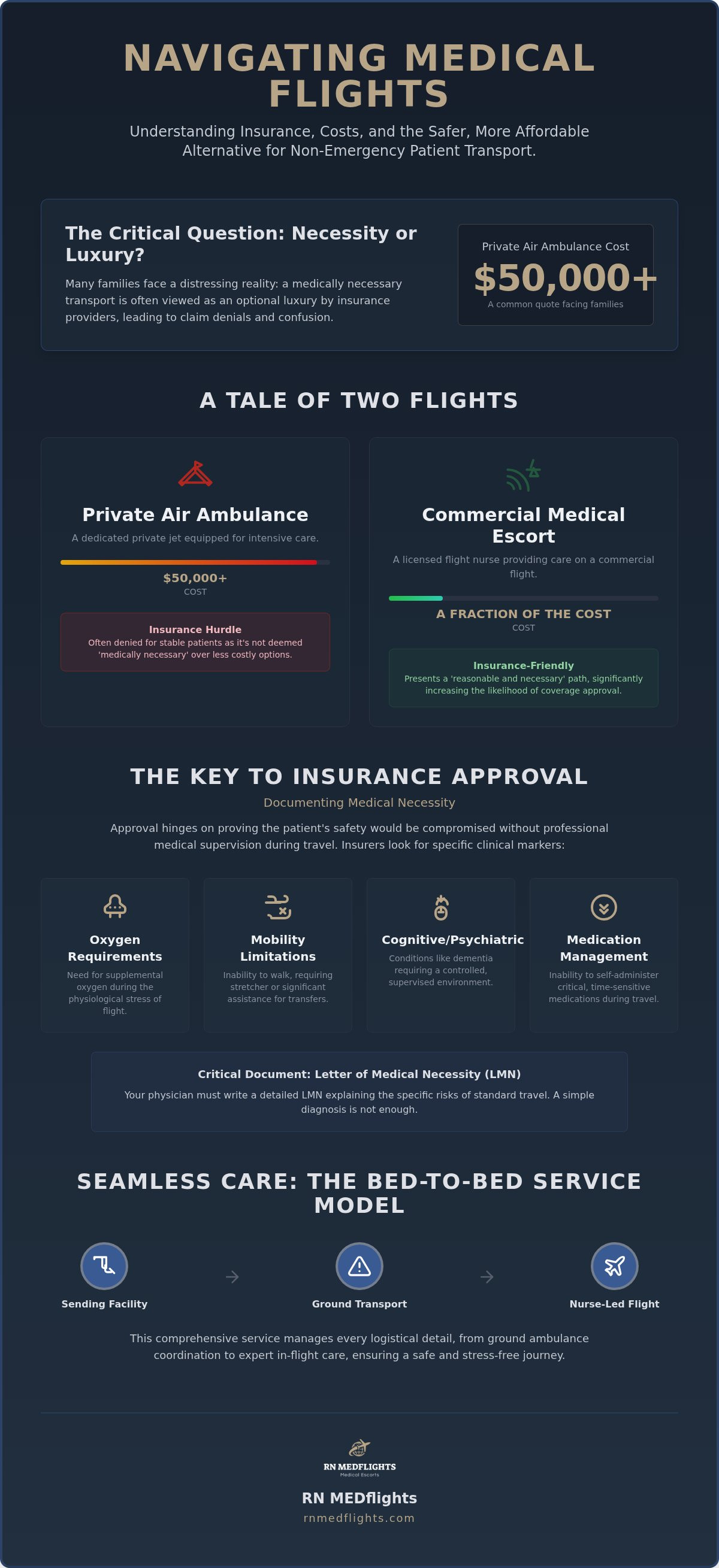
Because private air ambulances are exceptionally expensive, insurers often look for reasons to deny these claims for stable patients. A commercial medical escort offers a more insurance-friendly alternative. By providing a licensed flight nurse on a commercial flight, this service provides the necessary clinical safety at a much lower cost than a private jet. It bridges the gap between high-cost private flights and the risks of traveling alone. This model presents a path that insurers are more likely to consider reasonable and necessary, increasing the chances of obtaining insurance coverage for non-emergency medical flights while ensuring the patient's emotional and physical security.
Understanding 'Medical Necessity' in Non-Emergency Transport
Insurance coverage for non-emergency medical flights hinges on a single, critical determination: medical necessity. While a patient might be clinically "stable," this term often leads to confusion during the claims process. From the perspective of a flight nurse, stability simply means the patient isn't in an immediate, life-threatening crisis. It doesn't mean they can safely manage the physiological stresses of flight without professional intervention. Insurers look for specific clinical markers to justify the cost of transport. These markers often include the requirement for supplemental oxygen, significant mobility limitations that necessitate a stretcher, or psychiatric conditions that require a controlled, supervised environment.
The cornerstone of any successful claim is the Letter of Medical Necessity (LMN). Your treating physician must explicitly detail why standard commercial travel is contraindicated for the patient's specific condition. This document shouldn't just list a diagnosis. It needs to outline the specific risks, such as the potential for respiratory distress or the inability to self-administer life-sustaining medications during a long-distance journey. Without this clinical justification, insurers will likely categorize the relocation as elective and deny the claim.
Clinical Requirements for Insurance Approval
To secure approval, you must demonstrate that the patient requires active clinical management throughout the trip. This includes the continuous monitoring of vital signs to detect early signs of decompensation. Insurers also prioritize cases where the patient requires the administration of IV medications or specialized treatments that a layperson or family member cannot safely perform. Additionally, the physical inability to navigate an airport terminal or maintain a seated position in a standard cabin for the duration of the flight serves as a strong indicator that professional assistance is required.
Why 'Nearest Adequate Facility' is a Coverage Hurdle
One of the most challenging obstacles in securing insurance coverage for non-emergency medical flights is the "nearest adequate facility" clause. Most policies state that the insurer is only responsible for transporting a patient to the closest hospital capable of treating their acute condition. If you're stabilized at a facility in a foreign country but wish to return home for long-term recovery, the insurer may argue that your current location is already "adequate."
Overcoming this hurdle requires a strategic focus on continuity of care and the specific clinical benefits of a specialized facility at the destination. For those navigating these complexities across borders, our international medical repatriation services provide the necessary clinical documentation to support these arguments. Our team works closely with your physicians to ensure the transition is seamless. If you're feeling overwhelmed by these definitions, you can consult with a flight coordinator to understand how your specific medical needs align with current insurance standards.
Financial Comparison: Commercial Escorts vs. Private Air Ambulances
Families often face a staggering financial gap when choosing between a private air ambulance and a commercial medical escort. A private air ambulance functions as a flying intensive care unit, and its cost structure reflects that complexity. These flights typically range from $50,000 to over $200,000 depending on the distance and the level of specialized equipment required. In contrast, utilizing a commercial airline medical escort generally costs between $5,000 and $25,000. This massive price difference is the primary reason why insurers are significantly more likely to approve or reimburse claims for commercial escorts. When evaluating insurance coverage for non-emergency medical flights, providers look for the most cost-effective method to meet the patient's clinical needs. If a patient is medically stable enough for a commercial cabin, the insurer will rarely authorize a six-figure private jet.
When insurance denies a claim entirely, the lower cost of a commercial escort often makes the relocation feasible for families paying out-of-pocket. It transforms an impossible financial burden into a manageable logistical plan. This path ensures the patient receives professional care without the family facing a debt that could last for years.
Where the Cost Savings Come From
The financial efficiency of a commercial escort stems from the removal of massive overhead. Maintaining a dedicated medical aircraft requires millions in capital, specialized pilot crews, and expensive hangar fees. By leveraging existing commercial flight infrastructure, these costs vanish. The patient still receives dedicated 1-on-1 care from a licensed flight nurse, but the transport vehicle is a standard airline. For patients who cannot sit upright for long periods, commercial airline stretcher services provide a middle ground. This setup allows for a bed-to-bed transfer at a fraction of the price of a private charter while maintaining clinical safety.
The ROI of a Professional Medical Escort
The value of a professional escort extends beyond the initial ticket price. Unsupervised travel for a medically fragile patient carries the risk of a mid-flight emergency. Such incidents can lead to diverted flights, which result in massive airline fines and potential legal liabilities for the family. A nurse-led journey mitigates these risks through constant monitoring and immediate clinical intervention. The coordination of ground ambulances on both ends ensures that the patient isn't left waiting in high-stress airport environments. For a detailed look at how these logistics work, see our medical escort service guide. This end-to-end responsibility reduces total travel time and lowers the emotional temperature for everyone involved. Securing insurance coverage for non-emergency medical flights becomes a much more attainable goal when the requested service is both clinically sound and fiscally responsible.
How to Verify Your Insurance Benefits for Medical Travel
Verifying your insurance coverage for non-emergency medical flights requires a methodical and patient approach. You are dealing with complex policy language where a single word can determine the outcome of a claim. To protect your family from unexpected financial burdens, you must navigate the verification process with clinical precision. Follow these steps to ensure you have a clear understanding of your available benefits before the journey begins.
First, obtain the specific CPT or HCPCS codes that correspond to the transport service. For example, codes such as A0430 or A0431 are standard for air transport, but your provider may use different identifiers for a commercial escort. Next, contact the "Benefits" or "Claims" department directly. General customer service representatives often lack the specialized training needed to interpret aeromedical policy nuances. You must ask specifically about "Pre-Authorization" requirements. For non-emergency ambulance transport, failing to secure this approval beforehand is the most common reason for an automatic denial.
Request a written summary of your "Travel and Lodging" or "Repatriation" benefits. Having this document in hand provides a baseline for what the insurer is contractually obligated to cover. Finally, document every interaction with the insurer. Record the date, the representative's name, and the specific reference number for every phone call. This paper trail is vital if you need to contest a decision later.
Questions to Ask Your Insurance Provider
When you speak with a representative, use direct language to minimize ambiguity. We recommend asking these specific questions:
"Does my policy specifically cover non-emergency air ambulance or medical escort services?"
"What clinical criteria must be met for this transport to be considered a medical necessity?"
"Is there a cap on the maximum allowable amount for medical relocation or repatriation?"
Appealing a Denied Claim
If your initial request is rejected, you have the right to file a "Clinical Appeal." This process is most effective when a flight nurse or medical director provides a detailed justification for the care level provided. You must gather "Ground Truth" evidence, which explains why alternative transport—such as a multi-day ground ambulance journey—would be clinically unsafe or detrimental to the patient’s health. Most insurers require appeals to be filed within a strict 60-day window. Acting quickly ensures your case remains active and under review. If you're feeling overwhelmed by these administrative hurdles, our team can help you verify your benefits today to find a safe path home.
RN MEDflights: Cost-Effective Bed-to-Bed Medical Relocation
RN MEDflights serves as a clinically-led solution for families who find themselves at a crossroads with their insurance providers. When the complexity of insurance coverage for non-emergency medical flights leads to a denial, the need for a safe relocation remains. We provide a bridge between hospital care and home, offering a service that prioritizes clinical integrity and patient dignity. Our approach is built on a foundation of medical expertise. Every mission is led by a licensed registered flight nurse who possesses the specialized training required to manage patients in the unique environment of a commercial aircraft cabin. This ensures that while the setting is commercial, the care remains strictly professional.
Our bed-to-bed philosophy defines our commitment to continuity of care. We don't simply meet a patient at the airport; we take full responsibility for the journey from the moment they leave their current bedside until they are safely settled at their destination. This comprehensive oversight eliminates the logistical gaps where medical risks often increase. In 2026, families require transparency and predictability. We provide clear, upfront cost structures that allow you to plan with confidence, especially when navigating the financial uncertainty that often follows a medical crisis. We act as a steady, organized presence, ensuring that every detail is managed with the weight of medical authority and the heart of a caregiver.
End-to-End Coordination and Logistics
Managing the logistics of a medical relocation is an exhaustive process that requires specialized knowledge of both aviation and clinical requirements. Our team handles every aspect of airline medical clearance, which involves submitting detailed clinical documentation to airline medical departments to ensure the patient is cleared to fly. We also manage the complex requirements for portable oxygen concentrators and other essential medical equipment. A vital part of this journey is the "first and last mile." We coordinate the non-emergency ambulance service needed to transport the patient to and from the airport, ensuring a seamless transition between ground and air. You'll have a single point of contact throughout the process, which significantly reduces the cognitive load on family members during a stressful time.
Why Families Choose RN MEDflights
Families trust us because we are a veteran-owned and operated organization that has prioritized patient safety since 2010. We understand that when insurance coverage for non-emergency medical flights is unavailable, the financial burden of relocation falls entirely on the family. Our commercial medical escort model offers significant savings, often making a safe relocation possible when it otherwise felt out of reach. We specialize in complex cases, including international medical repatriation and the sensitive relocation of elderly patients with dementia. Our nurses are trained to manage the emotional and physical needs of these patients, providing a calm and reassuring presence. We view every patient as a person rather than a case, ensuring their journey home is as comfortable and secure as possible.
Securing a Safe Path Home
Securing insurance coverage for non-emergency medical flights requires a strategic focus on clinical necessity and precise documentation. You now understand that while standard policies often view relocation as elective, they are significantly more likely to approve the cost-effective model of a commercial medical escort. By choosing a solution that prioritizes clinical safety through nurse-led care, you provide your loved one with the protection they need at a price point that remains manageable. This approach bridges the gap between high-cost private jets and the risks of traveling alone.
RN MEDflights has been veteran-owned and operated since 2010. Our licensed flight nurses provide comprehensive bed-to-bed coordination, managing every logistical detail from ground ambulance logistics to airline medical clearance. We take full responsibility for the continuity of care throughout the entire journey. You can feel confident that the logistics are being handled by experts who prioritize patient safety above all else. Request a Transparent Quote for Your Medical Transport today. We are here to help you navigate this transition with the care and clinical excellence your family deserves.
Frequently Asked Questions
Does Medicare pay for non-emergency medical flights?
Medicare coverage for non-emergency air transport is extremely limited and only applies when a physician certifies that any other form of transportation would endanger the patient's health. While Medicare Part B covers 80% of approved emergency services, non-emergency flights are often categorized as elective. You must prove that the patient's condition requires the specialized care that only an aircraft provides, which remains a high hurdle for stable patients.
What is a Letter of Medical Necessity for a medical flight?
A Letter of Medical Necessity is a formal clinical document written by the treating physician that justifies the need for professional medical supervision during travel. This letter must explicitly state why standard commercial flight or ground transport is unsafe for the patient's specific condition. It should include the patient's diagnosis, current stability, and the specific clinical risks that require a flight nurse to be present for the duration of the journey.
Can I use travel insurance for medical repatriation?
You can use travel insurance for medical repatriation if your specific policy includes a provision for emergency medical evacuation or a return to your home country. It's vital to review the policy's definitions of "stable for travel" and "nearest adequate facility" before making arrangements. Many travelers find that while the insurance covers the initial stabilization, it may not cover the full cost of returning home unless repatriation is listed as a benefit.
How much does a commercial medical escort cost compared to an air ambulance?
Commercial medical escorts are approximately 50% to 70% less expensive than private air ambulance services. While a private jet carries the overhead of dedicated aircraft and specialized flight crews, a commercial escort utilizes existing airline infrastructure. This allows families to secure 1-on-1 care from a registered nurse while saving significant amounts of money. This cost-effective nature makes it a more viable option for those seeking insurance coverage for non-emergency medical flights.
What happens if insurance denies my medical flight claim?
If your claim is denied, you have the right to file a formal clinical appeal within the timeframe specified by your provider, which is usually 60 days. You should gather additional evidence, such as detailed nursing notes or a more specific physician’s statement, to contest the decision. If the appeal is unsuccessful, many families choose a commercial medical escort as a more affordable private-pay alternative that provides the necessary clinical safety without the air ambulance price tag.
Will insurance cover a nurse to fly with my elderly parent?
Insurance will only cover a professional flight nurse if their presence is deemed medically necessary for the patient's safety. Documentation must show that the parent requires skilled nursing interventions, such as medication administration or continuous vital sign monitoring, that a family member cannot perform. If the nurse is viewed as a travel companion rather than a clinical requirement, the insurer will likely deny the claim, making it an out-of-pocket expense.
Is ground ambulance transport included in medical flight coverage?
Ground ambulance transport is typically included in comprehensive bed-to-bed service models, though coverage varies by insurance policy. We coordinate the ground logistics at both the departing and arriving facilities to ensure a seamless transition for the patient. When verifying your insurance coverage for non-emergency medical flights, specifically ask if the policy covers the "first and last mile" ground transport or if those services are billed separately under your standard benefit.
How do I get pre-authorization for a non-emergency medical flight?
To obtain pre-authorization, you must contact your insurance provider's benefits department with the specific HCPCS or CPT codes for the service. You will need to submit the physician’s Letter of Medical Necessity and the patient's recent clinical records for review. This process should be initiated as early as possible, as insurers often take several business days to reach a determination. Securing this approval in writing before the flight is essential to avoid a claim denial.


