International Flight Nurse Service for Commercial Flights
A commercial flight can be an option for a patient who is stable and permitted to fly, with a nurse escort providing medical support along the way. An international flight nurse service can help bridge the gap between needing care during travel and using a commercial airline rather than an air ambulance. Flight nurses provide care before, during, and after air transportation, often for patients with serious medical needs.
It’s natural to want clear answers when a loved one needs to travel while managing a health condition. A nurse escort can accompany the patient on the flight, help maintain continuity of care, and support a calmer journey for both the patient and family.
This article explains what an international flight nurse service involves, how it differs from other medical transport, and who may be eligible. It also covers practical planning, from clinical review and travel coordination to the handoff at the destination.
Table of Contents
What is the role of a flight nurse?
An international flight nurse service arranges clinical support for a patient traveling between countries on a commercial flight. A qualified nurse accompanies the patient and supports care throughout the journey, helping connect the departure and arrival stages.
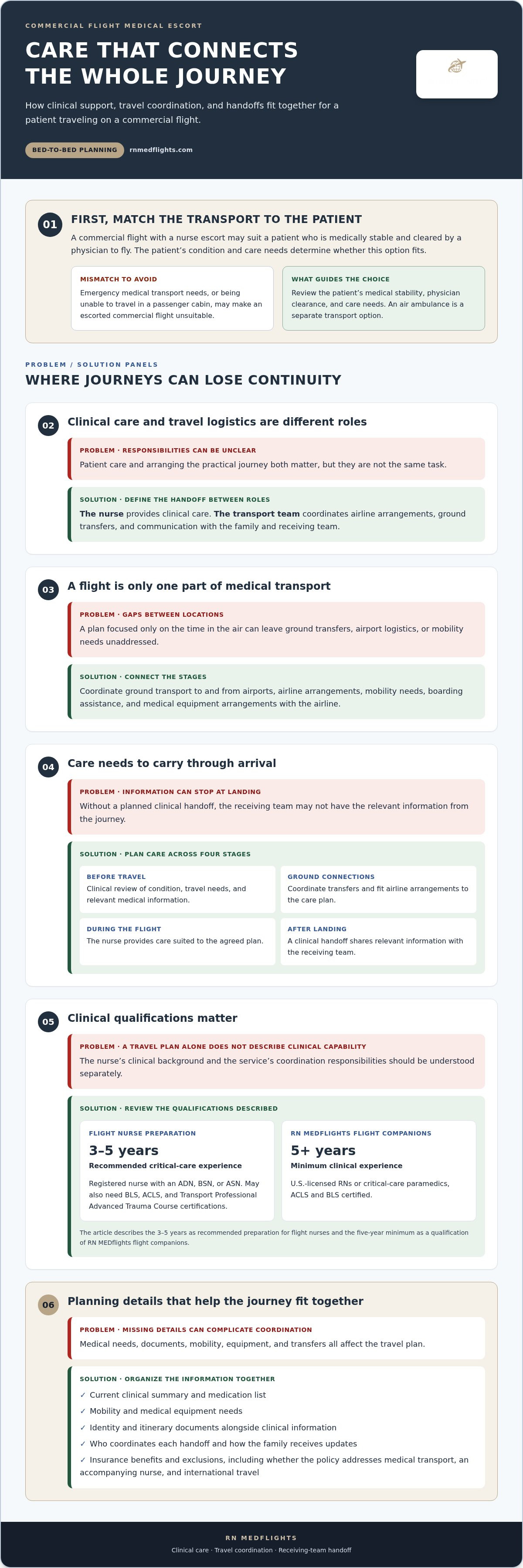
Commercial airline medical transport may suit a patient who is medically stable and cleared by a physician to fly. An air ambulance is a separate transport option. The patient’s condition and care needs determine which type of journey is appropriate.
This video illustrates a flight nurse’s role during commercial air travel:
Ground Transport and Medical Coordination
Medical transport involves more than the flight. Ground transfers connect the departure location to the airport and the arrival airport to the destination. Airline arrangements, mobility needs, and the patient’s care plan also need to fit together. For example, the team can coordinate boarding assistance and discuss medical equipment arrangements with the airline.
Care Across the Flight
Planning starts with a clinical review of the patient’s condition, travel needs, and relevant medical information. During the flight, the nurse provides care suited to the agreed plan. After landing, a clinical handoff shares relevant information with the receiving team. Together, these steps connect the journey from pickup to the receiving bed.
Flight nurses also care for patients transported to hospitals or trauma centers on civilian and military aircraft. In an emergency or interfacility transfer, their role centers on medical care during transport. A commercial flight escort serves a different purpose: accompanying a patient whose condition is stable and who is permitted to fly commercially.
A commercial flight is appropriate only when the patient’s condition and care needs fit the passenger-cabin setting. If the patient needs emergency medical transport or cannot travel on a commercial flight, an escorted airline journey may not be suitable. The transport plan must match the patient’s medical needs.
Insurance coverage for international flight nurse services depends on the policy’s benefits and exclusions. Review whether the policy addresses medical transport, an accompanying nurse, and international travel before making arrangements.
From the United States, commercial airline medical escort and international medical repatriation services arrange nurse-supported travel on scheduled flights. The route, patient’s care needs, ground transfers, and airline coordination shape how each patient transport is organized.
Flight nurse work settings include hospitals, emergency rooms, helicopters, and airplanes. This range shows that the role is not limited to accompanying a patient on a commercial flight. Hospitals and emergency rooms are among the listed settings, as are two types of aircraft. The settings provide a broader context for understanding flight nursing alongside the specific commercial-flight escort service described above. A flight nurse’s work can be associated with care settings on the ground as well as aircraft. Keeping these settings in view helps distinguish the broader work of flight nurses from the arrangements involved when a nurse accompanies a stable patient traveling commercially. The setting is one part of describing the role, alongside the patient’s transport and care needs.
Flight nurse and flight coordinator qualifications
When arranging an international flight nurse service, distinguish clinical care from travel coordination. The nurse provides care for the patient, while the transport team coordinates airline arrangements, ground transfers, and communication. Understanding both roles makes it easier to see how the journey will be managed.
Flight nurses are registered nurses with critical-care experience. The recommended preparation is 3-5 years of critical-care experience, alongside an ADN, BSN, or ASN. Flight nurses may also need Basic Life Support, Advanced Cardiac Life Support, and Transport Professional Advanced Trauma Course certifications. These qualifications relate to clinical responsibilities during patient transport, not simply booking travel.
Travel coordination connects the nurse’s care plan with the journey’s practical steps. This includes arranging ground transport, coordinating airline logistics, and communicating relevant information to the family and receiving team. Confirm that the plan covers both clinical support and the transfers between the patient’s bed and the aircraft.
When evaluating a service, ask who will accompany the patient and what clinical qualifications they hold. RN MEDflights flight companions are U.S.-licensed RNs or critical-care paramedics, ACLS and BLS certified, with a minimum of five years of clinical experience. Also ask how the service coordinates airline logistics, ground transfers, and the clinical handoff.
For international patient transport, organize a current clinical summary, medication list, and details of mobility or equipment needs. Medical documentation can support travel arrangements, including a travel companion; airline staff may coordinate pre-boarding or access to medical equipment such as oxygen tanks. Keep identity and itinerary documents together with the patient’s clinical information.
Medical documentation and airline requirements depend on the journey. Gather the treating team’s assessment and relevant records, then share the information needed for travel planning. This helps the transport team coordinate the flight, ground connections, and care arrangements.
Before travel, map the full journey from the patient’s current bed to the receiving destination. Clarify who coordinates each handoff, how the family will receive updates, and how itinerary changes will be managed. A bed-to-bed plan accounts for ground transfers and airline logistics, not just the flight.
Common conditions requiring assistance
A diagnosis alone does not determine whether a patient can travel commercially. Consider how the patient’s condition affects sitting, moving through an airport, managing medication, and handling the journey. For example, someone recovering after hospitalization may need help transferring between a wheelchair, vehicle, and aircraft seat.
Commercial airline medical escort is for medically stable patients cleared by a physician to fly. The patient’s current condition, care needs, and ability to travel in a passenger cabin shape the plan. An air ambulance is a distinct service for a different transport need.
Some patients mainly need help with mobility. A person who uses a wheelchair, needs assistance walking through an airport, or requires support boarding may benefit from coordinated arrangements. Plan for each transition, from the first ground transfer to boarding and onward transport at the destination.
Recovery after hospital care: A patient may need help maintaining a comfortable travel position and following the care plan during a long journey.
Medication routines: A traveler with scheduled medications needs a clear plan for carrying and taking them throughout the itinerary.
Mobility limitations: A patient who needs a wheelchair or transfer assistance requires arrangements that connect ground transport with airport and aircraft access.
Medical equipment needs: Equipment such as oxygen tanks can affect pre-boarding and airline coordination.
These examples describe support needs, not automatic eligibility. The treating team’s assessment helps establish the patient’s current condition and the care required in transit. A trained nurse escort can then align the patient transport plan with those needs. If the patient requires emergency-level care during transport, a commercial flight may not be the appropriate form of air medical transport.
International travel involves handoffs at both ends of the journey. A patient leaving a care facility may need ground transport to the airport and a coordinated transfer after landing. Mobility assistance, medical records, medication needs, and communication with the receiving team all help shape the plan.
Before arrangements begin, note the patient’s mobility, medications, equipment, and support needs. Share those details with the treating team and use them to plan the full journey. A clinical review and physician clearance help determine whether commercial travel is appropriate and what assistance is needed from pickup through arrival.
Communication with healthcare providers and family
Clear communication connects the patient’s treating team, nurse escort, family, and receiving care team. Gather a current medical summary, medication list, mobility needs, and equipment details before travel. If the patient uses oxygen, share that information early so the transport team can coordinate the relevant arrangements.
Begin with the treating healthcare provider. Share the route and travel details, then request a concise handoff covering the patient’s condition, medications, care needs, and any changes that require attention. The nurse can use this information to prepare for the journey and communicate relevant details to the receiving team.
Families can make communication easier by agreeing on a contact person and update plan before departure. One family member can gather questions, share itinerary changes, and pass updates to others. This avoids repeated requests while the patient and nurse are managing boarding, the flight, or ground transfers.
Before travel: Collect the medical summary, medication details, and equipment needs, then share them with the care and transport teams.
Before boarding: Confirm the departure plan, ground-transfer arrangements, and how the family will receive updates.
During the journey: Keep the agreed family contact available for practical coordination, such as a change to the arrival plan.
At the destination: Pass the care summary to the receiving team and confirm the next handoff with the family contact.
Ask specific questions to clarify each part of the journey. Ask the treating provider to outline the patient’s current needs, including medication timing and movement assistance. Ask the transport team who coordinates airline arrangements, boarding support, ground transfers, and equipment logistics.
For the healthcare provider: What information should the receiving team know about the patient’s care?
For the nurse escort: Which medical details and medication instructions guide care during travel?
For the family contact: Who will receive updates, and how will itinerary changes be shared?
For the receiving team: Which records and handoff details support continuity after arrival?
Keep clinical updates separate from travel logistics. A change in the patient’s condition should be shared with the healthcare team; a change in pickup timing should go to the person coordinating ground transport. Clear communication helps each team member act on the information relevant to their role.
Before departure, review the contact plan with the patient, family, and care team. Keep essential records accessible and decide who will receive the arrival update. This supports a clear handoff from care during travel to the next stage at the destination.
Nurse escorts on commercial flights
A nurse escort can accompany a patient on a commercial flight when the patient is medically stable and cleared by a physician to fly. The patient travels on a scheduled passenger flight with a qualified clinician providing support. Bed-to-bed coordination can connect the flight with ground transfers and the receiving team.
The key difference is the type of aircraft and setting. A commercial flight operates as a passenger service, so the care plan must suit the patient’s needs and cabin travel. An air ambulance is a separate medical transport option. The patient’s condition, mobility, and care requirements help determine which journey is appropriate.
Before departure, the nurse and transport team organize the patient’s route and handoffs. For example, a patient leaving a hospital may need ground transport to the airport, support through boarding, and another ground transfer after landing. A bedside-to-bedside plan connects those steps, rather than treating the flight as the entire journey.
During the journey, the nurse provides care in line with the patient’s needs and travel plan. The transport team coordinates airline logistics and ground transfers, while the nurse accompanies the patient and supports care during the flight. This lets family members focus on supporting their loved one.
Before booking: Gather the patient’s care summary, medication details, mobility needs, and equipment information.
For the itinerary: Map each transfer between bedside, vehicle, airport, aircraft, and destination.
For the handoff: Identify the receiving contact and share relevant care information upon arrival.
Commercial nurse escort transport is not suitable for every medical journey. The patient must be medically stable and cleared by a physician to fly. The care plan must also fit the passenger-flight setting; if commercial travel is not appropriate, a different transport plan is needed.
A flight companion’s clinical qualifications and the transport team’s coordination responsibilities are distinct. RN MEDflights flight companions are U.S.-licensed RNs or critical-care paramedics, ACLS and BLS certified, with a minimum of five years of clinical experience. Ask how the plan covers bedside handoffs, airport transitions, and ground transport at both ends.
For a patient who can fly commercially but needs nursing support, a commercial airline medical escort connects clinical assistance with scheduled air travel. For a route requiring coordinated ground transfers, bedside handoffs, and flight arrangements, arrange commercial airline medical escort as part of the patient’s transport plan.
RN MEDflights: Commercial Airline Medical Escort
RN MEDflights provides Commercial Airline Medical Escort for medically stable patients cleared by a physician to fly. A U.S.-licensed RN or critical-care paramedic accompanies the patient, while the team coordinates airline logistics and ground transport as part of bed-to-bed service.
Bed-to-Bed Medical Transport and Ground Ambulance Coordination connect ground transfers with the flight plan. Domestic Medical Relocation can support travel between locations in the United States. The appropriate arrangement depends on the patient’s needs, mobility, route, and destination.
Share the patient’s itinerary, current care needs, and transfer requirements to begin discussing a coordinated plan. Contact RN MEDflights to discuss a commercial airline medical escort for your journey.
Plan the Next Step With Care
An international flight nurse service may suit a medically stable patient who has physician clearance to fly and needs clinical support during commercial air travel. Bring the treating team’s guidance, destination details, and family priorities into the planning conversation. These details help shape the route, care plan, and handoffs.
RN MEDflights provides Commercial Airline Medical Escort, International Medical Repatriation, and Domestic Medical Relocation. These services support different travel needs, from nurse-escorted international flights to relocation within the United States. Share the patient’s situation and intended journey to discuss the appropriate plan.
Contact RN MEDflights to discuss the patient’s travel needs and possible arrangements. A clear plan can help your family move forward with greater confidence and care.
Frequently Asked Questions
What services do international flight nurses provide?
International flight nurses provide clinical supervision for patients traveling on commercial flights. Depending on the patient’s needs, arrangements may also include airline booking, mobility assistance, and coordination between the departure and receiving care teams. For example, a family arranging travel after a hospital stay can share the patient’s current condition, origin, and destination to support a clinical review and travel plan.
How do I arrange an international flight nurse for a patient?
Start by sharing the patient’s condition, current location, and destination with the transport service. For RN MEDflights, those details support a clinical review and a proposed travel plan. Gather the treating team’s current summary and the intended itinerary so the review can consider the patient’s needs alongside the route. Then discuss the proposed arrangements with the patient’s care team and family contact.
What medical conditions qualify for an international flight nurse escort?
Eligibility depends on the patient being medically stable and cleared by a physician to fly. A diagnosis alone does not establish whether commercial travel is appropriate; the physician considers the patient’s current condition and travel needs. A patient recovering after hospital care, for example, may need clearance and a plan for mobility or medication support before an escort is arranged.
What is the difference between a flight nurse escort and an air ambulance?
A flight nurse escort accompanies a patient on a scheduled commercial airline flight; an air ambulance uses a dedicated medical aircraft. RN MEDflights’ commercial medical escort service is for medically stable patients cleared by a physician to fly. The aircraft and the patient’s care needs are central to choosing the appropriate transport.
Can a flight nurse accompany a patient on a commercial airline?
Yes. A flight nurse can accompany a patient on a commercial airline when the patient is stable and permitted to fly commercially. The nurse travels with the patient and provides support suited to the agreed travel plan. For a patient who needs help with transfers or an orderly clinical handoff, include those needs when discussing arrangements so the journey plan addresses more than the flight itself.


