Long-Distance Transport for Bedridden Patients: The 2026 Comprehensive Guide
The most expensive medical transport option isn't always the safest choice for a fragile loved one. While 2024 industry reports show private medevac jets often cost upwards of $40,000, commercial air stretcher services provide a nurse-led environment that focuses on clinical stability and patient dignity at a fraction of that investment. We know you're likely feeling overwhelmed by the logistics of a long distance transport for bedridden patient, worrying if a multi-day van trip is too grueling or if a private flight is financially out of reach. It's a stressful position, but you don't have to manage these complex transitions without expert guidance.
This 2026 guide shows you exactly how to achieve a safe, efficient journey using our specialized bedside-to-bedside care model. You'll learn how our flight coordinators handle every detail, from ground ambulance coordination to advanced life support during the flight. We'll walk through the specific steps required to ensure your loved one moves seamlessly from their current bed to their new destination with uncompromising medical supervision and total peace of mind.
Key Takeaways
Learn how commercial airline stretcher units provide a faster and more cost-effective alternative to traditional ground transport for distances over 1,000 miles.
Discover the clinical protocols that ensure a safe long distance transport for bedridden patient relocation while maintaining patient dignity and medical stability.
Understand the seamless bed-to-bed coordination process, which integrates ground ambulance transfers with expert flight logistics for a stress-free journey.
Identify why a nurse-led medical escort is the gold standard for safety, offering advanced clinical assessment and peace of mind throughout the entire transit.
Explore the specialized "medical block" configuration used by major international carriers to provide a private, hospital-grade environment during flight.
Table of Contents Understanding Long-Distance Transport for Bedridden Patients Commercial Airline Stretcher Services: A Faster Alternative Comparing Ground vs. Air: Selecting the Right Transport Method The Bed-to-Bed Logistics: Coordinating a Seamless Journey Why a Nurse-Led Escort is the Gold Standard for Safety
Understanding Long-Distance Transport for Bedridden Patients
Long-distance medical transport involves the coordinated movement of individuals who require continuous recumbent positioning over distances typically exceeding 250 miles. This service isn't about the chaotic speed of an emergency siren; it's about the precision of a sustained, controlled clinical environment. Families frequently require long distance transport for bedridden patient care when relocating a loved one to a specialized facility, such as a traumatic brain injury center, or during international repatriation after a medical crisis abroad. The central challenge remains maintaining physiological stability during extended travel times that can last from six to sixteen hours or more.
We address this challenge through a bedside-to-bedside protocol. This industry gold standard ensures our medical team manages every transition, from the initial facility discharge to the final hand-off at the destination. By maintaining a single point of clinical responsibility, we eliminate the risks associated with fragmented care. This approach provides families with the peace of mind that their loved one is under the vigilant eye of a dedicated flight nurse throughout the entire journey.
When is Long-Distance Transport Necessary?
Post-surgical recovery often prevents patients from sitting in a standard vehicle for more than 30 minutes without risking hardware displacement or wound dehiscence. For instance, patients recovering from complex spinal fusions or hip replacements require specialized stretchers to maintain strict anatomical alignment. Elderly patients with advanced dementia represent another significant group. These individuals often experience "sundowning" or acute agitation when their routine is disrupted. A specialized medical environment helps manage these behavioral symptoms with compassion and clinical expertise.
Additionally, patients requiring continuous oxygen or cardiac monitoring cannot rely on traditional travel methods. Patient transport services ensure these medical requirements are met without interruption. Whether it's managing a high-flow oxygen concentrator or monitoring a stable cardiac arrhythmia, the presence of a Registered Nurse ensures that the patient's baseline remains steady from takeoff to landing.
The Limitations of Traditional Ground Transport
A 15-hour journey in a standard transport van can be physically grueling for someone who cannot move independently. The constant vibration and lack of advanced suspension systems in many ground vehicles increase the risk of physical exhaustion and pain. For a bedridden individual, the physical toll of a long road trip is often underestimated. We see cases where patients arrive at their destination significantly more fatigued than when they started, which can delay their overall recovery timeline.
Clinical risks also escalate during long road trips. Bedridden patients face a high risk of developing Stage 1 or Stage 2 pressure sores if they aren't repositioned every 120 minutes on a specialized high-specification mattress. Furthermore, ground transport lacks the sophisticated diagnostic equipment found in our air medical environments. If a patient’s condition changes on a remote highway, the nearest hospital could be 40 miles away. Our specialized long distance transport for bedridden patient protocols prioritize speed and advanced clinical intervention to mitigate these risks effectively.
Commercial Airline Stretcher Services: A Faster Alternative
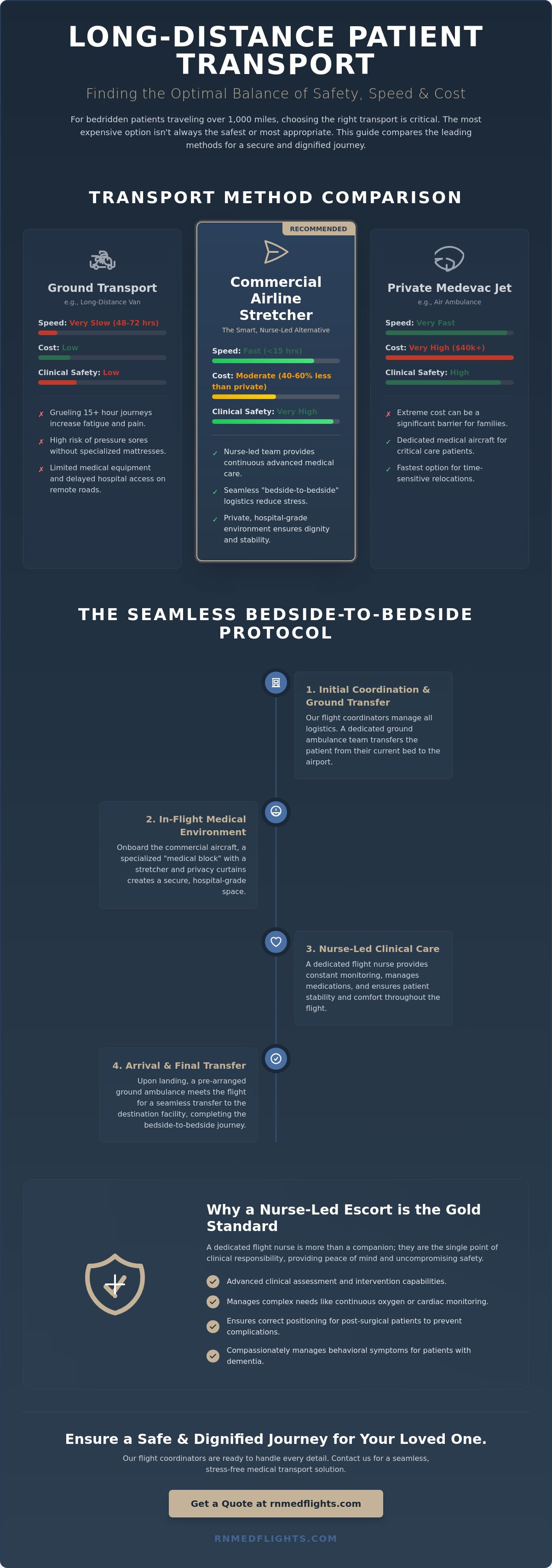
For families managing a long distance transport for bedridden patient, time and budget often pull in opposite directions. While ground transport is economical, it can take 48 to 72 hours to cross the country. Private air ambulances offer speed but often exceed $50,000 for a single mission. Commercial stretcher services bridge this gap. This specialized solution uses wide-body aircraft from international carriers like Lufthansa or Turkish Airlines to move patients across continents in under 15 hours. It's a method that maintains clinical integrity while reducing costs by 40% to 60% compared to private charters.
How the Commercial Stretcher Setup Works
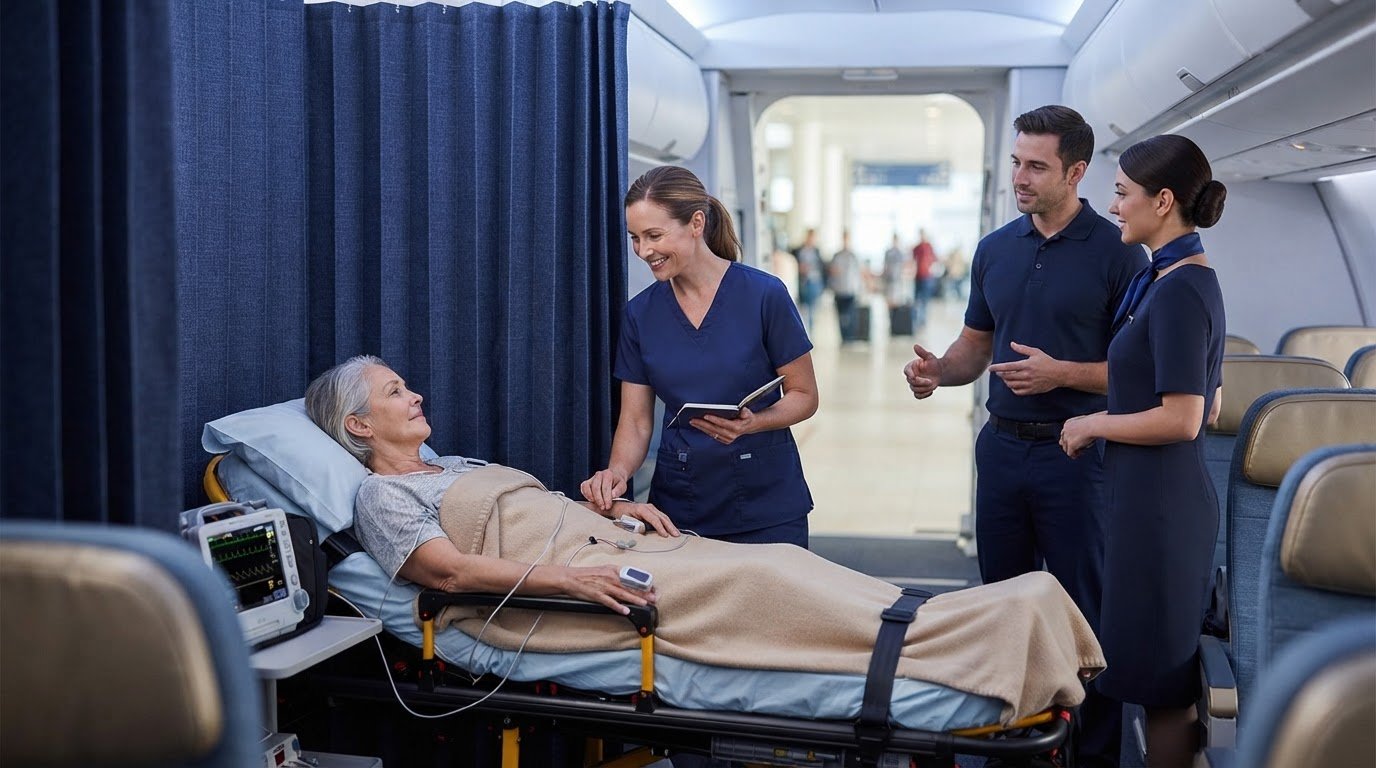
The process begins with a medical block installation. Technicians remove approximately six to nine economy seats to secure a specialized stretcher unit directly to the aircraft floor. To ensure dignity and peace of mind, we install privacy curtains around the patient area. This creates a mobile clinical environment within the cabin, equipped with oxygen, monitoring systems, and necessary medical supplies. Our flight coordinators manage the complex logistics with the airline's medical department to secure clearance. Because this happens on scheduled flights, it remains a non-emergency service for patients who are stable but require recumbent positioning. While commercial options are efficient, families should review Medicare coverage for ambulance services to understand what financial support might apply to the ground portions of these transfers.
Is Your Loved One Eligible for Air Stretcher Travel?
Safety is our uncompromising priority. To qualify, a patient must be medically stable, meaning their condition won't deteriorate during altitude changes or cabin pressure shifts. We require a full physician clearance and a detailed 24-hour medical history before booking. A dedicated flight nurse is essential for this mode of travel. They provide continuous monitoring and medication administration from takeoff to landing. This nurse-centric approach ensures that a long distance transport for bedridden patient is handled with the same care found in a hospital setting.
If you're unsure if your family member meets these criteria, our team is available 24/7/365 to provide a clinical assessment. We focus on delivering a seamless, stress-free experience that prioritizes patient dignity and bedside-to-bedside continuity. You can consult with our flight coordinators to discuss specific medical requirements and routing options for your unique situation.
Comparing Ground vs. Air: Selecting the Right Transport Method
Choosing the correct mode of travel for a long distance transport for bedridden patient requires a careful balance of clinical stability and logistical efficiency. The decision often hinges on the total time in transit. For a 1,000-mile journey, a specialized ground transport van typically spends 16 to 20 hours on the road, depending on traffic patterns and fuel stops. Conversely, air transport covers that same distance in approximately 4 to 5 hours. This time difference is not merely a matter of convenience. For a bedridden individual, every extra hour in transit increases the risk of skin breakdown, dehydration, and physical exhaustion.
Clinical oversight also varies significantly between these methods. Ground transports usually staff a CNA or a Paramedic. While these professionals are highly skilled, they may not have the advanced critical care training required for complex cases. Air transport through RN MEDflights utilizes an RN Flight Nurse. This ensures a higher level of medical intervention is available throughout the flight. Patient comfort is another deciding factor. Ground travel involves constant road vibration, noise, and the physical stress of stop-and-go traffic. A pressurized aircraft cabin provides a climate-controlled, stable environment that minimizes physical jarring and preserves the patient's energy reserves.
The 500-Mile Rule for Bedridden Patients
Distance is the most reliable metric for determining the safest transport method. Journeys under 500 miles often favor a non-emergency ambulance service. At this range, the time spent driving is manageable, and the patient can reach their destination without the complexities of airport logistics. However, when the distance exceeds 500 miles, the physical toll of being in a vehicle for 8 or more hours becomes a safety concern. For those traveling across national borders, international medical repatriation services become essential. These specialized air services provide the speed and clinical infrastructure necessary to navigate long-haul routes safely.
Cost Comparison: Transparency in Medical Logistics
Understanding the financial components of medical transport helps families make informed decisions. Total costs generally include several key elements:
Ground ambulance transfers at both the departure and arrival points.
Airfare or dedicated aircraft fuel and maintenance.
Specialized nursing fees for bedside-to-bedside care.
A commercial medical escort often serves as a middle-ground solution. It offers the high-level safety of a Registered Nurse at a lower price point than a private air ambulance. To ensure peace of mind, RN MEDflights provides all-inclusive quotes. This approach eliminates hidden fees and allows families to focus on their loved one's health. Our 24/7/365 coordinators manage every detail with uncompromising integrity, ensuring the logistics are as seamless as the clinical care.
The Bed-to-Bed Logistics: Coordinating a Seamless Journey
Executing a safe long distance transport for bedridden patient requires a synchronized, five-step protocol. This process eliminates the logistical burden on the family while maintaining clinical continuity. The journey begins with a rigorous clinical assessment and medical clearance by our flight coordinator, who consults with the attending physician to ensure the patient is stable for travel. Once cleared, we initiate a ground ambulance pickup from the originating hospital or residence. This transition is the first touchpoint of our bedside-to-bedside promise.
The third stage involves the airport tarmac transfer, where the patient is boarded using a specialized lift or high-loader. During the flight, a licensed Flight RN provides constant monitoring, managing everything from medication titration to wound care. The final step is the ground transfer from the arrival airport to the destination bedside. This methodical approach ensures that the patient remains under professional medical supervision for every mile of the trip.
The Role of Ground Ambulance Coordination
The "tarmac handoff" is a high-stakes moment where timing must be perfect. A delay of even 15 minutes can disrupt the flight plan or cause unnecessary patient fatigue. RN MEDflights manages all third-party ground providers to prevent these gaps. We don't just book a ride; we vet every provider for equipment standards. For patients with complex needs, we mandate Advanced Life Support (ALS) ground units equipped with ventilators and cardiac monitors. By controlling these logistics, we maintain a seamless environment that protects the patient's physiological stability throughout the transition.
Navigating Airport Security and Boarding
Privacy and dignity are paramount during the boarding process. Many families feel anxious about how a bedridden patient will navigate TSA checkpoints. We utilize private hangars and specialized gate access to bypass public terminals. Security screenings are conducted discreetly on the tarmac or in private areas by officials accustomed to medical transports. To move the patient into the aircraft, we utilize mechanical high-loaders. These platforms lift the stretcher level with the aircraft door, preventing the jarring movements associated with manual lifting. This specialized equipment ensures the boarding process is smooth, quiet, and respectful of the patient's condition.
Our team is ready to manage every clinical and logistical detail of your loved one's journey. Contact our flight coordinators to start the medical clearance process and secure a bedside-to-bedside transport plan.
Why a Nurse-Led Escort is the Gold Standard for Safety
RN Medflights provides a level of care that goes beyond simple logistics. Our veteran-led team brings decades of combined experience in emergency and critical care settings to every journey. When you are arranging long distance transport for bedridden patient safety, the primary concern is the clinical stability of your loved one. Utilizing a medical escort service ensures that every transition, from the initial bedside pickup to the final destination, is managed by a professional trained in advanced life support.
The "RN Advantage" lies in the ability to apply critical thinking in real-time. Our nurses don't just follow a basic checklist. They perform continuous clinical assessments, identifying subtle changes in a patient's condition before they escalate into emergencies. This proactive approach is what differentiates a specialized medical transport from a standard courier service. Every escort carries a comprehensive medical kit designed for high-stakes environments. These kits include:
Portable oxygen concentrators and backup delivery systems.
Advanced cardiac monitors and pulse oximeters.
Emergency medications for pain management, anxiety, or respiratory distress.
Point-of-care testing equipment for immediate diagnostic feedback.
Families gain immense peace of mind knowing a highly qualified protector is at the patient's side. We handle the complex coordination with airlines, ground ambulances, and facility staff, allowing you to focus on your family's emotional needs rather than the stresses of travel logistics.
Clinical Monitoring During High-Altitude Travel
Travel at 30,000 feet presents unique physiological challenges for those with chronic illnesses. Cabin pressure can cause oxygen saturation levels to drop by 5% to 10%, which is a significant risk for a long distance transport for bedridden patient with respiratory or cardiac issues. Our nurses monitor these levels every 15 minutes, adjusting supplemental oxygen as needed. They also manage hydration levels to prevent the thickening of blood and monitor for signs of deep vein thrombosis. Upon arrival, the nurse provides a detailed clinical hand-off report to the receiving facility, ensuring no gap in the continuity of care.
Dignity and Compassion in Bedridden Care
Medical transport is about more than vitals and dosages; it's about the person in the stretcher. Our team prioritizes the human element by offering companionship and emotional support to reduce the anxiety of relocation. At RN Medflights, we treat every patient like family. We maintain their dignity during hygiene tasks and ensure they feel respected throughout the journey. This commitment to integrity and compassion ensures a seamless transition. We remain available 24/7/365 to provide the steady hand and professional expertise your family deserves during a medical crisis.
Secure Your Loved One’s Safe Transition in 2026
Arranging long distance transport for bedridden patient care requires a strategy rooted in clinical precision and deep empathy. The 2026 standards for medical repatriation emphasize the necessity of nurse-led oversight to manage the complex physiological demands of travel. Whether utilizing a commercial airline stretcher or a dedicated medical flight, the priority is maintaining a seamless continuum of care from the initial bedside to the final destination. RN Medflights operates as a veteran-owned organization, bringing a level of discipline and integrity to every mission we undertake. Our team provides 24/7/365 availability, ensuring that families have a constant, reliable point of contact during global medical crises. We manage 100% of the bed-to-bed logistics, allowing you to focus on your family while we handle the technical and medical details. It’s our commitment to provide a steady hand in the storm, ensuring your loved one travels with the dignity they deserve. We’re here to help you navigate this path with confidence and peace of mind.
Frequently Asked Questions
Can a bedridden patient fly on a commercial airplane?
Yes, a bedridden patient can fly on a commercial airplane with the assistance of a medical escort or through an international stretcher service. On domestic flights, the patient must be able to sit upright for takeoff and landing, but on international carriers like Lufthansa, a stretcher can be installed in the cabin with 48 hours of notice. Our RN-led team coordinates every detail to ensure the patient remains stable throughout the journey.
How much does long-distance medical transport for a bedridden patient cost?
The cost varies based on the level of care and distance, but industry data shows that commercial medical escorts are typically 60% to 70% more affordable than private air ambulances. While private jet transports can range from $15,000 to over $100,000, utilizing commercial flights provides a cost-effective solution without compromising clinical safety. We provide a comprehensive quote after our flight coordinators perform a full clinical assessment of the patient's needs.
What is the difference between a medical escort and an air ambulance?
A medical escort accompanies a patient on a commercial flight, while an air ambulance is a private aircraft configured as a mobile intensive care unit. Medical escorts are ideal for stable patients who require monitoring and medication administration. Air ambulances provide advanced life support for those who are ventilator-dependent or critically ill. Both services provide bedside-to-bedside care to ensure a seamless transition between medical facilities.
Will insurance cover the cost of a long-distance medical transport?
Insurance coverage depends on the specific definition of medical necessity in your policy. For example, Medicare Part B may cover 80% of transport costs if a ground ambulance would endanger the patient's health, though this usually applies to the nearest capable facility. Most private insurers require pre-authorization before the trip. Our team helps families gather the necessary clinical documentation to support these claims for long distance transport for bedridden patient services.
How do you get a bedridden patient onto a commercial plane?
We use specialized equipment like an Ambu-Lift or an aisle chair to safely transition the patient from the ground ambulance to their aircraft seat. For international flights involving a stretcher, the patient is lifted through the cabin door using a hydraulic lift system. This process is managed by our experienced nurses who prioritize the patient's dignity and physical comfort. We ensure the loading process is methodical and stress-free for everyone involved.
What medical equipment is available during a commercial medical flight?
Our medical teams carry portable, FAA-approved equipment including oxygen concentrators, heart monitors, and pulse oximeters. We also bring emergency medications and specialized gear like the Zoll X Series monitor to track vital signs in real time. All equipment meets 14 CFR Part 121 safety standards, ensuring that we maintain a high standard of clinical precision during the flight. This allows us to respond to any change in the patient's condition immediately.
How long does it take to arrange a long-distance transport for a bedridden patient?
Arranging a long distance transport for bedridden patient typically takes between 24 and 72 hours. This timeframe allows our flight coordinators to secure airline medical clearances and synchronize ground ambulance schedules at both the departure and arrival locations. Our 24/7/365 dispatch center works tirelessly to expedite these logistics. We understand that timing is often critical, so we move with purpose to ensure the patient reaches their destination safely and without delay.
Can a family member fly with the bedridden patient?
Yes, we encourage at least one family member to fly alongside the patient to provide emotional support and peace of mind. On commercial flights, we book a seat directly next to the patient and the medical escort to keep the family unit together. For private air ambulance transports, the aircraft can usually accommodate one or two passengers depending on the weight and balance requirements. This inclusive approach is a core part of our caregiver-centered philosophy.