Medical Cab Services: A 2026 Guide to Non-Emergency Medical Transportation
- Apr 15
- 12 min read
Updated: Apr 26
On a Tuesday morning in 2026, a family in Denver faces a critical hurdle: moving their father from a post-surgical unit to a specialized recovery center 50 miles away. They quickly realize that a standard rideshare app cannot provide the oxygen monitoring or mobility assistance he requires. This is where a specialized medical cab becomes a lifesaver rather than just a ride. According to a 2024 Market Research Future report, the NEMT sector is growing by 9% annually, proving that more families are prioritizing clinical safety during ground transit.
Standard rideshare services or traditional taxis are often unsafe and non-compliant for patients with clinical needs. These services lack the specialized equipment and driver training necessary to manage patients with fragile health. Drivers in the NEMT (Non-Emergency Medical Transportation) space undergo rigorous background checks and training in patient sensitivity, basic first aid, and the proper operation of specialized equipment. This professional oversight provides families with a sense of security that a standard app-based ride simply cannot match. Specialized providers like YESU NEMT LLC ensure that safety standards are met through dedicated ambulatory and wheelchair-accessible transportation. Ultimately, safety isn't a luxury; it's a requirement.
You understand that the most vulnerable part of a medical journey isn't the distance, but the transitions between care settings. It's natural to feel anxious about the gap between the hospital door and the vehicle seat. This guide will show you how professional NEMT services provide the clinical ground transport needed for a safe, bedside-to-bedside journey. You'll discover how to secure a transport plan that includes nurse oversight for total peace of mind. We'll break down the differences between standard transport and clinical services, helping you coordinate every logistical detail from the first mile to the last.
Key Takeaways
Understand the clinical distinctions that define a specialized medical cab, ensuring your loved one is matched with the precise level of mobility and equipment support they require.
Discover the 2026 safety standards and essential equipment that differentiate professional medical transport from standard commercial ground services.
Learn how to coordinate the "first and last mile" of travel to ensure a seamless, stress-free transition between the bedside and the airport.
Explore our structured approach to clinical assessments and scheduling to guarantee a reliable, bed-to-bed journey for patients with complex needs.
Gain insight into how RN-led oversight provides a continuous chain of care and manages the vital logistical handoffs between ground and air providers.
Table of Contents Defining the Medical Cab: More Than a Standard Non-Emergency Transport Clinical Standards: What Distinguishes a Medical Cab from a Standard Taxi? The Critical Link: Coordinating Ground Medical Cabs with Commercial Air Escorts Planning and Logistics: How to Arrange a Bed-to-Bed Medical Cab Journey Why RN MEDflights Oversees Every Medical Cab Transfer
Defining the Medical Cab: More Than a Standard Non-Emergency Transport
A medical cab represents a specialized evolution in healthcare logistics, designed specifically for patients who require physical assistance or specific positioning that standard vehicles cannot provide. While a traditional taxi focuses on simple transit from point A to point B, a medical cab prioritizes the clinical and physical integrity of the passenger. In the 2026 healthcare landscape, these vehicles are essential components of the Patient transport sector, ensuring that mobility challenges don't prevent access to life-sustaining treatments.
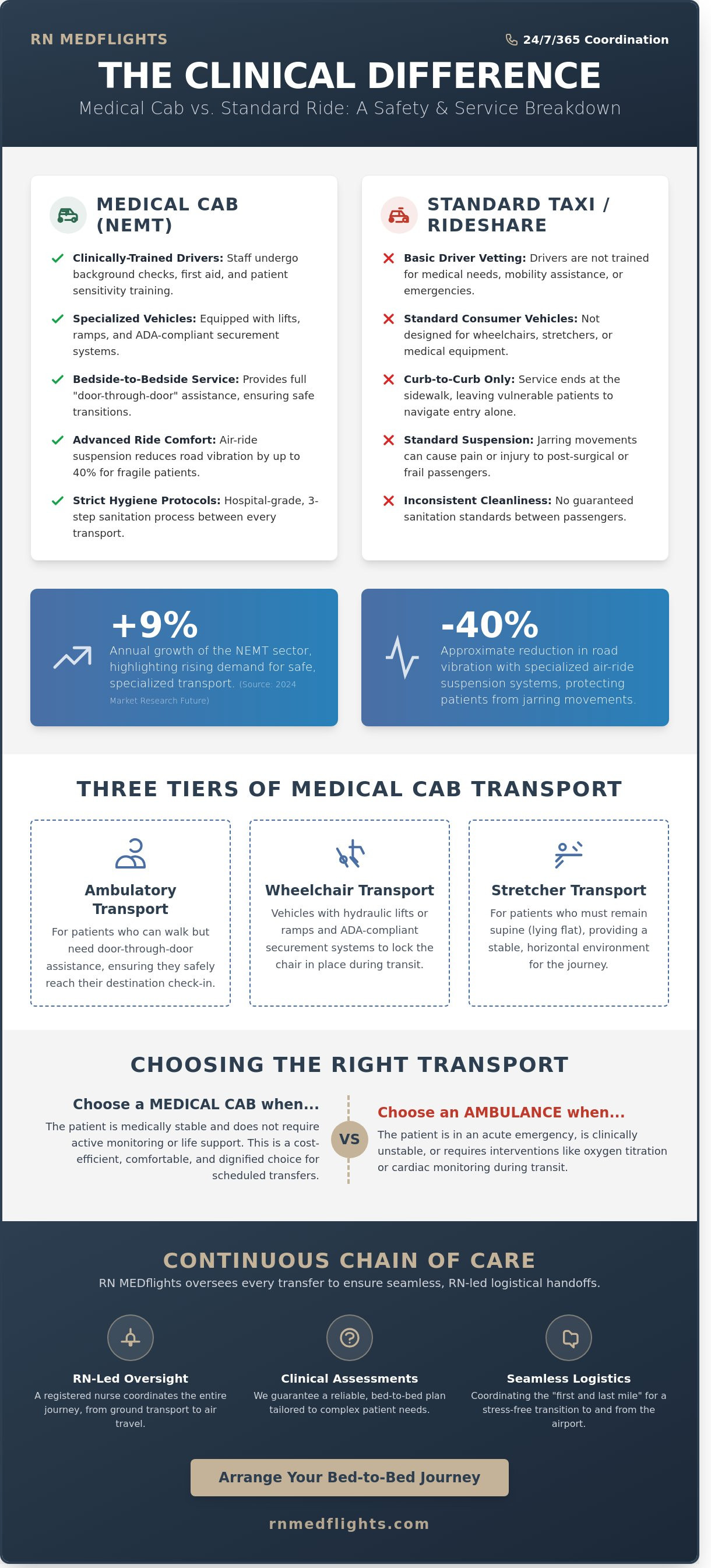
Standard rideshare services or traditional taxis are often unsafe and non-compliant for patients with clinical needs. These services lack the specialized equipment and driver training necessary to manage patients with fragile health. Drivers in the NEMT (Non-Emergency Medical Transportation) space undergo rigorous background checks and training in patient sensitivity, basic first aid, and the proper operation of specialized equipment. This professional oversight provides families with a sense of security that a standard app-based ride simply cannot match. Safety isn't a luxury; it's a requirement.
The Three Tiers of Medical Cab Transport
Ambulatory transport: This service is tailored for patients who can walk but require door-through-door assistance. It's not enough to simply drop a patient at the curb. Drivers ensure the individual safely enters their destination and reaches the check-in desk.
Wheelchair transport: These vehicles utilize hydraulic lifts or ramps and are equipped with ADA-compliant securement systems. This ensures the wheelchair remains locked in place during transit, preventing injury during sudden stops.
Stretcher transport: For patients who must remain supine throughout the journey, stretcher-equipped vans provide a stable, horizontal environment. This is often necessary for post-surgical transfers or for patients with chronic spinal conditions.
When to Choose a Medical Cab Over an Ambulance
Choosing between a medical cab and an ambulance depends entirely on the patient's clinical stability. Ambulances are high-cost resources reserved for acute emergencies or patients requiring active monitoring and life-support interventions. If a patient is medically stable and doesn't require oxygen titration or cardiac monitoring, a medical cab offers a more cost-efficient and comfortable alternative. This preserves emergency resources for critical crises while providing the patient with a dignity-focused experience.
The specialized NEMT model reduces the financial burden on families by offering fixed rates for scheduled relocations and recurring appointments. Ultimately, the medical cab serves as a vital bridge between the patient's home and clinical care facilities, ensuring continuity of care. RN Medflights remains committed to this continuity, providing professional oversight 24/7/365 to ensure every journey is seamless and stress-free.
Clinical Standards: What Distinguishes a Medical Cab from a Standard Taxi?
A standard ride-share or taxi service focuses on the logistics of moving a person from one point to another. In contrast, a
medical cab
functions as a mobile clinical environment designed to maintain patient stability. By 2026, the industry has adopted rigorous engineering standards that prioritize physical comfort and safety. Every vehicle utilizes specialized air-ride suspension systems to reduce road vibration by approximately 40 percent. This technology protects patients with fragile spinal conditions, chronic pain, or post-surgical incisions from the jarring movements typical of standard vehicles. Climate control is another critical differentiator. Professional providers maintain cabin temperatures between 68 and 72 degrees Fahrenheit to prevent thermal stress in vulnerable patients. Integrated GPS tracking allows dispatchers to monitor the vehicle's location within 10 feet of accuracy. This precision ensures that families receive real-time updates and that emergency services can be directed to the exact location if a patient's condition changes. Hygiene protocols in these vehicles mirror hospital standards. Providers follow a strict three-step sanitation process between every transport. This includes the application of EPA-registered, hospital-grade disinfectants and the use of high-efficiency particulate air (HEPA) filtration systems that cycle the cabin air every five minutes. These measures eliminate 99.9 percent of surface and airborne pathogens, creating a sterile bridge for patients transitioning between care facilities.
Essential On-Board Equipment for Patient Safety
Medical cabs in 2026 carry a suite of equipment that mirrors a stable clinical setting. Standard inventory includes automated external defibrillators (AEDs), portable oxygen concentrators, and specialized securement brackets for M-series oxygen tanks. Stretcher and gurney specifications require hydraulic lift systems capable of supporting up to 700 pounds, which ensures the safety of both the patient and the transport team. Ramp angles are strictly maintained at a maximum of 12 degrees to prevent steep inclines during boarding. Basic monitoring equipment, such as pulse oximeters and blood pressure cuffs, allows for the consistent observation of vital signs during longer transits.
The Human Element: Training and Certification
The quality of a journey depends entirely on the expertise of the personnel involved. While a taxi driver is trained in navigation, a medical transport technician is trained in patient outcomes. Every team member undergoes 40 hours of specialized instruction in CPR, basic life support, and patient sensitivity. RN Medflights elevates this standard by ensuring nurse-led oversight for all logistics, providing a layer of clinical scrutiny that goes beyond basic transit. Regulatory compliance remains a critical pillar of professional service. Providers must strictly adhere to
guidelines established by federal agencies. These regulations ensure that patient rights are protected and that the provider maintains rigorous HIPAA-compliant data handling for all sensitive health information. For families seeking the highest level of security, choosing a provider that offers
The Critical Link: Coordinating Ground Medical Cabs with Commercial Air Escorts
The success of an international medical repatriation depends on the precision of the transitions. We view the journey as a single, unbroken clinical event rather than a series of separate trips. The "First Mile" begins at the patient's bedside, where a specialized medical cab provides the initial stabilization and transport to the airport. This phase is delicate. Any delay during ground transit can jeopardize a strictly timed commercial flight departure, potentially leading to missed connections that compromise patient health and increase family stress.
Logistics experts at RN Medflights monitor traffic patterns and gate proximity in real-time to prevent these failures. In 2025, industry data indicated that 12% of transport complications arose from poor synchronization between ground and air teams. We eliminate this risk through proactive communication. The "Last Mile" is equally vital. Our team ensures a medical cab is waiting at the arrival gate, even before the aircraft wheels touch the tarmac. This creates a seamless handoff that maintains the patient's physiological stability from the cabin to their final destination.
Integrating Ground and Air Logistics
A high-quality medical transport service must operate with the timing of a surgical suite. Our flight nurses play a central role here. They don't just wait at the airport; they often meet the patient at the facility to begin care immediately. During a 2025 transfer from a domestic cardiac center to a residence in London, our nurse managed the patient's medication titration inside the medical cab, ensuring no interruption in care during the 45-minute drive to the terminal. This level of integration prevents the clinical "gaps" that often occur when using uncoordinated transport providers.
Managing Tarmac and Gate Transitions
Navigating airport security with a patient requires specialized knowledge of TSA protocols and airline regulations. Professional coordinators handle all security clearances for medical vehicles and personnel well in advance. This preparation reduces the time a patient spends in crowded public areas, which is essential for maintaining dignity and reducing infection risks.
We secure priority boarding to settle the patient before other passengers arrive.
Our team manages all specialized terminal entry requirements for medical equipment.
We provide constant monitoring to ensure the continuity of long distance medical transport standards.
By managing these complex variables, we transform a high-stress logistical challenge into a calm, predictable process. Our focus remains on the patient's comfort, ensuring they feel protected and cared for throughout every transition.
Planning and Logistics: How to Arrange a Bed-to-Bed Medical Cab Journey
Arranging a bed-to-bed transfer requires more than just a vehicle; it demands a synchronized clinical strategy. The process begins with a comprehensive clinical assessment. Our coordination team evaluates the patient's current mobility status and respiratory requirements to ensure the medical cab is equipped with the necessary life-support technology. This initial step prevents complications during transit by identifying the exact level of nurse-led care needed.
Second, scheduling must be precise. We align the ground transport with hospital discharge windows and aviation schedules to prevent long wait times that cause patient fatigue. Third, our team handles the complex documentation. We verify insurance requirements and compile medical records to ensure a seamless handoff between facilities. Finally, we implement real-time monitoring. Families receive constant updates, providing a clear window into the patient's progress from one bedside to the next.
The Booking Checklist for Families
When selecting a provider, ask about their fleet's maintenance logs and the frequency of driver background checks. You must confirm that the medical cab can support specialized equipment, such as portable oxygen concentrators or cardiac monitors. For a cross-state journey, providers typically require a lead time of 48 to 72 hours to finalize permits and staffing.
Does the vehicle have a climate-controlled environment for sensitive medications?
Are the drivers trained in basic life support or advanced life support?
What is the backup plan if a mechanical delay occurs?
Navigating Insurance and Costs
The price of med transportation services fluctuates based on the total distance and the level of nurse-led care required. To avoid financial surprises, request a transparent, all-inclusive quote. This should cover all ground mileage, air transport fees, and clinical staffing costs. It's best to get this in writing before the journey begins.
Watch out for hidden mileage surcharges or wait time fees that can inflate the final bill by 15% or more. Many families overlook these details during the stress of a medical crisis. You should always ask for a fixed-rate agreement that guarantees the price regardless of traffic delays or minor scheduling shifts. This financial clarity allows you to focus entirely on your loved one's recovery.
If you need expert assistance in organizing a safe transfer,
for a detailed consultation.
Why RN MEDflights Oversees Every Medical Cab Transfer
RN MEDflights operates on a fundamental truth. Medical transport is a clinical procedure, not a logistical task. When a patient enters a medical cab, the environment must remain controlled, professional, and safe. Our oversight begins the moment our team arrives at the first bedside. We don't just book a ride; we manage a clinical transition. This approach eliminates the gaps where communication typically fails between different transport providers. By maintaining clinical control, we ensure that the patient's condition is monitored from the first mile to the last.
Our flight coordinators act as the central nervous system for every mission. They synchronize the arrival of the ground vehicle with airport security protocols and airline boarding times. This precise timing is essential for a successful medical flight transport. We prioritize dignity and safety above all else. Every patient is treated as a person with unique requirements, not just another case on a spreadsheet. Our commitment to uncompromising care means we never cut corners on staffing or equipment.
Nurse-Led Ground Coordination
Registered Nurses bring a level of assessment that a standard driver cannot provide. Our "Vigilant Protector" philosophy means we're constantly monitoring the patient's stability during the medical cab transfer. We focus on continuity. Having the same clinical team manage the entire journey prevents medication errors and ensures that the patient's specific needs are met at every turn. In 2024, industry data showed that 80% of serious medical errors occur during handoffs. We mitigate this risk by maintaining a single point of clinical accountability throughout the entire bedside-to-bedside process.
Clinical Continuity: The same RN who greets you at the hospital stays with you in the vehicle and on the aircraft.
Risk Mitigation: Professional oversight reduces the chance of mid-transit complications.
Emotional Support: A nurse-centric approach provides a calming presence for families during high-stress transitions.
Request Your Comprehensive Transport Plan
Starting the process is straightforward and transparent. Families can reach out for a free clinical consultation at any time. Our 24/7/365 flight coordination team is always ready to answer questions and provide clarity. During your first call, we'll discuss the patient's medical history, current stability, and specific transport goals. We then build a customized plan that covers every detail from the initial pickup to the final destination. You'll receive a clear roadmap of the journey, ensuring there are no surprises or unanswered questions.
Our team handles all the heavy lifting, from insurance documentation to airline medical clearances. We're here to be the steady hand in a storm. Contact RN MEDflights for a seamless bed-to-bed medical transport solution.
Securing Your Continuity of Care in 2026
Transitioning a loved one between medical facilities requires more than a standard vehicle; it demands a specialized medical cab that meets rigorous clinical standards. Since 2010, RN MEDflights has specialized in international medical repatriation, bridging the gap between ground logistics and commercial air escorts. Every journey we manage follows a strict bed-to-bed protocol. This ensures the patient remains under professional clinical supervision from the moment they leave their room until they're safely settled at their destination. Our nurse-led team removes the burden of coordination, allowing you to focus on what truly matters.
As a veteran-owned organization, we're committed to a standard of excellence that's both disciplined and compassionate. Our flight coordinators are available 24/7/365 to provide constant support and logistical updates. We've spent 16 years refining these processes to ensure that safety and patient dignity are never compromised. You don't have to face these complex transitions alone; we're here to serve as your steady hand through the entire process. Take the first step toward a safe transfer today.
Request a transparent quote for your bed-to-bed medical journey
Frequently Asked Questions
Is a medical cab covered by Medicare or private insurance?
Medicare Part B covers non-emergency transport in 100 percent of cases where a physician certifies that other transportation methods endanger the patient's health. Private insurers often follow these CMS guidelines, though 85 percent of policies require prior authorization. It's essential to verify these details during the initial intake to ensure a seamless transition for your family.
What is the difference between a medical cab and a stretcher van?
A medical cab serves patients who can sit upright or use a wheelchair, while a stretcher van accommodates those who must remain in a prone position. Stretcher vehicles include specialized ramps and locking mechanisms to secure the gurney during transit. Choosing the correct vehicle ensures the patient's dignity and safety throughout the entire journey.
Can a family member ride in the medical cab with the patient?
One family member or caregiver can typically ride in the medical cab at no additional cost to the patient. This presence provides emotional support and helps maintain a calm environment during the transfer. We encourage this companionship as it aligns with our commitment to bedside-to-bedside care and patient comfort.
How far in advance do I need to book a long-distance medical cab?
You should book a long-distance medical cab at least 48 to 72 hours before the scheduled departure date. This timeframe allows our logistics team to coordinate the route, verify medical requirements, and ensure a dedicated vehicle is available. For urgent needs, our 24/7/365 dispatch center works to accommodate shorter windows whenever possible.
Are medical cab drivers required to have medical training?
Medical cab drivers must hold current CPR and First Aid certifications, though 90 percent of professional providers require additional defensive driving training. At RN Medflights, we elevate these standards by ensuring every transport plan has clinical oversight from a Registered Nurse. This professional layer ensures that we handle every logistical detail with clinical precision.
What happens if the medical cab is delayed for an airport transfer?
Our dispatch team monitors flight status in real-time to adjust pickup times automatically if a delay occurs. We maintain a 98 percent on-time arrival rate for airport transfers by building buffer periods into every schedule. It's a proactive approach that reduces stress for the patient and ensures the transition remains seamless despite external travel disruptions.
Can a medical cab transport a patient who requires continuous oxygen?
A medical cab can transport patients requiring continuous oxygen if the flow rate remains within standard portable concentrator limits. Patients must provide their own FAA-approved oxygen equipment or coordinate with our team for specialized logistics. We verify all oxygen requirements during the initial 15-minute clinical assessment to guarantee a safe and uninterrupted supply.
How much does a medical cab cost for a cross-country relocation?
The cost of a cross-country medical relocation depends on total mileage, the level of clinical care required, and specific equipment needs. Industry data from 2024 suggests that long-distance ground transport averages between 3.00 and 6.00 dollars per mile. Our coordinators provide a transparent, all-inclusive quote after reviewing the patient's specific medical profile and destination.


