Requirements for Flying with Medical Equipment: A 2026 Guide
What if a device passes airport security but still can’t be used as planned during the flight? The requirements for flying with medical equipment involve more than screening. Security rules and airline procedures serve different purposes, and overlooking either can add stress to an already demanding journey.
Plan ahead if travel depends on a device, batteries, or oxygen support. This guide explains what to verify with security agencies and the operating airline, how to prepare documentation and power, and why you shouldn’t rely on in-flight outlets without confirming your device’s needs and the airline’s policy.
You’ll also learn how equipment size, screening, and travel logistics fit into one practical plan. For non-emergency travel, a commercial airline medical escort can help coordinate patient care from ground transfers through the flight. A licensed registered flight nurse can accompany the patient, while airline approval for the equipment remains a separate step. Policies can change, so check current guidance before departure and allow time to organize each part of the journey.
Table of Contents
Flying with Medical Equipment: Separate Security Screening from Airline Approval
Flying with Medical Equipment: Check Device Approval, Batteries, and Onboard Use
Compare Airline Medical Equipment Rules Before Booking or Connecting
Prepare Medical Equipment for a Flight with a Step-by-Step Checklist
When a Medical Escort Can Help Coordinate Equipment and Patient Travel
Flying with Medical Equipment: Separate Security Screening from Airline Approval
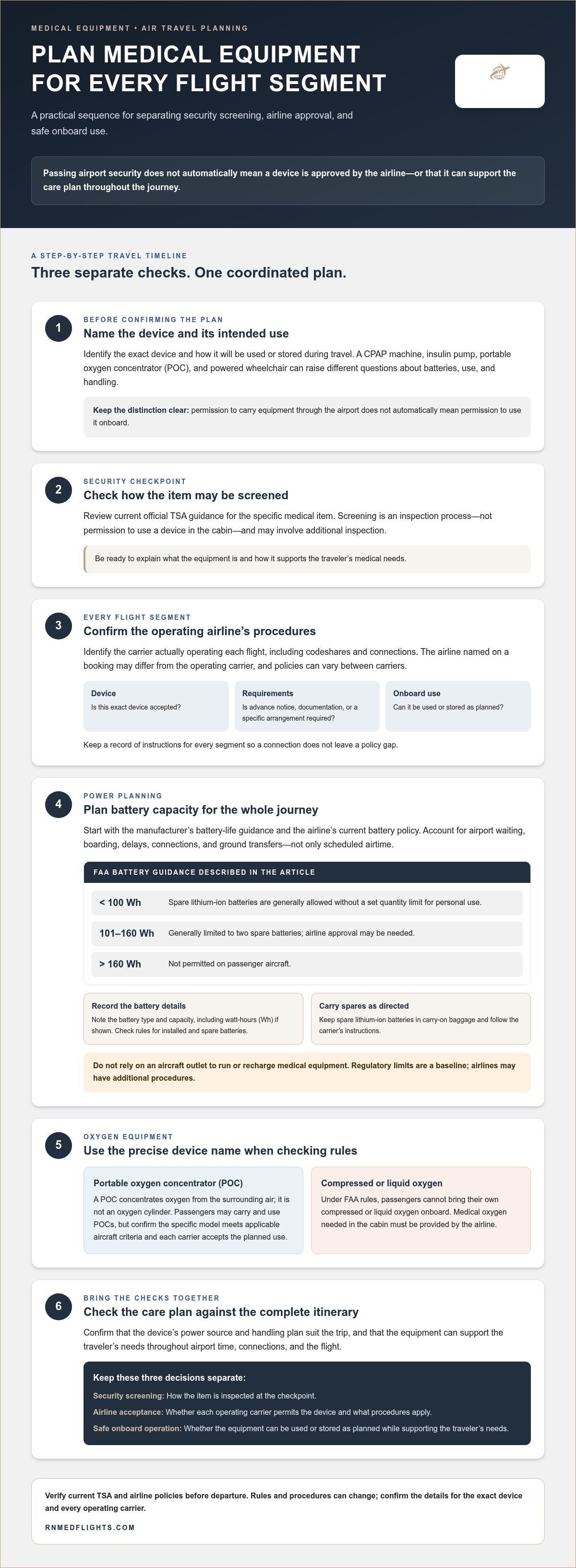
The requirements for flying with medical equipment aren’t one universal checklist. They apply at three separate points: airport security screening, acceptance by each operating airline, and safe use or storage during the flight. Passing one checkpoint doesn’t automatically clear the next. A device may pass security screening but still require airline approval or specific arrangements for onboard use.
Keep these decisions separate as you plan. Security officers screen items; the airline determines its procedures for carrying and using equipment; and the patient’s care plan must account for how the device will function throughout the journey.
For a related overview of travel screening, watch this video about packing medications. It doesn’t replace device-specific guidance from security agencies or an airline.
What does airport security screening cover?
Screening is a security process, not permission to use a device in the cabin. The TSA’s medical-items guidance is a useful starting point for understanding how categories of medical equipment may be screened, but it isn’t a complete plan for every flight. Review current official TSA guidance for the specific item, and be ready to explain what it is and how it supports the traveler’s medical needs. Screening may involve additional inspection.
What does the operating airline decide?
Each airline sets its own procedures for accepting medical equipment, battery transport, onboard use, and assistance. Look beyond the airline that sold the ticket: identify the operating carrier for every flight segment, including codeshares and connections. The name on your booking may differ from the carrier operating a particular flight, and policies can vary between carriers.
Before travel, check each operating carrier’s current guidance for the exact device and intended use. Confirm whether advance notice, documentation, or a specific arrangement is required. Keep a record of the instructions for every segment so a connection doesn’t create an unexpected policy gap.
Then consider the third checkpoint: safe onboard operation. Can the device meet the patient’s needs throughout the journey, including time at the airport and during connections? Does its power source and handling plan suit the trip? Airline acceptance alone doesn’t establish that the equipment can support the care plan for the whole journey.
Security screening: How the item is inspected at the checkpoint.
Airline acceptance: Whether each operating carrier permits the device and what procedures apply.
Safe onboard operation: Whether the equipment can be used or stored as planned while supporting the traveler’s needs.
Verify current TSA and airline policies before departure. Treat them as separate checks, then bring the answers together in one travel plan.
Flying with Medical Equipment: Check Device Approval, Batteries, and Onboard Use
Once you know which carriers operate each segment, match their policies to the device’s purpose. A CPAP machine, an insulin pump, a portable oxygen concentrator (POC), and a powered wheelchair raise different questions about batteries, use, and handling. The requirements for flying with medical equipment depend on the device and airline, so confirm current rules for every operating carrier before travel.
Permission to carry a device through the airport doesn’t automatically mean permission to use it onboard. Airline acceptance, battery arrangements, and in-flight use each need to be addressed.
How should travelers plan batteries and device power?
Start with the device manufacturer’s battery-life guidance and the airline’s current battery policy. Plan for the full travel period, not just scheduled airtime. Airport waiting, boarding, delays, connections, and ground transfers can all extend the time the device must remain available. Don’t rely on an aircraft outlet to run or recharge medical equipment.
Record the device’s battery type and capacity, including watt-hours (Wh) if shown.
Check how the carrier handles spare batteries, installed batteries, and required approvals.
Keep spare lithium-ion batteries in carry-on baggage. Under FAA rules, batteries under 100 Wh are generally allowed without a set quantity limit for personal use; batteries from 101 to 160 Wh are generally limited to two and may need airline approval. Batteries over 160 Wh aren’t permitted on passenger aircraft.
Plan usable power for likely ground time and disruptions, and carry the device and batteries as the airline directs.
These battery limits are a regulatory baseline, not a substitute for carrier instructions. Airlines may have additional procedures, so verify the details for your device and itinerary.
What should travelers know about oxygen and other powered devices?
Use the precise device name when speaking with the airline. A POC concentrates oxygen from the surrounding air; it isn’t an oxygen cylinder. Under FAA rules, passengers can’t bring their own compressed or liquid oxygen onboard, and any medical oxygen needed in the cabin must be provided by the airline. Passengers may carry and use POCs, but confirm that the specific model meets applicable aircraft criteria and that each carrier accepts it for the planned use.
For powered equipment such as CPAP machines or infusion pumps, confirm whether the device can operate during the flight, what battery arrangements apply, and whether advance notice or documentation is required. Don’t assume a device is approved because it has flown before or passed security screening. The airline’s current policy is the practical reference for that carrier.
Mobility equipment needs its own handling plan. For a powered wheelchair or scooter, provide the carrier with the device and battery details it requests, and follow its instructions for transport and assistance. Rules can vary by carrier and battery type, so don’t apply one airline’s process to another segment.
If equipment needs are part of a broader non-emergency travel plan, commercial airline medical escort planning can help coordinate patient care alongside the journey. An escort does not replace airline approval.
Compare Airline Medical Equipment Rules Before Booking or Connecting
Carrier policies can affect more than whether a device travels. They may set procedures for advance approval, batteries, onboard use, documentation, and assistance. Compare the rules before booking when possible, then revisit them if the itinerary changes. Delta and American Airlines provide examples of carrier-specific guidance, but their procedures don’t establish rules for other airlines.
Use this table as a comparison worksheet. For each operating carrier, record the answer that applies to the exact device and trip.
Which airline-policy questions should you compare?
Look for details that apply to the exact model, not just a broad device category. Check whether advance approval is needed, how batteries must be carried, and whether the equipment can be used during taxi, takeoff, or flight. Confirm whether the airline expects the device to operate on its own battery rather than aircraft power. Save the carrier’s instructions for check-in, boarding, storage, and assistance.
How do connecting flights change the planning?
Identify the operating airline for every segment. The carrier shown as the ticket seller may not operate each flight, especially on codeshare itineraries. A connection can introduce different procedures even when the device and traveler remain the same. Recheck the policy if a carrier, aircraft, or itinerary changes, and keep written instructions and airline responses with your travel documents.
The strictest relevant segment policy can shape the whole itinerary. If one carrier requires an arrangement that another doesn’t, plan around the stricter requirement or adjust the route before travel. A side-by-side record helps reveal those differences early and gives the traveler or care team a clear reference during check-in and connections.
Prepare Medical Equipment for a Flight with a Step-by-Step Checklist
A clear checklist brings the device, medical plan, airline procedures, and ground travel into one sequence. Start early enough to resolve questions with the operating carrier, then keep essential equipment and supporting information accessible according to its instructions. These steps can reduce last-minute uncertainty without assuming that one airline’s process applies to every itinerary.
What should travelers prepare before departure?
Begin with the patient’s care needs and how the equipment will be used during travel. Then confirm the carrier’s current procedures and gather the information staff may need to identify, screen, or handle the device. For broader journey planning, the commercial medical escort guide explains how patient care can fit into commercial travel planning.
Discuss the travel plan with the treating clinician. Review how the device will be used during the journey, what supplies are needed, and what instructions should guide safe handling. Organize relevant medical information for airline or screening discussions.
Identify the equipment. Record its make, model, and serial number. Add the traveler’s or caregiver’s contact details, the device manufacturer’s contact information, and written handling instructions where relevant. Keep a copy with travel documents and another accessible to the person accompanying the equipment.
Confirm procedures for every operating carrier. Check whether the exact device needs advance arrangements, what documentation the airline requests, and how the equipment should be carried, stored, or used. Recheck the policy if the itinerary changes.
Prepare the power plan. Follow the manufacturer’s battery-life and charging guidance. Account for airport waiting, flight time, connections, potential delays, and ground transfers. Confirm the carrier’s battery rules and don’t rely on an aircraft outlet to power or recharge the device.
Pack for access and safe handling. Organize the device, accessories, batteries, and necessary supplies so they can be identified and accessed as the airline directs. Keep essential equipment and supporting information with the traveler when carrier policy calls for it.
What should travelers do at the airport and on arrival?
Allow time for check-in, questions, screening, and any assistance arranged with the airline. Keep device accessories and required supplies organized, and follow staff instructions for inspection and boarding. Before leaving the destination airport, check the equipment and its case for visible damage or missing items.
At check-in and screening, explain the device’s purpose and present relevant information or airline instructions as needed. Keep supplies together so they can be located without disrupting the device’s safe setup.
During boarding and connections, follow the operating carrier’s handling and storage directions. Keep the device available for use only as permitted by the airline and consistent with the care plan.
After arrival, inspect the equipment, accessories, and case. If anything appears damaged or is missing, report it promptly to the airline and follow its reporting process.
For non-emergency travel where equipment needs are part of a broader patient-care plan, explore commercial airline medical escort support. Licensed registered flight nurses can accompany patients, while airline approval for equipment remains a separate requirement.
When a Medical Escort Can Help Coordinate Equipment and Patient Travel
Medical equipment can be only one part of a patient’s travel needs. A non-emergency commercial journey may also involve clinical supervision, transfers between home or a care facility and the airport, and coordination at the destination. A medical escort can help bring those elements together, but it doesn’t replace the airline’s approval process. The operating carrier must still accept the equipment and its planned use.
RN MEDflights provides non-emergency commercial airline medical escort, with licensed registered flight nurses accompanying patients. The service supports families who need professional supervision during a commercial flight and coordination for the broader journey. The patient’s clinical needs, equipment, route, and carrier procedures all remain part of the planning.
How does a flight nurse support a commercial journey?
A flight nurse accompanies the patient on the commercial flight and provides professional medical supervision during travel. The nurse’s role is distinct from airline staff, whose responsibilities include operating the flight, and from airport assistance, which supports movement through the terminal or boarding process. A nurse’s presence doesn’t authorize a device, change airline rules, or guarantee a particular clinical outcome. The airline’s equipment procedures still apply. Learn more about the flight nurse role and responsibilities.
Families can begin by discussing the patient’s travel needs with the treating medical team. Consider whether the patient needs clinical support in transit, what equipment must accompany them, and what the airline requires for each flight segment. This helps clarify whether an escort is appropriate for a planned non-emergency journey.
What does coordinated bed-to-bed travel involve?
Bed-to-bed coordination connects the different stages of a journey rather than treating the flight as the entire trip. When needed, ground ambulance transfers can be coordinated at departure and arrival alongside the commercial flight arrangements. The plan considers the patient’s condition, required equipment, route, and airline procedures together, while keeping the responsibilities of each part of the journey clear.
For example, a patient may need support getting from a care setting to the airport, during the commercial flight, and from the destination airport to another care setting. Coordinating these transitions helps families understand how the journey fits together, including where the equipment travels and which carrier procedures apply. Airline acceptance remains a separate requirement throughout.
If you’re weighing whether professional supervision and coordinated transfers fit your family’s non-emergency trip, gather the patient’s travel needs, equipment details, and itinerary. Discuss medical flight transport with RN MEDflights to explore a coordinated commercial journey.
Shape the Next Step Around the Patient
When equipment is essential to a journey, the goal is more than getting through the airport. It’s a travel plan that supports the patient from departure to arrival. Gather the care team’s guidance, the itinerary, and the details needed to make decisions about supervision and transitions. Then consider where coordination can make the journey easier for the patient and family.
The requirements for flying with medical equipment are one part of a larger picture. If planning is difficult to manage alongside a patient’s care, professional coordination can bring the travel arrangements into focus. RN MEDflights is a veteran-owned and operated small business that provides commercial airline medical escort and coordinates bed-to-bed transport.
Discuss a coordinated commercial medical journey with RN MEDflights and take the next step with a clearer plan. Thoughtful preparation and professional support can help families approach the journey with greater confidence.
Frequently Asked Questions
Can I bring medical equipment on a commercial flight?
Often, yes, but permission depends on the device, screening procedures, and the airline operating each flight. The requirements for flying with medical equipment aren’t settled at one checkpoint: TSA screening guidance addresses security, while carriers set their own rules for acceptance and use. Before travel, check official TSA information for the item and confirm with each operating airline how the device should be presented, carried, and handled at boarding.
Do I need airline approval to fly with a portable oxygen concentrator?
Airline procedures vary, so check the current policy of every operating carrier before flying with a portable oxygen concentrator (POC). Give the airline the device’s exact make and model, then ask about advance notice, documentation, battery arrangements, and permitted onboard use. A published policy or approval from one airline doesn’t necessarily apply to a codeshare or connecting flight operated by another carrier, so review every segment.
Can I use an aircraft outlet to power my medical device?
Don’t rely on an aircraft outlet unless the operating airline specifically confirms it can support your device. Delta states that its onboard outlets aren’t designed to power medical devices, but that is Delta-specific guidance, not a rule for all airlines or aircraft. Ask the carrier about your device and plan around its instructions. Include time on the ground and possible schedule changes in your power plan, not just time in the air.
How much battery power should I bring for medical equipment?
There isn’t one battery allowance that applies to every device and carrier. Use the manufacturer’s battery-life information and the airline’s policy to calculate what the equipment needs for the entire journey, including airport waiting, connections, delays, and ground transfers. Delta publishes a requirement of 150% of actual flight time for assistive-device battery capacity. Treat that as Delta’s policy example only, and don’t apply it automatically to another airline or device.
Can I bring medical equipment in my carry-on bag?
Often, essential medical equipment can travel in the cabin, but the airline’s instructions determine how it must be carried and stowed. Under the Air Carrier Access Act, medical devices such as CPAP machines don’t count toward an airline’s carry-on or personal-item limit. However, a bag containing the device plus nonessential personal belongings may be treated differently for baggage fees. Keep equipment accessible as directed and confirm arrangements for each operating carrier.
What documents should I bring when flying with medical equipment?
Bring information that helps identify the device and explain its travel needs, but check whether the airline requires particular forms or approvals. Useful records can include the make and model, battery specifications, manufacturer handling instructions, and relevant medical information. For an attached device such as an insulin pump, tell the TSA officer what it is and where it’s located before screening. A TSA notification card or medical documents may help explain the situation, but TSA doesn’t require them.
What happens if my medical equipment is damaged during a flight?
Inspect the device and its case as soon as practical after arrival. If you see damage or find something missing, report it to the airline promptly and follow its instructions for documenting the issue. Keep the device’s serial number and any notes or photographs showing its condition before travel available. If damage affects equipment needed for the passenger’s care, follow the treating clinician’s guidance while arranging appropriate support.
Can a flight nurse help when someone needs medical equipment during a commercial flight?
Yes. A licensed registered flight nurse can accompany a patient on a planned non-emergency commercial journey and provide medical supervision during travel. The nurse’s role is separate from airline staff and doesn’t replace the carrier’s device approval or operating procedures. RN MEDflights coordinates commercial airline medical escort and ground ambulance transfers as part of bed-to-bed transport. Families can discuss the patient’s care needs, equipment, route, and airline requirements together.