Airline Policies for Passengers Needing Medical Assistance: The 2026 Guide
Updated: Jun 20
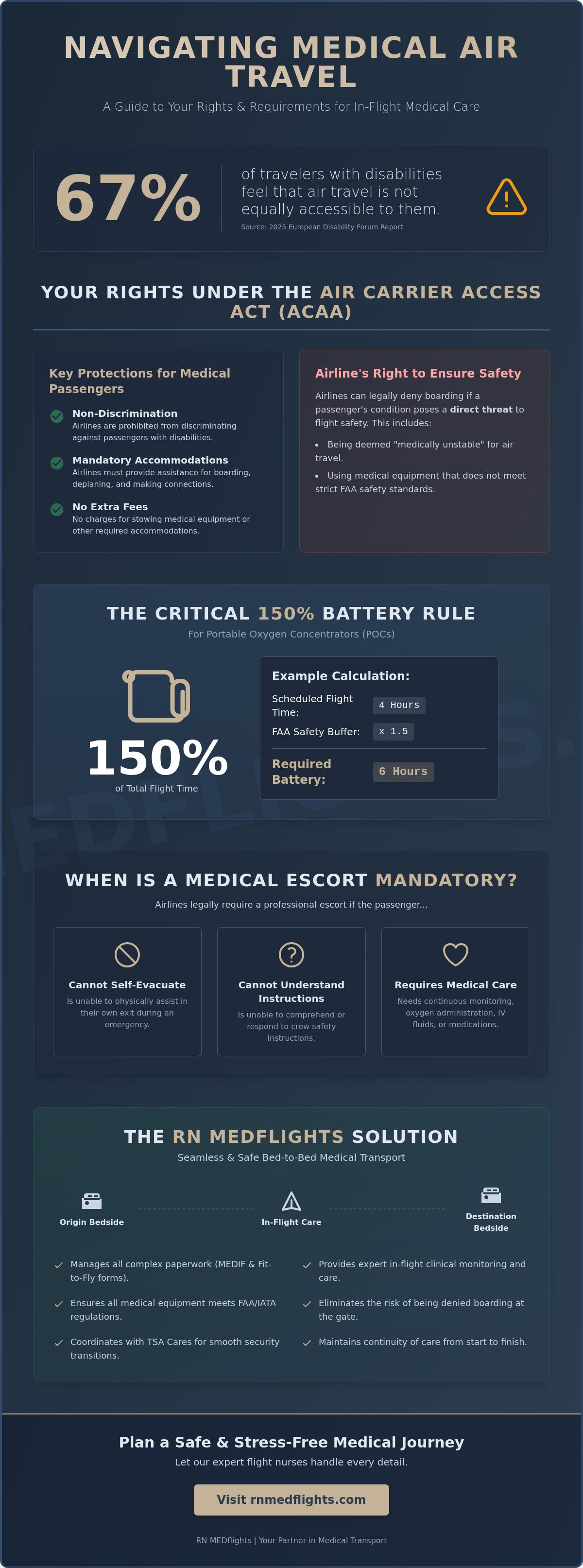
Did you know that 67% of travelers with disabilities still feel that air travel is not equally accessible to them? This statistic from a 2025 European Disability Forum report highlights a distressing reality for families managing complex health needs. When you're coordinating travel for a patient, the fear of being denied boarding at the gate due to a paperwork error is overwhelming. Understanding the latest airline policies for passengers needing medical assistance shouldn't feel like a clinical trial, yet the maze of MEDIF forms and oxygen regulations often creates more stress than the medical condition itself.
We understand that you need more than just a list of rules; you need a partner who views the patient as a person rather than a case. This guide provides a comprehensive breakdown of your rights under the updated 2026 Air Carrier Access Act and the specific safety protocols required for in-flight care. You'll learn how to navigate the 150% battery rule for portable oxygen concentrators and how to meet strict airline notification deadlines. We'll outline exactly how to transition from the confusion of regulations to a clear, clinical plan for safe bed-to-bed transport, ensuring every logistical detail is handled with professional precision and a caregiver's heart.
Key Takeaways
Identify your legal protections under the Air Carrier Access Act to ensure a safe, non-discriminatory travel experience for patients with complex needs.
Navigate airline policies for passengers needing medical assistance by understanding the critical submission deadlines for Medical Information Forms (MEDIF).
Prepare for in-flight safety by adhering to the FAA battery requirements for portable oxygen concentrators, including the mandatory 150% flight-time buffer.
Learn how to utilize TSA Cares and bed-to-bed coordination to maintain continuity of care through every security checkpoint and airport transition.
Understand the clinical advantage of employing a professional medical escort to handle complex logistical regulations and provide expert in-flight monitoring.
Table of Contents
Understanding the Legal Framework: The Air Carrier Access Act (ACAA)
The Medical Clearance Process: Navigating MEDIF and Fit-to-Fly Forms
Airline Policies for Medical Equipment: Oxygen, Batteries, and Devices
Logistical Coordination: From Bed-to-Bed and Through Security
Why a Commercial Medical Escort is the Solution for Complex Travel
Understanding the Legal Framework: The Air Carrier Access Act (ACAA)
The foundation of all medical travel within the United States rests upon the Air Carrier Access Act (ACAA). This legislation, originally passed in 1986, prohibits discrimination against travelers with disabilities and mandates that airlines provide specific accommodations. However, a critical distinction exists between standard disability assistance and the clinical requirements of a patient. While most people associate these rules with wheelchair access, airline policies for passengers needing medical assistance encompass a much broader range of clinical needs, including the use of life-sustaining equipment and specialized in-flight care.
It's vital to recognize that while the law protects your right to fly, it also grants airlines the authority to refuse boarding if a passenger's condition poses a direct threat to the safety of the flight. This often occurs when a patient is deemed "medically unstable" or if their equipment doesn't meet strict FAA safety standards. While the ACAA governs domestic flights and any foreign carrier flying into or out of the U.S., international journeys are often subject to IATA (International Air Transport Association) standards. These global guidelines can be more stringent, particularly regarding the types of medical devices allowed in the cabin.
To visualize how these rules impact the boarding process, watch this overview of disabled passenger rights:
Your Rights as a Medical Passenger in 2026
As we move through 2026, passenger rights have become more defined, yet the logistics remain complex. You have the legal right to receive assistance during every transition of your journey, including boarding, deplaning, and connecting between flights. Airlines cannot charge you additional fees for required disability-related accommodations, such as the stowage of a portable oxygen concentrator or the use of an on-board wheelchair. Under the 'Reasonable Accommodation' clause, airlines must work with you to ensure your medical equipment can be safely integrated into the cabin environment, provided it meets weight and power specifications.
When Airlines Can Legally Require a Medical Escort
There are specific scenarios where an airline will mandate that a passenger travel with a companion or a professional medical escort. The primary trigger for this requirement is the patient's ability to participate in their own evacuation during an emergency. If a passenger cannot physically assist in their own exit or understand safety instructions, a companion is legally required.
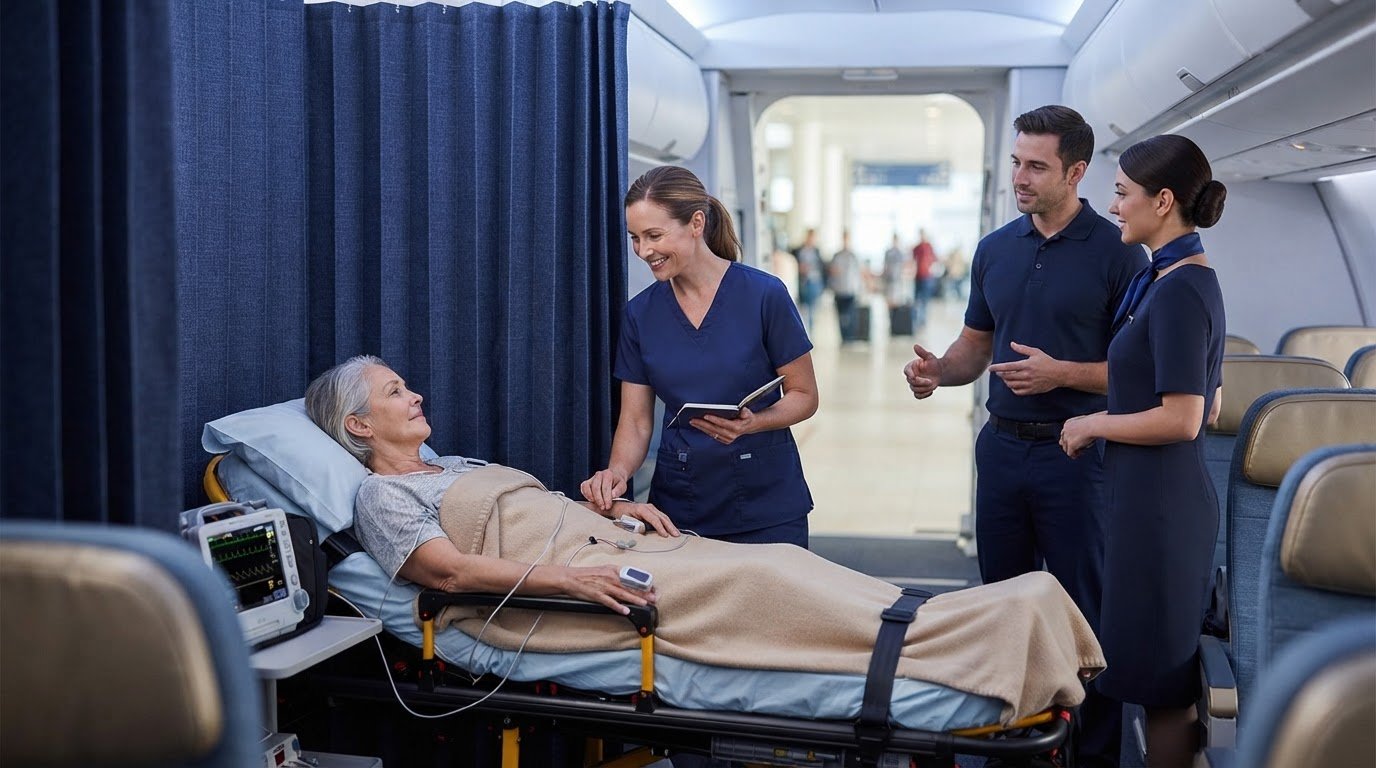
Airlines also demand a professional Commercial Airline Medical Escort or a private flight nurse when a patient requires continuous medical monitoring, administration of IV fluids, or frequent medication adjustments. In these cases, the airline's medical department evaluates "medical stability" based on the patient's recent clinical history. Having a licensed professional manage this process ensures that all medical clearance criteria are met before you ever arrive at the gate, preventing the heartbreak of a denied boarding.
The Medical Clearance Process: Navigating MEDIF and Fit-to-Fly Forms
Securing medical clearance is the most critical hurdle in any journey involving a compromised patient. The Medical Information Form (MEDIF) serves as a clinical bridge between your treating physician and the airline's medical department. It isn't merely a bureaucratic requirement; it's a vital safety tool designed to prevent in-flight emergencies. According to the IATA Medical Manual, airlines use this data to determine if the aircraft environment can safely support the patient's specific needs. For non-emergency patients, this form is mandatory for anyone requiring supplemental oxygen, a stretcher, or specialized medical equipment.
Timing is everything. Most airline policies for passengers needing medical assistance require MEDIF submission at least 48 to 72 hours before departure, though some international carriers require up to seven days for review. Waiting until the last minute often results in a grounded patient. Certain conditions, such as respiratory distress, recent abdominal surgery, or a stroke within the last 14 days, trigger an automatic and rigorous review. If the airline's medical desk isn't satisfied with the patient's stability, they will deny boarding without hesitation to maintain flight safety.
Step-by-Step Guide to Completing a MEDIF
Completing a MEDIF requires close coordination with the patient's clinical team. First, your treating physician must provide detailed clinical data, including recent vital signs and a summary of the current condition. Second, you must specify exact oxygen flow rates and the specific model of any portable oxygen concentrator (POC) being used to ensure it aligns with airline policies for passengers needing medical assistance. Finally, ensure the form is sent directly to the airline's dedicated medical desk. General customer service representatives often lack the training or authority to process these time-sensitive clinical documents.
Clinical Criteria for 'Fit to Fly' Status
Achieving 'Fit to Fly' status means the patient can withstand the unique stressors of flight, specifically the reduced atmospheric pressure at cabin altitudes. Cabin pressure is typically maintained at an equivalent of 6,000 to 8,000 feet. This altitude causes gases to expand, which is potentially life-threatening for anyone with a recent pneumothorax or post-surgical air pockets. We look for stability in vital signs and neurological status over a minimum 48-hour period before clearing a patient for travel.
Because these clinical assessments are complex, families often find that utilizing a professional medical escort service is the most reliable way to secure clearance. A professional team manages the physician communication and ensures the airline receives every necessary detail. If you're feeling overwhelmed by the paperwork, reaching out for a clinical consultation can provide the clarity you need to move forward with confidence.
Airline Policies for Medical Equipment: Oxygen, Batteries, and Devices
Managing medical devices in the pressurized environment of a commercial cabin requires more than just technical knowledge; it requires a vigilant commitment to safety. Current airline policies for passengers needing medical assistance have shifted significantly, specifically regarding supplemental oxygen. Most carriers no longer provide therapeutic oxygen tanks on board. Instead, they require passengers to bring their own FAA-approved Portable Oxygen Concentrators (POCs). This shift places the responsibility for power management directly on the family or the medical escort, making battery calculations a life-critical task.
The Federal Aviation Administration (FAA) strictly mandates that any passenger using a POC must carry enough battery life to power the device for 150% of the scheduled flight time. This extra buffer accounts for unexpected taxi times, weather delays, or holding patterns. In 2026, we've observed instances where gate agents misapply the IATA 30% state-of-charge rule, which is meant for cargo shipments, to carry-on medical batteries. It's essential to ensure your spare batteries are fully charged to meet the 150% requirement, as a partially charged battery could lead to a denial of boarding at the gate.
Respiratory assist devices like CPAP and BiPAP are generally permitted for in-flight use, but they must be verified against the airline's specific approved list. Similarly, managing injectable medications or temperature-sensitive biologics requires careful planning. Updated security protocols now allow for a separate medical bag that doesn't count toward your standard carry-on limit. This allowance ensures that life-saving medications and their cooling packs remain within reach throughout the journey, maintaining the continuity of care that is the hallmark of a professional Commercial Airline Medical Escort.
Flying with Supplemental Oxygen
To ensure operational fluidity, you must verify your POC model against the FAA-approved list for 2026 before booking. Airlines typically require a minimum of 48 to 72 hours of advance notice if you plan to use a POC. When packing spare lithium batteries, they must be individually protected to prevent short circuits and carried exclusively in your carry-on luggage. Clear labeling of these batteries helps security personnel identify them quickly, reducing the cognitive load on the family during the screening process.
Handling Specialized Medical Gear
Specialized equipment such as IV pumps, cardiac monitors, and suction units requires "Special Handling" status. It's important to distinguish between a standard wheelchair request and a Commercial Airline Stretcher Service. While wheelchairs assist with mobility, a stretcher service is a complex logistical arrangement for patients who must remain recumbent. For these cases, we coordinate directly with the airline's engineering and medical departments to ensure the equipment is safely secured and that the patient's monitoring remains uninterrupted from departure to arrival.
Logistical Coordination: From Bed-to-Bed and Through Security
The most vulnerable moments in a patient's journey occur during transitions. Moving from a hospital bed to a ground ambulance, and then from the ambulance to the terminal, requires seamless synchronization. This is why we prioritize Bed-to-Bed Medical Transport. It ensures that clinical monitoring never stops, even for a second. When you're reviewing airline policies for passengers needing medical assistance, you'll find that airlines are responsible for the on-board experience, but the responsibility for the terminal transition often falls on the family. We close that gap by maintaining a constant clinical presence from the point of origin to the final destination.
Utilizing the TSA Cares program is a helpful step for a dignified experience. It provides a dedicated point of contact for security screening. However, it doesn't provide medical care or logistical oversight. A professional escort ensures the patient remains stable while TSA officers perform necessary security checks. At the gate, priority boarding is a legal right under the ACAA. For non-ambulatory patients, airlines provide aisle chairs. These are narrow wheelchairs designed to fit between the rows of a commercial aircraft. Coordination here is vital to ensure the chair and the specialized boarding team are ready upon your arrival.
The Ground-to-Air Transition
Successful transport begins with the professional coordination of a non-emergency ambulance service to ensure the patient arrives at the terminal with ample time for check-in. Clinical documentation must be physically present for gate agent review. This includes the approved MEDIF and a recent clinical summary from the treating physician. The physical transfer from a stretcher to a commercial seat is a delicate procedure. It requires specialized lifting techniques to maintain the patient's comfort and safety. This phase is a critical component of airline policies for passengers needing medical assistance, as the airline must witness a safe transfer before they allow the aircraft to depart.
Navigating Security with a Medical Condition
You don't have to disclose a full medical history to TSA officers to receive assistance. A brief, professional description of the medical condition is sufficient to trigger the correct screening protocol. For patients who cannot stand or walk through a metal detector, TSA provides alternative screening methods in a private area if requested. A private flight nurse acts as a vital advocate during this process. They ensure that medical devices aren't mishandled and that the patient's dignity is preserved throughout the inspection. They manage the technical communication with security personnel so the family can focus on the emotional needs of their loved one.
Managing connections at hub airports is often the most stressful part of the journey. We handle all medical handoffs, ensuring the next gate is ready and the aisle chair is waiting. If you're planning a complex relocation, contact our clinical coordination team to secure a seamless bed-to-bed plan.
Why a Commercial Medical Escort is the Solution for Complex Travel
While understanding airline policies for passengers needing medical assistance is the first step, executing those requirements perfectly is a different matter entirely. A single missing signature on a MEDIF form or an incorrectly calculated battery requirement can ground a patient. A professional escort acts as a vigilant protector, assuming full responsibility for policy compliance. They serve as the clinical liaison between the treating physician and the airline's specialized medical desk, ensuring every regulatory hurdle is cleared before the journey begins. This proactive approach eliminates the risk of being denied boarding at the gate.
The presence of a licensed flight nurse provides a level of safety that standard airline assistance simply cannot match. While flight attendants are trained in basic first aid, a flight nurse manages complex medication schedules, monitors vital signs, and responds to clinical shifts with professional precision. This specialized care is also remarkably cost-effective. By utilizing commercial aircraft instead of private jets, families can access high-level medical supervision at a fraction of the cost typically associated with private air ambulance services. This model of transport is made possible by the professional standards of the aviation industry, where flight academies like 2FLY Airborne educate the pilots responsible for maintaining safety in the skies. We prioritize safety and operational fluidity to ensure the patient is always viewed as a person rather than just a case.
The Role of the RN MEDflights Team
Our team manages the entire clinical landscape from start to finish. We don't just provide a nurse; we provide a comprehensive solution that includes securing medical desk approval and coordinating every ground logistical detail. From the moment we assume care, our nurses provide continuous clinical monitoring and administration of necessary medications. We manage the handoffs at hub airports, ensuring that the patient's transition from one aircraft to another is fluid and safe. Our commitment to end-to-end responsibility means families never have to wonder who is in charge of their loved one's safety.
Peace of Mind for Families
The emotional weight of international medical repatriation is significant. Families are often dealing with the trauma of a sudden illness or injury while trying to navigate foreign healthcare systems and complex aviation rules. Having a professional protector present for every step of the journey lowers the emotional temperature of the crisis. We handle the technicalities of airline policies for passengers needing medical assistance so you can focus on being a supportive family member. Our goal is to provide a sense of security that the logistics are being handled by experts. If you're ready to bring your loved one home, contact our clinical team today for a personalized travel assessment.
Beyond the clinical requirements of repatriation, many families eventually seek restorative leisure experiences to celebrate recovery. For these journeys, The Russell Travel Team (Lightning Travel) offers specialized expertise in curated luxury travel, ensuring that even the most complex vacation plans are executed with professional precision and ease.
Securing Your Path Home with Professional Precision
Mastering the intricate airline policies for passengers needing medical assistance is the essential first step toward a safe and dignified relocation. By understanding your rights under the ACAA and meticulously preparing MEDIF documentation and equipment batteries, you transform a high-stress crisis into a manageable clinical procedure. Structural clarity and early preparation are your greatest allies in ensuring that no patient is left waiting at the gate. When you're armed with the right information, the complex world of aeromedical logistics becomes a clear path toward recovery.
RN MEDflights stands ready as your vigilant protector during these critical times. Veteran-owned and operated since 2010, our organization is clinically-led by licensed Registered Flight Nurses who prioritize patient safety above all else. We provide comprehensive bed-to-bed coordination, ensuring that from the initial hospital discharge to the final arrival, every medical and logistical detail is under expert control. You don't have to manage these complexities alone. We're here to guide you through every regulation and every mile, bringing your loved one home with the care and empathy they deserve.
Request a Professional Medical Travel Assessment from RN MEDflights today to begin your journey with confidence.
Frequently Asked Questions
Can I fly on a commercial airline if I need continuous oxygen?
Yes, you can fly while receiving oxygen, provided you use an FAA-approved Portable Oxygen Concentrator (POC). Airlines no longer provide therapeutic oxygen tanks in the cabin for passenger use. You must notify the airline's medical desk 48 to 72 hours before your flight. It's essential to verify your specific device model against the carrier's approved list to ensure a seamless boarding process without delays.
How do I get a 'Fit to Fly' certificate for an international flight?
You obtain this certificate through a clinical assessment performed by your treating physician or a specialized medical travel team. The document confirms you're stable enough to withstand cabin pressure and altitude changes during the journey. For international travel, this process often involves completing a MEDIF form and receiving formal approval from the airline's medical department at least 48 hours before your scheduled departure time.
What is the difference between a medical escort and an air ambulance?
A Commercial Airline Medical Escort utilizes existing commercial flights to provide a cost-effective solution for stable patients needing clinical monitoring. This service is a fraction of the cost of a private air ambulance. Air ambulances are private aircraft configured as flying ICUs for critically ill patients. RN MEDflights specializes in commercial escorts, offering high standards of clinical care and comprehensive bed-to-bed coordination on scheduled airlines.
Do airlines charge extra for passengers who need medical assistance?
No, the Air Carrier Access Act prohibits airlines from charging fees for standard disability-related assistance or for stowing necessary medical equipment. You're only responsible for the cost of the passenger's ticket and any additional seats required for specialized gear or a Commercial Airline Stretcher Service. While professional escort services involve a separate fee, the airline itself cannot charge you for the act of providing mandated assistance.
What happens if a passenger has a medical emergency mid-flight?
Flight attendants are trained in basic first aid and have access to an Emergency Medical Kit. They typically call for medical professionals on board or contact ground-based advisory services. Having a private flight nurse on board significantly improves safety, as they provide immediate, advanced clinical intervention. They manage the situation with professional precision, which helps lower the emotional temperature of the crisis for the family and other passengers.
How much battery life do I need for my medical equipment on a long-haul flight?
You must carry enough battery power for 150% of your total expected flight time. This is a strict requirement within airline policies for passengers needing medical assistance to account for potential delays or diversions. If your flight is 10 hours, you need 15 hours of battery life. This buffer is critical because aircraft power outlets aren't always available or reliable for life-sustaining medical devices during taxi or flight.
Can a nurse fly with me on a commercial airline to provide medical care?
Yes, a licensed Registered Flight Nurse can accompany you to provide continuous clinical care throughout your journey. This professional manages medication administration, vital sign monitoring, and any necessary medical interventions. This service ensures you remain stable and comfortable while navigating the complexities of airline policies for passengers needing medical assistance. It provides families with a constant, unwavering presence that prioritizes the patient's safety and emotional security above all else.
Does insurance cover the cost of a commercial medical escort?
Coverage varies significantly based on your specific policy and the established medical necessity of the relocation. Some long-term care or travel insurance plans may reimburse costs for International Medical Repatriation if local facilities cannot provide required care. We recommend contacting your insurance provider directly to verify your benefits. Our team provides the detailed clinical documentation necessary to assist families in the claims process, ensuring a professional and transparent experience.