Customs & Immigration in Medical Transport: 2026 Guide
Imagine standing at an international arrival gate with a vulnerable loved one, only to have a customs official question the legality of their essential medications. It's a moment of profound uncertainty that no family should face. When you are planning for customs and immigration during medical transport, the fear of being detained or the stress of complex paperwork can feel insurmountable. We understand that your primary focus is the patient's health, not managing the intricate web of international border laws.
This guide provides the expert logistical framework you need to ensure a predictable, seamless transition. Our 2026 guide outlines how to ensure compliance with all international health and immigration standards while maintaining the patient's comfort. We'll show you how to establish medical admissibility, proving the patient is a prepared traveler rather than a public health risk. You will learn about specific documentation for medical escorts, current regulatory updates, and how our clinically-led coordination keeps the journey moving forward without delay. We prioritize safety and continuity of care, ensuring that every detail is handled with precision and empathy.
Table of Contents
Beyond the Passport: Why Medical Customs Planning is Critical
Medical customs planning is the proactive pre-clearance of a patient's health status, specialized equipment, and medications with border authorities. It’s a specialized layer of logistics that sits atop standard travel requirements. When you are planning for customs and immigration during medical transport, the goal is to eliminate the unpredictability of a border officer's discretion. This process involves a detailed disclosure of the patient's clinical needs before they even leave the hospital bed.
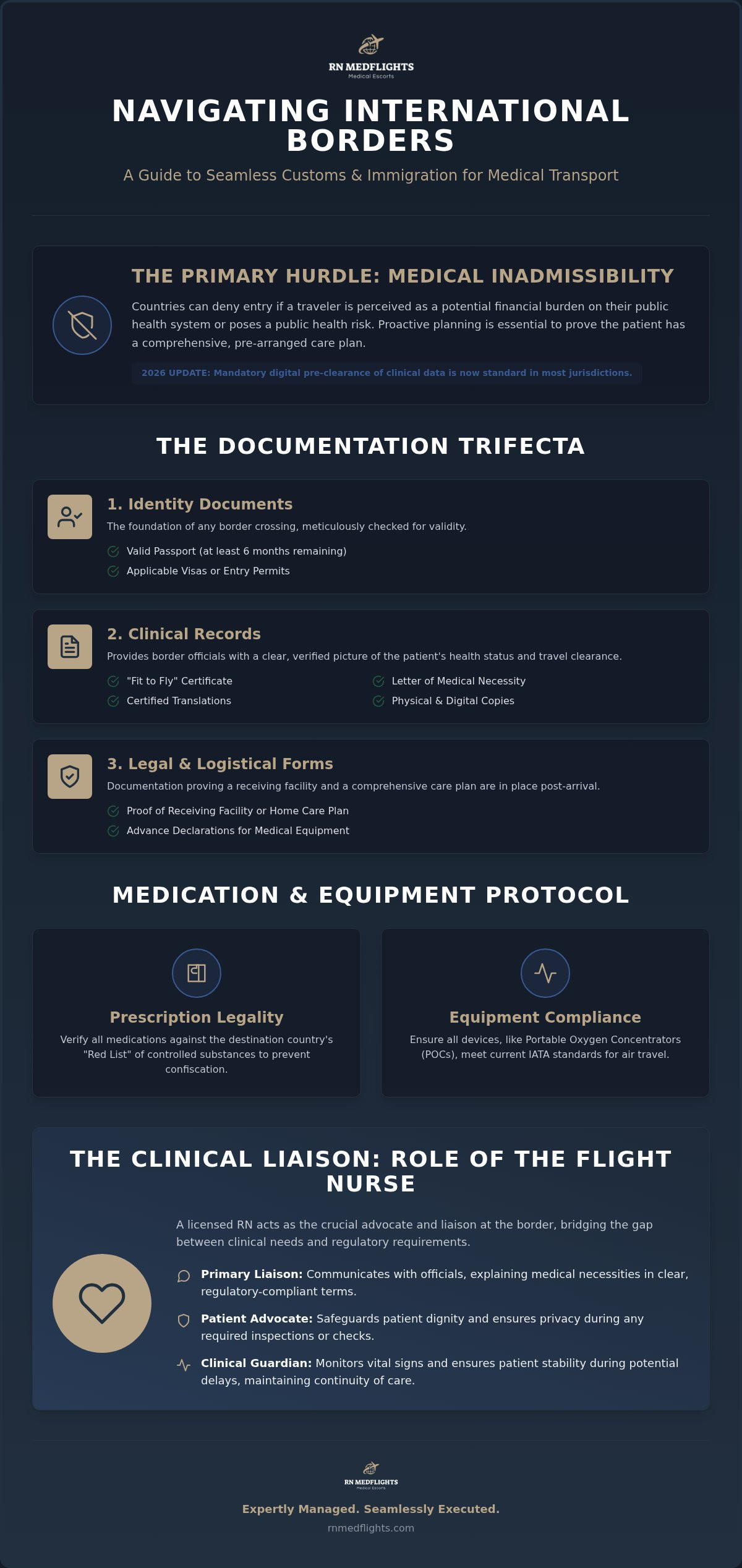
One of the most significant hurdles in international repatriation is the risk of "Medical Inadmissibility." Many nations reserve the right to deny entry if they believe a traveler will become a financial burden on their public health system or if their condition poses a public health risk. Immigration officials look for evidence that the patient is not just arriving, but is arriving with a comprehensive care plan. Without this pre-clearance, a patient could face hours of questioning or, in extreme cases, be denied entry entirely.
By 2026, the landscape has shifted toward mandatory digital pre-clearance. Most jurisdictions now require clinical data and equipment specifications to be uploaded to secure government portals well before the flight lands. This digital footprint allows authorities to review the case while the patient is still in transit. It turns a potentially chaotic border crossing into a documented, predictable event.
Understanding Medical Admissibility
When an immigration officer sees a patient on a stretcher or in a wheelchair, they are assessing whether the patient has a "receiving facility" or a verified home care plan in place. They need to know that the patient isn't being "dropped" into their healthcare system without resources. A "Fit to Fly" certificate is essential here. It acts as a clinical endorsement that the patient's condition is stable and that they have been cleared for travel by a medical professional, satisfying the immediate safety concerns of the border agents.
The Clinical Liaison: Why a Flight Nurse is Essential
A licensed RN does more than provide care; they act as a high-level liaison between the clinical and legal worlds. During Air medical services, the flight nurse is the primary person who communicates with border agents. They can explain the necessity of specific medications or equipment in terms that satisfy regulatory requirements without compromising patient privacy. Their presence signals to officials that the transport is professional and clinically managed.
Processing can be slow. A flight nurse monitors vitals during potentially long queues, ensuring the patient remains stable while waiting for document verification. They also safeguard the patient’s dignity. Inspections can be intrusive, but a professional nurse ensures that any physical checks are done with the utmost respect and privacy. They manage the technical questions so the family can focus on their loved one's comfort.
The Essential Documentation for International Medical Repatriation
Planning for customs and immigration during medical transport hinges on what we call the "Documentation Trifecta": identity, clinical, and legal records. These three pillars must be perfectly aligned to prevent a patient from being held in a sterile airport environment. You should maintain both physical folders and encrypted digital copies for every journey. While many international hubs in 2026 utilize biometric gates, the presence of a patient on a stretcher often triggers a manual review. In these moments, paper documents remain the gold standard for clarity and speed.
Certified translations are no longer optional for many international routes. If your clinical records are in a language other than the destination country's official tongue, border officials may delay entry until a local medical officer can verify the diagnosis. This is especially critical for a Letter of Medical Necessity. This document explains why specific life-support equipment or specialized monitors are crossing the border, ensuring they aren't seized as commercial goods or restricted technology.
Primary Travel and Identity Documents
A patient's passport must be valid for at least six months beyond the date of travel. This 2026 requirement is strictly enforced to account for potential hospital stays that might extend the patient's time in the country. Additionally, while the patient may have a medical visa, the accompanying commercial airline medical escort must also possess the correct work or transit authorization to avoid being separated from their charge. In complex cases, we recommend notifying the relevant consulate or embassy. Their involvement provides a diplomatic safety net if immigration questions arise regarding the repatriation.
Clinical Records for Border Clearance
The Physician’s Statement must be explicit. It needs to detail the patient's current stability and prove their status as a non-emergency traveler. This distinction is vital; it confirms the patient is not a public health threat and does not require immediate, unplanned emergency resources from the host country. You must also carry an updated WHO Yellow Card or digital health pass, as immunization requirements remain a primary focus for border health screenings.
When carrying medications, specifically controlled substances, compliance is mandatory. You should review the CBP rules for traveling with medication to ensure all prescriptions are in their original containers with clear labels. Planning for customs and immigration during medical transport means verifying that every vial and pill is documented in the discharge summary to match the clinical record exactly. This level of precision protects the patient from legal scrutiny and ensures their medication schedule remains uninterrupted.
Navigating Medication and Medical Equipment at the Border
Planning for customs and immigration during medical transport requires a meticulous clinical inventory that satisfies both health and security officials. While standard travelers might carry personal prescriptions with little thought, a patient undergoing international repatriation often travels with a complex array of medications and life-sustaining hardware. These items are subject to intense scrutiny. Each vial, syringe, and monitor must be accounted for to prevent delays that could compromise patient stability.
Every country maintains its own "Red List" of restricted substances. Medications that are routine in one jurisdiction, such as certain stimulants for ADHD or strong analgesics for chronic pain, may be strictly prohibited in another. Crossing a border with these without prior authorization can lead to the immediate seizure of the medication or legal complications for the escort and patient. We verify the legality of every substance in the patient's kit before departure to ensure continuity of care remains uninterrupted.
Medication Legality and Documentation
Original prescription bottles are non-negotiable. Border agents need to see the patient's name, the prescribing physician, and the exact dosage on the manufacturer's or pharmacy's label. To ensure compliance when entering the United States, we recommend reviewing the CBP guidelines for traveling with medication, which detail the specific requirements for quantities and labeling. Typically, a 30-day supply is the maximum allowed for personal use. If a longer stay is required, we coordinate additional documentation or local pharmacy transfers. For controlled substances, a notarized doctor's letter is often required to prove medical necessity and prevent suspicion of illicit transport.
Clearing Life-Sustaining Equipment
Commercial flights have strict rules for medical hardware, particularly regarding power sources. By 2026, IATA standards for Lithium-ion batteries have become even more precise. Most medical devices, like Portable Oxygen Concentrators (POCs), must have batteries that do not exceed 100Wh, or 160Wh with explicit airline approval. We handle the pre-registration of this equipment with the airline's accessibility desk to ensure the flight crew is prepared for the device's use on board.
When planning for customs and immigration during medical transport involving expensive hardware, we sometimes utilize a Customs Carnet. This "merchandise passport" allows us to move high-value medical equipment across borders without paying duties or taxes, provided the equipment leaves the country with us. This is a critical step for specialized monitors or ventilators that aren't intended for permanent import. Our team ensures that every piece of technology is labeled and documented, allowing for a smooth transition through TSA and international checkpoints.
Step-by-Step: Managing the Arrival and Immigration Process
Landing is not the end of the journey; it's the start of the final critical phase. Effective planning for customs and immigration during medical transport ensures that the transition from the aircraft cabin to the arrival hall is managed with clinical efficiency. The process is methodical and designed to lower the emotional temperature for the family while maintaining the patient's physiological stability. We don't leave the arrival sequence to chance, as this is often when logistics are most dense.
The Arrival Sequence
The "First Contact" protocol begins the moment the aircraft door opens. Depending on the patient's specific needs and the airport's infrastructure, we utilize an "Ambulift"—a specialized high-loading vehicle—or a narrow boarding chair to safely deplane. Our medical team remains at the patient's side, providing constant monitoring as we move toward the terminal. We prioritize speed without sacrificing safety.
Upon reaching the immigration hall, we present the prepared "Customs Packet" to the duty officer. By utilizing "Special Assistance" lanes, we bypass standard queues, significantly reducing the time the patient spends in a public environment. While ground agents handle the baggage and equipment reclaim, the flight nurse performs a focused clinical assessment. This isn't just a visual check; it's a verification of heart rate, oxygen saturation, and cognitive status to ensure the patient has tolerated the descent and is ready for the final leg of the trip.
Coordinating with Ground Transport
The success of our bed-to-bed service relies on the precise handoff between the flight nurse and the local ground crew. We manage the Coordinating Ground Ambulance and Flight Logistics to ensure the vehicle is staged and ready at the designated arrival point. Our team coordinates the exact curbside location so there's no searching for the vehicle in a busy terminal.
The flight nurse provides a detailed verbal and written clinical report to the ground paramedics, ensuring a total continuity of care. This transition is handled with speed and care, moving the patient from the terminal's air conditioning to the controlled environment of the ambulance without a gap in supervision. Planning for customs and immigration during medical transport means every second of the curbside transition is accounted for before the flight even takes off.
Once the patient is secured in the ground ambulance, a final post-customs reassessment occurs. The stress of border inspections, even when expedited, can impact vitals. We prioritize stabilizing the patient and ensuring their comfort before the final drive to their destination hospital or residence. Request a detailed transport plan today to see how we handle every mile of the journey.
How RN MEDflights Simplifies International Medical Logistics
RN MEDflights stands as a vigilant protector for families facing the complexities of international medical travel. As a veteran-owned and nurse-led organization established in 2010, we bring a unique combination of operational discipline and clinical empathy to every case. Our "Bed-to-Bed" promise isn't just a slogan; it's a commitment to managing every mile and every document from the moment the patient leaves their room until they're safely settled at their destination. We take the heavy burden of "red tape" off the family's plate, allowing you to focus entirely on your loved one's recovery while we navigate the logistics.
Successful planning for customs and immigration during medical transport requires more than just paperwork. It demands a deep understanding of how border laws intersect with medical necessity. We've managed complex repatriation cases where clinical expertise was the deciding factor in a smooth border crossing. Because our team is led by licensed Registered Flight Nurses, we speak the language of both the medical and regulatory worlds. This dual expertise ensures that every vial of medication and every piece of specialized equipment is cleared with the precision that authorities expect. Our specialization in non-emergency commercial airline stretcher services allows us to provide a cost-effective yet clinically superior alternative for families.
Our End-to-End Responsibility
Our role begins long before the flight departs. We perform exhaustive pre-flight customs vetting, identifying and solving potential documentation issues before they can cause a delay. This proactive approach includes real-time coordination with airline accessibility desks and ground ambulance providers in multiple countries. We maintain a constant, unwavering presence throughout the journey, ensuring that the continuity of care is never broken during a border transfer. For a deeper look at our specialized logistics, explore our International Medical Repatriation Services: The 2026 Comprehensive Guide.
Requesting Your Custom Transport Plan
Every international journey is unique, and our logistics assessments reflect that reality. To begin planning for customs and immigration during medical transport, we require a current medical report, a list of all necessary medications, and copies of travel identification. This information allows us to build a predictable, delay-free route tailored to the patient's specific health needs. We believe in transparency, providing clear and comprehensive pricing for our international medical escort services. Our goal is to provide security and peace of mind during a high-stress crisis. Contact RN MEDflights for a detailed medical transport quote today.
Ensuring a Predictable Path to Recovery
Expertly planning for customs and immigration during medical transport is the foundation of a successful international repatriation. By securing the Documentation Trifecta and verifying medical admissibility before takeoff, you eliminate the variables that cause delays at the border. We ensure your medications and life-sustaining equipment are cleared through every checkpoint with clinical precision. This methodical approach protects the patient's stability and provides families with the emotional security they need during a medical crisis.
RN MEDflights provides a steady presence throughout this complex journey. Our Licensed RN Flight Escorts manage every detail, from the hospital bed to the final arrival home. As a veteran-owned organization, we prioritize reliability and bed-to-bed coordination to ensure no gap in care occurs during transit. You don't have to navigate these international regulations alone. Our team is ready to handle the logistics so you can focus on what matters most: your loved one's health.
Frequently Asked Questions
Do medical patients have to go through regular customs lines?
Medical patients typically utilize expedited "Special Assistance" lanes or dedicated medical clearance areas rather than standard customs lines. This protocol minimizes the patient's exposure to public crowds and reduces the physical strain of waiting. When planning for customs and immigration during medical transport, we coordinate with airport ground agents in advance to ensure these lanes are staffed and ready for a stretcher or wheelchair arrival. This ensures the patient remains stable and comfortable.
What happens if a patient's medication is illegal in the destination country?
If a medication is restricted in the destination country, it risks immediate seizure by border officials. We vet every prescription against the destination’s "Red List" before departure. If a conflict exists, our clinical team works with the prescribing physician to find a legal alternative or coordinates with the relevant embassy to secure a specific medical waiver. This proactive step prevents any interruption in the patient’s essential care routine or legal complications at the border.
Does a flight nurse handle all the immigration paperwork for the patient?
Our flight nurse serves as the primary liaison with border officials, but the patient or family must provide the original identity documents like passports. The nurse organizes and presents the "Customs Packet," which includes the Physician’s Statement, clinical records, and equipment certifications. This professional management ensures that technical questions about the patient's condition or medications are answered with clinical precision, facilitating a much faster and more predictable clearance process for the family.
Can a patient fly if their passport is expired but they have a medical emergency?
International travel for medical repatriation almost always requires a valid passport. Most countries strictly enforce the "six-month validity" rule, even for patients on a stretcher. If a passport is expired, we assist the family in contacting the nearest consulate to request an Emergency Travel Document. However, for the non-emergency services we provide, ensuring all identification is current is a critical step that we address early in the pre-flight planning phase.
How do customs officers handle patients on stretchers or in wheelchairs?
Customs officers conduct manual bedside reviews for patients on stretchers or in wheelchairs. They prioritize verifying identity and medical admissibility while the patient remains in their transport equipment to ensure safety. Inspections of medical gear are usually conducted visually to maintain a sterile environment. Our nurses remain present to ensure the patient's dignity is protected and to explain the function of any life-sustaining monitors or devices to the officers during the inspection.
What medical equipment is prohibited on international commercial flights?
International commercial flights prohibit the use of liquid oxygen and any medical devices with lithium-ion batteries exceeding 160Wh. Most Portable Oxygen Concentrators (POCs) are permitted if they appear on the airline’s approved list and meet IATA standards. We verify all equipment specifications during the planning for customs and immigration during medical transport to ensure that every device used during the journey is fully compliant with both aviation safety regulations and international border laws.
Is there a specific visa for international medical repatriation?
While there isn't a single universal "repatriation visa," many countries offer specific medical visas for those seeking care or returning home for treatment. In many cases, a standard visitor or transit visa is sufficient when accompanied by a formal Letter of Medical Necessity. We help families understand which document is required based on the destination's 2026 entry requirements and the patient's specific clinical status, ensuring all legal forms are prepared in advance.
How long does the customs process typically take for a medical escort flight?
The actual interaction with immigration and customs officials usually takes between 20 and 40 minutes when all paperwork is correctly staged. However, the total time spent in the terminal includes deplaning via specialized equipment and moving to the ground ambulance staging area. Our goal is to make this process as rhythmic and predictable as possible, ensuring the patient is moved to the waiting ambulance without unnecessary delay or physical exhaustion for the family.


