


Flight Nurse Job Openings in 2026: The Ultimate Guide to Landing Your Dream Role
- 1 day ago
- 13 min read
What if your next shift didn't involve a crowded hospital unit but a pressurized cabin at 30,000 feet? You've likely spent years managing complex patient loads while feeling the heavy weight of institutional burnout. It's a reality for many of the 3.1 million registered nurses in the United States who crave more autonomy and a higher standard of one-on-one care. As the medical transport industry expands, flight nurse job openings in 2026 are providing a sophisticated escape from the traditional ward. You deserve a career that matches your clinical precision with a sense of purpose and professional integrity.
This guide serves as your professional roadmap for transitioning from the bedside to the sky. You'll learn the specific distinctions between CFRN and CTRN certifications to ensure your resume stands out to recruiters. We'll also break down the differences between high-stakes air ambulance missions and international commercial escorts. By the end of this article, you'll have a clear strategy to find a nurse-led organization that prioritizes patient dignity and your specialized expertise. It's time to trade the hospital corridors for a role where you're the steady hand in a patient's most critical hour.
Key Takeaways
Understand how the modern flight nurse role has evolved into a sophisticated hybrid of clinical expertise and logistical coordination in the 2026 landscape.
Distinguish between high-acuity air ambulance response and commercial medical escorting to identify the path that best suits your professional background.
Master the "Gold Standard" qualifications and certifications necessary to stand out when applying for flight nurse job openings in a competitive market.
Learn how to audit your clinical experience and leverage professional networks to ensure a seamless transition from the bedside to the aircraft.
Discover the advantages of working within a nurse-led organization that prioritizes clinical integrity, patient dignity, and uncompromising safety.
Table of Contents The 2026 Flight Nursing Landscape: Where the Jobs Are Choosing Your Path: Air Ambulance vs. Commercial Medical Escort Essential Qualifications for Flight Nurse Job Openings How to Successfully Navigate Your Job Hunt Join the Team: Career Opportunities with RN MEDflights
The 2026 Flight Nursing Landscape: Where the Jobs Are
The flight nursing profession has transitioned into a sophisticated hybrid role. In 2026, a flight nurse is no longer just a critical care provider; they're a logistical coordinator and a clinical architect. They manage high-acuity patient needs while navigating the complex variables of aviation. This evolution reflects a growing global reliance on specialized medical transport that extends far beyond traditional scene-response medevacs.
Demand for aeromedical professionals remains high across both domestic and international markets. As of early 2026, flight nurse job openings are increasingly found in sectors that prioritize long-distance continuity of care. While trauma response remains a core component, the industry has expanded into specialized medical relocation and international repatriation. This growth is driven by an aging population requiring domestic transfers and a global workforce that demands high-level medical security during travel. Currently, three primary sectors dominate the hiring market:
Private Air Ambulance: Providers offering bedside-to-bedside care for critically ill patients.
Commercial Medical Escorts: Nurses who accompany stable patients on scheduled airline flights.
Government and NGO Repatriation: Large-scale programs focused on returning citizens to their home countries for long-term recovery.
Emerging Trends in Aeromedical Recruitment
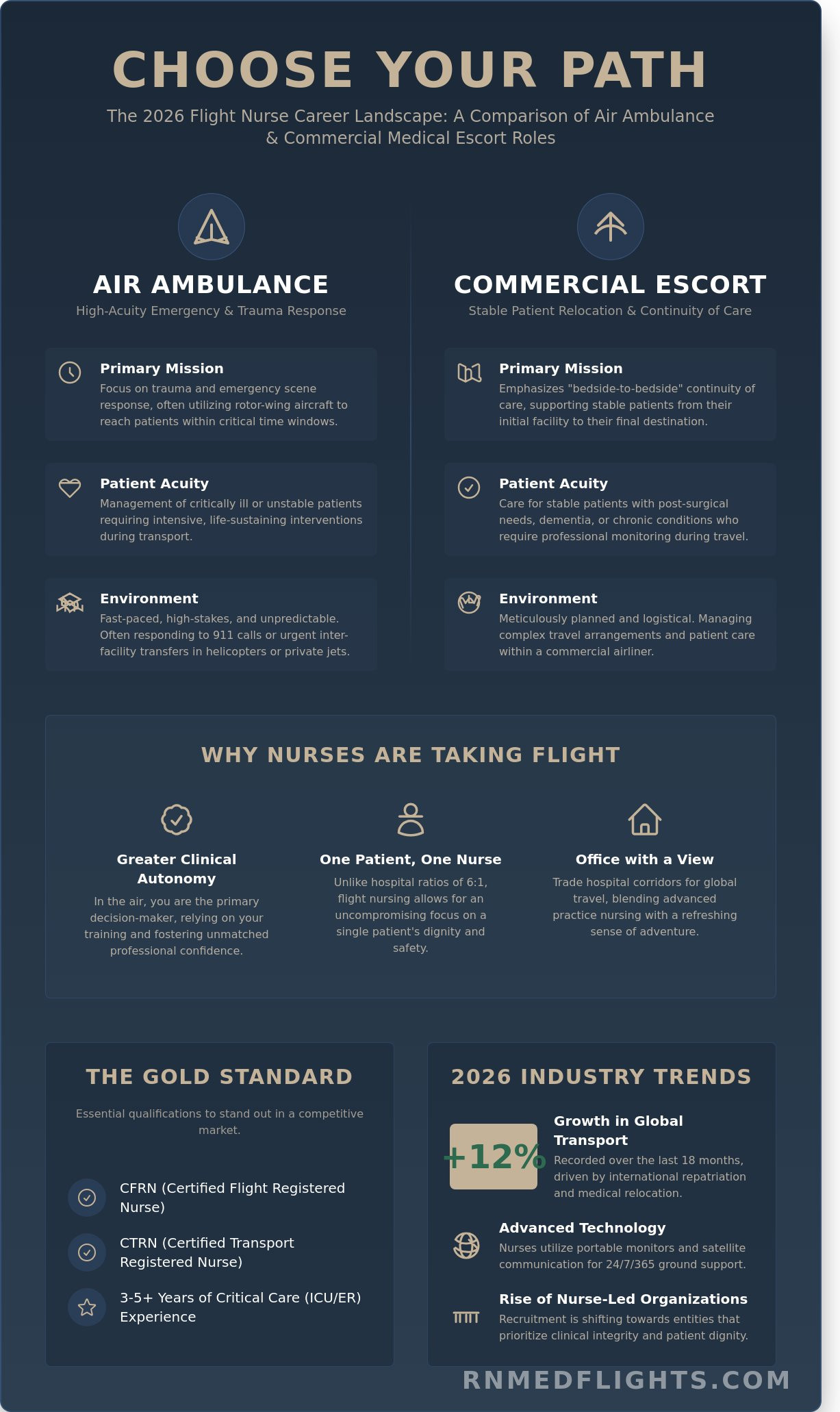
The recruitment landscape is shifting toward nurse-led and veteran-owned transport organizations. These entities prioritize clinical integrity over pure logistics. By 2026, technology has redefined the job description. Nurses now utilize advanced portable monitors and satellite communication systems that provide 24/7/365 connectivity to ground-based medical directors. International medical repatriation has become a primary hiring driver, with a 12% increase in global transport volume recorded over the last 18 months. This trend requires nurses who possess both clinical excellence and a deep understanding of international health regulations.
Why Nurses are Leaving the Bedside for the Clouds
Many registered nurses are moving away from traditional hospital environments to seek greater clinical autonomy. In the air, you're the primary decision-maker. You don't have a resident or a full code team down the hall; you rely on your training and your partner. This environment fosters a level of professional confidence that's difficult to find in a stationary unit.
The "one patient, one nurse" model is another significant draw. Unlike hospital settings where ratios might reach 6:1, flight nursing allows for uncompromising focus on a single individual. This dedication ensures the patient's dignity and safety are maintained throughout the entire journey. Additionally, the appeal of an "office with a view" and the opportunity for global travel provide a refreshing change of pace for those who've spent years within four windowless walls. It's a career path that offers a seamless blend of adventure and advanced practice nursing.
Choosing Your Path: Air Ambulance vs. Commercial Medical Escort
Deciding between air ambulance work and commercial medical escorting is the first step when reviewing flight nurse job openings. Each path offers a unique clinical environment and a distinct lifestyle. High-acuity air ambulance roles focus on trauma and emergency scene response, often utilizing rotor-wing aircraft to reach patients in critical windows. In contrast, commercial medical escorting focuses on stable patient relocation, international travel, and meticulous bedside-to-bedside care. Your choice will dictate whether you spend your shifts responding to 911 calls in a helicopter or managing complex logistics on a cross-continental flight. Both paths require a high level of clinical precision and the ability to work independently in an evolving environment.
The Clinical Scope of Commercial Medical Escorts
Commercial medical escorts provide a steady hand for patients who are stable but require professional monitoring during transport. You'll manage patients with dementia, post-surgical needs, or chronic conditions within the cabin of a commercial airliner. This role emphasizes "bedside-to-bedside" continuity, ensuring the patient is supported from their initial facility to their final destination. For a deeper look at these responsibilities, explore our medical escort service guide. The lifestyle often involves scheduled international trips, offering a predictable rhythm compared to traditional emergency services. It's a role that demands patience, coordination, and a deep sense of empathy for families during stressful transitions.
The High-Stakes World of Emergency Medevac
Emergency medevac is defined by the "Golden Hour" and the intense pressure of advanced life support (ALS) in confined spaces. This path typically requires 3 to 5 years of high-volume experience in a Level 1 trauma center or intensive care unit. Nurses must be prepared for 24-hour shifts and unpredictable scene responses where every second counts. To qualify for these competitive flight nurse job openings, obtaining your CFRN certification through the Board of Certification for Emergency Nursing is a standard requirement. It validates your specialized knowledge in flight physiology and critical care. This path is physically demanding and requires a vigilant protector's mindset to ensure safety at 10,000 feet. If you're ready to transition into a career that prioritizes clinical excellence and patient integrity, consult with our team to understand the high standards we maintain 24/7/365.
The lifestyle differences between these two paths are significant. Air ambulance crews often live near their base and work long, concentrated blocks of time, remaining on-call for immediate deployment. Commercial escorts may travel for several days at a time, navigating international airports and coordinating with ground transportation providers. Both roles require an uncompromising commitment to safety and the ability to remain calm when logistical challenges arise. Whether you prefer the adrenaline of a rotor-wing response or the complex coordination of an international repatriation, the flight nursing profession offers a rewarding way to use your clinical expertise outside the hospital walls.
Essential Qualifications for Flight Nurse Job Openings
Securing a position in the air medical field requires a transition from traditional bedside care to a highly autonomous, high-stakes environment. To be competitive for flight nurse job openings in 2026, you must meet the "Gold Standard" of clinical experience. Most leading transport programs require a minimum of 3 to 5 years of recent experience in a high-acuity setting, such as a Level I Trauma Center or a Cardiac Intensive Care Unit. This background ensures you have the clinical maturity to manage complex patients when you're thousands of feet in the air without a full hospital team for support.
The industry remains robust as healthcare needs evolve. According to the U.S. Bureau of Labor Statistics, the projected registered nurse job growth indicates a steady demand for specialized professionals who can bridge the gap between regional facilities and specialized care centers. Beyond clinical hours, a clean, unencumbered RN license is non-negotiable. You'll also need current certifications in Advanced Cardiovascular Life Support (ACLS) and Pediatric Advanced Life Support (PALS) before applying.
Physical and psychological readiness are equally vital. Aircraft have strict weight and height limitations to ensure safe weight-and-balance calculations; many programs cap clinician weight at 210 to 250 pounds including gear. Psychologically, you must demonstrate advanced stress management skills. Flight nurses operate in confined spaces, often under significant environmental pressure, requiring a calm, methodical approach to patient care that prioritizes safety and peace of mind.
The Must-Have Certifications in 2026
The Certified Flight Registered Nurse (CFRN) is the industry-standard board certification that validates a nurse's specialized knowledge in the flight environment. While the CFRN focuses on flight-specific physiology and safety, the Certified Transport Registered Nurse (CTRN) is tailored for those focusing on ground-based critical care transport. Many elite candidates first obtain their Critical Care Registered Nurse (CCRN) credential to build a strong theoretical foundation in hemodynamics and multisystem failure before pursuing flight-specific boards.
Soft Skills That Get You Hired
Success in this role depends on logistical problem-solving and emotional intelligence. When a commercial flight for a medical repatriation is delayed, a flight nurse must coordinate with the flight coordinator to adjust the bedside-to-bedside care plan without compromising patient safety. Cultural competency is also essential for international missions, as you'll navigate diverse healthcare systems and family expectations. You must provide empathetic communication, acting as a steady hand in a storm for families during their most vulnerable moments. Our teams are available 24/7/365, requiring nurses who are as committed to human dignity as they are to clinical precision.
How to Successfully Navigate Your Job Hunt
Securing a position in aeromedicine requires a transition from general nursing to a highly specialized mindset. You should begin by auditing your current clinical experience to ensure it aligns with the rigorous demands of flight transport. Most competitive flight nurse job openings require a minimum of 3 to 5 years of experience in high-acuity environments, such as a Level 1 Trauma Center or a Cardiothoracic ICU. This background ensures you possess the clinical autonomy needed to manage unstable patients in a confined aircraft cabin without the immediate support of a full hospital team. For a detailed roadmap of this transition, you can view our complete career guide for RNs.
Networking remains a cornerstone of the aeromedical community. You should join the Air & Surface Transport Nurses Association (ASTNA) to engage with mentors and stay informed on 2026 clinical standards. When you update your professional documents, optimize your resume for modern Applicant Tracking Systems (ATS) by integrating specific aeromedical keywords. Focus on terms like hemodynamic monitoring, mechanical ventilation, and CAMTS standards. These technical markers help your application move past digital filters and into the hands of a chief flight nurse who understands the value of your specialized skills.
Where to Find Active Flight Nurse Positions
Don't rely exclusively on general employment websites. While these platforms occasionally list roles, you'll find more success by visiting the career portals of transport companies directly. Finding the right flight nurse job openings often involves looking into niche sectors, including medical escort and international repatriation. You can find more leads by reviewing our guide on flight nurse positions. Always request a shadow day as part of your application process. Spending a full 12 hour shift with a flight crew allows you to witness the reality of the role, from pre-flight checks to patient handovers, ensuring the environment is the right fit for your career goals.
Nailing the Aeromedical Interview
The interview for a flight position is rarely a standard question and answer session. You should expect a scenario-based interview designed to test your clinical judgment under pressure. Be prepared to discuss complex ventilator management, RSI protocols, and the pharmacology of vasoactive drips in a high-altitude environment. You must demonstrate that you're calm under fire by providing concrete examples of past clinical crises you've managed successfully.
It's also essential to evaluate the organization's safety culture. Ask specific questions about their safety management systems and how they respect the pilot-in-command authority during weather-related "no-go" decisions. A professional flight program will value your focus on safety as much as your clinical expertise. This dialogue establishes you as a protector of both the patient and the crew, reflecting the integrity required for this elite nursing specialty.
If you are ready to take the next step in your professional journey, learn more about
.
Join the Team: Career Opportunities with RN MEDflights
Transitioning into flight nursing represents a significant career milestone for dedicated clinicians. RN MEDflights stands as a premier choice for those monitoring flight nurse job openings, offering a unique path within the commercial medical escort industry. Our organization operates under a nurse-led philosophy, ensuring that clinical integrity and patient dignity dictate every operational decision. We don't view our patients as mere passengers; they are individuals requiring continuous, sophisticated care during international medical repatriation missions.
Our nurses often cite the bedside-to-bedside care model as the most rewarding aspect of the job. This continuity of care allows you to remain with your patient from their initial hospital bed, through international airports, and finally to their destination facility. This end-to-end responsibility creates a profound bond between the nurse and the family, providing the "peace of mind" that defines our brand promise. You'll have the opportunity to see the world while saving lives, applying your critical care expertise in a dynamic, global environment.
The RN MEDflights Culture and Mission
As a veteran-owned and operated company, we instill a culture of discipline, precision, and excellence in every mission. We specialize in non-emergency medical relocation, which serves as a cost-effective alternative to traditional private jet medevacs. This focus allows us to help more families by utilizing commercial airline infrastructure while maintaining ICU-level standards of care. We provide comprehensive training for registered nurses transitioning into the role of commercial airline escorts, bridging the gap between hospital-based care and high-altitude clinical management.
Nurse-Centric Leadership: Decisions are made by clinicians who understand the complexities of patient care.
Global Reach: Our missions span across continents, requiring a deep understanding of international health regulations.
Professional Growth: We offer specialized training in flight physiology and international logistics.
What We Look For in Our Flight Nurses
We seek compassionate caregivers who possess the ability to manage complex international logistics without losing focus on patient comfort. You'll need advanced clinical skills and a "steady hand in a storm" personality to thrive in this role. RN MEDflights requires all flight nurses to maintain active licensure and specialized certifications to ensure uncompromising safety standards. We value nurses who can remain calm and professional while navigating the unpredictable nature of international travel.
If you're searching for flight nurse job openings that offer more than just a standard shift, our missions provide a profound sense of purpose. We operate 24/7/365 to ensure that no patient is left stranded during a medical crisis. Our team members are more than just employees; they are vigilant protectors of patient safety. Join a team where your medical expertise is the foundation of every journey and your compassion is the priority for every family we serve.
Launch Your Future in Flight Nursing Today
The 2026 medical transport landscape demands a sophisticated blend of technical expertise and empathetic care. Success in this field hinges on your ability to provide seamless transitions, especially as the global air medical services market is projected to grow by 9% annually through 2026. You've learned that securing competitive flight nurse job openings requires specialized certifications and a deep understanding of both air ambulance and commercial medical escort roles. Focusing on your clinical qualifications and navigating the job market with precision positions you for a role that offers true professional fulfillment.
RN MEDflights is a veteran-owned and nurse-led organization dedicated to uncompromising safety and patient dignity. We manage global operations 24/7/365, ensuring that every mission reflects our commitment to integrity and specialized care. Our focus on bedside-to-bedside continuity means we're looking for critical care professionals who treat every patient as a person, not just a case. If you're a registered nurse with the heart of a caregiver and the steady hand of a clinician, your next chapter starts here. We're ready to support your transition into this rewarding career path.
Explore Open Flight Nurse Positions with RN MEDflights
Frequently Asked Questions
What is the average salary for flight nurse job openings in 2026?
The average salary for flight nurse job openings in 2026 is projected to reach approximately $112,450 per year. This figure is based on Bureau of Labor Statistics data showing a 6 percent growth rate for specialized nursing roles through 2032. Compensation varies by state, with California and New York often offering packages exceeding $135,000 to maintain uncompromising clinical standards. These figures reflect the high level of expertise required for bedside-to-bedside care.
Do I need previous flight experience to apply for a flight nurse job?
You don't need previous flight experience to apply for most positions. Flight programs prioritize 3 to 5 years of high-acuity experience in an Intensive Care Unit or Emergency Department. We focus on your ability to provide seamless care during high-stress transitions. Once hired, you'll complete specialized flight physiology training and orientation to ensure patient safety. This training provides the specialized skills needed to manage patients in a unique transport environment.
What is the difference between a flight nurse and a travel nurse?
A flight nurse provides advanced life support during air transport, while a travel nurse works temporary contracts in various hospital settings. Flight nursing requires specialized certifications like the CFRN to manage patients in a pressurized cabin. Travel nurses typically fill staffing gaps for 13 week periods in stationary facilities. Our nurse-centric model ensures that flight nurses maintain a constant 24/7/365 readiness for critical missions, providing a steady hand during every transport.
How many years of ICU experience are required for flight nursing?
Most flight nurse job openings require a minimum of 3 years of recent experience in a Level I or Level II trauma center. This clinical foundation is vital because you'll operate as an independent practitioner in a confined space. Managers look for 4,000 hours of direct patient care in critical care environments. This ensures you can handle complex medical crises with the integrity and precision our patients deserve while maintaining their dignity.
Can I work as a flight nurse part-time or PRN?
You can work as a flight nurse on a part-time or PRN basis depending on the specific needs of the transport program. Approximately 20 percent of flight nursing roles are classified as per diem to allow for flexible scheduling. These positions still require the same uncompromising qualifications as full-time staff. PRN nurses help maintain our 24/7/365 availability, providing a reliable solution when mission volume increases or staff require relief.
What are the physical requirements for becoming a flight nurse?
Flight nurses must meet specific physical standards, including a weight limit that typically falls between 210 and 250 pounds including gear. You must demonstrate the ability to lift 75 pounds and maneuver in the restricted space of an aircraft. These requirements ensure the safety of the entire crew and the patient. Physical agility tests are mandatory every 12 months to confirm you can provide specialized care in any environment without compromise.
Is flight nursing safer than hospital nursing?
Flight nursing involves unique environmental risks, but strict adherence to CAMTS standards makes it a highly regulated and safe profession. While hospital nursing has high rates of back injuries and workplace violence, flight nursing focuses on rigid aviation safety protocols. We prioritize a culture of safety where every flight coordinator and clinician has the authority to decline a mission if conditions aren't perfect. This commitment protects our patients and our team.
How do I get my CFRN certification?
You obtain the Certified Flight Registered Nurse (CFRN) credential by passing a 150 question exam administered by the Board of Certification for Emergency Nursing. The exam costs $370 for non-members and requires a deep understanding of flight physiology and advanced life support. We recommend having 2 years of flight experience before sitting for the test. Achieving this certification demonstrates your specialized expertise and commitment to providing a stress-free experience for families.


