


How to Book a Commercial Stretcher Flight: A Step-by-Step Guide for Families
- May 4
- 12 min read
A private jet is not the only way to ensure your loved one receives high-quality medical care during transport. While private air ambulances often start at $50,000 for domestic routes, booking a commercial stretcher flight typically costs between $25,000 and $30,000, offering a sophisticated clinical solution at a significantly lower price point. We know you're likely feeling overwhelmed by the complexity of airline medical clearance and the rising costs of medical repatriation, which increased nearly 14% between 2023 and 2024. It's a heavy burden to manage these logistics while focusing on a family member's recovery.
At RN MEDflights, we understand that safety and peace of mind are your primary concerns. This guide provides the exact clinical and logistical steps required to secure a commercial airline stretcher for a bedridden but stable patient. You'll learn how to navigate the 10 day approval window, obtain the necessary "fit to fly" certification, and coordinate a nurse-supervised journey that prioritizes dignity and safety. We'll outline our uncompromising bedside-to-bedside process, showing you how to achieve a seamless, stress-free transfer without the need to manage multiple vendors yourself. Our goal is to provide the professional authority and medical expertise you need to bring your loved one home with absolute security.
Key Takeaways
Save up to 50% on international medical repatriation by choosing commercial stretcher services over private jet air ambulances.
Learn the specific clinical criteria for booking a commercial stretcher flight, including the requirements for the 10 day airline clearance window.
Understand how removing 6 to 9 seats creates space for an FAA-approved stretcher and a clinical environment within a standard cabin.
Follow a nurse-led, step-by-step roadmap that manages every logistical detail from the initial medical review to the final bedside destination.
Discover how our RN-led leadership and veteran-owned integrity ensure a seamless, bedside-to-bedside journey for your loved one.
Table of Contents What is a Commercial Stretcher Flight and How Does it Work? Determining Patient Eligibility for Commercial Stretcher Transport The Cost Advantage: Commercial Stretcher vs. Private Air Ambulance Step-by-Step: How to Book a Commercial Stretcher Flight in 2026 Why Families Choose RN MEDflights for Stretcher Services
What is a Commercial Stretcher Flight and How Does it Work?
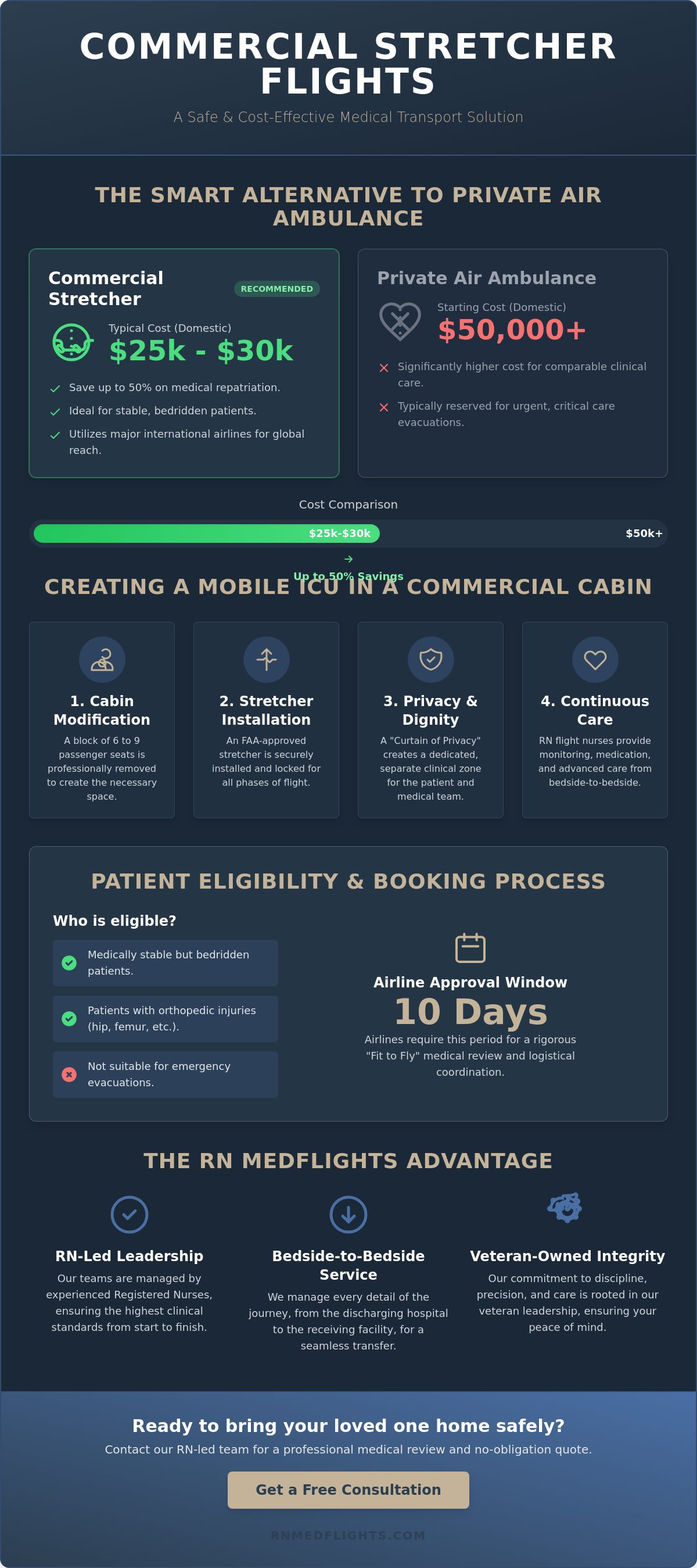
A commercial stretcher flight is a highly specialized configuration of a standard international airline cabin. It's designed to provide a safe, lying-down transport option for patients who are medically stable but cannot sit upright. When families begin the process of booking a commercial stretcher flight, they're often surprised to learn that this isn't just a reserved seat; it's a structural modification of the aircraft. This type of air medical services involves removing a block of six to nine seats to accommodate an FAA-approved stretcher installation. This setup provides a secure, level surface that remains locked in place through every phase of the journey, including takeoff and landing.
To ensure the patient's dignity, we utilize a specialized "Curtain of Privacy." This physical barrier separates the patient and medical team from the rest of the cabin, creating a dedicated clinical zone. Within this space, our flight nurses provide continuous monitoring and advanced care. We don't just watch over the patient; we manage every aspect of their well-being. This includes administering scheduled medications, performing hygiene care, and managing complex equipment like portable oxygen concentrators, suction units, and cardiac monitors. Every piece of equipment we bring on board is flight-certified and tailored to the specific clinical needs identified during our initial assessment.
Commercial Stretcher vs. Medical Escort
It's vital to understand the distinction between these two levels of care. A commercial stretcher is mandatory for bedridden patients who cannot sit upright for any portion of the flight, such as those with hip fractures, spinal injuries, or advanced neurological conditions. In contrast, a medical escort is appropriate for stable patients who can sit in a first-class or economy seat with assistance. When booking a commercial stretcher flight, our RN leadership determines the appropriate level of care based on a comprehensive review of the patient's current medical records and physical limitations.
The Clinical Environment on a Commercial Airliner
We maintain a "mobile ICU" standard by transforming a section of the commercial cabin into a sterile, high-functioning medical environment. Our team coordinates directly with airline ground crews to ensure priority boarding, which allows us to settle the patient and organize our equipment before other passengers arrive. We follow strict safety protocols for takeoff, turbulence, and landing, ensuring the patient remains secure and comfortable. This meticulous coordination between our medical team and the airline's flight deck ensures that the standard of care never wavers, regardless of the altitude or flight duration.
Determining Patient Eligibility for Commercial Stretcher Transport
The process of booking a commercial stretcher flight begins long before the aircraft leaves the tarmac. At RN MEDflights, our RN leadership conducts a rigorous "Fit to Fly" assessment to ensure the patient can safely tolerate the physiological stresses of flight, such as changes in cabin pressure and humidity. While many families assume a standard doctor’s note is sufficient, airline medical desks require a much higher level of clinical detail. They demand comprehensive medical reports that prove the patient is hemodynamically stable and doesn't require active ICU-level interventions during transit.
Stability is the cornerstone of airline clearance. For long-haul travel, we must demonstrate that the patient’s respiratory needs are managed and their cardiac status is predictable. Airlines typically require a 10 day window for medical review and approval; this makes the service unsuitable for emergency evacuations. We also navigate strict FAA regulations for medical stretchers regarding weight limits and the specific types of battery-operated equipment allowed on board. Every piece of life-support technology must be flight-certified to ensure it doesn't interfere with the aircraft’s navigation systems.
Common Qualifying Medical Conditions
Most patients who qualify for a commercial stretcher are those who are medically stable but physically unable to remain upright. This includes individuals with orthopedic injuries, such as hip, femur, or pelvic fractures, where immobilization is a clinical necessity. We also frequently assist patients with neurological conditions like a stable stroke or advanced dementia, where a supine position is required for safety and dignity. If a loved one requires continuous oxygen or monitoring and cannot sit for more than 4 hours, a stretcher is often the most compassionate choice. If you're unsure about your loved one's eligibility, our team can provide a preliminary clinical consultation to review their status.
When a Commercial Stretcher is Not an Option
Safety is our uncompromising priority. A commercial stretcher isn't a viable option for patients who are ventilator-dependent or require continuous, high-intensity ICU care. Airlines also prohibit passengers with highly infectious diseases or unstable psychiatric conditions that could jeopardize the safety of the crew and other travelers. If a patient's condition is volatile, the airline medical desk will deny clearance to prevent a mid-air diversion. In these complex cases, we always provide honest guidance to help families find the most appropriate level of care, even if it means recommending a private air ambulance instead. Our role is to ensure that the process of booking a commercial stretcher flight is only pursued when it's the safest path home.
The Cost Advantage: Commercial Stretcher vs. Private Air Ambulance
Managing the financial aspect of a medical crisis is often as stressful as the clinical care itself. While a private air ambulance is essentially a flying intensive care unit, its price reflects that exclusivity. Domestic private flights often exceed $50,000, and international missions can cost significantly more. In contrast, booking a commercial stretcher flight offers a strategic middle ground. By purchasing approximately eight seats on a scheduled airline, families can secure a professional medical environment for $25,000 to $30,000 on average. This choice represents a significant cost advantage without compromising the specialized care your loved one requires.
Why Commercial Options Save You Thousands
The primary driver of these savings is the elimination of "deadhead" costs. When you hire a private medevac jet, you often pay for the aircraft to fly empty to the patient's location and back to its home base after the mission. Commercial airlines already have their routes, crews, and fuel costs established. We simply leverage that existing infrastructure. Additionally, because we use wide-body commercial aircraft, more family members can travel on the same flight at standard ticket prices. This avoids the logistical headache and extra expense of booking separate travel for the support system.
Comparing the Two Options
A private air ambulance remains the necessary choice for emergencies, ICU-level needs, or transport from very remote locations where commercial hubs are unavailable. However, for stable patients requiring international medical repatriation services, the commercial stretcher is the gold standard for long-haul savings. Commercial flights often reach their destination faster than small medevac jets; they have larger fuel capacities and require fewer stops. This efficiency is especially relevant in Europe, where the cost of an air ambulance from the EU to the UK rose from approximately €15,000 in 2019 to as much as €30,000 in 2023.
When you receive a quote from RN MEDflights, it's a comprehensive, bedside-to-bedside figure. This includes ground ambulance transfers, airline fees, medical supplies, and the specialized nursing team. We also assist families in navigating medical air transport insurance claims. Given that the average cost of an air ambulance mission rose nearly 14% between 2023 and 2024, utilizing a commercial option is a prudent way to manage resources. Success in booking a commercial stretcher flight depends on this type of clinical advocacy combined with financial transparency.
Step-by-Step: How to Book a Commercial Stretcher Flight in 2026
The process of booking a commercial stretcher flight is a methodical clinical operation that requires precise timing and expert advocacy. It begins with a comprehensive medical assessment. Our flight nurse leadership reviews the patient's current medical records, including recent lab results and stability reports, to ensure they meet the airline's strict "fit to fly" criteria. This step is vital. We don't just look at the diagnosis; we evaluate how the patient will respond to the cabin environment over a long-haul journey. Once we confirm eligibility, we move into the logistical phase where the technical work of securing the aircraft begins.
The 48-72 Hour Approval Window
While the total lead time for these missions can reach 10 days, the most critical phase is the 48-72 hour window for airline medical desk approval. You cannot book a commercial stretcher last minute because the airline must physically remove seats and install the stretcher equipment. We handle the submission of the Medical Information Form (MEDIF) and provide the clinical summaries required by the airline's medical director. Our team speaks the language of the airline's clinical staff. We advocate for your loved one's specific needs, ensuring the airline understands the stability of the patient and the qualifications of our accompanying nurse. This reduces the risk of a late-stage denial that could disrupt your plans.
Coordinating Bed-to-Bed Logistics
Success depends on seamless continuity between the hospital bed and the aircraft. We manage every logistical gap, including ground ambulance synchronization. Our flight coordinator times the pickup to match the airline's specialized check-in requirements for stretcher passengers. We also secure tarmac access and navigate airport security protocols, which are significantly more complex for medical transfers. This ensures the patient is never left waiting in a public terminal or an unconditioned vehicle. We verify that the receiving facility is ready for the patient's arrival before the flight even departs, maintaining a constant pulse on the entire journey.
On the day of the flight, our nurse provides bedside-to-bedside care. This starts at the discharging facility and continues until the patient is safely settled in their final destination. We manage all medication administration, hygiene, and monitoring throughout the transit. If you need immediate assistance with your case, you can contact our flight coordinators 24/7/365 for a professional clinical review. We handle the complexities of booking a commercial stretcher flight so you can focus on being present for your family.
Why Families Choose RN MEDflights for Stretcher Services
Families facing a medical crisis need more than a logistics coordinator; they need a clinical advocate. RN Medflights stands apart as a nurse-owned and operated organization, which means medical expertise dictates every decision we make. Our veteran-owned status reinforces our commitment to integrity and transparent communication. We don't believe in "surprises" when it involves a loved one's safety. Our global reach extends across North America, Europe, and Asia, providing families with a sophisticated medical escort service or stretcher configuration wherever the need arises.
The process of booking a commercial stretcher flight requires a level of detail that only a medically-led team can provide. We act as your vigilant protector, managing the complex intersection of aviation law and clinical care nursing. Because we operate 24/7/365, we're always available to lower the emotional temperature of a high-stress situation. We provide clear, declarative statements about the next steps in your journey, ensuring you feel supported from the first phone call to the final handover.
Our Bedside-to-Bedside Guarantee
Our signature promise is continuity of care. The patient never leaves the supervision of a licensed healthcare professional from the moment we arrive at the origin hospital until they're safely settled in their destination bed. Our flight nurses manage all clinical needs, including medication administration, wound care, and hygiene, while maintaining the patient's dignity within the commercial cabin. We also prioritize the family's emotional well-being. We provide regular updates throughout the transit, ensuring you're never left wondering about the status of your loved one. This level of personalized, nurse-led care is why families trust us for booking a commercial stretcher flight during their most vulnerable moments.
Request Your Comprehensive Quote Today
Preparing for a medical transport requires gathering specific clinical data to ensure a safe journey. When you speak with our flight coordinator, please have the patient's current medical status, their current location, and the final destination facility ready. We use this information to build an all-encompassing solution that covers ground ambulance transfers, airline coordination, and specialized nursing care. You can Request a Quote for Medical Flight Transport through our secure portal to begin the clinical review process. We're here to provide the steady hand and medical expertise necessary to bring your loved one home safely.
Securing a Safe and Dignified Path Home
You now have the clinical and logistical framework required to bring your family member home safely. By choosing a commercial stretcher, you're opting for a specialized solution that balances advanced medical care with significant financial responsibility. We've established that this path provides a stable, nurse-supervised environment while avoiding the high costs associated with private jet transport. The process of booking a commercial stretcher flight is complex, but it doesn't have to be a source of distress for your family.
Since 2010, our veteran-owned and nurse-led team has served as a steady hand for families during these critical transitions. We provide uncompromising clinical oversight, managing everything from the rigorous airline medical clearance to the final bedside-to-bedside handover. Our dedicated flight coordinators are available 24/7/365 to begin your clinical review and ensure every detail of the journey is handled with precision and heart. You don't have to manage these logistics alone.
Book Your Bed-to-Bed Commercial Stretcher Flight Today and gain the peace of mind that comes with expert medical advocacy. Your loved one's safety and dignity are our highest priorities, and we're ready to guide you through every step of the journey home.
Frequently Asked Questions
How much does a commercial stretcher flight cost?
A commercial stretcher flight typically costs between $25,000 and $30,000. This price includes the purchase of approximately eight airline seats to accommodate the stretcher installation and medical team. It's a cost-effective alternative to private air ambulances, which often exceed $50,000 for domestic missions. Our quotes are all-inclusive, covering ground ambulance transfers, airline fees, and professional nursing care.
Which airlines offer commercial stretcher services?
Most domestic US airlines don't offer stretcher services; availability is primarily limited to international long-haul carriers. Major airlines in Europe, Asia, and the Middle East frequently provide these specialized configurations on wide-body aircraft. Because availability depends on specific aircraft types and routes, our coordinators verify current carrier options and equipment compatibility during your initial clinical consultation.
Can a family member fly with the patient on a stretcher flight?
Yes, family members can usually travel in the same cabin as the patient. While the stretcher and medical team occupy a specific block of seats, we can book additional seats nearby for loved ones. This proximity provides essential emotional support for the patient. We coordinate these travel arrangements simultaneously to ensure the entire support system stays together throughout the journey.
What is the difference between a medical escort and a stretcher flight?
The primary difference is the patient's physical ability to sit upright. A medical escort is appropriate for stable patients who can sit in a standard or first-class seat for the entire trip. A stretcher flight is mandatory for bedridden patients who must remain supine due to injuries like hip fractures or neurological conditions. Our RN leadership determines the safest level of care during our assessment.
How long does it take to arrange a commercial stretcher flight?
Arranging these flights is a methodical process that can take up to 10 days for final approval. This duration is necessary for airline medical desks to review the "fit to fly" certificate and for ground crews to reconfigure the cabin. We manage this entire timeline, advocating for a swift approval while ensuring every clinical detail meets the carrier's uncompromising safety standards.
Is medical equipment like oxygen provided on the flight?
We provide all necessary flight-certified medical equipment, including portable oxygen concentrators, suction units, and cardiac monitors. Every piece of technology we use must meet strict aviation regulations to ensure it doesn't interfere with aircraft navigation. We handle the logistics of battery management and oxygen flow rates to ensure the patient receives continuous, high-quality care during the transit.
Will insurance or Medicare pay for a commercial stretcher flight?
Medicare and Medicaid generally don't cover international medical repatriation or commercial stretcher services. However, private travel insurance policies often provide coverage if the transport is deemed medically necessary. We recommend reviewing your specific policy's benefit limits. Our team provides the detailed clinical documentation and itemized receipts required to support your insurance claim once the journey is complete.
What happens if the patient's condition changes before the flight?
Our medical team monitors the patient's status up until the moment of departure. If the patient's condition deteriorates, we'll consult with the airline's medical director to decide the safest course of action. Airlines will refuse transport for unstable patients to avoid mid-air diversions. We'll guide you through the process of booking a commercial stretcher flight once the patient reaches the necessary clinical stability.
