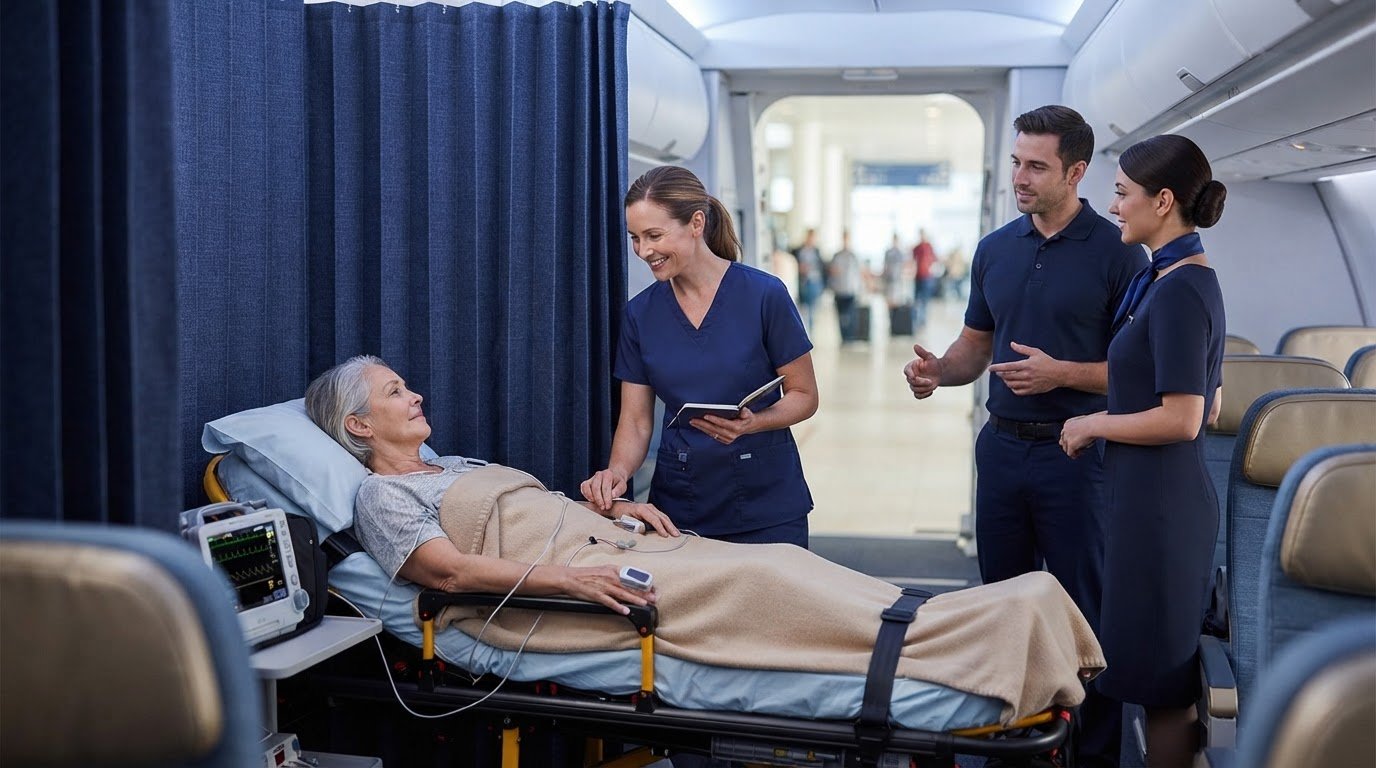
How to Transport an Elderly Parent Across the Country Safely
Updated: Mar 20
Last Tuesday, Sarah in Chicago discovered that moving her 82-year-old father from Phoenix wasn't just a matter of booking a flight; it was a high-stakes clinical operation. She faced the daunting reality of managing his stage two dementia and limited mobility across 1,700 miles of travel. Learning how to transport elderly parent across country shouldn't feel like a gamble with their health or their dignity. You likely feel the same weight of responsibility right now. It's natural to worry about a fall in a crowded terminal or how to handle a medical episode at cruising altitude. You want the assurance that your parent is protected by expert hands every step of the way.
This guide provides a comprehensive roadmap for long-distance medical transport. We'll show you how to secure professional, bedside-to-bedside care that often costs 50% less than a private air ambulance while maintaining 100% of the clinical safety. We'll break down the logistical steps of medical escorts, compare transparent pricing models, and explain how our RN-led teams manage everything from medication schedules to incontinence with quiet, professional grace. You'll gain the clarity needed to transition your loved one safely without the crushing stress of handling the logistics alone.
Key Takeaways
Evaluate the critical differences between ground and air transport to determine the safest and most dignified mode of travel for distances exceeding 500 miles.
Learn the clinical criteria used to determine how to transport elderly parent across country safely, including the vital "fit to fly" assessment and managing respiratory health at altitude.
Master the logistics of bedside-to-bedside care, a specialized approach that manages every transition to ensure uncompromising safety from the old residence to the new home.
Discover compassionate strategies for managing specialized needs like dementia and mobility issues, designed to minimize stress and prevent sundowning during long travel days.
Identify why a nurse-led medical escort provides the clinical expertise and steady hand needed to handle mid-air emergencies and logistical complexities with total confidence.
Table of Contents Comparing Long-Distance Transport Options: Ground vs. Air Clinical Readiness: Is Your Parent "Fit to Fly"? The Bed-to-Bed Journey: Managing the Logistics Specialized Care for Dementia, Mobility, and Incontinence Why a Nurse-Led Commercial Escort is the Safest Solution
Comparing Long-Distance Transport Options: Ground vs. Air
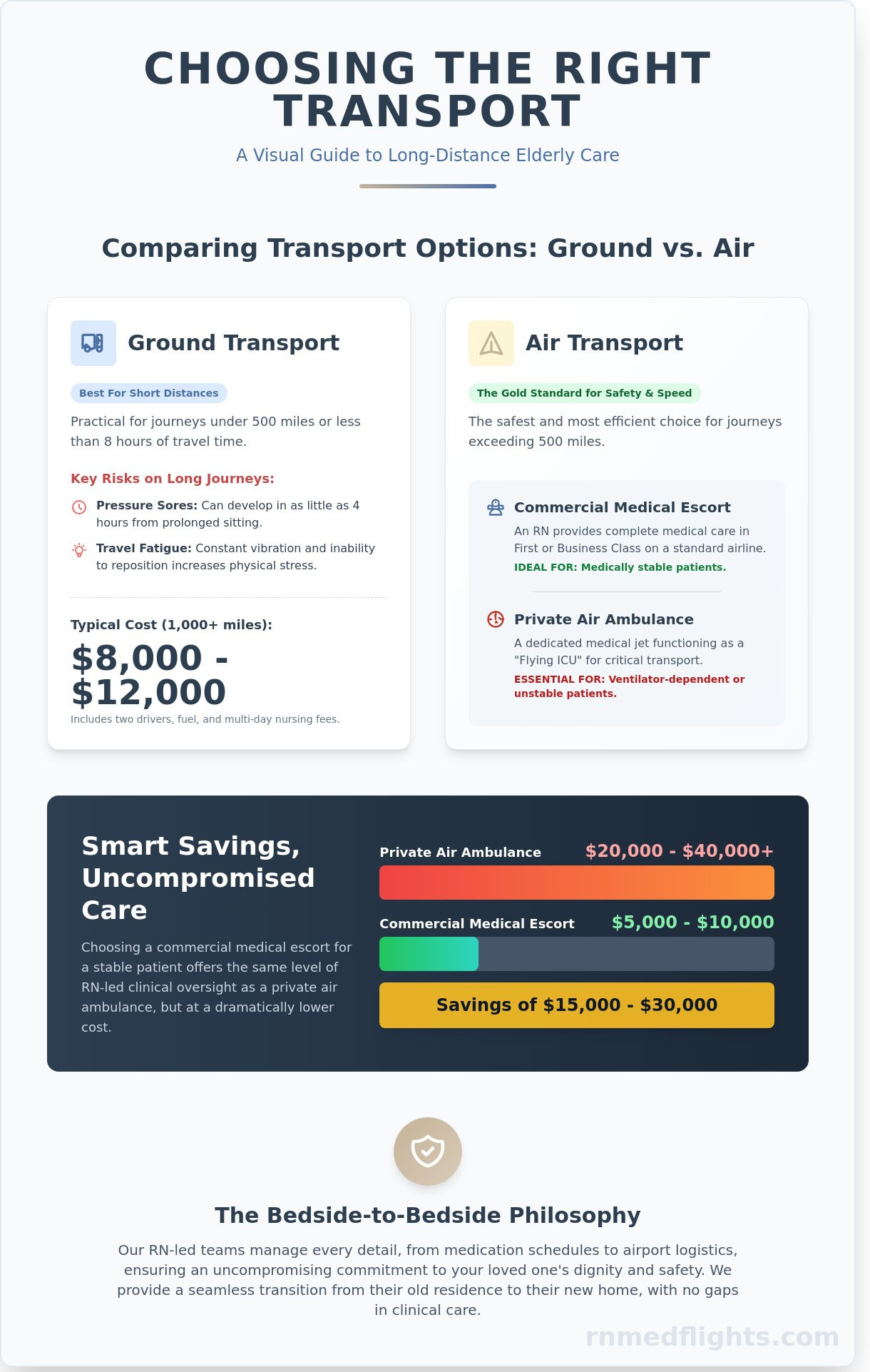
Deciding how to transport elderly parent across country requires a clinical assessment of their physical stamina and medical stability. For distances under 300 miles, ground transport is often practical. However, once a journey exceeds the 500-mile threshold, the physiological toll on a frail senior increases exponentially. Our flight coordinators often see families underestimate the "hidden" stressors of the road, such as constant vehicle vibration, frequent stops, and the inability to change positions. These factors can lead to rapid decline in patients with dementia or heart conditions.
Professional medical supervision provides a safety net that family-led transport cannot replicate. While a family member might miss the subtle signs of dehydration or a brewing respiratory issue, a Registered Nurse monitors vital signs and manages medications in real-time. This level of care ensures the patient arrives at their destination stable and comfortable, rather than exhausted and requiring immediate hospitalization. We focus on a bedside-to-bedside philosophy, ensuring no gap in care exists during the transition between facilities or homes.
Non-Emergency Medical Transport (NEMT) via Ground
Ground NEMT typically involves an ambulette or a specialized medical RV. These vehicles are suitable for shorter, regional trips where the total travel time stays under eight hours. When a drive stretches to 12 or 24 hours, the risks of "travel fatigue" and "pressure sores" become critical concerns. Seniors have thinner skin and reduced circulation; sitting in one position for a cross-country haul can cause stage II pressure ulcers in as little as four hours.
Families are often surprised to learn that ground transport for 1,000 miles or more frequently costs $8,000 to $12,000 due to the need for two drivers, fuel, and multi-day nursing fees. You can explore various Ambulance transport options to see the different levels of equipment available for ground moves. In many cases, this price point actually exceeds the cost of a commercial air escort while providing a lower standard of comfort.
Air Travel: Commercial Medical Escort vs. Private Air Ambulance
When determining how to transport elderly parent across country, air travel is the gold standard for safety and speed. There are two primary avenues for air transport:
Commercial Medical Escort: This service utilizes standard airlines. An RN accompanies the patient in first or business class, providing medical monitoring, hygiene assistance, and medication management. It's the most cost-effective professional option for stable patients.
Private Air Ambulance: This is a dedicated medical jet, essentially a flying ICU. Private charter companies like FlyEliteJets can arrange these flights, which are necessary for patients who are ventilator-dependent, require continuous IV drips, or cannot sit upright for any period.
The cost difference is substantial. Choosing a commercial medical escort can save a family between $15,000 and $30,000 compared to a private air ambulance. For a patient who is medically stable enough to fly commercially, the escort service provides the same high level of RN-led clinical oversight while significantly reducing the financial burden. Our team remains available 24/7/365 to evaluate which flight level is appropriate for your loved one's specific diagnosis, ensuring an uncompromising commitment to their dignity and safety.
Clinical Readiness: Is Your Parent "Fit to Fly"?
Fit to fly is a clinical status requiring stable vital signs, a controlled medical condition, and a formal physician sign-off to ensure the patient can withstand the physiological stresses of flight. Determining this status is the first critical step in learning how to transport elderly parent across country. Airlines mandate this clearance because the environment inside a pressurized cabin differs significantly from a ground-level hospital room or residence.
Aviation medicine experts focus heavily on "Cabin Altitude" effects. Most commercial aircraft maintain a cabin pressure equivalent to an altitude of 6,000 to 8,000 feet. At these heights, the partial pressure of oxygen drops. While a healthy adult might not notice the change, an elderly patient with underlying respiratory or cardiac conditions may experience a 10% to 15% decrease in blood oxygen saturation. Physicians utilize established fit to fly guidelines to evaluate if a patient's cardiovascular system can handle this decreased atmospheric pressure without entering distress.
The role of a Flight Nurse involves performing a pre-trip clinical assessment that goes beyond a standard checkup. They analyze the patient’s recent medical history, looking for triggers that could lead to an in-flight emergency. This proactive approach ensures that every potential risk is mitigated before the patient ever reaches the airport tarmac.
The Pre-Flight Medical Assessment
We start by auditing hospital discharge summaries and medication administration records (MARs) from the last 72 hours. Mobility is a non-negotiable metric. We verify if the patient can tolerate a seated position for a 4 to 6-hour cross-country flight or if they require a specialized stretcher configuration. If your parent uses supplemental oxygen, we ensure they have an FAA-approved Portable Oxygen Concentrator (POC). These devices must have a battery life that covers 150% of the total flight time to account for any unexpected ground delays.
Coordinating with Primary Physicians
RN Medflights works directly with your parent's current attending physician to secure formal medical clearance. We bridge the communication gap between the hospital and the airline's medical desk. This coordination results in a "Letter of Medical Necessity," which is a vital document for securing airline priority boarding and justifying the presence of specialized medical equipment. It's a precise process that eliminates guesswork for the family.
Many families worry that their parent is too frail to move across the country. We address this concern by comparing the stressors of different travel modes. A 5-hour flight with a dedicated nurse is often significantly safer and less exhausting than a 3-day ground journey in a van or ambulance. Our team provides bedside-to-bedside coordination to ensure that even the most vulnerable patients remain stable and comfortable throughout the transition. We focus on maintaining clinical integrity from the moment we leave the first bedside until the patient is safely tucked into their new home.
The Bed-to-Bed Journey: Managing the Logistics
Understanding how to transport elderly parent across country involves more than booking a ticket; it's a commitment to a "bed-to-bed" model of care. This clinical standard ensures that your loved one is never without professional supervision. We take full responsibility from the moment we arrive at the current residence until the patient is safely settled in their new home. This continuity is vital because the "seams" of the journey, those moments when a patient moves from a bed to a stretcher or a car to a plane, represent the highest risk for medical errors. Research from the Joint Commission indicates that 80% of serious medical incidents involve a breakdown in communication during these transitions. Our model eliminates these gaps by keeping the same medical team by your parent's side for the entire duration. This chain of custody provides a psychological safety net for the family, knowing that a single expert is accountable for every heartbeat and breath.
The logistics of ground ambulance coordination are handled with surgical precision. We sync with local providers at both the departure and arrival cities to ensure wait times on the tarmac or at the gate never exceed 15 minutes. Navigating airport security with a medical patient requires specialized knowledge of federal regulations. We utilize the TSA Cares program, which requires a 72-hour advance coordination. This allows our team to move through security checkpoints with medical equipment, such as Portable Oxygen Concentrators (POCs) and specialized monitors, without disrupting the patient's comfort or dignity. Our flight coordinators also verify that all medical devices have FAA-approved battery life, typically requiring 150% of the scheduled flight time to account for potential delays on the runway.
Ground-to-Air Transitions
Coordinating the hand-off between the ground ambulance and the flight nurse is a choreographed event designed to minimize stress. At major international airports like Hartsfield-Jackson or LAX, we often utilize high-lift vehicles or specialized medical elevators to board the aircraft. This prevents the need for the patient to navigate steep stairs or narrow jetways. By maintaining a calm, controlled environment during this shift, we reduce the risk of anxiety spikes in patients with cognitive impairments. Our flight nurses conduct a full head-to-toe assessment at the terminal meeting point before the patient ever crosses the threshold of the plane. Our goal is a transition so smooth it feels like a single, continuous movement rather than a series of disconnected steps.
Ensuring the arrival portion of the journey is just as seamless is crucial, especially if the destination is a major hub. For families arranging transport into South Florida, for example, it's wise to pre-arrange high-quality ground transportation. You can explore Airport Transfers (MIA, FLL, PBI) to see how professional car services coordinate with airport arrivals to provide a comfortable and dignified final leg of the journey.
In-Flight Care and Monitoring
At an altitude of 30,000 feet, the physiological needs of an elderly patient change significantly. Cabin humidity often drops below 15%, which can lead to rapid dehydration and respiratory distress. Our flight nurses monitor vital signs, including oxygen saturation and blood pressure, every 30 minutes to ensure stability and catch any subtle changes before they become emergencies. They manage all medication schedules and nutritional needs while acting as a vigilant advocate for the patient. If the cabin becomes too cold or the noise level too high, the nurse works directly with the airline crew to adjust the environment. This level of specialized attention is why families choosing how to transport elderly parent across country trust a nurse-led approach for total peace of mind. We don't just provide a seat; we provide a mobile clinical environment.
Specialized Care for Dementia, Mobility, and Incontinence
Transporting a parent with advanced health needs requires more than just a ticket; it demands a clinical strategy that prioritizes safety and emotional stability. When families research how to transport elderly parent across country, they often encounter the complex reality of managing cognitive decline and physical frailty in high-pressure transit environments. According to the CDC, roughly 5.8 million Americans lived with Alzheimer's in 2020, and for these individuals, the disruption of a cross-country move can trigger profound distress.
Long travel days often lead to "sundowning," a phenomenon where confusion and agitation intensify during the late afternoon and evening hours. This state is particularly difficult to manage in a crowded airport or a pressurized cabin. Professional medical escorts use de-escalation techniques to manage cognitive distress in-flight. These methods involve low-stimulation communication and sensory grounding to keep the patient calm. Maintaining dignity during these journeys is equally vital, especially regarding incontinence. We implement discreet, scheduled care every 2 to 3 hours to prevent skin breakdown and ensure the patient remains comfortable without drawing public attention to their needs.
Dementia-Friendly Travel Protocols
A calm, authoritative clinical presence acts as a "secure base" for a confused patient. Family members often struggle to manage these behaviors alone because the emotional bond can sometimes escalate a patient's frustration. Our nurses utilize distraction therapy, using familiar tactile objects like a specific photo album or a soft blanket, to redirect focus during the loud, vibrating moments of takeoff and landing. This methodical approach reduces the risk of a "flight or fight" response in the cabin.
Mobility and Physical Weakness
For patients who cannot stand or walk, the logistics of boarding require precision. We utilize specialized aisle chairs, also known as Washington chairs, which are engineered at approximately 16 inches wide to navigate the narrow passages of a commercial aircraft. Transfer anxiety is a significant hurdle for patients with physical weakness. Our team manages this by using specific pivot and lift techniques that ensure the patient feels physically supported and secure during the transition from a wheelchair to their seat.
Bedside-to-Bedside Responsibility: We handle every transfer, from the initial bed to the final destination, ensuring no gaps in care.
Pressure Injury Prevention: Nurses utilize specialized cushions and frequent repositioning to protect fragile skin during 4 to 6-hour flights.
Hydration Monitoring: We track fluid intake meticulously, as dehydration can rapidly worsen cognitive confusion in the elderly.
24/7/365 Coordination: Our flight coordinators are available at all times to adjust logistics if a patient's condition changes.
Managing the intersection of physical frailty and cognitive decline requires a level of vigilance that goes beyond standard travel assistance. It's about creating a "clinical bubble" around the patient, protecting them from the chaos of the travel environment. If you're concerned about how to transport elderly parent across country while maintaining their dignity and health, our bedside-to-bedside medical escort services offer the professional expertise necessary for a seamless transition. Our nurses are trained to anticipate needs before they become crises, providing your family with the peace of mind that your loved one is in expert hands.
Why a Nurse-Led Commercial Escort is the Safest Solution
Deciding how to transport elderly parent across country involves more than just booking a flight; it requires a comprehensive clinical strategy. RN MEDflights provides a specialized service where a licensed flight nurse manages every physiological and logistical detail of the journey. This isn't merely travel assistance. It's a mobile care environment adapted for commercial aviation. A flight nurse brings a minimum of five years of critical care experience to the cabin, ensuring that any physiological change, such as a drop in oxygen saturation or a sudden spike in blood pressure, is met with immediate clinical intervention.
The presence of a registered nurse transforms the travel experience from a high-risk event into a managed medical procedure. While a family member might struggle to identify the subtle signs of respiratory distress or cognitive fatigue, an RN uses objective data to guide care. They maintain a constant vigil, monitoring vital signs and managing the "medical suitcase" of emergency supplies. This professional oversight eliminates the guesswork, providing a level of safety that a standard travel companion simply cannot offer.
Beyond the clinical benefits, there's a profound psychological shift for the family. When you hire a professional escort, you stop being the "transporter" and return to your role as a daughter or son. You can focus on providing emotional support and comfort while the nurse handles the medication schedules, airport security protocols, and airline communications. This transition reduces the emotional temperature of the relocation, allowing for a dignified and calm transition to a new home or facility.
The Expertise of a Flight Registered Nurse (RN)
RN MEDflights employs nurses with Advanced Life Support (ALS) training and extensive backgrounds in ICU or ER settings. This expertise is vital because the pressurized cabin environment affects the body differently than ground-level care. The nurse manages a specialized medical kit containing diagnostic tools and emergency medications tailored to the patient's specific needs. Unlike a non-medical "travel companion" who can only offer basic assistance, an RN is legally and clinically qualified to administer medications and perform life-saving interventions mid-air.
Getting Started with RN MEDflights
The process begins with a detailed clinical consultation to build a customized transport plan. Our flight coordinators review the patient's current medical status and destination requirements to ensure a seamless transition. We provide transparent, all-inclusive pricing for our bedside-to-bedside service, covering everything from ground ambulance coordination to airline ticketing. To begin your journey, you can request a personalized medical transport quote from our flight coordinators 24/7/365.
Final Relocation Checklist for Families:
Obtain a "Fit to Fly" letter from the primary physician dated within 72 hours of departure.
Ensure a 48-hour buffer supply of all maintenance medications is packed in the carry-on bag.
Confirm the receiving facility or residence is prepared for the specific hour of arrival.
Pack a small "comfort kit" with familiar items, such as a favorite sweater or family photos.
Verify that all legal documents, including Power of Attorney and DNR orders, are easily accessible.
Choosing the right professional support is the most effective way to solve the challenge of how to transport elderly parent across country without compromising their health. With RN MEDflights, the journey is defined by uncompromising safety and clinical integrity, ensuring your loved one arrives at their destination stabilized, comfortable, and ready for their next chapter.
Ensure a Safe and Dignified Journey Home
Choosing the right path for a senior's relocation requires balancing clinical needs with logistical precision. You've seen how air travel can reduce transit time by 80% compared to long-distance driving, which is vital for patients with limited stamina. Success depends on a comprehensive "Fit to Fly" evaluation and a seamless bedside-to-bedside transition. Mastering how to transport elderly parent across country means looking beyond the flight and focusing on the specialized care required for dementia or mobility challenges.
RN Medflights offers a steady hand through our veteran-owned and operated service. Our medical teams are 100% RN-led, ensuring that every patient receives professional clinical monitoring throughout their entire trip. With 24/7/365 global availability, our flight coordinators handle every detail so you don't have to manage the stress of a medical crisis alone. We're committed to delivering uncompromising safety and peace of mind for your family.
Your parent deserves a journey defined by dignity and expert care, and we're here to make that a reality.
Frequently Asked Questions
How much does it cost to transport an elderly parent across the country?
Transporting an elderly parent across the country typically costs between $3,500 for a commercial medical escort and $25,000 or more for a private air ambulance. These rates depend on the 2,500 mile distance and the specific clinical care required. A flight coordinator provides a fixed, all-inclusive quote that covers bedside-to-bedside logistics; this ensures there aren't any hidden fees during the journey.
Can I fly with my parent if they have dementia or Alzheimer’s?
Yes, you can fly with a parent who has dementia or Alzheimer’s, provided they have a specialized medical escort to manage potential agitation or sundowning. Our RNs use specific de-escalation techniques and clinical protocols to maintain a calm environment. Since 1 in 9 seniors over age 65 live with Alzheimer's, we've developed standardized care plans to ensure their dignity and safety throughout the entire 5 hour or 6 hour flight.
What is the safest way to move a bedridden senior long distance?
The safest way to move a bedridden senior long distance is through a commercial stretcher service or a private air ambulance equipped with advanced life support. This approach ensures the patient remains supine and stable, preventing pressure sores or respiratory distress. When you're learning how to transport elderly parent across country, prioritizing a bedside-to-bedside transition minimizes the physical strain of multiple transfers between vehicles. Our nurses handle every movement.
Does Medicare or private insurance cover the cost of medical escorts?
Medicare and most private insurance providers generally don't cover the cost of non-emergency medical escorts or long-distance relocations. Medicare Part B only pays for emergency transport to the nearest appropriate facility. Statistics show that 90% of families pay for these specialized services out-of-pocket. Some long-term care insurance policies may offer partial reimbursement for medically necessary transfers, so it's vital to review your specific policy documents first.
What happens if there is a medical emergency during the flight?
If a medical emergency occurs during the flight, our Registered Nurses are trained in Advanced Cardiovascular Life Support (ACLS) to provide immediate intervention. They carry specialized medical kits containing emergency medications and diagnostic tools. Our flight coordinators also maintain 24/7/365 communication with a medical director to adjust care protocols in real time. We monitor vitals every 15 to 30 minutes to catch any clinical changes before they become critical.
How far in advance do I need to book a medical escort service?
You should ideally book a medical escort service 7 to 10 days in advance to secure the best airline rates and flight schedules. However, we can often coordinate bedside-to-bedside transport in as little as 48 to 72 hours for urgent situations. This timeline allows our team to complete a full clinical assessment and obtain necessary medical clearances. We handle the paperwork with the airline's medical desk to ensure a seamless boarding process.
Can my parent use their own oxygen tank on a commercial flight?
Passengers can't use their own liquid or compressed oxygen tanks on commercial flights due to FAA safety regulations. Instead, your parent must use an FAA-approved Portable Oxygen Concentrator (POC) or the airline's onboard oxygen system. Our team manages this requirement by verifying that the device battery life exceeds the flight duration by 150%. This 1.5x safety margin ensures a continuous supply of oxygen even if there are runway delays.
What is the difference between a medical escort and an air ambulance?
A medical escort accompanies a stable patient on a commercial flight, while an air ambulance is a private aircraft configured as a flying ICU. Choosing between them is a critical step in how to transport elderly parent across country safely. Air ambulances provide 100% control over the environment and schedule; they're necessary for patients who require ventilators or continuous intravenous infusions that commercial airlines simply won't accommodate.