International Medical Escort Cost: What Shapes the Price
There’s no single fixed cost for an international medical escort. The cost of an international medical escort depends on the patient’s medical needs and travel plan, including the level of clinical support, flight arrangements, equipment, and ground transport. A case-specific price is provided after a quote request.
It’s understandable to want a clear figure when you’re arranging care across borders. But two journeys to the same destination can involve different requirements, from whether the patient can travel seated to whether airline approval is needed for oxygen or other equipment.
This article explains how the patient’s medical needs and travel arrangements affect the cost of an international medical escort. It also outlines what to consider when deciding whether commercial air travel is suitable and planning the journey.
Table of Contents
How Much Does a Medical Escort Cost?
There’s no single fixed rate for an international medical escort. The estimate reflects the patient’s clinical needs, route, staffing, and travel arrangements.
Factors Affecting Escort Pricing
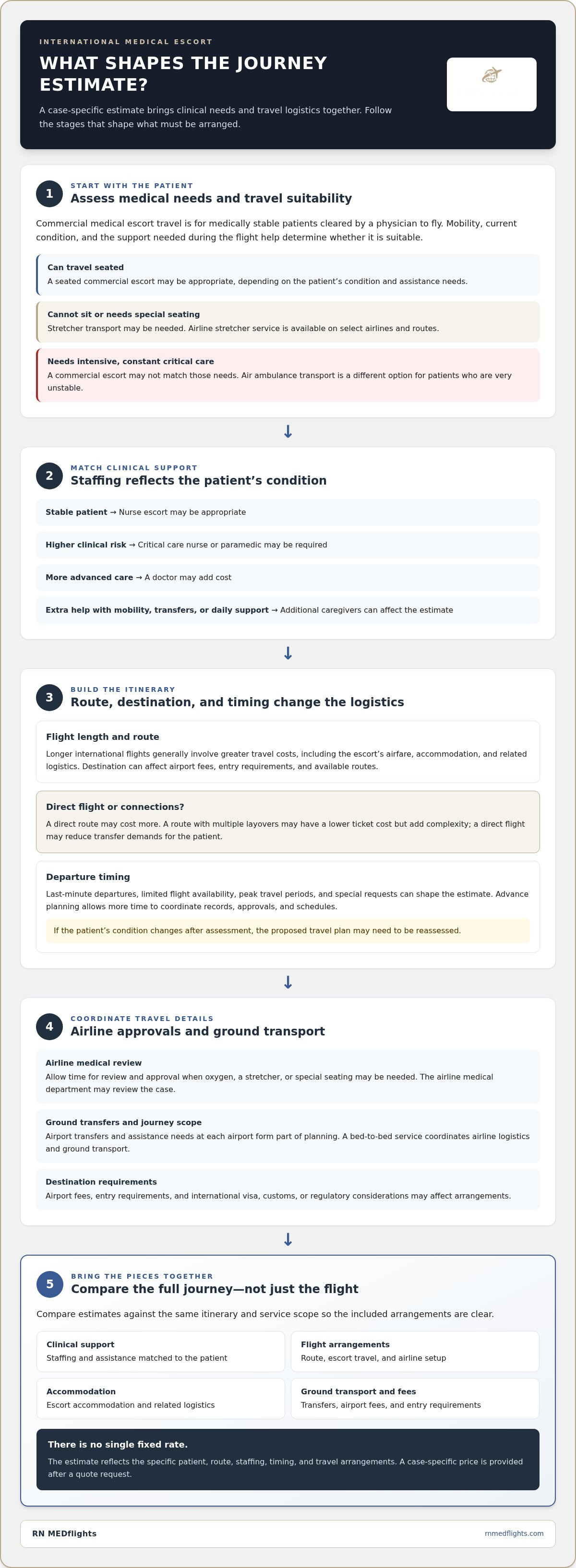
Escort pricing reflects the clinical support and travel logistics required for a particular journey. This matters because a nurse accompanying a stable patient may involve different arrangements from a trip requiring a doctor or additional caregivers. The cost of international medical escort services also changes with distance, destination, and transport type. A commercial stretcher journey usually costs more than a seated escort because it requires a different airline setup.
Timing Considerations
Timing affects how easily flights, staff, and ground transfers can be coordinated. This matters because a last-minute departure or limited flight availability can increase costs, while advance planning allows more time to coordinate records, approvals, and schedules. Peak travel periods and special requests may also shape the estimate. If a patient’s condition changes after assessment, the proposed travel plan may need to be reassessed.
The itinerary is a major part of the estimate. Longer international flights generally involve greater travel costs, including the escort’s airfare, accommodation, and related logistics. Destination also matters: airport fees, entry requirements, and available flight routes differ between locations. A route with several connections may add complexity, even when its ticket costs less than a direct flight.
Clinical needs influence both staffing and travel planning. A stable patient may need a nurse escort, while higher clinical risk may require a critical care nurse or paramedic. A doctor may add cost when the patient needs more advanced care. Additional caregivers can also affect the estimate when the patient needs more assistance with mobility, transfers, or daily support during the journey.
Transport type changes the arrangement. A patient who can travel seated may be suited to a commercial medical escort, while someone unable to sit may need stretcher transport. An air ambulance is a different transport option for patients who are very unstable and need an air ambulance team. These choices depend on the patient’s condition, the support needed, and whether commercial air travel is suitable.
For a useful estimate, the travel plan brings together the patient’s medical requirements, origin and destination, preferred timing, and ground transport needs. Each factor affects what must be arranged, from the escort’s travel to airport transfers. A quote therefore reflects the specific case and is provided after a quote request, with costs shaped by clinical support, route, timing, and logistics.
What a commercial medical escort service provides
A commercial medical escort pairs a patient with a qualified clinician on a scheduled airline flight. RN MEDflights’ service is for medically stable patients cleared by a physician to fly.
The escort provides clinical support during the journey and helps the patient manage the practical demands of air travel. Depending on the patient’s needs, support can include monitoring, medication administration, and mobility assistance. RN MEDflights also coordinates airline logistics and ground transport as part of its bed-to-bed service.
Staffing reflects the patient’s condition. A nurse may accompany a stable patient, while greater clinical risk can call for a critical care nurse or paramedic. A physician escort may be arranged when more advanced care is needed. A commercial medical escort generally accompanies a patient on a commercial flight, while air ambulance transport uses a different type of aircraft.
Eligibility to travel on commercial airlines
Commercial flights may suit patients who are medically stable and cleared by a physician to fly. The patient’s mobility and the support needed during travel are important considerations. Airline stretcher transport is available on select airlines and routes.
The treating clinician may recommend travel, while the transport provider and airline medical department may also review the case. Their assessment considers the patient’s current condition and the support required during the flight. If the patient needs intensive, constant critical care, a commercial escort may not match those needs.
How to arrange the journey
Start by gathering the treating clinician’s travel recommendation and information about the patient’s current care needs. Then outline the route, travel dates, mobility needs, and assistance required at each airport. These details help define the escort’s role and support planning for the flight.
RN MEDflights reviews the patient’s needs and itinerary, then coordinates airline logistics, including booking and boarding arrangements. Sharing relevant medical information and assistance needs helps the team plan the flight and ground transfers together.
The price depends on clinical needs, staffing, route, and itinerary; the case-specific figure is provided in a quote. For a patient who may travel commercially with clinical support, commercial-flight medical escort support can be a relevant option to explore.
Airline, accommodation, and ground transport logistics
Compare quotes against the same itinerary and service scope. Review the flight route, escort travel, accommodation, airport transfers, and any fees or entry requirements included in each estimate.
International transport has more moving parts than a domestic journey. Distance, available flights, stopovers, airport fees, and destination entry requirements can all affect arrangements. International routes may also involve visa, customs, or regulatory considerations. A direct flight may cost more than a route with multiple layovers, yet reduce transfer demands for a patient. The appropriate itinerary balances travel logistics with the patient’s condition and ability to manage connections.
Ground transport connects the hospital or residence with each airport. The estimate can change with the distance, vehicle type, and level of assistance needed for transfers. For example, a patient who uses a wheelchair may need a different arrangement from someone who can walk into a standard vehicle. For a journey with separate pickup and arrival locations, each ground leg should be accounted for. This helps families understand how door-to-airport and airport-to-destination transport fit into the plan.
Escort accommodation is another logistical component, particularly when flight schedules require an overnight stay. The itinerary may also require the escort to travel to the departure city before meeting the patient. A detailed estimate should clarify how airfare, lodging, and transport for the escort are treated, alongside the patient’s own arrangements. This makes the full journey easier to assess, rather than focusing only on the patient’s flight.
Flight plan: Compare origin, destination, connections, and travel dates.
Ground legs: Identify pickup and drop-off points, vehicle arrangements, and transfer support.
Escort logistics: Review airfare, accommodation, and travel to the patient’s departure location.
Route requirements: Note destination entry requirements and applicable airport or travel fees.
To compare quotes from international medical escort providers, use the same route, travel dates, patient needs, and ground-transfer scope for each estimate. Check which flight, lodging, transfer, and entry-related costs are included, so differences reflect the plan rather than missing components.
A transparent estimate ties each logistical item to a specific part of the journey. For example, it should distinguish the patient’s airport transfer from the escort’s travel arrangements. It should also show how route changes, additional stops, or a different vehicle affect the plan. With those components visible, families can understand what the transport involves and compare like with like, while keeping patient mobility and comfort central to the decision.
How medical escort costs are estimated
An estimate combines the patient’s medical condition with the travel plan. The main components are airfare, staffing, transport arrangements, and possible insurance reimbursement.
Airfare, Seating, and Route Costs
Airfare estimates account for the patient’s itinerary and the escort’s travel arrangements. Route length, flight availability, and the number of stops influence the total. Seating needs can also change the plan, especially if a patient requires special seating or a stretcher arrangement. These details matter because a lower-cost connection may involve more transfers than a direct flight, which may be less suitable for some patients.
Medical Crew and Staffing Costs
Staffing costs reflect the clinical support required during travel. A stable patient may need a nurse escort, while a patient with higher clinical risk may require a critical care nurse or paramedic. A doctor may add staffing costs when more advanced care is needed. Additional caregivers can also affect the estimate if the patient needs extra assistance with mobility or transfers.
The medical condition guides the staffing plan, rather than the destination alone. For example, a patient who needs routine monitoring may require a different level of support from someone needing more complex interventions. The estimate connects that level of care to the journey, including how long the escort must travel and whether the itinerary requires an overnight stay.
Out-of-Pocket Costs and Additional Fees
Additional costs can include the escort’s airfare, accommodation, ground transfers, and destination-related fees. International itineraries may also involve entry requirements, visa costs, or customs fees. These components matter because an estimate focused only on the patient’s ticket can leave out other parts of the transport plan.
To understand potential out-of-pocket expenses, review the estimate by category: patient travel, escort travel, lodging, and ground transport. For example, an overnight connection may involve accommodation, while a distant arrival hospital may require a longer ground transfer. The case-specific price depends on these logistics and clinical needs, and the exact figure is provided in a quote.
Insurance Coverage
Travel and medical insurance don’t automatically cover a commercial-flight medical escort. Coverage varies by policy, and travel insurance may exclude preexisting conditions unless the traveler obtains a waiver. Without travel insurance, families usually pay privately. This distinction matters when planning the budget, since a policy’s general medical benefits may not include this type of assistance.
In the United States, most domestic health plans, including Medicare, don’t cover a medical escort on a commercial flight, although coverage varies by policy. The Centers for Medicare & Medicaid Services describes coverage for medically necessary ground or air ambulance transportation, which is distinct from an escort traveling on a commercial flight. Review the policy terms for the specific transport being arranged.
Oxygen, equipment, and airline approvals
Medical equipment affects both the care plan and the aircraft arrangements. The treating clinician’s recommendation, patient’s needs, and airline medical review help determine what can travel.
Airlines may require advance notice and medical-department approval for oxygen, wheelchair assistance, stretcher arrangements, or special seating. Oxygen can be used on a commercial flight only with advance airline approval and equipment that meets that airline’s rules. This review can affect route planning because equipment acceptance and assistance arrangements must align with the selected flight.
Oxygen cylinders are restricted or unavailable on some flights. An approved portable oxygen device may be accepted when documented in advance. For the commercial-flight patient parameters described, supplemental oxygen therapy is capped at 5 liters per minute. That figure isn’t a universal fitness-to-fly rule; the patient’s needs and the airline’s requirements shape the arrangement.
Wheelchair assistance is another planning detail. The airline needs advance notice when a patient requires this support, so airport movements can be coordinated with the itinerary. A stretcher requires a more extensive cabin setup: the airline installs it by removing a row of seats. Since only a few airlines offer stretcher transport, and only on international routes, the available route can shape both timing and logistics.
Medical monitoring and intervention needs also influence equipment and staffing. Medical escorts generally carry emergency medical equipment, while more complex transport needs may call for additional equipment and support. A patient needing a ventilator or ECMO machine may require an air ambulance. A dedicated air ambulance may also be necessary when a patient is unstable or critical and needs constant monitoring and intervention.
These distinctions matter because equipment requirements can change which aircraft and transport plan are appropriate. A seated patient whose needs can be met with approved portable oxygen has different airline arrangements from someone needing a stretcher. If the patient’s condition changes after the initial assessment, the travel plan should be reassessed before departure.
To prepare for airline review, organize the treating clinician’s recommendation, current care requirements, and details of the requested equipment. Include wheelchair, oxygen, seating, or stretcher needs in the travel plan. The airline medical department can then review the relevant arrangements for the proposed route, helping align the flight plan with the patient’s medical care.
For help coordinating clinical needs with commercial-flight arrangements, arrange a commercial airline medical escort.
RN MEDflights: Commercial Airline Medical Escort
RN MEDflights provides commercial airline medical escort for medically stable patients cleared by a physician to fly. A U.S.-licensed RN or critical-care paramedic accompanies the patient, with bed-to-bed travel coordination.
RN MEDflights also provides International Medical Repatriation and Bed-to-Bed Medical Transport, coordinating ground transport and airline logistics from pickup through delivery to the receiving bed. Domestic Medical Relocation supports patients travelling within the country.
The right arrangement depends on the patient’s condition, mobility, and support needs throughout the journey. For guidance on arranging commercial airline medical escort, contact RN MEDflights.
Plan the Next Step With Confidence
Before arranging travel, bring the treating clinician’s current assessment and the intended route into one clear plan. This helps connect the patient’s medical needs with a suitable journey, so families can focus on decisions rather than coordinating details in isolation. The cost of international medical escort depends on the case and travel arrangements, and a quote reflects those specifics.
RN MEDflights offers Commercial Airline Medical Escort, International Medical Repatriation, and Domestic Medical Relocation. These services support patients who need medical assistance while travelling commercially, returning across borders, or relocating within the country. Sharing the patient’s condition, mobility needs, origin, destination, and preferred timing gives the conversation a practical starting point.
Every journey deserves a plan centered on the person travelling. Contact RN MEDflights to discuss your trip and take the next step with greater clarity.
Frequently Asked Questions
How much does an international medical escort typically cost?
The cost of an international medical escort depends on the patient’s clinical needs and travel plan, including staffing, route, timing, and required assistance. A case-specific price is provided after a quote request. For example, a patient travelling seated with a nurse may need a different arrangement from someone requiring stretcher transport. Reviewing the itinerary and care needs together gives families a clearer basis for planning.
What factors affect the cost of an international medical escort?
Clinical support, route, airline arrangements, timing, and ground transfers all shape an estimate. A patient who needs help moving through an airport may require different coordination from someone who can board independently. A route with connections can also add logistical steps compared with a direct itinerary. Changes in the patient’s condition may require reassessing the travel plan and the support needed for the journey.
What is the average price per hour or per day for a medical escort?
There isn’t a reliable universal hourly or daily rate for an international escort. The service is planned around the complete trip, including travel time, the patient’s care requirements, and the itinerary. A short domestic journey and a multi-leg international trip involve different logistics. For budgeting, consider the full transport plan rather than multiplying an assumed hourly figure by flight time alone.
Are airfare, lodging, meals, and ground transportation included in medical escort quotes?
Inclusions can differ, so a quote should make each travel component clear. Look for the patient’s airfare, the escort’s airfare and lodging, meal arrangements, and ground transfers to or from the airport. For example, a trip requiring an overnight stay may have different lodging needs from a same-day itinerary. Separating these items helps families understand what the estimate covers and plan for expenses outside it.
How do medical escort costs vary by destination, distance, and flight duration?
Longer distances and flight durations generally require more travel time and can increase airfare and escort logistics. Destination affects available routes, airport arrangements, and entry requirements. For example, a direct flight may simplify transfers, while a connecting itinerary adds airport transitions for the patient. The route should be assessed alongside the patient’s mobility and tolerance for travel, not by distance alone.
What credentials and services should an international medical escort provider include?
RN MEDflights’ flight companions are U.S.-licensed RNs or critical-care paramedics, with current ACLS and BLS certifications and a minimum of five years of clinical experience. They are matched to each patient’s medical needs, diagnosis, and travel requirements. The bed-to-bed plan includes clinical support and handoff at the receiving bed.
How do you arrange an international medical escort, and how far in advance?
Share the patient’s condition, current location, destination, and travel needs to begin clinical review and trip planning. Earlier coordination gives time to organize medical records, airline review, flight schedules, and ground transfers. For example, a patient needing wheelchair assistance or special seating requires those details to be part of the itinerary. The appropriate lead time depends on the route, airline arrangements, and the patient’s clinical plan.