Non-emergency medical repatriation by air: Costs and care
A medical flight can feel urgent for a family without being an emergency transfer. Non-emergency medical repatriation by air is for a patient who is medically stable and cleared by a physician to fly, with medical supervision arranged as needed. Emergency transport is for someone who needs immediate care or critical monitoring. The distinction shapes the travel plan, care during transit, and available options.
It’s understandable to focus first on getting your loved one home. The right arrangement depends on the patient’s condition and ability to travel: medically stable patients cleared by a physician may be able to fly commercially with a medical escort, while others may need a stretcher or a different transport arrangement. Their medical needs and ability to tolerate the journey guide the decision.
This article explains how emergency and non-emergency repatriation differ, what affects transport costs, and how families can arrange travel for an incapacitated U.S. citizen. It also covers medical supervision, airline arrangements, ground transfers, and coordination between facilities, so you can understand the decisions involved and what to expect.
Table of Contents
What is the difference between emergency and non-emergency medical repatriation?
The key difference is the patient’s condition and how quickly transport must happen. Emergency transfers serve unstable patients who need immediate care, life support, or critical monitoring. Non-emergency travel is planned for stable or recovering patients who can travel safely with medical supervision. A patient’s status, not the family’s understandable urgency, determines which type of transfer fits.
For example, a patient recovering from orthopedic surgery abroad may be stable enough to fly with a medical escort. A patient needing intensive intervention during flight may require a dedicated air ambulance instead. Commercial travel can also be unsuitable if the patient cannot tolerate cabin conditions, delays, or the care available onboard. The distance matters, but clinical needs shape the transport choice first.
How does air medical repatriation work, step by step? First, the patient’s condition and ability to tolerate travel are reviewed. Then the travel mode and level of medical support are matched to the patient’s needs. The journey is coordinated with the sending and receiving facilities, and ground ambulance transfers can connect them with the airports.
Four options can form part of a planned transfer:
Medical escort: A nurse or other medical professional accompanies a stable patient on a commercial flight. This can suit someone who can manage the cabin environment and doesn’t need intensive in-flight intervention.
Airline stretcher: A commercial airline stretcher allows a patient to travel lying down, with medical arrangements made for the flight. It can suit a patient who cannot sit upright but doesn’t require a dedicated aircraft.
Air ambulance: A dedicated aircraft carries a medical team and supports patients whose condition or equipment needs make commercial travel unsuitable. It may also be used for a stabilized patient needing a medically supported transfer home.
Ground ambulance: Ambulance transfers can link the hospital, airport, and receiving facility. They help create a bed-to-bed journey rather than leaving the family to manage separate travel legs.
A medical escort and an air ambulance differ in the setting and level of support. An escort accompanies the patient in a commercial aircraft cabin, where space and care options are limited. A dedicated air ambulance is arranged around the patient’s clinical requirements. If immediate critical care is needed, emergency transport may be necessary rather than a planned commercial flight.
A medically stable patient cleared to fly may still be unable to travel in a commercial cabin. For instance, someone who must remain lying down may need an airline stretcher arrangement. A patient who can sit and tolerate the flight may be able to travel with an escort. Mobility, required care, equipment, and route all help determine the appropriate option.
Ground transport remains part of the decision, even when most of the distance is flown. Ambulance transfers may be needed at both ends, and coordination keeps the hospital handoffs connected to the flight plan. Medical escort transports can be completed in 72-96 hours, although the route and arrangements shape the schedule. Each mode serves a different level of need, from supervised commercial travel to intensive airborne care.
Factors affecting transport costs
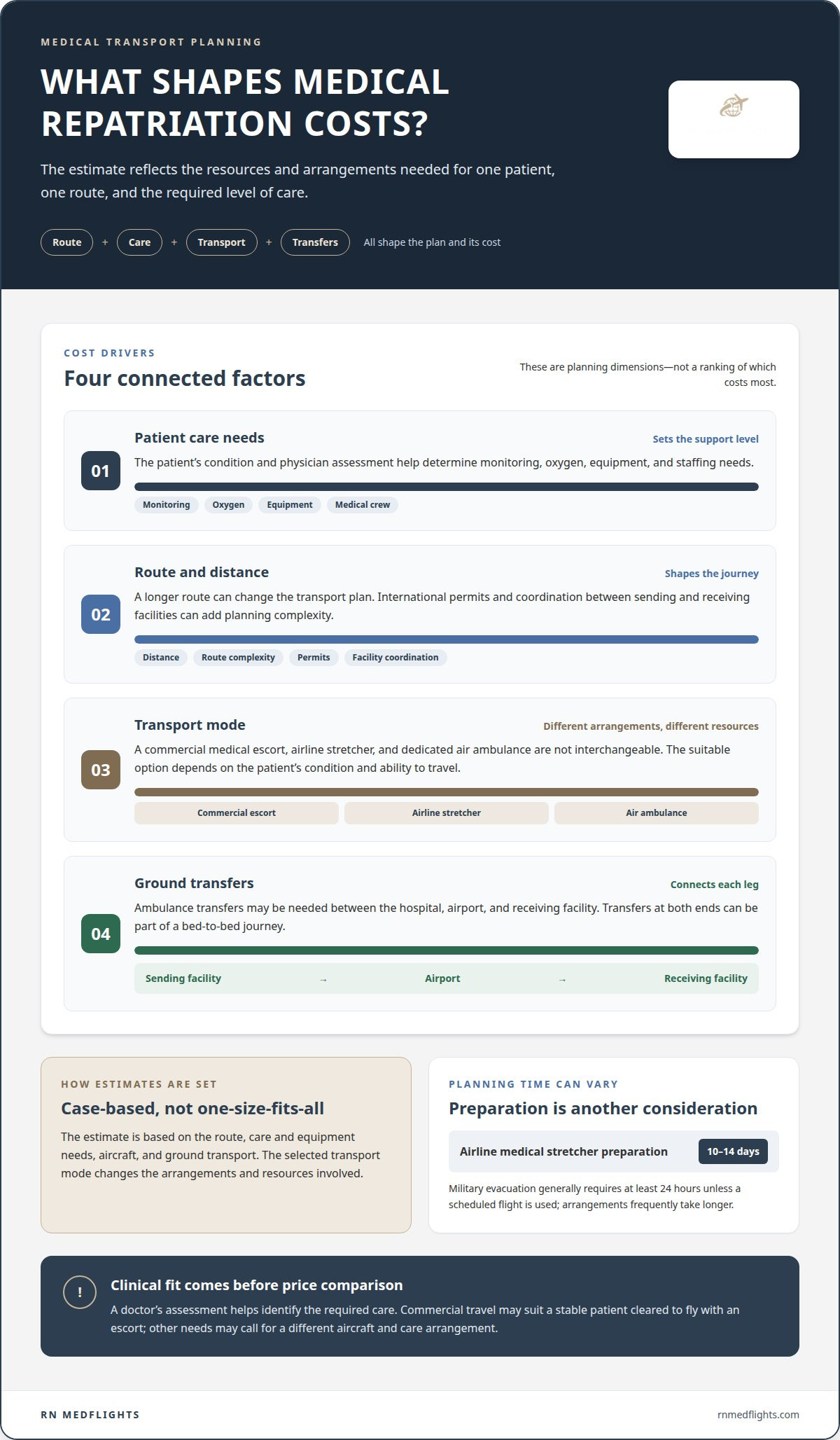
Transport costs reflect the patient’s care needs, route, aircraft, and ground transfers. How long does it take to arrange a medical repatriation flight? Military evacuation generally requires at least 24 hours unless a scheduled flight is used, and arrangements frequently take longer; preparing an airline medical stretcher transport may take 10-14 days.
Regional and Transport Cost Estimates
Transport estimates vary because distance, transport type, and care needs shape the journey. A commercial medical escort, airline stretcher, and dedicated air ambulance involve different arrangements and resources, so their costs aren’t interchangeable.
For a route from Europe, Asia, or Central America to the United States, the selected mode determines the arrangements involved. An escort accompanies the patient on a commercial flight, while a stretcher requires airline arrangements for a patient who must lie down. An air ambulance uses a dedicated aircraft. The cost depends on the case and is provided after a quote request, based on the route, care and equipment needs, aircraft, and ground transport.
Route complexity matters as well as distance. International permits and coordination between the sending and receiving facilities can affect planning. Ground ambulance transfers to and from airports may also be part of the journey, especially when the patient needs continuity between facilities.
Factors That Affect Flight Costs
Flight costs reflect the resources needed to transport a specific patient between facilities. A longer route, dedicated aircraft, larger medical crew, or specialized equipment can change the transport plan and its cost.
The patient’s condition influences the level of care needed during the flight. A doctor’s assessment helps identify monitoring, oxygen, equipment, and staffing needs. Commercial travel may suit a medically stable patient cleared by a physician to fly with an escort; other needs may call for a different aircraft and care arrangement.
Ground transport is another cost factor, not an incidental detail. The plan may include ambulance transfers at both ends, airport coordination, and communication between facilities. International routes can involve additional permit requirements. These factors work together: even a shorter flight may require substantial ground coordination or clinical resources.
Insurance Coverage and Arrangement Time
Insurance coverage depends on the policy, benefit limits, and whether transport is considered medically necessary. Travel insurance may include medical evacuation or repatriation benefits, while private health plans may cover some transport when medical necessity applies. Coverage for overseas treatment alone doesn’t mean international transport is covered.
Medicare doesn’t cover medical repatriation or other medical services received abroad. Medicare Part B pays 80% for necessary air ambulance services, but that benefit shouldn’t be assumed to cover repatriation. Policy limits and exclusions can leave families responsible for transport expenses, so the distinction between treatment benefits and travel benefits matters.
Military routing can affect onward arrangements. Unless a scheduled military flight is used, U.S. Air Force medical evacuation arrivals on the East Coast are routed to Andrews AFB near Washington, DC; West Coast arrivals go to Travis AFB near San Francisco. If the final destination is elsewhere, families usually arrange onward commercial transportation. For help understanding medical transport coordination, consider how the flight, hospital handoffs, and ground legs fit together.
Arranging transportation for incapacitated U.S. citizens
For an incapacitated U.S. citizen, the plan depends on the patient’s condition, required care, and receiving facility. A doctor must determine whether travel is medically suitable before arrangements proceed.
Situations That May Warrant Air Transport
Air transport may be appropriate when a patient needs to reach a home-country hospital or a facility closer to home for continued care. A critically ill patient stabilized in a foreign hospital may need an air ambulance transfer, while a stable patient may travel with medical oversight on a commercial flight.
Ventilators, vasoactive drips, ECMO, complex neonatal care, and high-acuity pediatric needs can require dedicated airborne critical care. Oxygen needs also matter: patients requiring more than 2-3 liters per minute may need air ambulance transport. These clinical needs help determine whether commercial travel can safely support the patient.
Patient Stability and Transport Suitability
A doctor assesses whether the patient is stable enough to travel by considering their current condition, treatment, and ability to tolerate the journey. The sending and receiving facilities coordinate the handoff, and a receiving bed should be confirmed before transport proceeds.
Timing after a major event can affect readiness. A patient who has had a heart attack should rest for 24 hours before transport. Someone just intubated may need at least 24 hours to stabilize on a ventilator. For ventilator or advanced cardiac support, planning must account for cabin altitude tolerance, oxygen reserves, battery-backed equipment, uninterrupted infusions, and access to emergency intervention.
The travel mode follows the patient’s clinical requirements. A medically stable patient cleared by a physician to fly may be considered for a commercial escort, while someone needing a higher level of care may require another transport arrangement. Patients or their authorized representatives typically arrange air-ambulance transportation and coordinate with the hospital and transport service, rather than relying on a consular officer to arrange it.
Transport Certifications and Accreditations
Certification is one part of assessing an air medical transport operation, because it relates to the aircraft operator and the transport being arranged. Air ambulance operators must hold FAA certification.
Families can support medical planning by ensuring the care team has an accurate picture of the patient’s needs. Details such as ventilator settings, oxygen requirements, cardiac support, and infusion continuity affect the equipment and clinical staffing required in transit. They also help the sending and receiving facilities coordinate a safe handoff.
Commercial carriers may refuse a passenger if authorized personnel determine that travel would be unsafe or would violate Federal Aviation Regulations. The cited provisions include 14 CFR 382.19(c), 14 CFR 91.3, 14 CFR 121.533, and 49 U.S.C. 44902. This makes early clinical planning important: the proposed travel mode must fit both the patient’s condition and the care available during the journey.
Common reasons for non-emergency medical flights
Non-emergency medical flights help patients continue treatment closer to home after illness, injury, or surgery abroad. The appropriate travel mode depends on mobility, care needs, and whether a commercial cabin can safely support the patient.
A patient recovering after surgery may need to remain lying down, making an airline stretcher arrangement relevant. Others may need oxygen or specific medical equipment during travel. For a medically stable patient cleared by a physician to fly, a medical escort can provide clinical supervision, medication support, and oxygen management while coordinating airport transitions.
Specialized needs can change the plan. Neonatal and pediatric repatriation requires age-specific equipment, precise medication dosing, and clinicians trained in small-patient physiology. High-risk obstetric transport requires attention to maternal and fetal status, along with contingency planning if either condition changes during transfer. These needs make clinical planning specific to the patient and destination.
Commercial flights aren’t suitable for every patient. Cabin space limits the care an escort can provide, and an aircraft may need to divert for an emergency landing. The cabin environment also matters: it is described as 3,500 feet in the air, with low humidity and oxygen levels. A patient whose condition cannot tolerate those constraints may need another transport arrangement.
International flights involve logistical steps beyond the clinical plan. Depending on the route and country, repatriation may require overflight and landing permits, customs declarations, immigration review, and country-specific medical transport documentation. These requirements can involve departure and destination authorities. Documentation and permissions must fit the route and transport type.
Families should distinguish an escort’s role from the support available on a dedicated air ambulance. On a commercial flight, a medical escort supervises the patient within the cabin’s limits and coordinates airport transitions. This may suit a medically stable patient cleared by a physician to fly, but it does not provide the same care environment as a dedicated aircraft. The patient’s condition and expected care determine which setting fits.
Medical staffing must match the patient’s needs, not simply the flight distance. A neonatal case, for instance, calls for clinicians familiar with small-patient physiology and appropriately sized equipment. A post-surgical adult who needs to lie flat may need a stretcher arrangement instead. These examples show why clinical information, airline arrangements, and destination planning must align before departure.
Repatriation planning also accounts for possible changes during flight. Medical teams should anticipate clinical or logistical problems, including events that arise two hours into the journey. For high-risk obstetric travel, contingency plans address changes in maternal or fetal status. This preparation helps define the support needed throughout the flight and at arrival.
Emergency and non-emergency medical repatriation
The decisive difference is whether a patient needs immediate critical care or can travel through a planned medical arrangement. Emergency transport prioritizes rapid access to treatment; non-emergency repatriation plans a return home once the patient is stable enough to travel.
Emergency medical repatriation is intended for critically ill patients who need immediate care. It typically uses an air ambulance equipped for intensive care, with staff trained for emergency needs. For example, a patient with a severe head injury in a remote area may need transfer to the nearest neurosurgical center. An air ambulance can typically move a patient to a higher level of care within 24 hours.
Non-emergency repatriation has a different destination and purpose. It returns a patient to their home country, often for continued treatment or recovery near family. Medical evacuation instead takes a patient needing critical care to the closest appropriate facility. That distinction matters: a flight home may not be the right immediate route if the patient first needs specialized treatment elsewhere.
Being medically stable makes planned travel possible, but it doesn’t mean the patient needs no care. A physician assesses whether the patient can tolerate travel and what monitoring or support is required. A patient cleared to fly may travel with a medical escort on a commercial flight; someone who must remain lying down may need an airline stretcher. A dedicated aircraft may be appropriate when commercial travel cannot meet the patient’s clinical needs.
Planning also changes the pace. Non-emergency repatriation allows coordination with the sending hospital, family, and receiving facility. A receiving bed should be confirmed before transport proceeds. Medical repatriation is often described as covering 2,000 miles and taking 24 to 72 hours, while an airline stretcher arrangement may take 10-14 days to prepare. Those timelines reflect different transport types, not a single standard schedule.
Families can use one question to clarify the route: does the patient need immediate treatment, or can they safely travel to continue care at home? If immediate intervention is needed, emergency evacuation to an appropriate facility takes priority. If the patient is stable and cleared to fly, a planned return can align the aircraft, care team, and facility handoff. International routes also require coordination between departure and receiving facilities.
For a patient who is stable and needs a medically supported return, discuss a planned medical repatriation and the care required throughout the journey.
RN MEDflights: Commercial Airline Medical Escort
RN MEDflights helps families arrange medically supervised travel for patients who are stable and cleared by a physician to fly. Its Commercial Airline Medical Escort supports patients who need clinical oversight during travel but don’t require emergency transport. For patients who need to remain lying down, its Commercial Airline Stretcher Service may be appropriate on select airlines and routes.
For international returns, International Medical Repatriation can coordinate travel between countries. Domestic Medical Relocation supports medically supervised travel within the United States. Bed-to-Bed Medical Transport brings the journey together with ground ambulance coordination at both ends, connecting the sending and receiving facilities.
If a doctor considers commercial air travel suitable, contact RN MEDflights to discuss the patient’s needs and travel arrangements.
Prepare for the next step with clarity
Bring the medical and travel details together in one clear picture. Keep the latest clinical summary, current medication list, treating physician’s contact details, and receiving facility information in one place. A designated family contact can help keep updates consistent as plans develop.
Focus the next conversation on the patient’s needs across the full journey, not only the flight. Clarify what support is needed before boarding, during travel, and after arrival. Make sure the receiving team understands the handoff plan so everyone shares the same information.
Arranging non-emergency medical repatriation by air means coordinating the medical plan with the practical travel arrangements. The goal is a route and level of support suited to the patient’s condition and destination. A clear discussion can help your family approach the next decision with greater confidence.
Contact RN MEDflights to discuss transport and the arrangements your family is considering.
Frequently Asked Questions
How Much Does a Repatriation Flight Cost?
There’s no single fixed cost for a repatriation flight. The price depends on the case and is provided after a quote request; factors include the route, transport type, clinical staffing, equipment, and ground ambulance coordination. A commercial flight with a medical escort differs from an airline stretcher arrangement or a dedicated aircraft. Insurance benefits may affect what a family pays, but policy limits and medical-necessity terms matter.
Are there any non-life-threatening conditions that make commercial flight impossible?
Yes. A condition doesn’t need to be life-threatening to make a standard airline seat unsuitable. For example, a patient who must remain lying down may need an airline stretcher arrangement, while someone needing more than 2-3 liters per minute of oxygen may need another transport mode. Pregnancy beyond 36 weeks can also make commercial flying more concerning. Airline personnel may refuse travel they determine is unsafe.
How do urgency, cost, and patient condition affect the choice?
Immediate clinical needs take priority over choosing the least expensive option. A patient who is unstable and needs critical care may require emergency transport, while a medically stable patient cleared by a physician to fly can be assessed for planned travel with medical supervision. A commercial escort, stretcher arrangement, and dedicated aircraft involve different resources. The physician’s assessment, required care, route, and ground transfers all help determine the appropriate plan.
What is non-emergency medical repatriation by air?
It’s a planned return by air for a patient who is medically stable and cleared by a physician to fly but needs medical oversight or special arrangements. The plan may use a commercial flight with an escort, an airline stretcher, or another aircraft suited to the patient’s needs. Coordination can connect the sending facility, airport transfers, and receiving facility, so the travel plan accounts for each stage.
Who qualifies for non-emergency medical repatriation by air?
Patients may qualify when a physician considers them medically stable and clears them to fly, and the planned arrangements can support their condition. Mobility matters: someone able to sit through a commercial journey may be considered for an escort, while a patient unable to sit may need a stretcher arrangement. The care team also considers oxygen needs, monitoring, medications, and the receiving facility’s ability to continue treatment.
How much does non-emergency medical repatriation by air cost in the United States?
There’s no single U.S. cost because the total depends on transport mode, route, care and equipment needs, and ground ambulance transfers. The price depends on the case and is provided after a quote request. A domestic commercial escort and an international stretcher journey involve different airline and coordination requirements. Insurance benefits may offset eligible expenses, subject to policy terms and limits.
Does health insurance or travel insurance cover medical repatriation flights?
Some travel policies include medical evacuation or repatriation benefits, and private health plans may cover transport considered medically necessary. Coverage depends on the policy’s limits and terms, so treatment coverage abroad shouldn’t be assumed to include transport home. Medicare doesn’t cover medical repatriation or other medical services received abroad. Medicare Part B’s air ambulance benefit is separate and doesn’t establish coverage for repatriation.
What medical staff and equipment are provided on a repatriation flight?
Staffing and equipment depend on the transport type and patient’s needs. RN MEDflights’ commercial airline medical escort uses U.S.-licensed registered nurses or critical-care paramedics, all with current ACLS and BLS certifications and a minimum of five years of clinical experience. On a commercial flight, an escort can provide clinical supervision, medication support, and oxygen management. Equipment is matched to the planned care.