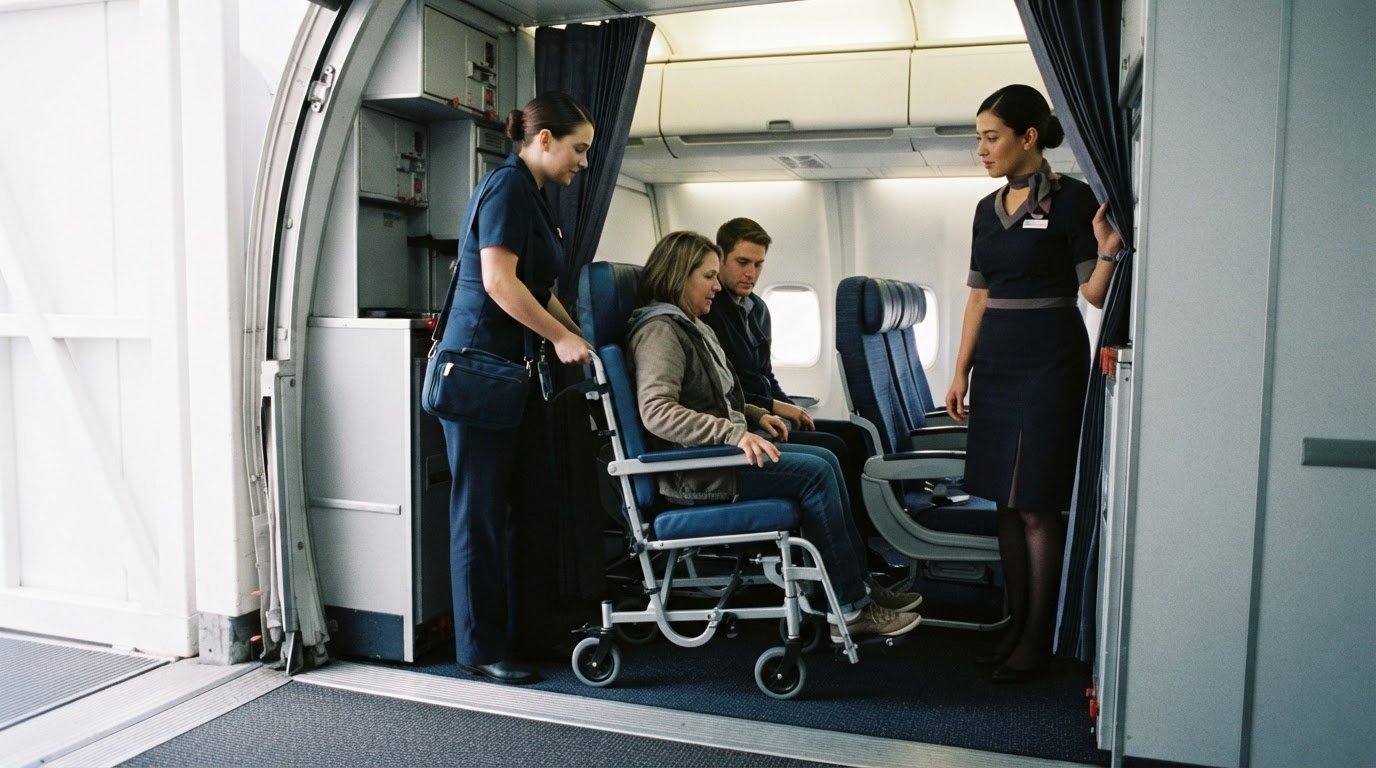
How to Arrange a Regional or Intercontinental Medical Flight
Updated: 5 hours ago
A simple regional international medical flight can sometimes be arranged within 12-24 hours, while a complex intercontinental flight may take 24-72 hours. How long it takes to arrange a medical flight depends on the patient’s readiness, aircraft availability, and the coordination required for the journey. Families asking how long it takes to arrange a medical flight should know that the route is only one factor.
It’s understandable to expect a longer route to take longer, but distance is only part of the picture. The type of flight matters too: a stable patient may be able to travel on a commercial flight with medical support, while a stretcher arrangement involves different planning. This guide explains how medical, airline, and ground-transport arrangements come together, which documents help move the process forward, and how regional and intercontinental timelines compare. You’ll also learn how commercial medical escorts and stretcher services differ from other flight options, helping you understand the choices involved in planning a transfer.
Table of Contents
Coordination of medical, airline, and ground-transport services
Start with a clinical assessment and a clear transfer plan. Medical transport teams review the patient’s condition remotely or in person, then speak with treating doctors about stability, mobility, monitoring, and care during travel. For example, a patient who can sit upright may need different support from someone requiring a stretcher. This assessment helps determine whether a medical escort can accompany the patient on an airline flight and what clinical arrangements the route requires.
Coordinate with the treating team and the receiving facility before finalizing travel. Gather relevant medical information and confirm that the receiving facility can accept the patient and continue care. For a hospital-to-hospital transfer, establish who will receive the patient and handle the clinical handoff. This gives the transport team essential details for coordinating the flight and ground transfers.
Align airline requirements with the patient’s clinical needs. A medical escort can accompany a medically stable patient on a commercial flight, subject to the required review and airline arrangements. The treating physician must determine that the patient is cleared to fly. Share the patient’s condition and travel needs early so the airline medical review and travel plan can proceed.
Arrange ground transport at both ends of the flight. Bed-to-bed medical transport connects the departure facility, airport, destination airport, and receiving hospital. Ground ambulance coordination should match the patient’s mobility and clinical support needs, as well as the flight schedule. For example, a stretcher patient may need ambulance teams prepared for transfers between the hospital bed and aircraft. Confirming pickup and arrival plans helps prevent gaps between medical care and air travel.
Plan a clinical handoff after landing. Contact the receiving facility before departure so staff can prepare for the patient’s arrival and continued care. The escort can share relevant information about the journey and the patient’s condition with the receiving team. This connects the flight to the next stage of care and completes the bed-to-bed transfer.
Aircraft availability and flight planning
Aircraft, crew, route, and patient needs must align before a medical flight can proceed. Weather or limited aircraft availability can delay departure, while positioning a nonlocal crew may add planning time.
Confirm Aircraft and Crew AvailabilityAsk the coordinator to match an aircraft and medical team to the patient’s needs. Check that the aircraft can support the planned transfer and that qualified crew can reach the departure location. An urgent request may still need time for a crew to reposition if they are not local. Avoid treating an aircraft’s presence in a region as proof that it is ready for this specific mission.
Plan Around Weather and AvailabilityBuild weather review and aircraft availability into the flight plan before setting a departure expectation. Conditions along the route may affect whether a flight can operate safely or whether its timing needs adjustment. Aircraft availability in the region also affects how quickly arrangements can progress. Ask the coordinator to explain how a change in route or departure timing affects airport transfers and the ground ambulance schedule.
Match the aircraft and medical team to the patient’s clinical requirements. The care plan, mobility, and need for monitoring shape which transport arrangement is appropriate. For example, a patient able to travel seated may have different requirements from someone who needs a stretcher. The medical team’s role should also fit the planned care during the journey. These decisions need to be made before finalizing the aircraft and crew plan.
Confirm the route and operational sequence with the flight coordinator. Departure and arrival airports, flight planning, and any required permits can affect the schedule, especially on international journeys. A route with multiple operational steps needs coordination across each stage. Ask how the planned route connects with the patient’s pickup and arrival arrangements, rather than focusing only on the time spent in the air.
Coordinate ground transport and family arrangements against the flight plan. A ground ambulance at either end needs to meet the aircraft’s expected timing and the patient’s mobility needs. If a family member is travelling separately or accompanying the patient, include that detail in the transport plan. This helps the coordinator align airport transfers with the patient’s departure and arrival instead of leaving a gap between flight and ground care.
Keep one current plan for any changes. If weather, aircraft availability, crew positioning, or route planning shifts the schedule, update the hospital and ground-transport teams using the same revised details. For an urgent transfer, this prevents one team working from an earlier departure time while another prepares for a later arrival. Confirm the next coordination step and who is responsible for communicating it to the people involved.
Preparing medical records and supporting documents
Organize current medical records and travel details for the clinical review and airline arrangements. Clear, consistent information helps the team assess the transfer and coordinate the next steps.
Gather Medical RecordsAsk the treating department to assemble recent records that explain the patient’s condition and current care. Include the physician’s notes, relevant test results, medication list, and details of mobility or monitoring needs. These documents help the transport team understand the care required during travel. Keep the records consistent with the patient’s current condition, and avoid sending an older summary without updates from the treating team.
Ask the treating physician to assess whether the patient is sufficiently stable before signing a fit-to-fly declaration. The airline’s medical department may review fit-to-fly forms before approving a patient for a commercial flight. Send the required clinical information in the format requested for that review, and keep a copy of the completed forms with the medical records. If the patient’s condition changes, provide updated details rather than relying on an earlier assessment.
Collect Supporting Documents and InformationPrepare the patient’s identifying details, departure and destination information, hospital contacts, and the receiving facility’s acceptance details. Add the planned route and relevant travel documents to the same file, so medical and coordination teams can work from consistent information. For international medical repatriation, organize destination and contact details early. Avoid sending conflicting itinerary versions, especially when airline arrangements or ground transport change.
Include a clear summary of practical support needs. Note whether the patient needs a medical escort, assistance moving between locations, or a stretcher arrangement, and provide a contact who can answer questions. If insurance is involved, gather policy details and related correspondence. Coverage varies by policy, and some insurers require pre-approval or co-payment, so keep relevant communications together.
If pregnancy is relevant to the patient’s care, ask the treating physician to include the information needed for an individual travel assessment. Share current pregnancy-related clinical notes and any care considerations with the medical team reviewing the journey. Don’t assume a general medical summary covers those details. The physician’s assessment and the airline’s review can then consider the patient’s specific circumstances when determining travel arrangements.
Before sending the file, compare names, dates, hospital contacts, and route details across each document. Correct mismatches with the issuing department, then provide one clearly labeled current set. For example, an outdated destination address can complicate coordination between the receiving hospital and the arrival arrangements. Keep a copy available for the patient’s family member or authorized contact, so they can support communication during the transfer.
Time needed to arrange regional and intercontinental medical flights
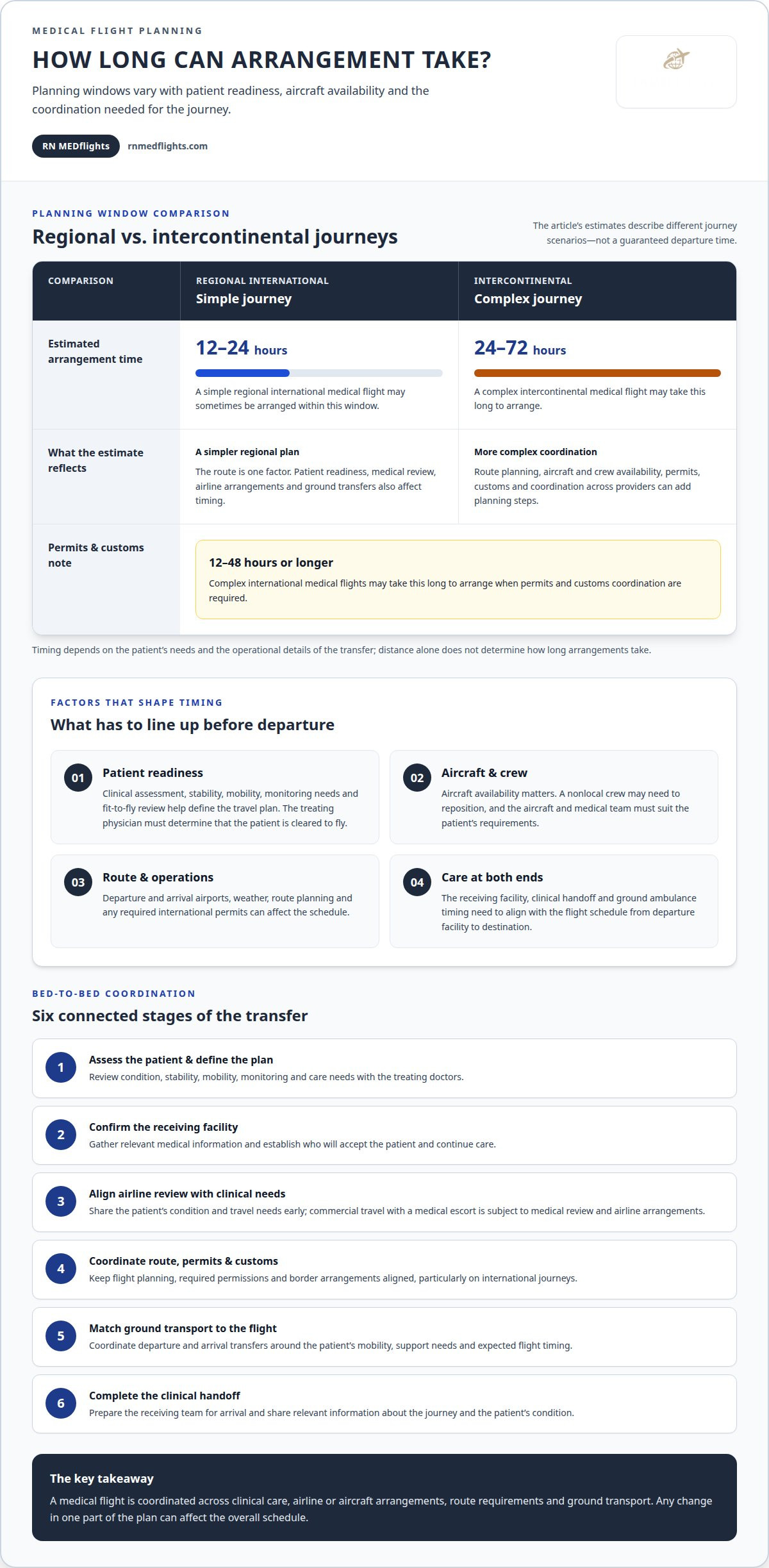
A simple regional international medical flight can sometimes be arranged within 12-24 hours. A complex intercontinental flight may take 24-72 hours, with medical clearance, aircraft planning, and international coordination shaping the timeline.
Booking and dispatch time depends on the patient’s medical readiness, aircraft and crew availability, route, permits, and ground ambulance coordination. Weather can also affect flight plans and departure timing.
Insurance approval has no single timeline: it depends on the insurer’s review process and whether it has the medical documents needed to assess coverage. Medical clearance and flight planning sit within the overall arrangement period, which can range from 12-24 hours for a simple regional route to 24-72 hours for a complex intercontinental transfer.
Complete Medical Clearance and Flight PlanningCoordinate the treating doctor’s assessment with route planning and the receiving facility’s acceptance. A medical escort or ambulance arrangement depends on the patient’s condition and travel needs. Share the current clinical documents early, then align the departure plan with aircraft availability, destination arrangements, and any required international permits. Avoid treating flight planning as complete before those elements are coordinated.
Assess Booking and Dispatch FactorsReview the route, aircraft availability, crew positioning, required permits, and the patient’s readiness to travel as a connected set of factors. A local aircraft and available crew may simplify planning, while a nonlocal crew or complex international clearances can add coordination steps. For example, an intercontinental repatriation involving permits and customs coordination may take 12 to 48 hours or longer.
Identify who will coordinate the transfer and manage payment discussions. The patient or family can work with the treating hospital, transport coordinator, and insurer to share clinical information and organize travel. Ask the insurer about its review process and required documents, since coverage varies by policy and some policies require pre-approval or co-payment. Keep the treating team informed as arrangements progress.
Separate the flight-arrangement timeline from the service price. The price depends on the case and is given after a quote request; route distance, aircraft and medical-team requirements, permits, and ground ambulance coordination affect the overall cost. International medical transport can involve multiple providers, so clarify which parts of the journey the proposed arrangements cover before comparing the plan with the patient’s needs.
Use the route and complexity to set practical expectations with family members. A short regional transfer with straightforward coordination may progress within 12-24 hours, while a complex intercontinental journey may require 24-72 hours. Permits and customs coordination can add time, and complex international flights involving these arrangements may take 12 to 48 hours or longer. Keep plans flexible as clearances and flight details are coordinated.
Commercial flights, stretchers, private charters, and air ambulances
Match the flight type to the patient’s condition and care needs. A commercial medical escort is an option for a stable patient able to travel on a regular airline flight with a medical professional. Patients often travel several days after a medical emergency, once stable and no longer considered at risk of complications. The treating team’s assessment helps establish whether commercial travel can support the patient safely.
Consider a commercial airline stretcher arrangement if the patient cannot travel seated. Stretcher transport is available on select airlines and routes, and requires coordination of the patient’s position, airport transfers, and airline arrangements. Plan the full journey, from the departure facility to the receiving bed, including ground transport at both ends.
Assess whether a private charter fits a medically stable patient’s situation. A private aircraft with a medical escort can offer a different travel arrangement from a scheduled airline, but aircraft availability and route planning still shape the schedule. Include the destination, the patient’s clinical requirements, and ground transport at both ends in the plan. A charter is not the same as an air ambulance.
An air ambulance is a separate transport option from a commercial airline medical escort. RN MEDflights provides commercial airline medical escort services for medically stable patients cleared by a physician to fly. The treating physician’s assessment helps determine whether this type of travel is appropriate.
Clarify who may accompany the patient before finalizing travel. Depending on the flight type and aircraft, one or sometimes two companions may be able to travel with the patient. On a commercial flight, a family member’s arrangements may differ from those for a stretcher patient. Confirm how companion travel fits the clinical plan and available space, then coordinate their itinerary with the patient’s destination transfer.
Compare each option across the entire transfer before choosing a plan. Ask how the patient will move from the hospital to the aircraft, what medical support continues in flight, and how care reaches the receiving facility. For example, a stable patient travelling with an escort may use a commercial route, while a patient needing life support may require an air ambulance. The safest suitable arrangement depends on the patient’s condition and continuity of care needs.
RN MEDflights: Commercial Airline Medical Escort
RN MEDflights coordinates commercial airline medical escort and repatriation for medically stable patients cleared by a physician to fly. Its Domestic Medical Relocation and International Medical Repatriation services support transfers within the United States and internationally, with bed-to-bed coordination.
For patients who cannot travel seated, Commercial Airline Stretcher Service is available on select airlines and routes. Bed-to-Bed Medical Transport coordinates pickup, ground transport, airline arrangements, and delivery to the receiving bed. The plan is tailored to the patient’s condition, travel requirements, and destination.
Contact RN MEDflights to discuss the patient’s transfer and the medical transport arrangements involved.
Take the Next Step With a Clear Plan
Once medical travel becomes a possibility, give the family a clear role in the planning process. Choose one person to share updates with the treating team and coordinate information among relatives. This keeps decisions organized and gives everyone a consistent point of contact. Write down the patient’s destination, key contacts, and immediate questions so discussions can focus on what needs to happen next.
Understanding how long it takes to arrange a medical flight is useful, but the next step is turning that estimate into a plan suited to the patient. Keep communication open as circumstances develop, and make sure the people involved understand their responsibilities. A coordinated conversation can help the family approach the transfer with greater clarity.
Contact RN MEDflights about your flight to discuss the patient’s travel needs and possible arrangements. A thoughtful next step can make a difficult period feel more manageable.
Frequently Asked Questions
How fast can a medical flight be arranged?
A simple regional international medical flight can sometimes be arranged within 12-24 hours; a complex intercontinental flight may take 24-72 hours. The difference often comes down to route complexity and how many arrangements must align. For example, a direct regional itinerary may involve fewer planning steps than a long-distance journey with international clearances. Share the patient’s current location, destination, and medical situation early so teams can begin coordinating relevant arrangements.
Do you coordinate with hospitals?
Yes, medical flight coordination can include both the sending and receiving hospitals. For example, the discharge planner at the departure hospital can help organize the patient’s records, while a contact at the destination facility confirms the transfer plan. Before travel, establish who will receive the patient and relevant clinical information. This helps the hospital teams prepare for the handover and continue care after arrival.
Is the flight staffed by medical professionals?
Staffing depends on the flight arrangement and the patient’s needs. RN MEDflights provides commercial airline medical escorts with U.S.-licensed registered nurses or critical-care paramedics. These clinicians hold current ACLS and BLS certifications and have a minimum of five years of clinical experience. For a commercial flight, the accompanying professional supports the patient during travel; the specific care plan is based on the patient’s condition and travel requirements.
How long does it take to arrange an emergency medical flight in the US?
For true emergencies, many medical-flight providers may have an aircraft ready for takeoff within two to four hours of an initial call, if logistics allow. This refers to potential aircraft readiness, not a universal timeline for every transfer. Patient condition, aircraft and crew location, and flight logistics all affect dispatch. RN MEDflights focuses on non-emergency commercial airline medical escort and repatriation for stable patients.
How quickly can an air ambulance be dispatched after booking?
Booking alone doesn’t set the dispatch time. The flight plan must also account for the patient’s transport needs, aircraft and crew positioning, route, and any required clearances. For true emergencies, some providers can have an aircraft ready for takeoff within two to four hours of the initial call, if logistics allow. That timeframe describes possible emergency aircraft readiness, rather than the full coordination process for every medical transfer.
How quickly can a medical flight be arranged for a non-emergency transfer?
A simple regional international transfer can sometimes be arranged within 12-24 hours, while a complex intercontinental journey may take 24-72 hours. For a stable patient travelling commercially, the airline’s medical review and travel arrangements also need to fit the patient’s condition. A family can help by identifying the preferred destination and a hospital contact who can discuss the proposed transfer.
What information and documents are needed to arrange a medical flight?
Prepare the patient’s current medical summary, treating physician’s contact details, medication information, and a clear description of mobility and support needs. Include the departure and destination, hospital contacts, and any documents requested for airline review. Explain whether the patient can travel seated or needs a stretcher arrangement, and share updates if the patient’s condition changes.
How long do medical flight permits and international clearances take?
Complex international flights involving permits and customs coordination may take 12 to 48 hours or longer to arrange. The time depends on the route and the clearances needed for that journey. A transfer involving several countries or airports can require coordination across multiple parties. Share the intended route and destination early, and keep the itinerary details consistent as the arrangements progress.