Domestic Medical Escort Services: Commercial vs Charter
Patients who need clinical supervision during a domestic trip often face a choice between a dedicated charter aircraft and a commercial flight with a registered nurse on board. Charter and air ambulance flights provide a fully equipped cabin, but their cost places them out of reach for many non-emergency patients and families. A domestic medical escort offers a third path: a licensed RN accompanies the patient on a scheduled commercial airline flight. This article explains when that model fits, when it does not, and how to decide between the two options for a specific medical situation.
Table of Contents
Quick Takeaways
Key Insight | Explanation |
|---|---|
Commercial RN escort suits stable patients | A patient who can sit upright for takeoff and landing, or who can lie on a stretcher configured across economy seats, and who does not need continuous life support is a strong candidate. |
Charter remains necessary for unstable patients | Patients who require ventilation, continuous advanced monitoring, or critical care should travel on a fully equipped air ambulance. |
Cost is the main difference | A commercial escort avoids paying for an entire aircraft, including empty seats and positioning flights, which is the largest component of charter pricing. |
Seating method determines lead time | Seated escorts can often be arranged within a shorter window, while a stretcher across several economy rows requires more seats and additional planning days. |
Medical clearance should be gathered early | Physician statements, medication schedules, and oxygen plans often take time to complete, so they should be requested before a departure date is fixed. |
Ground legs belong in the plan | Transfers from the home or facility to the airport, and from the destination airport to the final address, can affect fatigue and timing as much as the flight itself. |
Compare itemized quotes only | A commercial and a charter quote should cover the same services, including ground transport and arrival handoff, before the two totals are compared. |
What a Domestic Medical Escort Covers
A domestic medical escort is a registered nurse's supervised travel within the United States, in which the patient flies on a scheduled commercial airline. The nurse assesses the patient before departure, manages medications and equipment during the flight, and hands the patient over to receiving clinicians or family at the destination. The service is designed for patients whose condition requires skilled monitoring but does not require the resources of an intensive care aircraft.

Escort services take several forms, and the right structure depends on where the trip begins and ends. Some families need support only at the airport, while others require a complete chain of care from the bedside to the destination. RN MEDFLIGHTS organizes its domestic work around that distinction so that each itinerary matches the clinical needs and logistics of the patient.
Door-to-door medical escort
A door-to-door arrangement covers the full journey, beginning at the patient's home and ending at the destination address. The escort team coordinates ground transport to the departure airport, check-in, boarding, the flight itself, and the ground leg at arrival. For patients who cannot manage airport logistics alone, this structure removes the need for family members to coordinate each step.
In practice, the most common planning error is underestimating the ground segments. A patient who tolerates the aircraft well can still struggle in a crowded terminal or during a long wait at a security checkpoint. Building those segments into the plan from the start prevents avoidable strain during the trip.
Hospital-to-hospital medical escort
A hospital-to-hospital escort moves a patient between two facilities, often when a specialist treatment is available only at a distant center. The sending hospital typically provides discharge summaries, medication lists, and relevant imaging, while the escort nurse carries the clinical handoff details. Receiving teams benefit from a written summary that states the patient's condition at departure and any changes during transit.
Hospital-to-hospital moves are often time-sensitive, so the planning window is usually shorter than for a family-arranged trip. Case managers should confirm bed availability at the receiving facility before booking, because a flight that arrives without an accepting team creates delays and added cost.
Commercial Flights Versus Charter Models
A charter flight is a dedicated aircraft that the patient or payer books for a specific route and schedule. A commercial escort uses seats on a scheduled airline, with the escort nurse traveling alongside the patient. The clinical difference is significant: a charter aircraft can be configured around the patient's equipment and monitoring needs, while a commercial cabin is shared and its layout is fixed.
The financial difference is equally important. Charter pricing reflects the cost of the entire aircraft, its crew, and its positioning flights, so the patient pays for seats that may remain empty. A commercial escort spreads the travel cost across seats already sold on the airline, which is the main reason families choose it for non-emergency transfers.
Seating and stretcher configurations
Commercial escorts depend on the patient's ability to sit upright during takeoff and landing. Patients who can be assisted to a seat, with or without a wheelchair, can often travel in business or first class, where seats recline into a flat position. Patients who cannot sit upright may require a stretcher built across several economy rows, which is screened for privacy and requires more seats in the cabin.
A stretcher configuration reduces the number of passengers who can be accommodated on that flight, so it requires more lead time and seat availability. Charter aircraft avoid this constraint because the cabin is set up for the patient from the start. Planners should confirm the seating method before choosing a commercial route, since it determines both the schedule and the cost.
Scheduling and availability
Commercial routing depends on published airline schedules, so departure options are set by the airline rather than the family. A patient who must leave on a specific morning may find that the nearest commercial departure arrives too late for the receiving clinic. Charter flights can depart on a timetable that suits the medical plan, but they require a larger financial commitment.
In practice, this trade-off is best resolved early. Families with a window of several days can usually secure a commercial escort at lower cost, while same-day transfers often justify a dedicated aircraft if the medical team confirms the need.
The most reliable domestic plan is the one that matches the patient's least stable condition, not the most convenient flight.
When Commercial Escort Is the Right Choice
A commercial escort suits patients whose clinical condition is stable and predictable for the length of the flight. Typical candidates include patients recovering from surgery who need medication management, patients receiving oral or intermittent treatment, and patients with chronic conditions that require observation rather than intervention. The escort nurse provides continuous supervision, documentation, and a clinical point of contact throughout the trip.
Clinical stability is the first screening question, but it is not the only one. The patient's mobility, cognitive status, and capacity to report symptoms also determine whether a commercial cabin is a safe setting. A patient who can follow instructions and tolerate a confined seat is generally well suited to this model.

Patients who can sit upright
Patients who can sit upright for takeoff and landing have the widest range of commercial options. In these cases, the escort team can seat the patient in a premium cabin where the seat converts to a bed once the aircraft reaches cruising altitude. This arrangement provides privacy and space for the nurse to administer medication and monitor vital signs without disturbing other passengers.
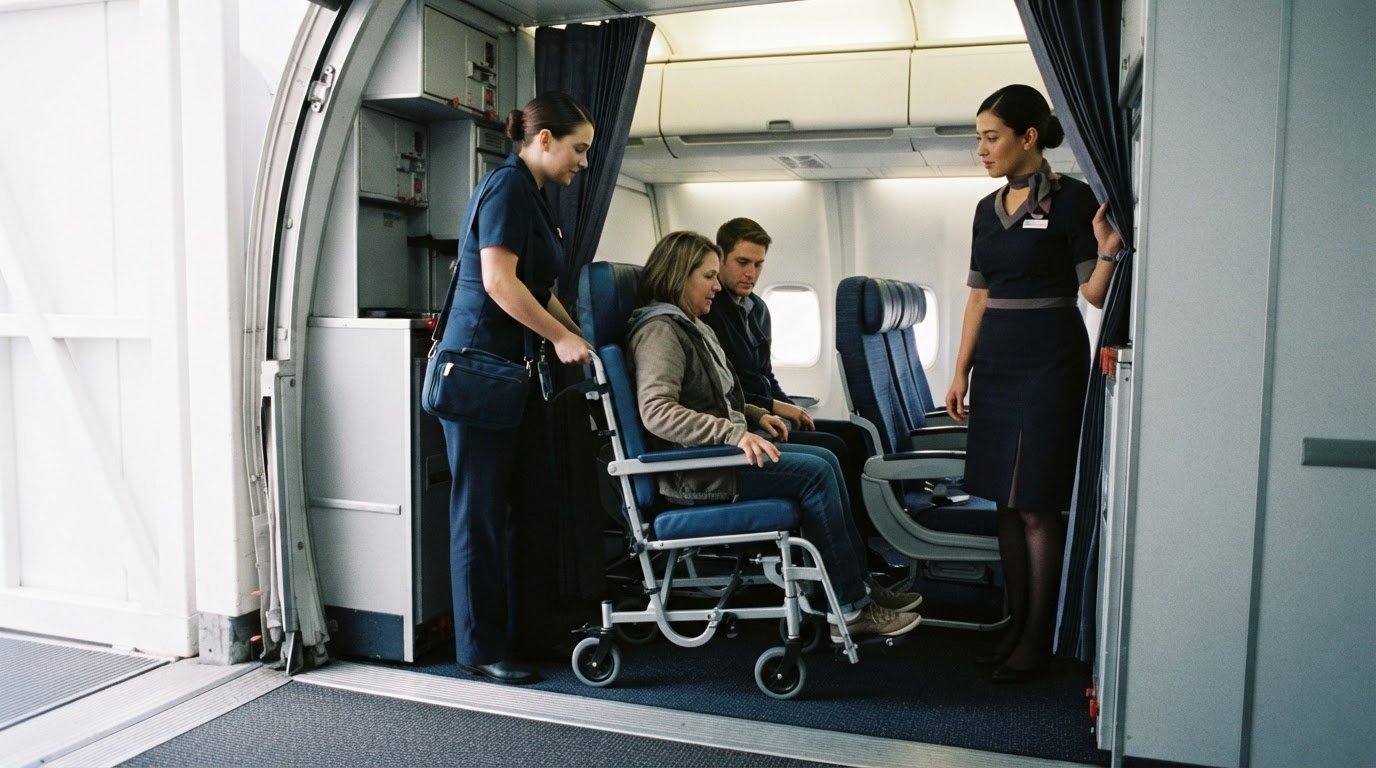
Families sometimes assume that a patient who uses a wheelchair cannot fly commercially. In practice, a wheelchair is a mobility aid for the airport, and many patients transfer to an airline seat with assistance. The escort team confirms this with the airline during planning so that boarding does not become a problem on the day of travel.
Non-emergency transfers between facilities
Many domestic transfers are planned rather than urgent. A patient moving to a rehabilitation center, a long-term care facility, or a specialist clinic for a scheduled evaluation is a common example. The commercial model allows these transfers to proceed on a published schedule while keeping the patient under the care of a licensed nurse.
Nursing homes and healthcare facilities often arrange these trips for residents who need supervision but do not require emergency transport. Facilities should share the resident's current medication administration record and care plan before departure, so the escort nurse can continue care without interruption.
When Charter or Air Ambulance Is Necessary
Some patients cannot be transported safely in a commercial cabin, regardless of the escort level. Patients who require mechanical ventilation, continuous advanced life support, or intensive monitoring generally need a fully equipped air ambulance with the aircraft configured for critical care. A commercial escort is not a substitute for this level of support.
The decision should be made by the treating physician and the transport team together. A clinical assessment that identifies instability, unpredictable deterioration, or equipment needs beyond what a cabin can accommodate points toward a dedicated aircraft. Recognizing that boundary early protects the patient and family from a costly change of plan during the journey. RN MEDFLIGHTS also offers an air ambulance service for these cases.
Clinical conditions that require a dedicated aircraft
Patients on ventilators, patients receiving continuous infusions that require pump-based titration, and patients with unstable cardiac or respiratory status fall outside the commercial escort model. Neonatal and pediatric critical care transfers also require specialized equipment and staffing. These cases belong with a dedicated air ambulance operator that can carry the full clinical team and equipment load.
Some conditions are not life-threatening but still require a stretcher for the entire flight, and the number of seats needed may affect whether a commercial route is feasible. Planners should confirm the stretcher requirement, the seat count, and the available departures before rejecting a dedicated option on cost alone.
Risk assessment before booking
A written risk assessment helps the case manager and escort team agree on the appropriate transport mode. The assessment should cover current vital signs, oxygen requirements, mobility, the medication schedule, and any events likely to occur during the flight. A patient whose status changes between the assessment and the departure date may need a new evaluation before travel.
In practice, the most useful assessment names the specific events the team wants to prevent. A patient at risk of low blood sugar or dehydration has different needs from a patient at risk of respiratory decline, and each requires a different level of onboard equipment and staffing.
Cost Factors in Domestic Escort Planning
Cost is often the decisive factor in choosing between a commercial escort and a dedicated aircraft. Published industry guides place domestic medical escort costs in a broad range of roughly $3,000 to $25,000, depending on distance, the level of escort staffing, and the seating method. These figures are estimates and should be confirmed with a provider for each specific itinerary.
Air ambulance pricing follows a different structure. A published guide to medical flight costs reports that a Life Flight or air ambulance trip in the United States typically ranges from $12,000 to $50,000 without insurance. The gap between these categories explains why many families and case managers evaluate a commercial escort first.

Published price ranges
Price ranges are most useful as a planning baseline rather than a quote. A domestic trip with a short distance and a seated patient typically falls at the lower end of published ranges, while a long-distance trip with a stretcher and a larger escort team moves toward the upper end. Requesting a free quote with the exact origin, destination, and seating requirement produces the most accurate comparison.
Ground transport is priced separately from the flight. Long-distance ground medical transport also varies by level of assistance, from ambulatory and wheelchair service to stretcher transport. A comparison guide for long-distance transport is useful as a reference for ground costs only, not for air travel.
Expenses that are easy to overlook
Several costs appear after the initial quote. Families may need to pay for additional seats, companion tickets, specialized equipment, or extended lodging if the flight schedule does not match the clinical timetable. Each item should be listed in the written estimate before the family commits to a route.
A common mistake is comparing a commercial escort quote with a charter quote that excludes ground legs. Both quotes should cover the same services, including airport transfers and arrival handoff, so that the comparison reflects the true total cost of each option.
Pro tip: Ask every provider to itemize the escort fee, airfare or charter cost, ground transport, and any seating surcharges. A side-by-side itemized comparison reveals differences that a single total price can hide.
Comparing Domestic Transport Options
The table below compares three common domestic approaches. The best option depends on the patient's clinical stability, seating needs, and schedule flexibility rather than on price alone.
Transport Option | Best Suited For | Key Considerations |
|---|---|---|
Commercial flight with RN medical escort | Stable patients who can sit upright or who can travel on a stretcher configured across economy seats | Scheduled departures, lower cost than charter, and stretcher setups that require additional lead time |
Dedicated charter or air ambulance | Patients who need critical care equipment, continuous monitoring, or a fixed departure time | Higher cost, an aircraft configured around the patient, and a full clinical team on board |
Ground medical transport | Shorter trips where air travel is not clinically necessary | Travel time increases with distance, and longer journeys add fatigue for patients who need a stretcher |
In practice, the commercial option works best when the medical plan is settled and the schedule has some flexibility. Ground transport remains a sound choice for shorter distances, but it is rarely the efficient option for long domestic routes. The dedicated aircraft is the appropriate choice when clinical risk, not cost, determines the plan.
Booking a Domestic Medical Escort
A well-prepared booking reduces delays at the airport and avoids last-minute changes to the clinical plan. The process begins with a clear statement of the patient's condition, the origin and destination, and the preferred travel window. Once those details are confirmed, the provider can identify the seating method and the departure options that match them.
Timing matters. Standard seated escorts can often be arranged within a shorter window, while stretcher arrangements and long-distance itineraries generally require more planning time. RN MEDFLIGHTS provides a free quote by phone, which allows families and case managers to compare options before securing a schedule.
Information to gather before calling
Before requesting a quote, gather the patient's diagnosis summary, current medication list, oxygen requirements, mobility status, and recent vital signs. Include the names and contact details for the treating physician and the receiving facility. A complete set of records allows the escort team to scope the service accurately on the first call.
Airlines often require documentation for passengers who use oxygen or who need assistance boarding. These requirements vary by carrier, so the escort team should verify them early and notify the family of any forms the physician must complete.
Common planning mistakes
A frequent mistake is treating the flight as the only step. Families who plan the airport, the ground transfer, and the arrival handoff separately often discover gaps at each transition. A single coordinator for the whole itinerary prevents those gaps.
Another common error is delaying medical clearance until the week of travel. Physicians may need time to complete forms, and a late change can force the team to adjust the seating plan or move to a different departure.
Pro tip: Keep a printed copy of the medication schedule, care plan, and provider contact numbers in the patient's carry-on bag. Printed records remain accessible if a device fails or a connection is lost during travel.
Frequently Asked Questions
Is a domestic medical escort the same as an air ambulance?
No. A domestic medical escort places a licensed registered nurse with the patient on a scheduled commercial airline flight, while an air ambulance is a dedicated aircraft configured for medical transport. The commercial model suits stable patients, and the air ambulance is designed for patients who need critical care equipment or continuous monitoring.
Can a patient in a wheelchair travel on a commercial flight with an escort?
Many patients who use a wheelchair can travel commercially with an escort. The airport wheelchair assists with check-in and boarding, and the patient transfers to an airline seat with help. The escort team confirms the patient's ability to sit upright and the airline's requirements before booking.
How far in advance should a domestic medical escort be booked?
Standard seated escorts can often be arranged within a shorter window, while stretcher arrangements generally require more time because they need several economy seats. Booking as early as the medical plan allows gives the team time to secure seats, obtain clearance, and coordinate ground transport.
Does a domestic medical escort include door-to-door service?
Door-to-door service is available for families who need help with the complete journey. The arrangement can include ground transport from the home or facility, airport coordination, the flight with the escort nurse, and transfer to the destination. The included services should be confirmed in writing before travel.
What information does a provider need for a quote?
A provider needs the origin and destination, the patient's diagnosis summary, mobility status, oxygen and medication requirements, and the preferred travel dates. Additional details, such as stretcher needs or the number of companions, affect both availability and cost. A phone consultation allows the provider to ask these questions directly.
Are commercial medical escorts used for international trips?
Commercial escorts are also used for international trips, although international travel involves additional documentation and longer planning timelines. This article addresses domestic routes only. Families planning an international transfer should request a separate assessment.
Please share the factors that shaped your own decision on a domestic transfer, or any experience you would like other families and case managers to consider.
References
Guide to typical United States costs for medical flights and air ambulance trips
Long-distance medical transport cost guide covering ground and air options