Long Distance Transport for Stroke Patient Recovery: A Guide to Safe Relocation
- 6 days ago
- 12 min read
The most advanced stroke rehabilitation facility in the world won't help your loved one if the journey to get there poses a risk to their stability. When a family member survives an ischemic stroke, which accounts for 87% of all cases, the pressure to find the best possible care often leads to a difficult realization: the right facility might be thousands of miles away. You're likely feeling the weight of this decision, balancing the urgent need for long distance transport for stroke patient recovery against the high cost of private air ambulances and the fear of a medical crisis during transit.
It's natural to feel overwhelmed by the logistics of moving a patient after a neurological event. You want the best outcome, but the confusion over airline medical clearance and the safety of commercial travel can feel like an impossible barrier. This guide helps you discover how professional medical escorts provide a safe, cost-effective bridge to specialized stroke rehabilitation centers worldwide. We'll detail how bed-to-bed medical transport and expert clinical oversight ensure a smooth transition, allowing you to focus on your loved one's healing while we manage the complex clinical details of the journey.
Table of Contents
The Critical Link Between Long Distance Transport and Stroke Recovery
Recovery following a stroke is a race against time. The initial phase of healing is when the brain is most receptive to relearning lost skills through neuroplasticity. However, many patients find themselves stabilized in acute care hospitals that lack the intensive, specialized equipment required for significant motor and speech gains. This creates a "rehab gap" where progress stalls because the patient isn't in the right environment. When a survivor remains in a standard hospital bed rather than a dedicated neurological rehabilitation unit, they lose precious days of the most effective recovery window.
To bridge this gap and ensure facilities are equipped with the latest technology, healthcare providers can explore Verified Supplier Membership to source specialized medical devices from leading manufacturers.
To better understand this concept, watch this helpful video:
Securing patient transport services early in the process ensures that this vital window isn't wasted. While local facilities provide excellent emergency care, they often don't have the sub-acute infrastructure needed for the repetitive, high-intensity therapy that defines modern stroke recovery. Moving a patient closer to a leading rehabilitation center or back to their home city provides more than just better medical tools; it offers the psychological security of being near family. Clinical evidence suggests that patients who feel emotionally supported and motivated by their surroundings show better cognitive healing and higher participation in therapy.
Understanding the Stroke Rehabilitation Window
Neuroplasticity allows the brain to form new neural connections to compensate for damaged areas, but this process is most active shortly after the event. High-quality long distance transport for stroke patient recovery maintains medical stability while bridging the distance to these elite centers. Maintaining bed-to-bed continuity prevents the physiological and emotional setbacks often caused by fragmented care during a move. The golden period for stroke rehabilitation is the first three months post-incident.
The Risks of Delayed Relocation
Staying in a general hospital longer than necessary carries hidden dangers, including an increased risk of hospital-acquired infections in facilities that aren't optimized for long-term recovery. For families, the emotional toll of being separated by hundreds or thousands of miles can lead to caregiver burnout and decision fatigue. This is especially true for those dealing with a medical crisis in a foreign country. If you find yourself in this situation, our International Medical Repatriation Services provide the expertise needed to bring your loved one home safely and efficiently. Timely relocation isn't just about convenience; it's a clinical necessity to protect the progress your loved one has already made.
Commercial Medical Escort vs. Air Ambulance: Choosing the Right Path
Choosing the mode of travel is one of the most significant decisions a family faces during the recovery journey. While many providers push for expensive private air ambulances as the default, this is often unnecessary for stable patients. For many survivors, long distance transport for stroke patient recovery can be safely and effectively managed through commercial airline medical escorts. This approach allows families to preserve their financial resources for the years of intensive physical and occupational therapy that lie ahead, rather than exhausting their budget on a single day of flight.
Clinical stability is the primary factor in determining if a patient is "fit to fly." Medical professionals assess several variables, including respiratory status and the risk of deep vein thrombosis. According to guidelines on Air Travel After Stroke, changes in cabin pressure and reduced oxygen levels can impact neurologically sensitive individuals. A private flight nurse mitigates these risks by transforming a standard business class seat or a commercial stretcher into a mobile clinical environment, equipped with supplemental oxygen, monitoring tools, and emergency medications.
Commercial airline stretcher services provide a practical middle ground for patients who must remain prone but don't require the intensive care of a private jet. This service involves removing several rows of seats to install a FAA-approved stretcher unit with a privacy curtain. It offers a dignified, secure way to travel at a fraction of the cost of a private air ambulance. If you're unsure which level of care is appropriate, you can consult with our clinical coordinators to review your loved one's latest medical reports.
When to Choose a Commercial Medical Escort
This option is ideal when the patient is hemodynamically stable and no longer requires a ventilator. They should be able to sit for extended periods or utilize a stretcher if needed. Families who choose medical escort services benefit from professional monitoring and medication management without the six-figure price tag of a private jet. It's a nurse-led solution that prioritizes safety while respecting the long-term financial needs of the survivor.
When an Air Ambulance is Non-Negotiable
Certain conditions make commercial travel unsafe. Patients in the acute phase who require highly pressurized cabins or continuous high-flow oxygen must utilize a private air ambulance. If vital signs remain unstable or if there are recent surgical complications, a specialized medical aircraft is the only responsible choice. RN MEDflights always prioritizes patient safety; if our clinical assessment determines that commercial long distance transport for stroke patient recovery poses an unacceptable risk, we'll refer you to a trusted air ambulance partner.
Clinical Safety: How Flight Nurses Manage Stroke Risks at 30,000 Feet
Flying at high altitudes introduces unique physiological stressors that don't exist in a hospital room. For a stroke survivor, changes in cabin pressure and oxygen saturation levels can be more than just uncomfortable; they can be clinically significant. A specialized flight nurse understands that long distance transport for stroke patient recovery requires constant vigilance against altitude-induced hypoxia and secondary hypertensive events. We transform a standard airline cabin into a controlled clinical space where every physiological shift is anticipated and managed.
Sudden shifts in atmospheric pressure during ascent and descent can lead to barotrauma, commonly known as "airplane ear." In neurologically sensitive patients, this physical discomfort can trigger agitation or a dangerous spike in blood pressure. Our nurses use proactive techniques to help patients equalize pressure and maintain a calm, stable environment. We also prioritize continuous blood pressure monitoring. Preventing a secondary hypertensive event is our top priority, as even a brief spike can jeopardize the progress made during the initial stabilization phase.
Immobility during long-haul flights poses a significant risk for Deep Vein Thrombosis (DVT), especially for patients with hemi-paralysis or limited mobility. We mitigate this risk through a combination of hydration, compression garments, and passive range-of-motion exercises performed right in the seat. Every hour, the nurse conducts "mini-neuro checks." These assessments include evaluating pupil response, motor strength, and speech clarity. This rhythmic monitoring ensures that we can identify and address subtle neurological changes immediately, long before they become a crisis.
In-Flight Stroke Protocols
Hydration is a clinical priority because airplane cabins are notoriously dry, and dehydration can increase blood viscosity. We also manage complex medication schedules, especially when crossing multiple time zones, to ensure therapeutic levels remain consistent throughout the journey. A flight nurse uses specialized aviation-medical training to spot subtle neuro-changes that a standard clinician might miss in the noisy environment of a commercial cabin. This expertise is what makes long distance transport for stroke patient recovery safe and predictable.
Equipment and Airline Coordination
We handle all technical requirements, such as managing FAA-approved portable oxygen concentrators (POCs) and specialized medical kits. Navigating the TSA and securing airline medical clearance through MEDIF forms are complex hurdles that we manage entirely on your behalf. Our "Silent Care" approach means we provide this high-level clinical oversight discreetly. We want the patient to feel like a traveler rather than a patient, ensuring they remain comfortable and dignified without drawing unnecessary attention from other passengers.
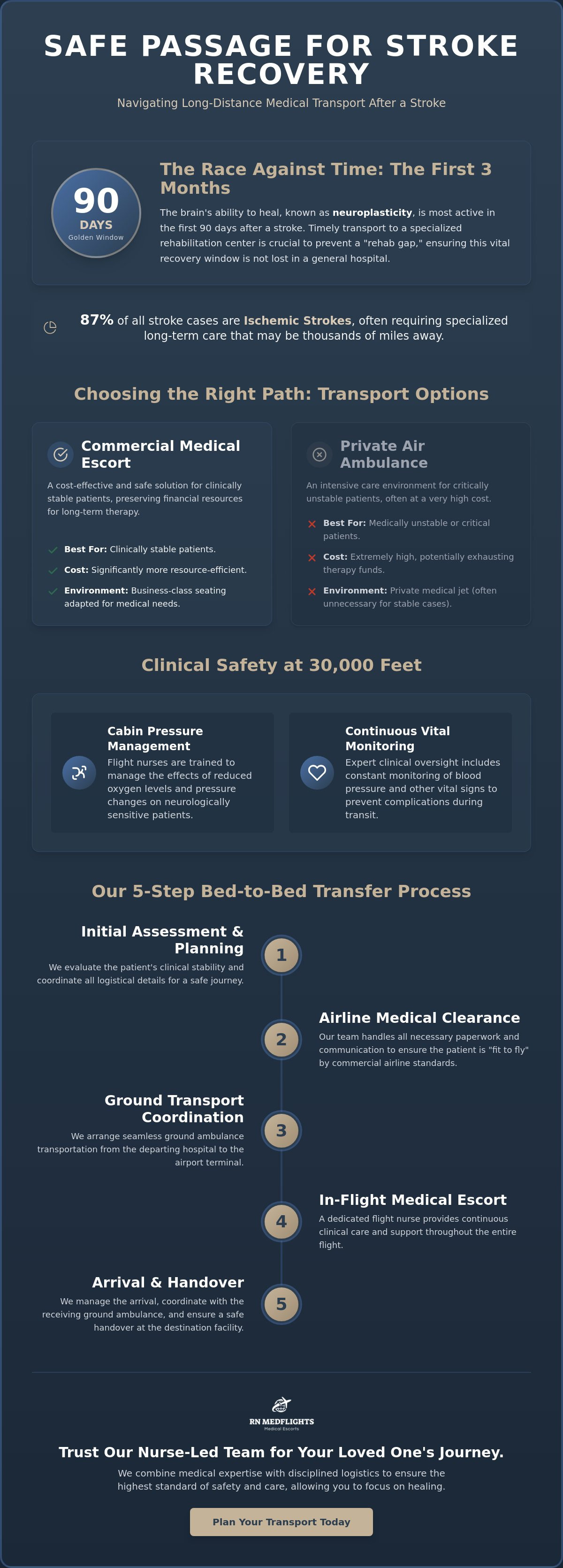
The Bed-to-Bed Transfer: A 5-Step Seamless Journey
Our bed-to-bed process begins long before we reach the airport. Step 1 involves a rigorous clinical assessment where our medical director reviews hospital records to verify stability. We don't just look at the diagnosis; we analyze oxygen requirements, mobility limitations, and medication needs. Step 2 shifts to logistical planning. We manage specialized seating, coordinate ground ambulances, and clear airline medical hurdles. Long distance transport for stroke patient recovery relies on this meticulous preparation to prevent surprises during transit.
Step 3 is the departure phase, starting with a bedside hand-off at the discharging facility. Our flight nurse assumes full responsibility, ensuring the patient is safely moved to the waiting ground transport. Step 4 encompasses the flight itself. This stage provides continuous medical supervision from the hospital bed to the aircraft seat and back to the new facility. Finally, Step 5 is the arrival. We deliver the patient directly to their room, providing a comprehensive clinical report to the new care team. This structured approach to long distance transport for stroke patient recovery ensures that no detail is overlooked.
Coordinating Ground Ambulance Logistics
The "first and last mile" of any medical trip are often the most stressful for families. Moving a patient from a hospital bed to a ground ambulance, and then from that ambulance into the airport terminal, requires precise timing and specialized equipment. We ensure that oxygen flow and clinical monitoring don't stop during the tarmac-to-plane transition. For more details on how we manage these land-based segments, you can read about our Non-Emergency Ambulance Service.
Communication with the Receiving Facility
A successful transfer relies on what we call a "Warm Hand-off." This is a direct, professional conversation between our flight nurse and the receiving rehab doctor. We ensure that all medical records and imaging are physically and digitally transferred so the new facility has a complete picture from the moment of intake. Our pre-arrival briefing allows the rehab team to be ready for immediate admission, preventing delays in starting therapy. If you're ready to begin this process, you can request a comprehensive transport plan from our team today.
Why Families Trust RN MEDflights for Stroke Recovery Transport
Families facing a medical crisis need a partner who understands both the clinical complexity of a neurological event and the logistical rigor of aviation. RN MEDflights stands apart as a clinically-led organization where every decision is filtered through the lens of patient safety. Our nurse-led model ensures that medical expertise, rather than just logistical convenience, dictates the pace and protocol of your journey. This approach is essential for successful long distance transport for stroke patient recovery, as it guarantees that a qualified professional is always anticipating the patient's next clinical need.
Our operations are built on veteran-owned precision. This background instills a level of discipline and reliability that is critical when managing international medical repatriation across multiple continents. Whether we're moving a patient across state lines or halfway around the globe, our team maintains a methodical rhythm that minimizes stress for everyone involved. We also prioritize financial clarity. By providing transparent pricing with no hidden fees, we help families protect their resources for the long-term rehabilitation costs discussed earlier in this guide.
A Compassionate Approach to Medical Crisis
Our role extends beyond medical monitoring. We recognize that families are often in the midst of the most stressful period of their lives. We offer emotional security through constant, around-the-clock availability. You won't be left wondering about the status of your loved one's relocation. Our previous clients frequently highlight this unwavering presence as the factor that allowed them to finally breathe after weeks of hospital-induced anxiety. We view every patient as a person with a family waiting for them, not just a case to be managed.
Getting Started with Your Recovery Plan
Initiating a recovery plan is a straightforward, sequential process. It begins with a clinical consultation to review the patient's current status and specific needs. To expedite this, please have a recent discharge summary and a current medication list ready for our team to review. We'll handle the airline medical clearances, ground coordination, and bedside hand-offs from there. Taking the first step ensures that your loved one moves toward a facility better equipped for their long-term healing without further delay. Our team is ready to provide the professional oversight necessary for a safe arrival.
Securing the Path to Neurological Healing
Choosing a premier rehabilitation facility is only half the battle. Getting there safely is what protects your loved one's hard-won progress. We've explored how nurse-led oversight and meticulous bed-to-bed coordination bridge the gap between acute hospitalization and specialized recovery centers. By selecting a commercial medical escort, you prioritize clinical safety while preserving vital financial resources for the years of therapy that lie ahead. For families considering specialized European care, Hani Amcha facilitates high-quality rehabilitation stays in the Czech Republic, ensuring the destination matches the excellence of the transport. This strategic approach to long distance transport for stroke patient recovery ensures that the journey itself doesn't become a setback.
RN MEDflights is a veteran-owned organization with over 15 years of medical aviation experience. Our team of registered flight nurses manages every clinical and logistical detail, ensuring the patient remains stable from the moment they leave their hospital bed until they are settled into their new room. We take full responsibility for the "first and last mile," providing the continuity of care that stroke survivors require. You don't have to manage this complex transition alone. We're here to provide the steady, professional presence your family needs during this critical time.
Frequently Asked Questions
How soon after a stroke can a patient fly long distance?
Patients can typically fly 14 days after an ischemic stroke, provided they have achieved clinical stability and received clearance from their treating physician. This timeline ensures the risk of a secondary event or complications from cabin pressure changes is minimized. We work closely with the discharging hospital to review neurological status and confirm that the patient is fit for travel before the journey begins.
Does health insurance cover the cost of a medical escort for stroke recovery?
Most health insurance policies do not provide direct coverage for commercial medical escort services. While Medicare Part B covers medically necessary air ambulance transport to the nearest appropriate facility, long distance transport for stroke patient recovery to a preferred rehab center is typically a private-pay service. We provide all necessary documentation to help families seek potential reimbursement from their insurance providers after the move.
Will the patient need a stretcher or can they fly in a standard seat?
The choice between a standard business class seat or a commercial airline stretcher service depends entirely on the patient's physical stability and mobility. If a survivor cannot sit upright for the duration of the flight, we coordinate a stretcher unit within the commercial cabin. Stable patients with partial mobility often find business class seats provide sufficient comfort and space for continuous clinical monitoring.
How do you handle medical emergencies if they happen during the flight?
Our flight nurses are trained in Advanced Cardiac Life Support (ACLS) and carry emergency medications to manage acute changes in status. We maintain constant communication with the flight deck and utilize the airline's ground-based medical support if a diversion becomes necessary. Every transport plan includes a detailed emergency protocol tailored to the patient's specific neurological and cardiovascular risk profile.
Can a family member fly with the stroke patient and the medical escort?
Yes, we encourage family members to fly alongside the patient and the medical escort whenever possible. Having a familiar presence can significantly reduce patient anxiety and support cognitive healing during the transition. We manage the logistics to ensure the family is seated near the patient for easy communication and emotional support throughout the journey.
What kind of medical equipment does the flight nurse bring on board?
We bring FAA-approved medical equipment including portable oxygen concentrators (POCs), physiological monitors, and automated external defibrillators (AEDs). Our nurses also carry a specialized medical kit containing blood pressure management medications and other critical care supplies. This equipment allows us to maintain a hospital-grade level of oversight while in the air.
Do you coordinate the ground ambulance at both the departure and arrival cities?
We provide comprehensive ground ambulance coordination at both the departure and arrival cities as part of our bed-to-bed service. This ensures a seamless transition of care without any gaps in monitoring or oxygen support. We manage the timing and clinical hand-offs so the family doesn't have to navigate local logistics in unfamiliar cities.
Is a commercial flight safe for a patient with aphasia or mobility issues?
Commercial flights are safe for patients with aphasia or mobility issues when they're accompanied by a professional escort who understands these specific challenges. We use specialized communication techniques for patients with aphasia and manage all physical transfers using proper lifting mechanics and specialized equipment. Long distance transport for stroke patient recovery is designed to accommodate these neurological deficits with dignity and care.


