Medical Escort for Spinal Cord Injury Patients: 2026 Guide
Could a commercial flight be possible after a spinal cord injury, and what needs to be in place first? A medical escort for spinal cord injury patients can support non-emergency travel when the treating clinician’s assessment indicates that the patient is ready to fly. Readiness depends on the person’s current condition and care needs, not simply on the diagnosis.
Before planning a trip, consider practical questions about positioning, transfers, skin protection, respiratory support, and personal care. The treating clinician can assess medical readiness and identify needs that should shape the travel plan. A licensed registered flight nurse can accompany a patient on a commercial flight, while coordinated ground ambulance transfers can connect the departure and arrival locations with the flight.
This guide covers what to discuss with the treating clinician, how to plan for spinal cord injury-related needs, and how nurse-supported commercial travel can work from one bedside to the next. It also explains the handoffs that help organize continuity of care throughout a non-emergency relocation.
Table of Contents
Medical escort for spinal cord injury patients: what the journey involves
A medical escort provides clinical support during non-emergency travel on a commercial airline. For a person with a spinal cord injury, this may include accompaniment by a licensed registered flight nurse. The treating clinician’s assessment should guide whether commercial travel is appropriate and what care the journey requires. A flight nurse escort is not emergency medical transport and is not automatically suitable for every patient. The right plan depends on the person’s current condition, clinical needs, and ability to complete the journey with appropriate support.
Spinal cord injuries can affect movement, sensation, and other aspects of health in different ways. An overview of Spinal Cord Injury can provide general background, but it cannot determine an individual’s readiness to travel. That assessment belongs with the treating clinician, who understands the patient’s circumstances.
Why spinal cord injuries can shape travel planning
Plan around how the person moves, what they can feel, and the assistance they need with daily care. Reduced sensation, for example, may make it harder to notice discomfort from prolonged pressure. Skin protection and position changes are therefore important topics to discuss with the care team. Transfer needs also matter: moving between a bed, wheelchair, vehicle, and aircraft seat may require different assistance at each stage.
Consider personal care across the full itinerary, not just during the flight. Autonomic dysreflexia is another subject for individualized clinical discussion, including whether the person has a history of it and what their care team recommends for travel. These details help shape a realistic plan without assuming that every person with a spinal cord injury has the same risks or needs.
What a medical escort contributes during a commercial flight
A flight nurse provides professional medical supervision while accompanying the patient on a commercial flight. The nurse’s role is separate from the airline crew’s responsibility for operating the aircraft and managing onboard safety. A nurse escort is also different from routine passenger assistance provided under airline procedures. The travel plan should specify which clinical needs require nurse support and which mobility or access arrangements need coordination with the airline.
Good coordination connects these responsibilities rather than leaving families to piece them together. RN MEDflights provides non-emergency commercial airline medical escorts with licensed registered flight nurses and coordinates bed-to-bed transport and ground ambulance transfers. This connects the clinical plan with practical arrangements before departure and after arrival. For a broader overview of the process, see Medical Escort Service: The Complete Guide to Safe Commercial Medical Travel in 2026.
The following sections explain what to discuss with the treating clinician, how to plan transfers and in-flight needs, and how to coordinate the journey from pickup to arrival.
Assessing flight readiness with a spinal cord injury care team
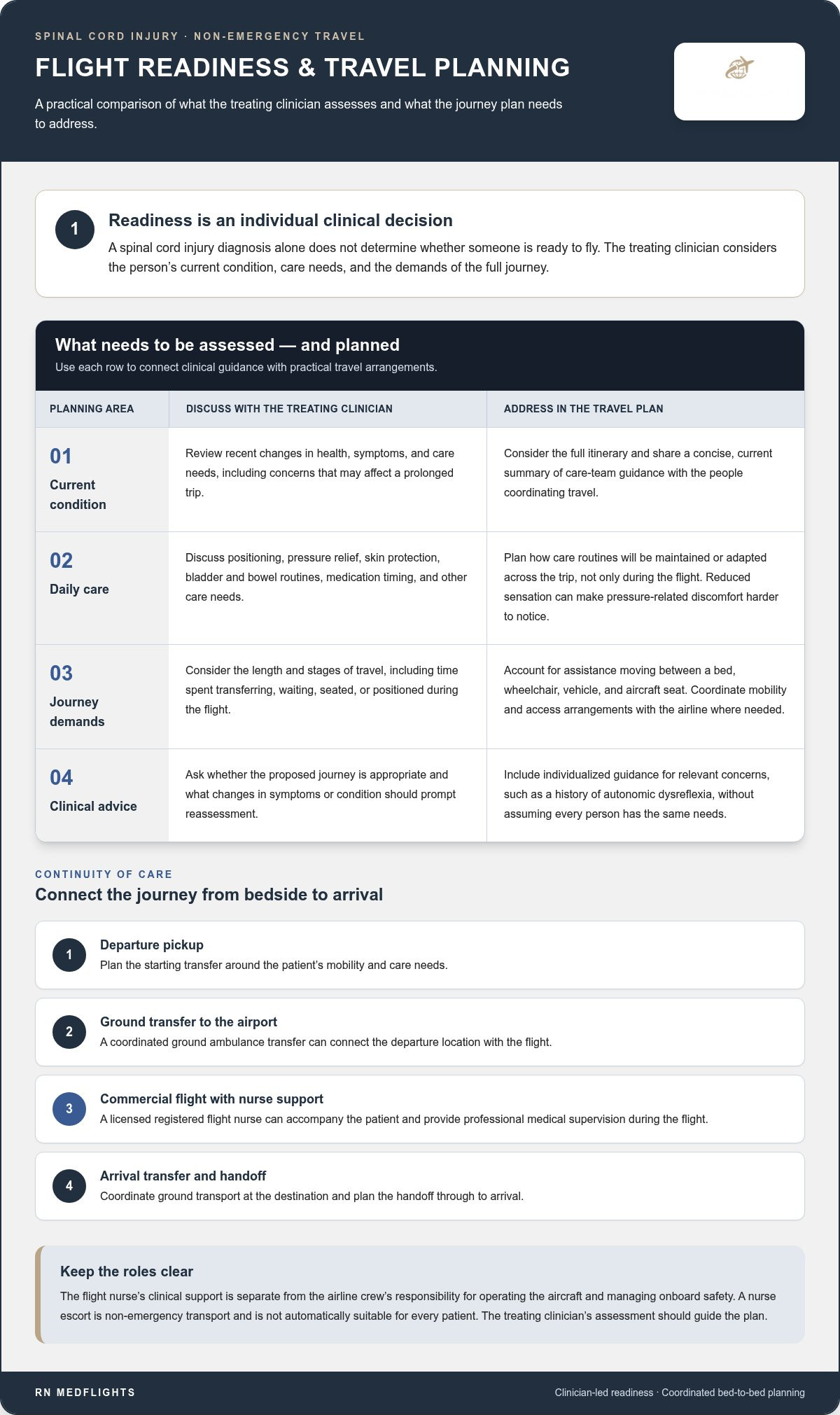
Flight readiness is not determined by a spinal cord injury diagnosis alone. It is an individualized clinical decision based on the person’s current health, support needs, and the demands of the planned journey. The treating clinician’s assessment should guide whether commercial air travel is appropriate and identify the care arrangements the trip requires. Share recent health changes and discuss complications with the care team before finalizing travel arrangements.
A structured conversation can help the patient, family, and clinicians work through the decision:
Current condition: Review recent changes in health, symptoms, or care needs, including concerns that may affect a prolonged trip.
Care needs: Describe the assistance needed with positioning, skin protection, bladder and bowel routines, medication timing, and other daily care.
Journey demands: Consider the length and stages of travel, including time spent transferring, waiting, and seated or positioned during the flight.
Clinician advice: Ask whether the proposed journey is appropriate and what changes would call for reassessment.
Questions to discuss with the treating clinician
Bring practical questions as well as the itinerary. Discuss how the patient’s current condition may be affected by a prolonged journey and which parts of their usual care routine need to be maintained or adapted. Cover positioning and pressure relief, skin protection, bladder and bowel routines, and medication timing. Clarify what changes in symptoms or condition should prompt a pause in planning or a new clinical assessment.
Write down the care team’s guidance and share it with the people coordinating travel. A concise, current summary gives everyone a common reference without replacing the clinician’s judgment.
When medical needs may call for a different transport plan
Commercial air travel is one possible non-emergency option, but only when the patient’s needs and clinical assessment support it. If health needs are changing rapidly or the situation may be an emergency, seek prompt direction from the treating clinicians rather than treating a planned commercial flight as emergency transport. The appropriate plan depends on the patient’s condition and the level of care required during transport.
For a comparison of transport approaches, see Medical Escort vs. Air Ambulance: Key Differences. If the clinician supports non-emergency commercial travel, RN MEDflights’ commercial medical escort planning can connect the clinical discussion with a nurse-supported relocation plan.
Planning transfers, positioning, and in-flight care needs
A workable travel plan covers more than time in the air. Map each stage, from the residence or care facility to the vehicle, airport, aircraft, arrival transfer, and receiving destination. At each handoff, identify the assistance the patient needs, who will provide it, and how relevant care information will be passed to the next person. This makes gaps easier to identify before travel day.
For a medical escort for spinal cord injury patients, transfer arrangements should reflect the person’s abilities and clinical guidance. A patient who can assist with some movements may need a different plan from someone who requires full assistance. Document transfer needs for each location with the treating team and transport coordinators. Do not assume the same method will work at the residence, airport, and destination.
Preparing for transfers and time spent seated
Review each transfer point with the treating team and the people coordinating transportation. Consider how the patient will move between their usual support surface, vehicle, airport arrangements, and aircraft seating. Discuss positioning, pressure relief, and skin protection before confirming the plan, especially if travel involves extended periods in one position. The care team should guide any techniques or timing; a general travel checklist cannot replace individualized advice.
Airline seating, accessibility arrangements, and procedures can differ by carrier and route. Verify the details for the specific itinerary rather than assuming arrangements from a previous flight will apply. Include the relevant findings in the transfer plan, along with who will assist and what needs to be communicated to airline personnel.
Organizing medications, supplies, and personal care
Work with the treating clinician to prepare a written plan for medications and essential care supplies. Include timing across the itinerary, how items need to be accessed during travel, and any storage considerations that affect the plan. Check current carrier procedures for the actual route instead of assuming what an airline will allow or how an item can be carried.
Personal care also needs practical planning. Consider when the patient may need assistance, which supplies should be accessible, and how the itinerary affects established routines. Make necessary care needs clear to the people coordinating the journey while preserving the patient’s comfort and dignity. Broader travel preparation topics are covered in Flying with Medical Needs: A Traveler’s Handbook.
Before departure, compare the itinerary with the clinician-reviewed care plan. Confirm that transfer arrangements, positioning needs, medication timing, supplies, and personal care have been considered at each stage. If the itinerary or the patient’s condition changes, revisit the plan with the care team and coordinators. This preparation supports a connected handoff from pickup through arrival, while allowing for the needs of the individual patient and the specific airline.
Building a coordinated plan from pickup to arrival
A coordinated relocation connects clinical planning with the practical details of the itinerary. For a medical escort for spinal cord injury patients, each handoff matters: from the residence or facility to ground transportation, through the airport and flight, and onward to the receiving destination. A written sequence helps the patient, family, clinicians, and transport team understand what happens next and who is responsible for each arrangement.
Build the plan in stages:
Align on clinical needs. Use the treating clinician’s guidance to describe the patient’s care and mobility requirements during the trip.
Coordinate the itinerary. Match flight timing with pickup, airport access, and the arrangements needed at the destination.
Plan the handoffs. Identify who will meet the patient at each transition and what information needs to be communicated.
Review route details. Verify current airline procedures and accessibility arrangements for the specific carrier and itinerary. For international travel, plan for route-specific documentation and airline processes.
Connecting ground ambulance transfers with the flight
Ground transfers at both ends can connect the patient’s starting location and receiving destination with commercial air travel. Align pickup timing with the flight itinerary, and plan airport access and arrival arrangements together. For example, make clear where the departing transfer ends, how the patient proceeds through the airport, and who will receive them after landing. For dedicated vehicle options that accommodate specific mobility requirements, you can explore Private Point-to-Point Transport and Specialized Medical/NDIS Transfers to help coordinate smooth airport connections.
RN MEDflights coordinates ground ambulance transfers alongside non-emergency commercial airline medical escorts. This helps organize the transportation stages around the flight, while recognizing that each part of the journey has its own responsibilities and handoffs. Clear planning supports continuity without implying that one team provides uninterrupted clinical coverage at every point.
Keeping the patient and family informed
Use one shared itinerary as the working reference for the patient, family, clinicians, and transport team. Include key contacts, planned milestones, transfer arrangements, and the care-plan information needed for each handoff. Limit sensitive medical details to the people who need them, and involve the patient in decisions and communications according to their preferences.
Review the itinerary together before travel. Confirm that everyone understands the pickup plan, flight sequence, arrival arrangements, and whom to contact if a detail changes. A clear, respectful briefing can reduce uncertainty without overwhelming the patient with logistics. It also gives family members a consistent picture of the plan while leaving room for the patient’s questions and choices.
For help coordinating a non-emergency commercial relocation, learn about nurse-supported medical flights and ground transfers with RN MEDflights.
How RN MEDflights supports non-emergency travel for spinal cord injury patients
Planning a relocation after a spinal cord injury involves clinical guidance and careful coordination across the journey. RN MEDflights provides non-emergency commercial airline medical escorts for patients whose needs and clinical assessment support this form of travel. Licensed registered flight nurses accompany patients on commercial airline relocations, and ground ambulance coordination can connect the departure location, flight, and receiving destination.
This service is not emergency transport, and an escort does not determine whether a patient is fit to fly. The treating clinician’s assessment remains central. When commercial travel is appropriate, the itinerary and care information help organize the journey around the patient’s individual needs.
What the RN MEDflights journey coordination includes
RN MEDflights coordinates commercial airline nurse escorts, bed-to-bed medical transport, and ground ambulance transfers at both ends. These arrangements connect the patient’s starting point with the flight and receiving destination. The nurse provides professional supervision during the commercial flight, while ground transportation is coordinated as part of the broader relocation plan.
These services support domestic medical relocation and international medical repatriation. Each journey has its own itinerary and coordination requirements. For an international route, planning includes attention to the relevant airline process and route-specific documentation. The travel plan should reflect the clinician’s guidance and the patient’s stated care needs, without assuming one arrangement suits every spinal cord injury or guarantees a particular clinical outcome.
Families can prepare by gathering information that makes the plan specific and usable:
The proposed route, travel dates, and departure and receiving locations
The treating clinician’s advice about travel and the patient’s current care needs
Mobility and transfer assistance requirements at each stage
Relevant medication timing, supplies, and care routines to account for during travel
Contact details for the family, care team, and receiving facility or support person
Sharing these details helps the coordination team understand how the travel stages fit together. It also gives the patient and family a clear basis for discussing the itinerary and handoffs.
Taking the next step with a care team and escort coordinator
Begin with the treating clinician’s guidance, then gather the itinerary and a concise outline of the patient’s needs. Clear, current information helps the escort coordinator plan the non-emergency transport journey and organize details such as ground transfers and airline-specific procedures. If the patient’s condition or itinerary changes, share the update with the care team and coordinator so the plan can be revisited.
If you’re considering a nurse-supported commercial relocation, discuss your medical transport needs with RN MEDflights. The conversation can focus on the proposed journey and coordination needs, with the treating clinician’s assessment guiding whether commercial travel is appropriate.
Take the next step with a clear travel plan
Planning can feel more manageable when the next decision is specific. Identify the question that still needs an answer, whether it concerns clinical readiness, a transfer arrangement, or how care needs fit the proposed itinerary. Bring it to the treating clinician or transport coordinator, and keep the patient’s preferences at the center of the conversation.
A medical escort for spinal cord injury patients is one form of non-emergency travel support when the clinical assessment and individual needs make commercial air travel appropriate. You do not need to solve every detail at once. A clear starting point can help the patient and family move through the planning process with greater confidence and make informed decisions together.
When you’re ready to explore a commercial flight with coordinated ground transportation, talk with RN MEDflights about travel planning. Share the clinician’s guidance, intended route, and support the patient needs to begin planning the journey.
Frequently Asked Questions
Can a person with a spinal cord injury fly on a commercial airplane?
Yes, some people with a spinal cord injury may be able to fly commercially, but suitability depends on their individual condition and care needs. The treating clinician should assess the proposed trip, including its duration and transfer demands, before arrangements are finalized. A change in health since the last appointment, for example, may affect the plan. Airline accessibility and medical procedures also vary, so review details for the specific carrier and route.
Does a spinal cord injury patient need a medical escort to fly?
Not necessarily. The need for an escort depends on the person’s clinical needs, mobility, and the support available throughout the trip. Someone who needs professional medical supervision during a non-emergency commercial journey may benefit from an escort, while another traveler’s needs may differ. Discuss the decision with the treating clinician. A medical escort for spinal cord injury patients is an option, not a requirement based on diagnosis alone.
What should a spinal cord injury patient discuss with a doctor before flying?
Discuss how the patient’s current condition may be affected by the full journey, including airport time and transfers. Bring a clear account of recent health changes, medications, daily care routines, positioning needs, and any complications the clinician should consider. Ask what changes would require another assessment or a revised itinerary. A written summary of the clinician’s travel guidance can help the patient, family, and transport coordinator work from the same information.
How can pressure injury risk be managed during air travel?
Ask the treating clinician to recommend an individualized approach to positioning, skin protection, and pressure relief for the planned journey. The plan should account for how long the patient may remain in each position and what assistance they need to make adjustments. If the patient has reduced sensation, discuss how caregivers can notice possible skin concerns. Do not rely on a generic schedule or technique; the clinician should guide decisions for that person.
Can a flight nurse help a spinal cord injury patient during a commercial flight?
Yes. A licensed registered flight nurse can accompany a patient on a commercial flight and provide professional medical supervision during travel. The nurse’s role is separate from the airline crew’s responsibility for operating the flight, and it does not replace airline assistance procedures for passengers with mobility needs. The care team and escort coordinator can discuss the patient’s needs and clarify the planned support for the flight and related travel stages.
How are ground ambulance transfers coordinated for a medical escort flight?
Ground ambulance coordination connects the patient’s departure location and receiving destination with the commercial flight itinerary. The plan should align pickup details with airport timing and identify how the patient will be received after landing. For example, the family and transport team can put the destination address, key contacts, and relevant handoff information in one itinerary. This helps organize transitions between transport stages without assuming that one team covers every part of the journey.
What happens if a patient's condition changes before the flight?
Tell the treating clinician and transport coordinator promptly if the patient’s condition changes before departure. The clinician can advise whether the change requires reassessment and whether the current travel plan remains appropriate. Share updated guidance with those coordinating the itinerary, since flight, transfer, or care arrangements may need review. If the change appears urgent, seek prompt medical direction rather than relying on a planned commercial escort as emergency transport.