Oxygen on Commercial Flights: The 2026 Guide to Safe Medical Air Travel
Imagine sitting at the departure gate, checking your Portable Oxygen Concentrator (POC) display and wondering if your batteries will truly last through an unexpected two-hour tarmac delay. For the 15 million Americans currently living with chronic obstructive pulmonary disease, the technicalities of managing oxygen on commercial flights often create more anxiety than the travel itself. It's natural to feel concerned about conflicting airline battery rules or the physiological effects of cabin pressure at 30,000 feet. You deserve a journey that's defined by clinical stability rather than logistical fear.
This 2026 guide provides a rigorous clinical roadmap to ensure your medical air travel is uncompromisingly safe and stress-free. We'll outline the exact steps for expert coordination, from calculating the mandatory 150% battery life buffer to understanding FAA-approved device lists. You'll gain a clear understanding of how our bedside-to-bedside nursing model provides the specialized oversight needed to handle any altitude-related respiratory changes with professional confidence.
Key Takeaways
Understand how cabin pressure at 35,000 feet impacts blood oxygen saturation and why the "8,000-foot rule" is a critical safety threshold for medical travelers.
Navigate the 2026 FAA regulations for oxygen on commercial flights to ensure your portable oxygen concentrator (POC) is fully approved and legal for air travel.
Follow a clinical step-by-step checklist to secure essential medical clearances, including the High Altitude Simulation Test (HAST) and mandatory physician prescriptions.
Learn how specialized flight coordination manages the complex logistics of TSA security and ground transfers for a seamless, bedside-to-bedside journey.
Discover the RN MEDflights advantage, where licensed professionals provide continuous monitoring to ensure uncompromising safety and peace of mind for your family.
Table of Contents Understanding the Physiology of Flight: Why Oxygen Matters at 35,000 Feet FAA Regulations and Portable Oxygen Concentrators (POCs) in 2026 The Logistical Burden: Why Families Struggle with Independent Travel Step-by-Step Checklist for Flying with Oxygen The RN MEDflights Advantage: Professional Oxygen Coordination
Understanding the Physiology of Flight: Why Oxygen Matters at 35,000 Feet
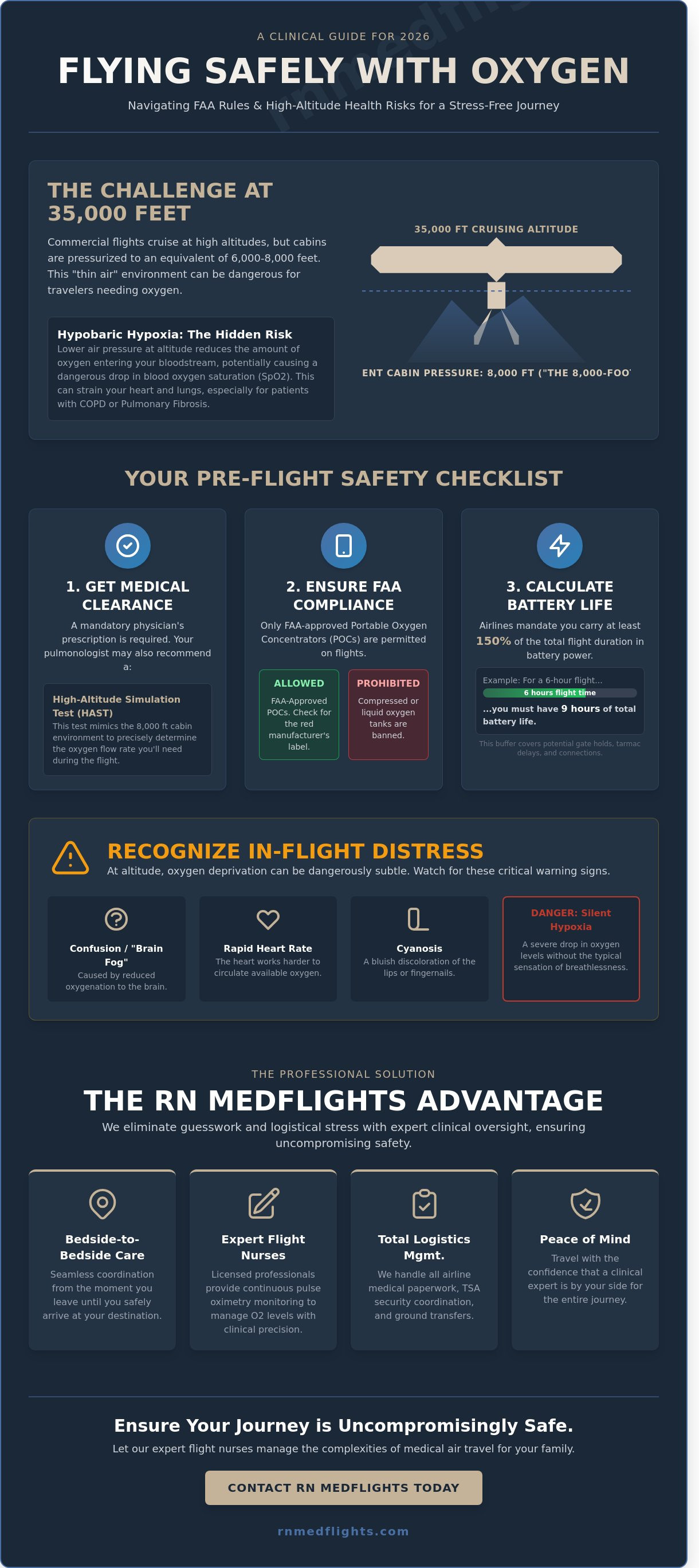
Traveling at high altitudes presents unique physiological challenges that the human body isn't naturally equipped to handle. While a modern jet cruises at high altitudes, the physiology of flight at 35,000 feet requires sophisticated engineering to keep passengers safe. Most commercial cabins are pressurized to an equivalent altitude of 6,000 to 8,000 feet. This "8,000-foot rule" means that even though you're sitting in a comfortable chair, your body experiences the atmospheric pressure of a mountain peak. For a healthy traveler, this shift is negligible. However, for those requiring oxygen on commercial flights, the drop in barometric pressure leads to hypobaric hypoxia, a condition where lower air pressure reduces the amount of oxygen entering the bloodstream.
Patients with Chronic Obstructive Pulmonary Disease (COPD) or Pulmonary Fibrosis are particularly vulnerable during these transitions. On the ground, these individuals may maintain stable saturation levels with minimal support. Once the cabin reaches cruising altitude, the decreased partial pressure of oxygen can cause blood oxygen saturation (SpO2) to plummet. A patient who is stable at sea level might find their respiratory system working twice as hard to compensate for the thin air, leading to rapid fatigue and cardiac strain. This is why ground-level requirements rarely mirror the support needed during transit.
The High-Altitude Simulation Test (HAST): Your Safety Baseline
Your pulmonologist may recommend a High-Altitude Simulation Test (HAST) before you clear for travel. This clinical evaluation mimics the 8,000-foot cabin environment by having the patient breathe a specialized gas mixture containing only 15.1% oxygen for a set duration. Clinicians monitor heart rate and SpO2 levels to predict how your lungs will respond to the actual flight. HAST is the clinical gold standard for determining in-flight flow rates. By identifying these needs early, our flight coordinators can ensure your bedside-to-bedside care plan includes the exact liter flow required for a seamless journey.
Signs of Respiratory Distress at Altitude
Recognizing the onset of respiratory distress is vital for maintaining patient dignity and safety. Early warning signs often include cyanosis, which is a bluish tint to the lips or fingernails, alongside sudden confusion or an increased respiratory rate. One of the most dangerous risks is "silent hypoxia." In these cases, a patient's oxygen levels drop significantly without the typical sensation of breathlessness, leading to a sudden loss of consciousness or cardiac events.
Increased heart rate (tachycardia) as the body struggles to circulate oxygen.
Cognitive impairment or "brain fog" caused by reduced cerebral oxygenation.
Physical exhaustion from the increased work of breathing.
To mitigate these risks, our team provides continuous pulse oximetry monitoring. The presence of a specialized flight nurse ensures that oxygen levels are managed with clinical precision throughout the trip. We take the guesswork out of oxygen on commercial flights, providing a vigilant, 24/7/365 presence that prioritizes your safety and peace of mind.
FAA Regulations and Portable Oxygen Concentrators (POCs) in 2026
Safety protocols for oxygen on commercial flights are uncompromising. As of January 2026, the FAA maintains an absolute prohibition on the transport of compressed oxygen cylinders or liquid oxygen tanks in the cabin. These items are classified as hazardous materials due to their pressurized nature and the risk of combustion. Instead, travelers must use an FAA-approved Portable Oxygen Concentrator (POC). These devices don't store oxygen; they extract it from the surrounding air, making them safe for pressurized environments.
To verify your device is legal, check the exterior for a manufacturer's label in red lettering stating that the device is FAA-approved. You can also cross-reference your model with the latest FAA regulations for Portable Oxygen Concentrators to ensure compliance. If the label is missing or illegible, gate agents may deny boarding to protect the safety of the aircraft.
Battery Logistics: The #1 Point of Failure
The most common reason for travel disruption isn't the device itself, but insufficient power. The FAA requires travelers to carry enough battery life to cover 150% of their total flight duration. This calculation is vital because it accounts for taxiing delays, weather diversions, and unexpected layovers.
To calculate your needs, multiply your total expected travel time by 1.5. For example, if you're on a 6-hour flight with a 2-hour layover, your total travel time is 8 hours. You must carry 12 hours of battery life. This math must be based on your specific flow rate. A device set at 2 Liters Per Minute (LPM) consumes power much slower than one set at 5 LPM. Always verify your battery's actual performance at your prescribed setting before heading to the airport.
You cannot rely on in-seat power outlets. Most aircraft outlets provide limited wattage and are prone to tripping when a medical device draws a surge of power. For patients undergoing international medical repatriation, our teams recommend carrying external battery packs and ensuring all units are 100% charged before leaving the bedside.
Navigating Airline-Specific Oxygen Policies
While FAA rules provide a baseline, individual carriers have unique notification requirements. Delta and American Airlines require a minimum of 48 hours' notice if you plan to use oxygen on commercial flights. United Airlines utilizes a digital accessibility portal where you must upload your device's specifications at least 48 hours before departure.
International carriers often have more stringent protocols. Lufthansa and Emirates frequently require their own medical clearance forms, signed by a physician, to be submitted up to 72 hours in advance. Failure to meet these windows can result in a forced rebooking.
Standard documentation includes a Physician’s Statement. This document must confirm your ability to hear the device alarms, your required flow rate, and whether you need oxygen during all phases of flight or just at cruise altitude. If these logistics feel overwhelming, contact a flight coordinator
The Logistical Burden: Why Families Struggle with Independent Travel
Managing oxygen on commercial flights involves more than just purchasing a ticket. It requires meticulous planning for every foot of the journey. Families often underestimate the physical toll of navigating sprawling hubs like Atlanta (ATL), London Heathrow (LHR), or Dubai (DXB). Carrying a 5 to 10-pound Portable Oxygen Concentrator (POC) while managing luggage and a vulnerable patient creates significant physical strain. Battery anxiety is a constant pressure. Most airlines require a battery life of 150% of the flight duration to account for unexpected delays. This means a 10-hour flight requires 15 hours of battery life. Carrying multiple spare batteries adds even more weight to the traveler’s load, complicating an already stressful situation.
The "Gap" in Care: Ground to Air Transitions
The transition from a residence or hospital to the airport terminal represents the most vulnerable period for a patient. Continuous flow must be maintained without interruption. A specialized non-emergency ambulance service bridges this critical gap. These services ensure the patient remains stable from their front door to the gate. Boarding and deplaning are high-risk moments where oxygen levels can fluctuate due to physical exertion or emotional stress. A seamless bedside-to-bedside transfer plan eliminates these risks by providing professional oversight during these transitions. Our flight coordinators act as a steady hand, managing the logistics so the family can focus on their loved one’s comfort.
TSA and Security: Avoiding Medical Delays
Security checkpoints present a unique set of challenges. Under the Air Carrier Access Act (ACAA), passengers have the right to travel with approved medical devices. However, the 2026 security protocols require rigorous inspection of all electronic equipment. You must ensure the POC remains operational during the search to prevent desaturation. It's helpful to reference the Code of Federal Regulations for medical oxygen to understand the legal framework that protects your right to carry these life-sustaining devices. Our nurse-led team ensures every piece of equipment is compliant before you ever reach the airport. We provide the technical medical terminology needed to communicate effectively with security personnel.
To prevent delays, keep these documents in your carry-on:
A signed physician’s statement dated within the last 30 days.
The manufacturer's technical data sheet for the POC.
A list of all prescribed medications and their specific dosages.
A written contingency plan for device malfunction or battery failure.
Our flight coordinators manage these details 24/7/365 to ensure that oxygen on commercial flights remains a safe and viable option for our patients. We prioritize dignity and clinical integrity throughout the entire process, providing a sense of security that the logistics are being handled by experts.
Step-by-Step Checklist for Flying with Oxygen
Preparation is the foundation of clinical safety. To ensure a seamless journey while using oxygen on commercial flights, patients must follow a rigorous protocol. This checklist reflects the standard of care our flight coordinators use to manage complex respiratory cases with precision and empathy.
Step 1: Consult your pulmonologist. Request a High Altitude Simulation Test (HAST) to determine how your body reacts to decreased partial pressure. Secure a written prescription that specifies your exact liter flow for both rest and activity.
Step 2: Verify FAA compliance. Confirm your Portable Oxygen Concentrator (POC) appears on the FAA-approved list for 2026. Airlines won't permit non-approved devices in the cabin.
Step 3: Notify the airline. Contact the "Special Assistance" desk at least 72 hours before departure. This lead time allows the carrier to document your medical needs and verify your POC model.
Step 4: Calculate battery life. FAA regulations require battery power for 150% of your total travel time. If your flight and layovers total 8 hours, you must carry 12 hours of charged battery life.
Step 5: Secure professional support. For patients with high-risk conditions or those requiring constant monitoring, arranging for medical escort services provides an essential layer of clinical oversight and peace of mind.
Packing Your Medical Carry-On
A well-organized "Go-Bag" prevents mid-flight crises when traveling with oxygen on commercial flights. Our flight nurses always carry a secondary pulse oximeter to monitor saturation levels accurately. Pack at least two spare nasal cannulas and a dedicated AC adapter for charging during layovers. Keep rescue medications, such as albuterol inhalers or nebulizer solutions, in an easily accessible pocket. This ensures every tool needed for respiratory stability is within reach at 35,000 feet.
In-Flight Management Strategies
Maintaining physiological stability requires active management. We advise patients to sit upright to maximize lung expansion and prevent atelectasis. Proper hydration is equally vital; cabin air is notoriously dry, which increases mucous viscosity and hinders oxygen exchange. If anxiety increases, focus on slow, pursed-lip breathing to prevent hyperventilation. Our bedside-to-bedside care model prioritizes these clinical nuances to ensure your safety remains uncompromising throughout the journey.
If you need assistance coordinating your next journey, our flight coordinators are available 24/7/365 to provide
.
The RN MEDflights Advantage: Professional Oxygen Coordination
Managing oxygen on commercial flights involves more than just carrying a portable concentrator; it requires a meticulous clinical plan that begins long before takeoff. Our flight coordinators take the full weight of logistics off your shoulders by managing all airline medical clearances and required Physician's Statement forms. We ensure every technical detail meets the specific airline's 2026 safety standards, which prevents stressful boarding denials at the gate. This end-to-end management provides a cost-effective alternative to private air ambulances, often reducing transport expenses by 50 percent or more while maintaining uncompromising clinical safety.
Our team assumes full bed-to-bed responsibility for every patient. This means we manage the oxygen supply and medical needs from the hospital room, through the airport terminal, and into the patient's home. You don't have to worry about battery life, backup supplies, or ground transport transitions. We handle every detail with clinical precision, providing the peace of mind that comes from knowing a professional is in control.
Nurse-Led Clinical Supervision
Having a Registered Nurse by your side is vital because physiological needs change rapidly at 30,000 feet. Our RNs monitor vitals and pulse oximetry 24/7, allowing for the precise titration of oxygen during turbulence or bouts of respiratory distress. If a Portable Oxygen Concentrator (POC) fails or a battery malfunctions, our nurses are trained to initiate emergency interventions immediately. They carry specialized backup equipment to ensure the patient's breathing remains stable throughout the journey.
In June 2024, we successfully managed the international repatriation of a 72-year-old patient with Stage III COPD traveling from London to New York. During a period of heavy turbulence over the Atlantic, the patient's oxygen saturation levels dropped to 86 percent. Our flight nurse quickly identified the distress, adjusted the flow rate according to standing orders, and utilized specialized breathing techniques to stabilize the patient. We avoided a costly mid-flight diversion and ensured the patient arrived at their destination safely and with dignity.
Seamless Logistical Execution
We utilize a "Zero-Friction" approach to manage every transition between the medical facility and the aircraft. Our flight coordinators synchronize ground ambulance arrivals with flight schedules to minimize the time a patient spends in crowded or high-stress terminal environments. We navigate the 2026 global travel landscape by pre-clearing medical equipment with security agencies and international customs, ensuring a smooth path through every checkpoint. This methodical rhythm ensures the patient feels cared for and secure at every stage of the trip.
Securing Your Path to Safe Medical Travel
Managing oxygen on commercial flights requires more than a portable device. It demands a sophisticated understanding of how 35,000-foot altitudes impact respiratory physiology and blood oxygen saturation. Since 2010, RN MEDflights has delivered uncompromising medical repatriation services for families facing these complex travel hurdles. Our veteran-owned team specializes in international medical repatriation, providing nurse-led bedside-to-bedside care that bridges the gap between hospital and home. We ensure your travel meets the specific 2026 FAA battery requirements and airline safety protocols so you don't have to worry about technical failures or boarding denials. Our flight coordinators manage every logistical detail, including ground transport and in-flight clinical monitoring. This specialized approach reduces the emotional burden on families and ensures the patient's dignity remains intact throughout the transit. You deserve the peace of mind that comes with a steady, expert hand guiding your journey. We're ready to help you or your loved one return home safely and comfortably.
Frequently Asked Questions
Can I use the airline’s on-board oxygen supply?
Most commercial airlines don't provide supplemental oxygen for passenger use during a flight. While they carry oxygen for decompression emergencies, FAA regulations prevent them from dispensing it for routine medical needs. You must bring your own FAA-approved Portable Oxygen Concentrator (POC) to maintain your saturation levels. Our flight coordinators ensure your device meets every specific carrier requirement before you reach the gate.
How many batteries do I really need for a 10-hour flight?
You must carry enough battery power to last 150% of your total travel time. For a 10-hour flight, you'll need 15 hours of battery life to account for taxiing, gate delays, or unexpected diversions. This is a strict requirement under 14 CFR Part 121. We recommend calculating battery life based on your specific liter flow setting, as higher settings drain power faster.
What happens if my POC stops working during the flight?
If your device fails, you must notify the flight crew immediately to access the aircraft’s emergency oxygen system. This is a critical safety situation that requires immediate clinical intervention. Having a registered nurse escort from RN MEDflights provides a redundant layer of safety. We carry backup equipment and monitor your vitals constantly to manage equipment malfunctions without compromising your health.
Does Medicare or private insurance pay for in-flight oxygen or escorts?
Medicare doesn't pay for oxygen on commercial flights or the cost of professional medical escorts. According to the Medicare Claims Processing Manual, coverage for oxygen is limited to the home environment. Private insurance policies rarely cover these services unless they're deemed a medical necessity for an emergency transfer. We provide detailed documentation to help families seek potential reimbursement from private providers.
Is a doctor’s note enough to board with oxygen in 2026?
A standard doctor's note isn't sufficient for travel in 2026. Most airlines require a specific Medical Data Form (MEDIF) or a formalized Physician’s Statement signed within 10 days of departure. This document must explicitly state your oxygen flow rate and your ability to respond to device alarms. Our team manages this clinical paperwork to ensure a seamless transition from the bedside to the aircraft cabin.
Can I fly with oxygen if I have a cold or respiratory infection?
Flying with a respiratory infection is dangerous because cabin pressure changes can cause severe ear pain or a rapid drop in oxygen saturation. A 2022 study in the Journal of Travel Medicine suggests that even mild congestion increases the risk of barotrauma. If you're unwell, our medical directors perform a clinical assessment to determine if you require a higher level of care during your transport.
What is the Air Carrier Access Act and how does it protect oxygen users?
The Air Carrier Access Act (ACAA), specifically 14 CFR Part 382, prohibits airlines from discriminating against passengers who require oxygen on commercial flights. It mandates that carriers allow the use of FAA-approved POCs and provide assistance during boarding. This federal law ensures your right to travel with medical equipment. We advocate for your rights under this act to guarantee you receive the specialized care you deserve.
How do I know if my Portable Oxygen Concentrator (POC) is FAA-approved?
You can verify if your POC is FAA-approved by checking for a manufacturer’s label with red lettering stating it meets SFAR 106 requirements. The FAA has approved over 25 specific models, including the Inogen One G5 and the Philips Respironics SimplyGo. If the label is missing or illegible, the airline will deny boarding. Our flight coordinators verify your equipment’s compliance 48 hours before your scheduled departure.


