


Repatriation of Remains vs Medical Repatriation: Key Differences Explained
- Apr 26
- 13 min read
On a Tuesday evening in March 2024, a family in London found themselves paralyzed by the technical differences between repatriation of remains vs medical repatriation. They were unsure if they needed to coordinate the return of a recovering father or arrange for a deceased loved one to be brought home for a final resting place. You’re likely feeling that same weight of confusion while trying to manage a logistical crisis from thousands of miles away. It's difficult to decipher industry jargon when every hour counts and the emotional stakes are high.
This guide clarifies these vital distinctions so you can secure the precise professional support your situation demands. As a nurse-led organization, we want to ensure you find a cost-effective, safe, and dignified solution without the fear of choosing the wrong service. We will break down the clinical requirements, legal documentation, and specialized transport methods needed for both living patients and the deceased. This clarity provides the steady hand you'll need to move forward with confidence and peace of mind.
Key Takeaways
Clarify the fundamental distinction between returning a living patient for ongoing clinical care and transporting a deceased loved one for final resting arrangements.
Learn how medical repatriation provides essential bedside-to-bedside continuity, ensuring living patients receive professional supervision throughout their journey home.
Understand the specialized legal and mortuary requirements necessary to navigate the sensitive process of returning remains with dignity and international compliance.
Compare the specific costs, timelines, and urgency factors of repatriation of remains vs medical repatriation to secure the appropriate level of professional intervention.
Discover how expert medical escort services offer a seamless, stress-free solution for families navigating the complexities of international medical travel.
Table of Contents Repatriation of Remains vs Medical Repatriation: The Fundamental Difference Medical Repatriation: Ensuring Clinical Continuity for the Living Repatriation of Remains: Dignity and Legal Compliance for the Deceased Comparing Costs, Timelines, and Requirements Choosing the Right Path: How RN MEDflights Supports Living Patients
Repatriation of Remains vs Medical Repatriation: The Fundamental Difference
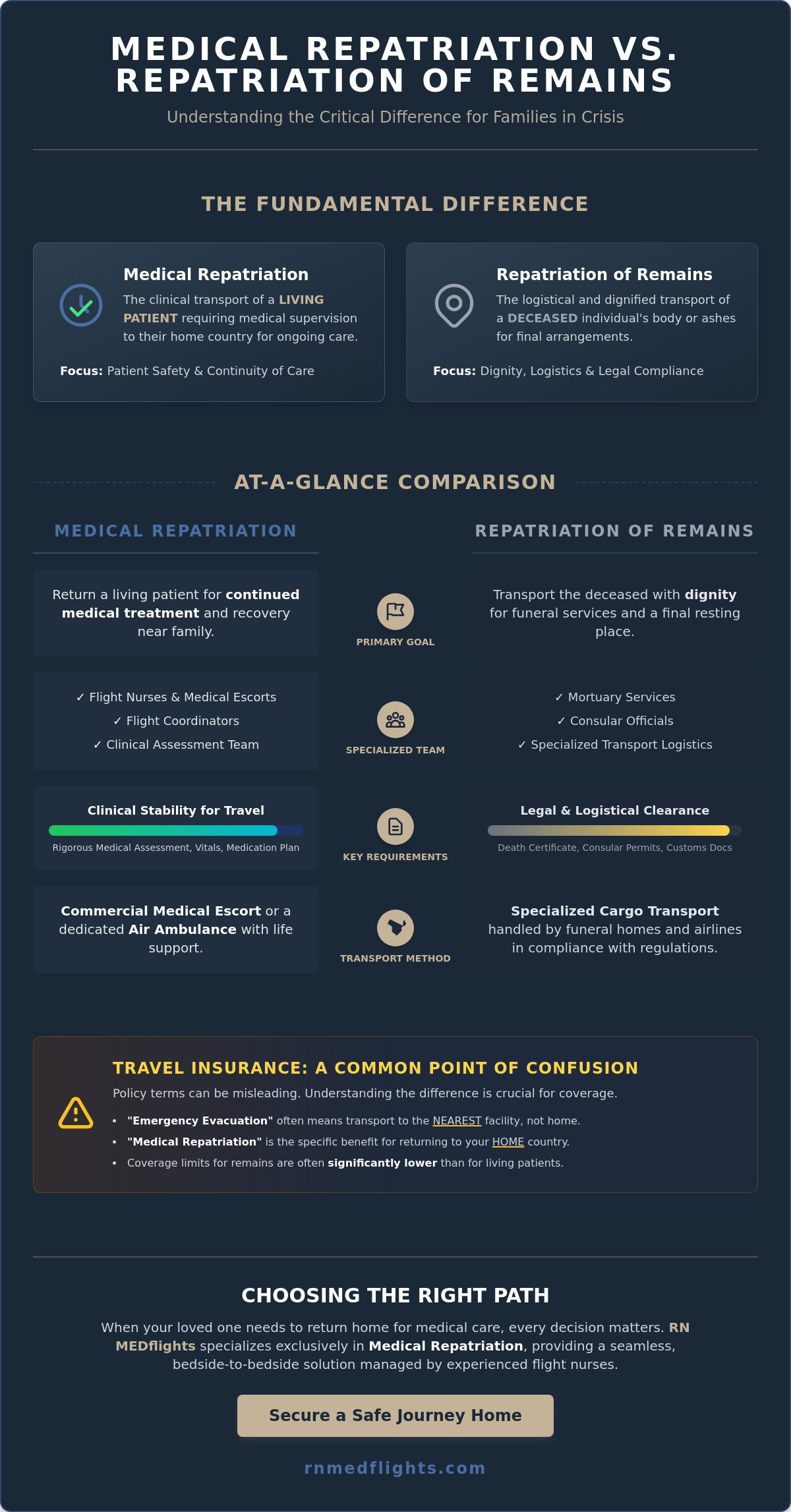
At its core, Repatriation is the process of returning a person to their country of origin or citizenship. While the term sounds straightforward, its application in a crisis requires absolute clarity to ensure the correct resources are deployed. Understanding the distinction between repatriation of remains vs medical repatriation is vital for families facing an unexpected emergency abroad. These two services serve entirely different purposes, follow distinct international regulations, and involve different specialized teams.
Medical Repatriation is the clinical transport of a living patient who requires medical supervision during their journey home. This process often utilizes specialized air ambulances equipped with advanced life support or commercial medical escorts. Conversely, Repatriation of Remains is the logistical and dignified transport of a deceased person's body or cremated ashes. As global travel continues to expand in 2026, distinguishing these terms is essential for accurate insurance claims and seamless logistical planning. A mistake in terminology can lead to significant delays during a time when every hour counts.
Why Terminology Matters in a Crisis
Using the wrong term during an emergency call can delay the coordination of life-critical transport. International regulations for living patients, governed by aviation and health authorities, focus on clinical stability and bedside-to-bedside care. Transporting a deceased person involves a different set of customs, consular requirements, and health department permits. Medical repatriation is a clinical journey for the living that prioritizes patient safety and continuity of care. Our flight coordinators operate 24/7/365 to manage these specific regulatory hurdles, ensuring that the patient's medical needs remain the primary focus throughout the transition.
Common Misconceptions in Travel Insurance
Families often confuse "Emergency Evacuation" with "Medical Repatriation" when reviewing their policy documents. Emergency Evacuation typically only covers the cost of moving a patient to the nearest "appropriate" medical facility, which may still be thousands of miles from home. Medical Repatriation is a specific benefit that facilitates the journey back to the patient's home country for long-term recovery. It's important to identify the specific triggering events required for these benefits to activate. Most insurance providers require a clinical determination that the patient is stable for transport but requires specialized medical monitoring.
Coverage Limits: Many policies cap the repatriation of remains vs medical repatriation benefits at different levels, often providing lower limits for deceased transport.
Clinical Necessity: Insurance companies usually only trigger medical repatriation when the local facility cannot provide the necessary level of care.
Logistical Control: Families should confirm whether they have the right to choose their transport provider or if the insurer mandates a specific vendor.
Clear communication with insurance adjusters ensures that the patient receives the appropriate level of care without unnecessary financial strain. Understanding these nuances allows families to act with confidence and secure the peace of mind they need during a medical crisis.
Medical Repatriation: Ensuring Clinical Continuity for the Living
Medical repatriation focuses on the safe, structured transfer of a living patient back to their home country for continued treatment or long-term recovery. While the logistics are often confused in the context of repatriation of remains vs medical repatriation, the two processes serve entirely different needs. The primary goal here is clinical continuity. We utilize a bedside-to-bedside care model, meaning a dedicated flight coordinator manages every detail from the initial hospital discharge in a foreign land to the final admission at a local facility. This seamless transition ensures that the patient's care never falters during the thousands of miles spent in transit.
Before any mission begins, our clinical team conducts a rigorous medical assessment. This process isn't just a formality; it's a safety imperative. We review current vitals, medication lists, and oxygen requirements to ensure the patient is stable for high-altitude travel. This professional oversight aligns with CDC information on medical evacuation and repatriation, which highlights the complexity of returning home after a health crisis abroad. Utilizing international medical repatriation services provides a layer of protection that standard travel insurance often lacks, prioritizing the patient's dignity and physiological stability.
The Role of the Flight Nurse Escort
A Registered Nurse serves as the patient's clinical advocate and vigilant protector throughout the journey. They manage complex medication schedules, monitor pulse oximetry, and provide specialized wound care in the aircraft cabin. Beyond the clinical tasks, there's a profound psychological benefit to having an RN present. Families experience a sense of security knowing an expert is managing the journey's "what-ifs." These nurses also handle the technical logistics, coordinating directly with airline medical desks to secure necessary clearances, a process that typically requires 48 to 72 hours of lead time.
Commercial Airline vs. Private Air Ambulance
For patients who are stable but require clinical supervision, a commercial escort is a cost-effective alternative to a private jet. This service often utilizes business class seating to allow for elevation and comfort. In cases where a patient cannot sit upright for the duration of the flight, we arrange commercial stretcher services. This involves the airline removing 6 to 9 seats to accommodate a medical stretcher and equipment. However, if a patient's condition is critical or requires advanced life support, we upgrade the mission to a private medevac jet. This decision is based on a patient-first philosophy, ensuring the environment matches the acuity of the case. If you're navigating a current crisis, consulting with our flight team can help determine the safest transport level for your loved one. Our 24/7/365 availability ensures that expert guidance is always just a phone call away.
Repatriation of Remains: Dignity and Legal Compliance for the Deceased
When a death occurs abroad, the priority shifts from clinical intervention to the dignified return of the deceased to their principal residence for burial or cremation. This process, known as repatriation of remains, differs fundamentally from medical repatriation. While medical repatriation focuses on stabilizing and transporting a living patient under the care of a specialized medical crew, the repatriation of remains relies on mortuary science and strict adherence to international law. At RN Medflights, our mission centers on the living; however, we recognize the profound emotional and logistical weight families carry when managing the transport of a loved one who has passed away.
The process is governed by the regulations of both the departing and receiving nations. Consulates and embassies serve as the primary facilitators. They verify the identity of the deceased and ensure all local legal requirements are met before remains can cross international borders. This is a bureaucratic journey that requires precision to avoid delays during an already difficult time. It's a standard of care that prioritizes legal compliance and public health over clinical monitoring.
Required Documentation and Legal Hurdles
Transporting a body internationally involves a complex paper trail. Authorities require a certified death certificate, an embalming certificate, and a transit permit. Many countries, such as Italy and Germany, enforce specific standards for "sealed caskets" or "zinc linings" to meet public health codes. Families should prepare for a timeline that typically spans 7 to 14 days. These requirements ensure the deceased is handled with integrity while complying with international sanitary regulations. Accuracy in this documentation is vital to prevent the remains from being held at customs.
Logistical Coordination: Funeral Homes and Airlines
Successful transport requires seamless coordination between a foreign funeral director and a receiving funeral home in the home country. The International Air Transport Association (IATA) sets rigorous regulations for human remains on commercial cargo decks, requiring specific crating and labeling. If a family chooses cremation abroad, the process changes significantly. Transporting cremated remains is often faster and involves different airline rules, though it still requires a certificate of cremation and a death certificate.
Understanding the nuances of repatriation of remains vs medical repatriation helps families make informed decisions during a crisis. Our team remains available 24/7/365 to offer guidance and support. We ensure that every individual, whether they require advanced life support or a final journey home, is treated with uncompromising respect and dignity. Our nurse-led perspective ensures we view every case through a lens of compassion and specialized expertise.
Comparing Costs, Timelines, and Requirements
Families often face a heavy emotional burden when arranging transport for a loved one. Understanding the logistical layers of repatriation of remains vs medical repatriation helps clarify why these services require significant financial and operational resources. While medical repatriation focuses on stabilizing a living patient during transit, the repatriation of remains prioritizes the dignified return of a deceased individual. Both processes involve complex international laws, specialized equipment, and rigorous coordination between multiple agencies.
The urgency factor varies between these two services. Medical repatriation is frequently a race against time, where every hour counts for a patient's recovery or access to specialized care. In contrast, the timeline for remains is often driven by religious or cultural requirements. For example, certain faiths necessitate burial within 24 to 48 hours, placing immense pressure on logistical teams to secure immediate consulate clearances and flight space. When air transport isn't feasible for shorter distances, a specialized non-emergency ambulance service provides a controlled ground alternative for stable patients or local transfers.
Families frequently ask why these services carry such high costs. The answer lies in the uncompromising safety standards and the number of professionals involved. A single transport might require flight coordinators, medical directors, customs brokers, and ground handlers. You aren't just paying for a flight; you're paying for a mobile intensive care unit or a legally compliant international transfer that bypasses the standard delays of commercial travel.
Cost Drivers for Both Services
Several variables influence the final investment for these services. Flight distance is the primary factor, but specialized equipment also plays a major role. Medical flights require ventilators and monitors, while remains require specialized caskets or air trays designed for high-altitude pressure changes. In 2026, peak travel seasons have seen a 12% increase in private charter costs due to limited hangar availability and fluctuating fuel surcharges. While a nurse escort on a commercial flight typically costs between $5,000 and $15,000, international mortuary shipping often ranges from $10,000 to $20,000 depending on the destination and local consulate requirements.
Insurance and Financial Assistance
It's vital to review your travel insurance policy immediately. Many standard plans include medical evacuation but list "Repatriation of Remains" as a separate, capped benefit. If a patient is uninsured, private pay options are available, and our team often helps families navigate payment plans to ease the immediate pressure. Veterans may be eligible for specific burial and plot allowances through the VA, such as those outlined in VA Form 21P-530. Some employer-sponsored travel programs also provide "bedside-to-bedside" assistance that covers the total cost of transport for employees working abroad.
To discuss your specific logistics and receive a transparent cost breakdown,
today.
Choosing the Right Path: How RN MEDflights Supports Living Patients
Understanding the distinction between repatriation of remains vs medical repatriation is the first step in managing a family crisis. While funeral directors handle the sensitive logistics of the deceased, RN MEDflights serves as the clinical guardian for living patients who need to return home for care. We specialize in the complex medical and logistical requirements of medical repatriation, ensuring your loved one receives continuous clinical oversight during their entire journey. Our medical escort service offers a specialized solution for stable patients, providing peace of mind by placing a highly trained flight nurse by their side on commercial aircraft.
Choosing the right path depends entirely on the patient's clinical stability and the distance involved. We provide a steady hand during these high-stress moments, offering professional guidance that prioritizes safety over all other factors. Families don't have to navigate these complexities alone; we act as the bridge between international medical facilities and domestic healthcare providers.
The RN MEDflights Bed-to-Bed Promise
We don't just manage the flight portion of the journey. Our team coordinates the entire clinical continuum through a strict bed-to-bed protocol. This process involves syncing ground ambulance transport at both the origin hospital and the destination facility. By managing these transitions, we ensure there are no gaps in monitoring or care. This continuity is vital for maintaining the patient's physiological stability during the move.
Our veteran-owned team operates with a foundation of integrity and deep compassion. We understand that we're transporting a person, not just a case. Every mission is staffed by flight nurses who have completed specialized training in aeromedical logistics and advanced life support. This clinical precision allows us to handle unexpected medical changes mid-flight with the same expertise found in a high-acuity hospital setting.
Next Steps for Families in Crisis
When you contact our flight coordinators, having specific information ready allows us to generate a precise care plan quickly. Please prepare the following details:
The patient's most recent clinical medical report or discharge summary.
The current hospital's name, city, and country.
The name and location of the receiving facility or home address.
A list of required medical equipment, such as supplemental oxygen or mobility aids.
Our flight coordinators remain available 24/7/365 to answer urgent questions and provide immediate clinical consultations. We help families evaluate the most appropriate mode of transport based on the patient's current medical status and the family's budget. This methodical approach ensures that every detail is accounted for before the patient ever leaves their bed. Contact RN MEDflights for a compassionate medical repatriation quote today.
Securing a Safe and Seamless Journey Home
Choosing between repatriation of remains vs medical repatriation depends entirely on the clinical status of your loved one and the specific logistical requirements of the situation. While the return of a deceased individual requires strict legal compliance and mortuary coordination, medical repatriation focuses on maintaining advanced life support and clinical continuity for living patients. Since 2010, RN MEDflights has bridged this gap by providing veteran-owned expertise and nurse-led oversight for every mission. Our 24/7/365 global coordination center manages every detail of the bedside-to-bedside process, ensuring that medical standards never waver during transit.
We understand that these moments are filled with pressure; therefore, we've refined our protocols over 14 years to minimize your stress. Our team prioritizes patient dignity and medical integrity, utilizing specialized flight coordinators to navigate complex international permits. You can trust our experienced clinicians to serve as a steady hand during this transition. We're ready to help you navigate these choices with clarity and professional care. You're not alone in this journey, and your family's peace of mind is our primary mission.
Frequently Asked Questions
Is medical repatriation the same as an air ambulance?
Medical repatriation is the logistical process of returning a patient to their home country, while an air ambulance is the specific vehicle used for that transport. This process often involves private aircraft configured as mobile intensive care units. RN Medflights manages these bedside-to-bedside transfers using specialized equipment and nurse-led teams to ensure clinical continuity throughout the entire journey.
Does travel insurance always cover repatriation of remains?
No, travel insurance doesn't always cover the repatriation of remains because coverage depends on your specific policy and the cause of death. Statistics from the insurance industry show that roughly 85 percent of comprehensive travel policies include this benefit, but exclusions for pre-existing conditions or high-risk activities are common. You should check your policy for the "repatriation of remains vs medical repatriation" clauses to understand your specific financial protection.
Can a family member fly with the patient during medical repatriation?
Yes, most private air ambulance flights allow one family member to accompany the patient at no additional cost. Having a loved one nearby provides essential emotional support during a high-stress medical crisis. Our flight coordinators confirm these details during the initial planning phase, ensuring the aircraft's weight and balance accommodate both the medical team and your family member safely.
How long does it take to arrange an international medical repatriation?
Arranging an international medical repatriation typically takes 24 to 72 hours from the initial call to takeoff. This timeframe allows our team to secure international landing permits, coordinate with foreign medical facilities, and staff the flight with specialized nurses. RN Medflights remains available 24/7/365 to expedite these logistics, as we understand that every hour is critical for a patient's recovery and peace of mind.
What happens if a patient passes away during a medical repatriation flight?
If a patient passes away during transport, the medical team follows established clinical protocols and international aviation laws to handle the situation with dignity. The pilot coordinates with air traffic control to determine the best landing site based on legal jurisdictions and the family's wishes. This transition from medical repatriation to the repatriation of remains is handled with the utmost compassion and professional integrity by our flight crew.
Do I need a funeral director for repatriation of remains?
Yes, you must hire a licensed funeral director in both the originating country and the destination country to manage the transport. These professionals handle the "Consular Mortuary Certificate" and ensure the body is prepared according to the 1973 Strasbourg Agreement on the Transfer of Corpses. They also coordinate with customs officials to ensure the casket meets international shipping standards, which often require specific zinc lining for air travel.
Can RN Medflights help if my loved one is on a ventilator?
Yes, RN Medflights specializes in transporting patients who require mechanical ventilation and advanced life support. Our nurse-centric teams use portable, hospital-grade ventilators and continuous monitoring systems to maintain the patient's stability. We provide uncompromising bedside-to-bedside care, meaning our specialized medical staff stays with your loved one from the moment they leave the hospital bed until they're safely admitted to the receiving facility.
What is the cheapest way to repatriate a patient internationally?
The most cost-effective method for international transport is a commercial medical escort if the patient is clinically stable. This service involves a registered nurse accompanying the patient on a commercial airline, either in a business class seat or on a cleared stretcher section. Utilizing a commercial escort can reduce the total cost by 50 percent compared to a private air ambulance while still providing professional medical oversight and peace of mind.
