Transporting a Non-Ambulatory Patient by Air: A 2026 Guide
Being unable to walk doesn’t automatically rule out a commercial flight. Transporting a non-ambulatory patient by air may be possible when the patient’s medical needs, positioning, and transfer requirements can be accommodated throughout the journey. The right option depends on more than mobility alone.
It’s understandable to have questions about airline assistance, medical support, and how to coordinate travel between home, airports, and the destination. Each part of the journey needs to connect, with the patient’s comfort, dignity, and continuity of care in view.
This guide explains what to consider when planning travel, how commercial medical escort and stretcher arrangements differ, and why ground transfers and airline coordination matter. RN MEDflights arranges non-emergency travel on commercial airlines with licensed registered flight nurses. Bed-to-bed coordination and ground ambulance arrangements can connect the journey from departure through arrival.
Table of Contents
Can You Transport a Non-Ambulatory Patient by Air?
In some circumstances, yes. Being unable to walk independently doesn’t automatically rule out a commercial flight, but it does mean the journey needs careful planning. The patient’s condition, ability to remain comfortably positioned, transfer needs, and required support all matter. Airline arrangements also affect what is practical for a particular trip.
Mobility describes how a person moves. It doesn’t, by itself, determine whether they are medically suited to fly. Keeping that distinction in mind helps families ask more useful questions instead of assuming the same arrangement will work for everyone.
This video offers an introduction to patient transport on a scheduled flight:
What non-ambulatory means during air travel
“Non-ambulatory” describes mobility. It may refer to someone who can’t walk independently, needs help moving between a bed and a wheelchair, or relies on assistance to transfer into a seat. The term doesn’t explain what clinical care the person needs or which travel arrangement is appropriate.
For example, one passenger may use a wheelchair but be able to sit upright and travel with mobility assistance. Another may need help maintaining a particular position or require clinical support during the trip. Those are different needs, and neither can be assumed from the label alone. The treating clinician can describe the patient’s condition and support needs, while airline arrangements also need to be built into the plan.
Why a commercial flight may be considered
A commercial flight may be an option for non-emergency travel when the journey can be planned around the patient’s needs. Assess the whole trip, not just the time in the air: transfers to and from the airport, movement through the terminal, boarding, seating or stretcher arrangements, and onward travel at the destination. An onboard arrangement still needs to fit the ground journey.
Families can begin by discussing the patient’s condition, positioning, and travel support with the treating team. This information can guide airline arrangements and help frame whether a seated medical escort or another plan is appropriate to explore. A complete guide to medical escort services explains how clinical support can accompany a planned commercial journey.
Commercial medical travel differs from air ambulance transport, which uses a dedicated aircraft for patient transport. The Air ambulance overview describes fixed-wing and rotary-wing services. The important question is which travel model fits the patient’s needs and the journey, rather than relying on mobility status alone.
What Determines Whether a Non-Ambulatory Patient Can Fly?
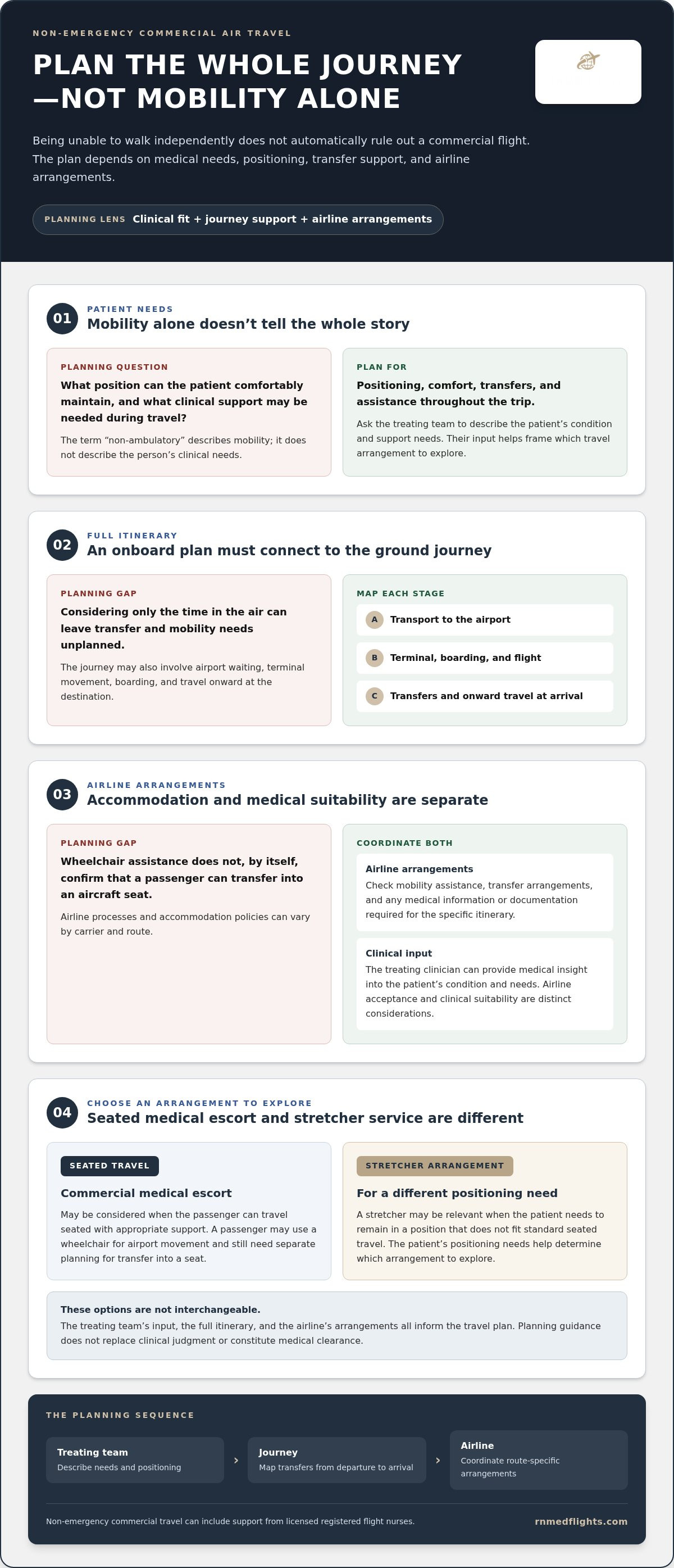
No single mobility label or checklist determines whether a patient can travel. A practical assessment considers three connected areas: the patient’s clinical and positioning needs, the demands of the full journey, and the airline’s arrangements for the route. Considering these together helps families identify questions early and gives the treating team a clear picture of the proposed trip.
Airline acceptance and clinical suitability are separate considerations. The airline’s accommodation process covers the flight and its requirements. The patient’s treating clinician can provide medical insight into the patient’s condition and needs. Both matter when planning.
Clinical needs, positioning, and assistance
Start by identifying what the patient can comfortably tolerate and what support they need during travel. Can they sit upright for the journey, or do they need to remain in another position? Will they need help transferring between a bed, wheelchair, and seat? Consider whether their condition or comfort needs may change during a long trip, including while waiting at the airport.
A clinician familiar with the patient can describe relevant medical needs and discuss whether the proposed journey is appropriate to consider. This planning does not replace the clinician’s judgment or constitute medical clearance. The Aerospace Medical Association’s Medical Guidelines for Airline Travel provide a reference for physicians advising patients with medical conditions.
Airline accommodations and mobility arrangements
Next, map the mobility support needed at each stage. Wheelchair use may help a passenger move through the airport, but it doesn’t establish whether they can transfer into an aircraft seat. Assisted transfers need separate planning. A passenger who can sit in a standard seat may need a different arrangement from someone who requires a stretcher. These options aren’t interchangeable, and the patient’s positioning needs help determine which arrangement to explore.
Airline processes and accommodation policies can vary by carrier and route. Plan for mobility assistance, transfers, and any medical information or documentation the airline requires. Map the full itinerary: travel to the airport, movement through the terminal, boarding, the flight, and onward transport. A suitable onboard arrangement still needs to connect with practical transfers at both ends.
Ask the treating team to describe the patient’s positioning and assistance needs.
Identify every transfer point, including transport at arrival and the destination.
Organize airline accommodation details and required documentation for the specific itinerary.
For families weighing transporting a non-ambulatory patient by air, a flight nurse can provide clinical support on a commercial journey when appropriate to the patient’s needs. Learn more about the flight nurse role and responsibilities. RN MEDflights arranges non-emergency commercial airline travel with licensed registered flight nurses, alongside bed-to-bed coordination and ground ambulance arrangements. Explore medically supported commercial travel as you shape a plan around the patient and itinerary.
Commercial Flight, Stretcher Service, or Air Ambulance?
These options involve different aircraft, care arrangements, and planning processes. With a commercial medical escort, the patient travels on a scheduled airline flight accompanied by a registered flight nurse. A commercial stretcher service also uses a scheduled flight, but requires a stretcher arrangement coordinated with the airline. A private air ambulance uses a dedicated aircraft and is a separate service category.
The comparison below outlines the main differences. Use it as a starting point for discussion, not as a determination of what a particular patient can safely use.
Care model
Journey context
Planning focus
Commercial medical escort:
Patient travels on a scheduled flight with a registered flight nurse.
Planned, non-emergency travel when the patient’s needs and arrangements suit commercial travel.
Clinical support needs, airline arrangements, transfers, and ground transport.
Commercial stretcher service:
Patient travels on a scheduled flight using an airline-coordinated stretcher arrangement.
A possible arrangement for a patient who cannot travel seated, subject to airline policies and route logistics.
Airline-specific coordination, patient needs, documentation, and transfers at both ends.
Private air ambulance:
Patient travels in a dedicated aircraft arranged for medical transport.
A distinct transport category for situations requiring a different aircraft and care model.
An appropriate clinical transport decision based on the patient’s condition and needs.
A medically escorted commercial flight may be appropriate when travel is non-emergency and the patient’s clinical needs, positioning, and support can be planned around a scheduled airline journey. A registered flight nurse accompanies the patient, and the itinerary must also account for airport movement and ground transfers. This option isn’t suitable for every non-ambulatory patient. The treating team’s input, airline arrangements, and route logistics all inform the plan.
A commercial stretcher service differs from a seated escort. Airline-specific policies and coordination are central to determining whether it can be arranged for a particular route. Neither commercial option should be assumed to meet needs that call for a different level or type of transport. If the patient’s condition is urgent or requires a high-acuity care environment, the treating team should guide the appropriate clinical transport decision.
Ground transport is another part of the journey. Some plans combine a commercial flight with ground ambulance arrangements to connect departure and arrival locations. This guide to non-emergency ambulance services explains how ground options fit into patient travel.
When transporting a non-ambulatory patient by air, compare the care model and the full journey, not just the time in flight. RN MEDflights arranges non-emergency commercial airline travel with licensed registered flight nurses and coordinates bed-to-bed medical transport and ground ambulance services. This brings the patient’s needs, comfort, and continuity of care into view at each transition.
How to Plan Air Travel for a Non-Ambulatory Patient
A clear sequence can make a complex trip easier to manage. Begin with the treating team, then build the itinerary around the patient’s needs and the airline’s process. Allow time for coordination because requirements and arrangements can vary by carrier, route, and travel setup.
Discuss the proposed journey with the treating team. Share the intended route and ask the clinician familiar with the patient to advise on relevant travel considerations. Note how the patient moves, whether they can sit upright, what positioning they need, and what help they require during transfers. This information helps shape the plan, but it doesn’t replace clinical judgment.
Gather essential care and travel details. Prepare a concise summary of relevant care needs, medication details, mobility and positioning requirements, and clinician contact information. Keep these records accessible throughout the journey rather than packing them in checked luggage. Having key details together can make handoffs clearer for everyone supporting the patient.
Map the airline arrangements. Follow the airline’s established process to understand the accommodation steps for the specific itinerary. Ask about mobility assistance, boarding arrangements, transfer considerations, and any medical forms or supporting documents required. Processes vary, so don’t assume one carrier’s instructions apply to another or that a connecting route follows the same arrangements as a direct flight.
Plan equipment and practical support. List any mobility or positioning equipment the patient uses, then determine how it fits into the journey and what arrangements apply to its use or transport. Align the plan with airline instructions and the treating team’s guidance. Consider how the patient will move at every point, not only how they will travel onboard.
Coordinate every ground transfer. Map the trip from the departure location to the airport, through arrival, and onward to the destination. Include wheelchair assistance, transfers between mobility aids and seats, and any ground ambulance coordination the journey requires. Identify who is responsible at each handoff so planned assistance is in place between transport stages.
Review the itinerary and timing as one plan. Allow time for airline coordination, document preparation, and ground transport arrangements. Revisit the schedule if a connection, route, or patient need changes. Before departure, keep travel details, contact information, and essential records together and easy to access.
Planning to transport a non-ambulatory patient by air means coordinating clinical information, airline arrangements, and arrival-side support as one journey. RN MEDflights arranges non-emergency commercial airline travel with licensed registered flight nurses and coordinates bed-to-bed medical transport and ground ambulance arrangements at both ends. Arrange medically supported commercial travel with a plan built around the patient’s needs and itinerary.
How RN MEDflights Supports Non-Emergency Air Transport
Once a family understands the patient’s needs and the possible travel arrangements, the next challenge is connecting each part of the journey. RN MEDflights arranges non-emergency domestic and international medical travel on commercial airlines. Licensed registered flight nurses accompany patients, and the service includes bed-to-bed coordination and ground ambulance arrangements at both ends.
This approach brings clinical support and travel logistics together while keeping the patient’s comfort, dignity, and continuity of care in view. It is designed for planned, non-emergency travel. Private air ambulance and emergency medical transport are separate transport categories, and urgent needs call for an appropriate clinical transport decision.
A nurse-led commercial airline journey
On a commercial airline journey, a licensed registered flight nurse accompanies the patient as a clinical escort. The nurse’s presence is part of a planned travel arrangement, not a substitute for the treating team’s role in advising on the patient’s needs. Sharing relevant care and travel information during planning helps shape an arrangement for the individual, rather than treating mobility as the only consideration.
Every patient’s circumstances are different. The support required, how the patient will travel, and the airline arrangements all inform the plan. A commercial medical escort is a non-emergency option when it suits the patient and itinerary. It isn’t a fit for every person who cannot walk, and it isn’t equivalent to a dedicated air ambulance.
Coordinating the journey from departure to arrival
Air travel is only one part of the trip. A patient may need transport from their current location to the departure airport, then onward from the arrival airport to the destination. RN MEDflights coordinates ground ambulance arrangements at both ends and bed-to-bed medical transport, connecting these stages within a coordinated plan.
For families and caregivers, understanding how the transitions fit together can make the process easier to follow. A plan can account for the patient’s needs from departure through arrival, rather than leaving relatives to coordinate separate legs without a clear view of how they connect. Coordination also keeps handoffs and travel details visible to those supporting the patient.
When planning a journey, bring together the proposed route, the treating team’s input, and a clear description of the patient’s mobility and support needs. These details help shape the travel plan and its coordination. The aim is an organized, respectful, non-emergency journey that considers the person as well as the logistics.
If you’re planning non-emergency travel, discuss medical travel with RN MEDflights and the coordination that can support the journey from departure through arrival.
Take the Next Step Toward a Thoughtful Travel Plan
You don’t need to solve every detail at once. Start with what matters most to the patient: their comfort, the support they rely on, and what they’ll need upon arrival. Those priorities can guide conversations with the treating team and help shape a plan that respects the person behind the travel arrangements.
Transporting a non-ambulatory patient by air involves decisions specific to each person and journey. Bring together the route, the patient’s needs, and any remaining questions, then consider how they can inform a coordinated non-emergency plan. RN MEDflights is a veteran-owned and operated small business founded in 2010, supporting families as they plan medical travel.
Start planning a non-emergency medical journey with RN MEDflights. Take the next step toward a coordinated plan built around the patient and their travel needs.
Frequently Asked Questions
Is a volunteer pilot flight the same as a medically escorted commercial flight?
No. A volunteer pilot flight is arranged through a volunteer organization, while a medically escorted commercial journey takes place on a scheduled airline flight with a registered flight nurse accompanying the patient. The aircraft, operating arrangements, and support differ. Before considering either option, clarify who will accompany the patient, what support is included, and whether the arrangement fits the patient’s needs.
Can a family member travel with a non-ambulatory patient?
Often, a family member can travel on the same commercial flight by booking a separate seat, depending on the itinerary and airline arrangements. Their presence may offer familiarity and reassurance, but it helps to agree in advance on their role. For example, clarify who will assist with communication, personal items, and family updates, and how transfers will be handled alongside the patient’s travel support.
What happens if the patient’s condition changes before departure?
Tell the treating clinician and the people coordinating the journey promptly. A new symptom, change in mobility, or different positioning need may affect the existing plan. Don’t assume an earlier travel assessment still applies if the patient’s circumstances have changed. The treating clinician can advise on the patient’s current needs, and travel arrangements may need to be reviewed before departure.
Can international air travel be arranged for a non-ambulatory patient?
Yes. International travel may be arranged for a non-ambulatory patient as a planned, non-emergency journey. Transporting a non-ambulatory patient by air across borders can involve more coordination than the flight itself, including itinerary-specific travel documents, carrier arrangements, and transfers at each end. Plan the full route so support is arranged from the departure location to the destination, including connections and handoffs.
Does a non-ambulatory patient need a wheelchair at the airport?
Not always. The suitable arrangement depends on how the patient moves and transfers, and what support they need at different points in the airport. A person may use a wheelchair for longer distances but need a different plan for boarding or transferring to a seat. Describe the patient’s specific mobility needs when arranging airport assistance rather than assuming one aid will work for every stage.
Are volunteer flights suitable for every patient traveling to medical care?
No. Volunteer pilot organizations set their own criteria, and a volunteer flight isn’t an air ambulance or automatically a medically supervised journey. A patient who needs a registered nurse to accompany them, for example, may need to consider a commercial airline medical escort instead. The treating clinician’s advice can help families assess the patient’s support needs before deciding whether a volunteer flight is appropriate.