What Does a Flight Nurse Do on a Commercial Flight? A 2026 Guide to Medical Escort Services
In early 2025, a family faced the daunting task of relocating a post-stroke patient across three time zones, only to find themselves stalled by complex airline medical clearances. You likely share this same sense of uncertainty and worry about how a loved one will handle the physical demands of air travel. It's natural to feel anxious about navigating TSA with specialized equipment or managing a potential emergency at 30,000 feet. We understand that you need more than just a ticket. You need a clinical guardian who ensures the journey is handled with dignity and precision.
This 2026 guide answers the vital question: what does a flight nurse do on a commercial flight to guarantee a safe, stress-free experience? You'll learn how our nurse-centric approach provides 24/7/365 support, from securing mandatory physician statements to delivering bedside-to-bedside clinical care. We'll outline the specific protocols that provide families with total peace of mind during a medical relocation. We'll show you how professional medical escort services transform a logistical challenge into a seamless, specialized transition to a new facility or home.
Key Takeaways
Understand exactly what does a flight nurse do on a commercial flight to manage complex medical needs while navigating the rigorous logistical challenges of international air travel.
Learn how Registered Nurses provide continuous clinical monitoring and advanced medication administration to maintain patient stability at 35,000 feet.
Discover the essential administrative steps required for a seamless transfer, including securing airline medical clearances and managing comprehensive "Fitness to Fly" certifications.
Identify the specific medical stability criteria that determine if a commercial medical escort is a safe, cost-effective alternative to private medevac services.
Explore the importance of "bed-to-bed" clinical continuity and why nurse-led leadership is vital for ensuring uncompromising patient safety throughout the entire journey.
Table of Contents Defining the Flight Nurse Role in Commercial Medical Escort In-Flight Clinical Responsibilities: Managing Care at 35,000 Feet Logistical and Administrative Duties: Navigating the Complexities of Air Travel Determining Eligibility: Is a Commercial Medical Escort Right for You? The RN MEDflights Difference: Bed-to-Bed Clinical Continuity
Defining the Flight Nurse Role in Commercial Medical Escort
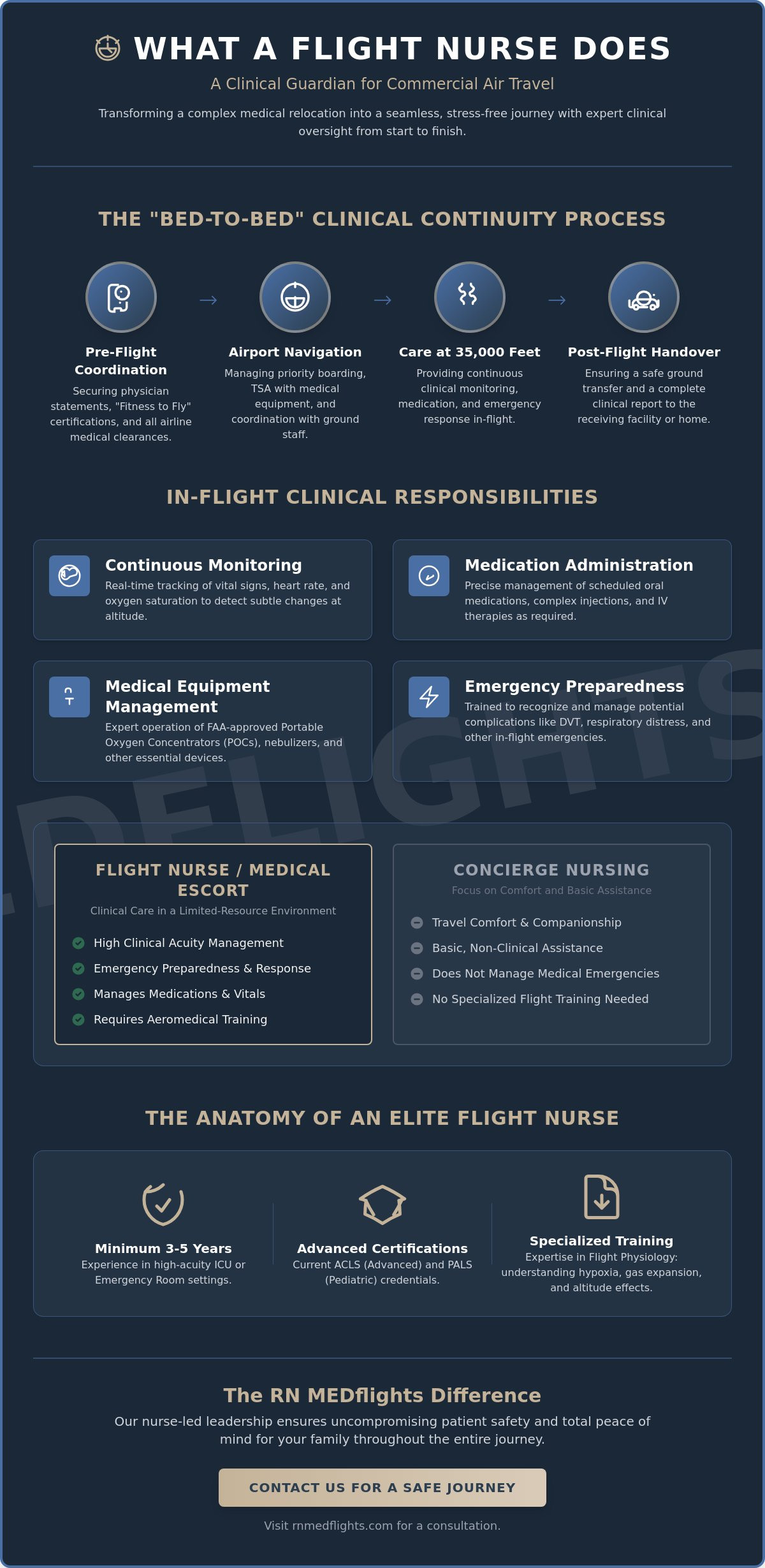
Navigating international medical repatriation requires more than just a plane ticket. It demands a specialized clinician who manages every physiological and logistical detail of the journey. When families ask what does a flight nurse do on a commercial flight, the answer centers on clinical oversight within a public environment. Unlike private air ambulance staff who operate in a controlled, mobile ICU cabin, a commercial flight nurse adapts advanced care to the cabin of a standard airliner. This role is built on 24/7/365 vigilance, providing a seamless bridge between the hospital bedside and the final destination.
These professionals act as the primary liaison during the journey. They coordinate with airline ground staff to ensure priority boarding and communicate with the flight crew regarding oxygen needs or medical equipment. By maintaining this constant presence, they shield the family from the complexities of aviation regulations. A Medical escort ensures that the patient’s dignity remains intact while their clinical needs are met without compromise. This bedside-to-bedside approach guarantees that the patient is never left without expert supervision, even during layovers or ground transfers.
Medical Escort vs. Concierge Nursing
It’s vital to distinguish between medical escorting and concierge nursing. While concierge services often focus on travel comfort and basic assistance, a flight nurse manages high clinical acuity and emergency preparedness. They aren't just there for companionship. They monitor vital signs, administer scheduled medications, and manage potential complications like deep vein thrombosis or respiratory distress. Specialized aeromedical training is non-negotiable because the pressurized cabin environment changes how the human body reacts to illness. Safety-critical tasks always take precedence over simple travel convenience.
The Essential Qualifications of a Flight RN
Not every Registered Nurse is suited for the skies. At RN Medflights, we recognize that the aircraft cabin is a limited-resource environment. We require a minimum of 3 to 5 years of experience in high-acuity settings like the Intensive Care Unit (ICU) or Emergency Room. This background ensures the nurse can make split-second decisions without the immediate backup found in a traditional hospital. The qualifications for this role are rigorous and specific:
Advanced Certifications: Nurses must hold current ACLS (Advanced Cardiovascular Life Support) and PALS (Pediatric Advanced Life Support) credentials.
Flight Physiology: Specialized training is required to understand how altitude, gas expansion, and hypoxia affect a patient’s condition.
Clinical Autonomy: The ability to operate independently while maintaining communication with a medical director.
A flight nurse is a highly specialized RN trained for the unique stressors of flight. This expertise allows them to provide care with total integrity, turning a high-stress medical crisis into a managed, professional transition. By combining clinical precision with a calm, supportive presence, they provide the peace of mind families need during difficult times.
In-Flight Clinical Responsibilities: Managing Care at 35,000 Feet
A flight nurse functions as a critical bridge between hospital-level care and the logistical constraints of air travel. When considering what does a flight nurse do on a commercial flight, the focus remains on maintaining clinical stability in a dynamic, high-altitude environment. They don't just sit with the patient; they manage a complex, individualized care plan. This involves the continuous monitoring of vital signs and oxygen saturation levels using portable, FAA-approved medical monitors. By tracking these metrics in real-time, the nurse can detect subtle physiological changes before they escalate into serious complications.
The nurse handles all medication administration with clinical precision. This includes managing scheduled oral medications, injections, and complex IV therapy. They are experts in managing specialized equipment such as portable oxygen concentrators (POCs) and nebulizers, ensuring these devices function correctly despite changes in cabin pressure. Every action is documented, providing a seamless clinical record that follows the patient from the originating facility to their final destination.
Managing Flight Physiology and Patient Comfort
Altitude changes the way the human body functions. Cabin pressure at cruising altitude typically mimics an elevation of 6,000 to 8,000 feet, which can lead to hypoxia or the expansion of trapped gases. A flight nurse anticipates these shifts, adjusting oxygen flow rates as needed to maintain safe saturation levels. They implement proactive protocols to prevent Deep Vein Thrombosis (DVT), a risk that increases during long-haul travel. This includes guided movement, hydration monitoring, and the use of compression garments. For patients with dementia or high anxiety, the nurse provides a "sanctuary of calm," using therapeutic communication to shield them from the stressors of a crowded, noisy cabin.
Emergency Preparedness and Rapid Response
Preparation is the foundation of patient safety. If a patient's condition deteriorates mid-flight, the nurse is qualified to execute Advanced Life Support (ALS) interventions immediately. They follow established CDC guidelines for in-flight medical emergencies to coordinate care with the flight crew and ground-based medical direction. The nurse remains the steady hand in a crisis, communicating clearly with the pilot while keeping the patient stabilized. This level of expertise ensures that a medical shift doesn't become a tragedy. Families often find that our bedside-to-bedside service provides the security and peace of mind needed to navigate these complex travel logistics safely.
Logistical and Administrative Duties: Navigating the Complexities of Air Travel
When families ask what does a flight nurse do on a commercial flight, they often focus on the clinical monitoring. However, the success of a medical escort mission depends heavily on the nurse's ability to manage complex logistics. This administrative work begins long before the patient reaches the airport. The nurse conducts an exhaustive review of medical records to identify specific risks, such as the potential for respiratory distress in a pressurized cabin. This clinical oversight ensures every safety protocol is tailored to the patient's current status. The duties of a flight nurse involve serving as a professional liaison between the treating physician and the airline's medical desk to ensure a seamless transition.
Security is another critical hurdle that requires specialized knowledge. A flight nurse navigates TSA checkpoints with life-sustaining medical equipment, ensuring that monitors, medications, and FAA-approved oxygen concentrators pass through without delay. They carry the necessary documentation to prove the medical necessity of these items, preventing technical holdups that could cause patient fatigue. By handling these stressors, the nurse protects the patient's dignity and keeps the journey on schedule.
The Airline Medical Clearance Process
Securing airline approval is a rigorous process that requires clinical precision. The flight nurse coordinates directly with airline medical departments, such as MedAire, to obtain the necessary 'Fitness to Fly' certificates. We ensure all equipment meets 2026 FAA standards for lithium-ion batteries and electromagnetic interference. Our team handles the entire paperwork burden. This administrative integrity allows families to focus on their loved one's recovery rather than debating technical requirements with airline gate agents. It's a specialized service that transforms a complex international or domestic flight into a manageable medical procedure.
Ground Ambulance and Terminal Logistics
The transition from a hospital bed to an aircraft seat is a vulnerable moment for any patient. The flight nurse manages the critical hand-off between the ground transport team and the aircraft crew. They oversee long distance medical transport coordination to ensure the ground ambulance arrives exactly when the terminal is ready. Once at the airport, the nurse utilizes priority boarding protocols. This allows the patient to settle into their seat before the general cabin fills, which minimizes exposure to crowds and reduces anxiety. Our bedside-to-bedside promise means the nurse is the steady hand managing every wheelchair transfer and ramp transition with uncompromising care.
What does a flight nurse do on a commercial flight to maintain safety? They act as a vigilant protector of both health and logistics. By managing the 24/7/365 communication required for these trips, they provide a sense of security that is essential during a medical crisis. Every detail, from the timing of the deplaning process to the coordination of the final ground transport, is handled with the clinical authority of a registered nurse.
Determining Eligibility: Is a Commercial Medical Escort Right for You?
Choosing the right mode of medical transport is a decision that balances clinical necessity with financial reality. While many families initially assume a private jet is required, a commercial medical escort often provides a safe, high-quality alternative for stable patients. To understand what does a flight nurse do on a commercial flight, one must first look at the eligibility phase. Our flight coordinators conduct a detailed clinical assessment to confirm the patient can tolerate cabin pressure changes and extended travel durations. We prioritize your peace of mind by ensuring every logistical detail aligns with the patient's specific medical profile.
Medical Stability Requirements
Commercial airlines have strict protocols for passengers requiring medical assistance. To qualify for a commercial escort, a patient must be fit to fly, meaning they've maintained stable vital signs for at least 72 hours. We evaluate the patient's ability to sit upright for takeoff and landing, though some international carriers allow for commercial stretcher services in specific configurations. Certain conditions act as immediate contraindications. For instance, a patient with a pneumothorax within the last 21 days or an unstable bowel obstruction cannot fly commercially due to the risk of gas expansion at altitude. Our RN-led team coordinates directly with primary physicians to secure the necessary medical clearance forms, handling the complex bureaucracy so you don't have to.
Comparing the Costs of Medical Travel
The financial difference between transport types is substantial. Utilizing a private air ambulance typically involves costs for a dedicated aircraft, specialized flight crew, and fuel, which can reach six figures for long-distance missions. In contrast, a commercial medical escort utilizes existing airline infrastructure, often saving families thousands of dollars compared to a private jet. When asking what does a flight nurse do on a commercial flight to justify this cost, remember they provide continuous bedside-to-bedside care. This includes medication administration, hygiene management, and emergency intervention if needed. The total price of a mission depends on the required cabin class, the number of clinical staff members assigned, and the specific medical equipment, such as portable oxygen concentrators, needed for the journey.
If a patient requires a ventilator, continuous high-flow oxygen, or is hemodynamically unstable, a private air ambulance remains the only safe option. Our team remains available 24/7/365 to help you determine which path ensures the highest level of safety for your loved one. Contact our flight coordinators today for a clinical consultation.
The RN MEDflights Difference: Bed-to-Bed Clinical Continuity
The core of our service is the Bed-to-Bed promise. This isn't just a marketing phrase; it's a clinical guarantee that an RN MEDflights professional will never leave the patient's side from the moment they depart their current facility until they're safely tucked into their destination bed. When families ask what does a flight nurse do on a commercial flight, the answer is found in this unbroken chain of care. Our nurses manage the complex logistics of ground ambulance coordination, airport security clearance, and in-flight medical monitoring without a single hand-off that could compromise patient safety.
RN MEDflights is uniquely nurse-owned and operated. This leadership structure ensures that every decision, from equipment selection to flight routing, is filtered through a clinical lens rather than a purely financial one. Our veteran-owned status brings a level of disciplined precision to high-stress medical relocations. We pair this technical rigor with the "Caregiver Heart," a philosophy that prioritizes empathy. We recognize that we aren't just transporting a patient; we're moving a beloved family member during one of the most vulnerable moments of their life.
Seamless Transitions from Hospital to Home
The "gap" between a hospital bed and an airport terminal is where most logistical failures occur. We bridge this gap by conducting a comprehensive clinical assessment 24 hours before departure. Our flight nurses manage the flow of information by providing detailed shift reports to the receiving facility, ensuring they're prepared for the patient's specific needs upon arrival. For families requiring global assistance, we offer specialized international medical repatriation services to navigate the complexities of customs and international healthcare standards.
Peace of Mind for Families
We understand that the emotional burden on a family during a medical transfer is immense. To mitigate this stress, our flight coordinators provide real-time updates through secure communication channels, allowing family members to track progress without having to manage the logistics themselves. Our team handles every detail, from booking specialized seating to coordinating with airline medical desks. We define our commitment to dignity as an uncompromising standard of care that preserves the patient's humanity throughout every mile of the journey.
24/7/365 Availability: Our clinical team is always ready to respond to urgent relocation needs.
Advanced Clinical Oversight: Every mission is overseen by a Medical Director to ensure the highest safety protocols.
Global Reliability: We maintain a 100% success rate in patient transfers across six continents.
Veteran-Led Precision: Our operational workflows are built on military-grade reliability and accountability.
By focusing on clinical continuity, RN MEDflights ensures that the transition is not just a flight, but a sophisticated medical mission. Understanding what does a flight nurse do on a commercial flight means recognizing the constant vigilance required to maintain stability in a pressurized cabin. We take that responsibility seriously, providing a steady hand and a calm presence from bed to bed.
Securing Your Path Home with Expert Medical Oversight
Navigating the skies with a medical condition requires more than just a plane ticket; it demands a clinical guardian. Gaining a clear understanding of what does a flight nurse do on a commercial flight clarifies how these professionals manage both clinical emergencies and the stressors of travel. These specialists monitor physiological changes at 35,000 feet while overseeing the 100% coordination of ground and air transitions. This level of vigilance ensures that the patient's health remains stable through every phase of the itinerary.
At RN MEDflights, our veteran-owned and operated team provides RN-led clinical coordination for every mission. We uphold a strict bed-to-bed service guarantee, which means professional responsibility doesn't end until your loved one is safely settled at their final destination. By choosing a nurse-centric model, you're prioritizing safety and clinical integrity over simple transportation. Our 24/7/365 availability means we're ready to act the moment you need us, providing the specialized care your family deserves.
You don't have to navigate these medical and logistical complexities alone. We're here to provide the steady hand and expert care needed to bring your family member home safely and with dignity.
Frequently Asked Questions
Is a flight nurse the same as a flight attendant?
No, a flight nurse is a highly trained medical professional, while a flight attendant focuses on general cabin safety and passenger service. When people ask what does a flight nurse do on a commercial flight, the answer involves providing specialized clinical care that attendants aren't licensed to perform. Our nurses are Registered Nurses with at least 5 years of experience in high-acuity environments like the ICU or Emergency Room.
They provide continuous clinical monitoring and bedside-to-bedside care throughout the entire journey. While flight attendants manage the aircraft cabin, your nurse manages the patient's physiological stability and medical needs. This distinction ensures that patients with complex health requirements travel with a vigilant protector who's prepared for any clinical challenge.
Can a flight nurse administer IV medication on a commercial plane?
Yes, a flight nurse can administer IV medications and fluids if they're part of the physician-ordered plan of care. When considering what does a flight nurse do on a commercial flight, medication management is a core responsibility that requires precise timing and expertise. We coordinate with the airline's medical desk to ensure all injectable medications and supplies meet TSA and FAA regulations.
Our nurses carry specialized kits to maintain IV patency and deliver dosages with clinical precision during the flight. We handle the logistics of carrying needles and controlled substances through security, ensuring the patient's medication schedule remains uninterrupted. This seamless clinical support provides peace of mind for families who worry about maintaining complex treatment regimens at 30,000 feet.
What medical equipment does a flight nurse bring on the flight?
We bring a comprehensive suite of FAA-approved medical equipment tailored to the patient's specific diagnosis and clinical needs. This typically includes a portable pulse oximeter, an automated external defibrillator (AED), and a professional-grade blood pressure monitor. We also carry a specialized medical bag containing emergency medications and supplies for wound care or respiratory support.
Every piece of technology we use is tested to ensure it doesn't interfere with the aircraft's electronic systems. Our nurses are experts at operating these tools in a confined cabin environment, ensuring constant vigilance over the patient's vital signs. This equipment allows us to maintain a high standard of care from the moment we leave the hospital until we reach the final destination.
How do you handle airline medical clearance for a patient?
Our flight coordinators manage the entire medical clearance process by submitting the required Medical Information Form (MEDIF) to the airline's medical department. This process generally takes between 48 and 72 hours for most domestic and international carriers. We communicate directly with airline physicians to confirm the patient is stable for transport at altitude and meets all safety criteria.
This coordination removes the logistical burden from the family, ensuring all paperwork is verified before you arrive at the airport. We also arrange for any necessary oxygen concentrators or specialized seating that the airline requires. Our bedside-to-bedside promise means we handle these details so you can focus on your loved one's recovery and comfort.
Can a flight nurse accompany a patient with dementia or Alzheimer's?
Yes, we frequently provide specialized medical escorts for patients living with dementia or Alzheimer's disease. Our nurses use proven de-escalation techniques and cognitive engagement strategies to manage anxiety or "sundowning" caused by the stressful airport environment. We prioritize the patient's dignity and comfort, ensuring they remain calm and safe throughout the transition.
This 24/7/365 support allows families to feel confident that their loved one is in expert hands. We manage every interaction with airport security and airline staff to minimize confusion for the patient. By providing a steady, familiar presence, we reduce the risk of wandering or agitation during the long hours of travel.
What happens if there is a medical emergency during the commercial flight?
If a medical emergency occurs, the flight nurse immediately initiates Advanced Life Support (ALS) protocols to stabilize the patient. They utilize the emergency equipment on hand and coordinate with the flight crew to access the aircraft's onboard medical kit if necessary. Our nurses are trained to make critical decisions, such as recommending a flight diversion if the condition requires immediate hospital intervention.
They remain the primary clinical lead until the patient is safely handed over to ground emergency services. Because our nurses have years of emergency room experience, they stay calm and focused during these high-stress moments. This professional response ensures that the patient receives the best possible care until they reach a definitive medical facility.
Is a medical escort covered by standard health insurance?
Standard health insurance policies rarely cover commercial medical escort services as a standard benefit. Data from the health insurance industry shows that over 90% of commercial plans exclude non-emergency medical transport unless it's specifically listed as a policy rider. We recommend checking your specific policy for "repatriation" or "medical evacuation" clauses that might provide some relief.
Our team can provide a detailed clinical summary and a comprehensive invoice to help you seek reimbursement from long-term care insurance providers. While we don't bill insurance companies directly, we support your efforts to secure any benefits you're entitled to. We focus on providing a transparent, high-quality service that prioritizes patient safety above all else.
How much notice is needed to book a flight nurse escort?
We generally require 3 to 5 days of lead time to secure airline medical clearance and finalize complex travel logistics. This window allows us to complete a thorough clinical assessment and coordinate the bedside-to-bedside transition with the sending and receiving facilities. It's the most reliable way to ensure a seamless and stress-free journey for the patient.
However, we understand that medical needs can change rapidly and emergencies don't wait for a schedule. Our team is available 24/7/365 to handle urgent requests, often mobilizing a specialized nurse in as little as 24 to 48 hours. We work tirelessly to expedite the process while maintaining our uncompromising standards for patient safety and clinical integrity.


