


Comprehensive Guide to Med Transportation Services in 2026: Safety, Costs, and Options
- 19 hours ago
- 14 min read
Last Tuesday, Sarah in Chicago sat with 14 open browser tabs, trying to figure out how to move her post-stroke father 900 miles without risking his life. She quickly discovered that coordinating med transportation services involves more than just booking a flight; it requires a specialized level of clinical oversight that most airlines simply can't provide. You likely feel that same weight of responsibility right now. It's exhausting to balance the fear of a medical emergency at 30,000 feet with the crushing reality of private medevac costs that can exceed $25,000.
You deserve a plan that replaces this logistical nightmare with uncompromising safety. This guide provides expert insights on securing a bedside-to-bedside transport solution that fits your budget and clinical needs in 2026. We'll break down the 20% difference in cost between private air ambulances and commercial medical escorts. You'll also learn how our RN-led teams manage every detail from ground ambulance coordination to 24/7/365 flight monitoring. By the end, you'll have total clarity on insurance coverage and the professional supervision required to bring your loved one home with dignity.
Key Takeaways
Understand the clinical spectrum of specialized med transportation services to determine the safest and most appropriate level of care for your loved one.
Compare the cost-effectiveness of commercial flight escorts against private air ambulances to find a travel solution that fits your budget and medical needs.
Learn the essential "bed-to-bed" protocols that ensure a seamless transition and uncompromising continuity of care between medical facilities.
Discover why Registered Nurse (RN) oversight is critical for managing the complex physiological impacts of high-altitude travel on patient stability.
Navigate the complexities of insurance coverage and clinical clearances to streamline your mission and secure peace of mind during a medical crisis.
Table of Contents What Are Med Transportation Services? Defining the Levels of Care Comparing Your Options: Ground, Private Air, and Commercial Escorts The Logistics of Bed-to-Bed Medical Transport Safety and Standards: The Flight Nurse Difference Planning Your Mission: Costs, Insurance, and Next Steps
What Are Med Transportation Services? Defining the Levels of Care
At its core, med transportation services represent a specialized sector of the healthcare industry designed for patients who require clinical supervision during transit but do not face immediate, life-threatening emergencies. These patient transport services bridge the gap between a standard taxi or rideshare and a high-intensity 911 ambulance response. The primary goal is to maintain a patient's physiological stability while moving them between facilities or across long distances. This oversight ensures that individuals with complex medical needs receive continuous care, preventing the complications that often arise during the stress of travel.
The spectrum of care is broad, ranging from local non-emergency medical transport (NEMT) vans equipped with wheelchair lifts to international long-distance transfers involving flight nurse escorts. While "non-emergency" is the technical classification, it's a mistake to view these journeys as non-clinical. For a patient traveling 1,000 miles or more, the environment must be highly controlled. Professional providers utilize key logistical strategies like "bed-to-bed" care. This process ensures a medical professional is physically present from the moment the patient leaves their room until they're safely tucked into their new destination. This continuity of care is vital for medical repatriation, which involves returning a patient to their home country or a local hospital after an unexpected health event occurs abroad.
NEMT vs. Emergency Medical Services
Understanding when to book a service versus calling 911 is critical for patient safety. Emergency Medical Services (EMS) are designed for rapid intervention during a crisis, such as a heart attack or major trauma. In contrast, med transportation services are scheduled in advance for patients who are medically stable. To qualify for this level of care, a physician must provide a "clearance for travel" certificate, confirming the patient's vitals are consistent and they can withstand the duration of the trip. Common conditions served include post-operative recovery, stage 3 or 4 dementia requiring specialized handling, and chronic illnesses like Parkinson's disease that make standard commercial travel impossible.
The Growing Need for Long-Distance Medical Relocation
The demand for specialized transport has increased significantly, with the U.S. Census Bureau reporting that 10,000 people turn 65 every day. This aging population often requires relocation to be closer to family or specialized memory care units. We also see a high volume of "snowbird" transfers, where patients who migrate south for the winter experience a health decline and need to return to their primary specialists. Medical relocation is the strategic movement of a patient to a higher or more appropriate level of care. Since 2023, the complexity of these moves has grown, requiring rigorous ground coordination to sync ambulances with air medical teams. By managing every detail, from oxygen requirements to medication schedules, these services provide a seamless transition that protects the patient's dignity and health.
Comparing Your Options: Ground, Private Air, and Commercial Escorts
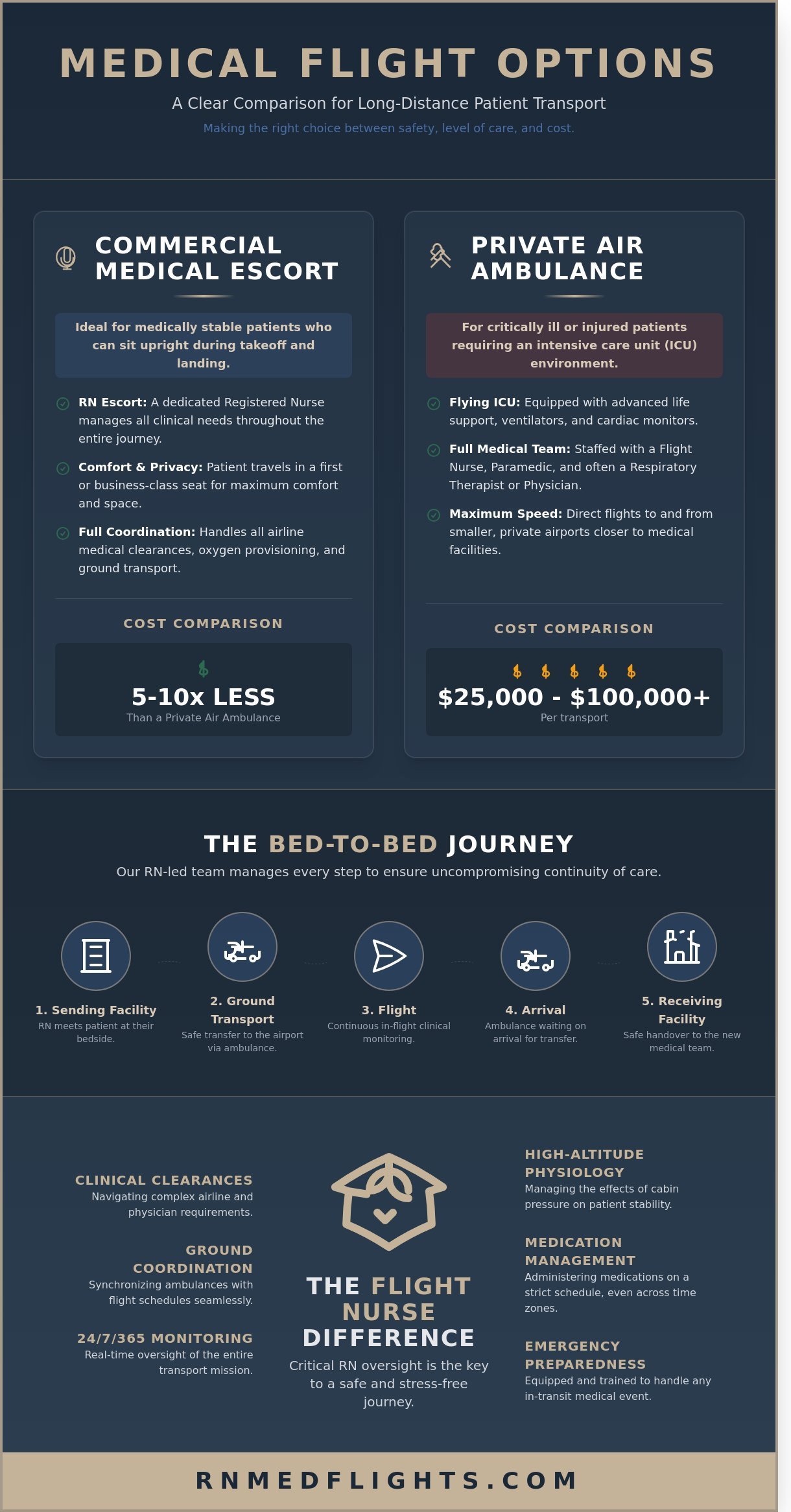
Selecting the right med transportation services involves a meticulous evaluation of the patient's clinical status and the family's logistical needs. While a private air ambulance provides a self-contained Intensive Care Unit environment, it often carries a price tag between $25,000 and $100,000. In contrast, a commercial medical escort typically costs 5 to 10 times less, making it a more accessible option for stable patients. The choice hinges on three critical factors: the patient's ability to sit for extended periods, the level of clinical intervention required, and the total distance of the journey.
Decisions regarding the mode of transport aren't merely about budget; they're about the physiological impact of travel. Our flight coordinators analyze every detail of the patient's medical record to determine if they require a private jet or if a commercial solution is viable. We prioritize the standard of bedside-to-bedside continuity, ensuring that the transition between facilities remains stable and dignified. Our team adheres to rigorous Aeromedical Transport safety protocols to ensure every transition remains seamless and medically sound.
Ground Ambulance Transport: Pros and Cons
Ground transport remains a practical choice for distances under 300 miles. It offers a direct route without the complexities of airport logistics. However, for trips exceeding 5 hours, the "road fatigue" factor becomes a significant clinical concern. Elderly patients and those with spinal injuries or chronic pain often find the constant vibration and movement of a long-distance ambulance taxing. When ground transfers cross multiple state lines, the costs can also escalate quickly, sometimes approaching the price of a commercial flight without the benefit of speed.
The Commercial Airline Medical Escort Advantage
Commercial medical escorts represent a sophisticated use of existing aviation infrastructure. A registered nurse or flight paramedic accompanies the patient on a commercial flight, providing oxygen management, medication administration, and continuous vital sign monitoring. This method is the preferred standard for international medical repatriation, as it allows for long-distance travel at a fraction of the cost of a private jet. Families seeking a balance of cost and clinical excellence often find that a dedicated medical escort provides the necessary peace of mind during a crisis.
For patients who cannot sit upright for the duration of a flight but don't require the advanced life support of a private jet, the "Stretcher Service" on commercial airlines offers a vital middle ground. This specialized arrangement involves removing 6 to 9 rows of seats to accommodate a medical stretcher and a dedicated clinical team. It provides a flat surface for the patient while utilizing commercial routes, saving families up to 60% compared to private air medical flights. Every second of the journey is managed with the precision of a clinical procedure, ensuring safety is never compromised for the sake of the budget. Our 24/7/365 availability ensures that no matter the mode of transport, your loved one is never without an expert advocate.
The Logistics of Bed-to-Bed Medical Transport
Managing a medical crisis requires more than just a flight; it demands a seamless transition of care that prioritizes the patient's dignity and clinical stability. Our bedside-to-bedside promise ensures that a patient is never left without expert supervision. This continuity starts at the origin facility and concludes only when the patient is safely admitted to their destination. Specialized med transportation services bridge the gap between hospital rooms, providing a steady hand through every mile of the journey. We view the patient as a person, not a case, which is why our RN-led teams maintain a vigilant presence from start to finish.
The process is methodical and follows a strict four-step protocol to eliminate variables. This structural clarity helps reduce the cognitive load on families who are often navigating the most stressful days of their lives. Our team operates with uncompromising integrity to execute the following stages:
Step 1: Clinical Assessment and Clearance. Within 4 hours of your initial inquiry, our medical director reviews the patient's current vitals and charts. We secure medical clearance for flight by ensuring the patient is stable for the specific altitudes and durations required.
Step 2: Ground Ambulance Coordination. We vet and book high-acuity ground providers at both ends of the trip. These teams are synchronized to the minute, ensuring the patient never waits on a tarmac or in a drafty hangar.
Step 3: Airline and TSA Management. Our coordinators interface with airline medical desks to secure approval for specialized equipment. This includes managing the complex paperwork required for life-sustaining devices.
Step 4: The Supervised Journey. A dedicated Registered Nurse remains at the patient's side throughout the transit. They monitor vitals every 15 minutes and manage all medication administration, providing a level of care that mirrors a clinical setting.
Navigating Airline and TSA Regulations
Airline travel for the medically fragile involves significant red tape. We manage the Medical Information Form (MEDIF) required by major carriers, which confirms a patient's fitness to fly. Our team ensures all Portable Oxygen Concentrators (POCs) meet FAA standards under 14 CFR Part 382. By coordinating with the TSA Cares program, we secure a dedicated representative to expedite security screening, which typically reduces transit wait times by 25 minutes.
Coordinating Ground Ambulance Transfers
The handoff is the most critical part of the mission. Our flight coordinators use real-time satellite tracking to monitor for weather delays or air traffic changes. If a flight is delayed by even 10 minutes, we update the ground ambulance team immediately to maintain a synchronized arrival. This precision is a hallmark of professional med transportation services. We only partner with providers who maintain Advanced Life Support (ALS) capabilities, ensuring the standard of care remains high. Our team is available 24/7/365 to manage these moving parts, providing families with total peace of mind.
Safety and Standards: The Flight Nurse Difference
Choosing between different med transportation services involves more than comparing costs or vehicle types. The clinical depth of the personnel on board determines the safety of the mission. While basic medical technicians provide essential care in ground ambulances, the complex environment of a pressurized aircraft cabin requires the advanced critical thinking skills of a Registered Nurse (RN). These professionals don't just follow a checklist; they possess the diagnostic intuition developed through years of bedside experience in high-acuity environments.
Air travel introduces unique physiological stressors that don't exist on the ground. At a standard cabin altitude of 8,000 feet, atmospheric pressure decreases significantly. This change causes gases within the body to expand, which can lead to severe complications for patients with recent surgeries, bowel obstructions, or pneumothorax. Oxygen saturation levels often drop by 5% to 10% in healthy individuals; for a patient with chronic obstructive pulmonary disease or heart failure, this decline can be life-threatening. A flight nurse anticipates these shifts, adjusting supplemental oxygen flow and monitoring blood pressure trends before a patient reaches a state of crisis.
Safety protocols during long-distance med transportation services are rigorous and uncompromising. If an emergency occurs at 30,000 feet, there is no option to pull over to the side of the road. Flight nurses are trained to manage cardiac arrhythmias, respiratory distress, and neurological changes in a confined space. This vigilant protection allows the patient to remain stable throughout the transition, ensuring they arrive at their destination in the same clinical condition, or better, than when they departed.
Qualifications of a Professional Flight Nurse
Top-tier flight nurses typically possess a minimum of five years of experience in intensive care units (ICU) or emergency departments. This background is vital because it prepares them to handle hemodynamic instability and complex ventilator management without immediate physician oversight. Their training includes specialized courses in aviation medicine, where they study the laws of physics that govern gas expansion and fluid shifts at altitude. Every RN MEDflights escort is a licensed Registered Nurse with advanced life support certifications.
Monitoring and Intervention at 30,000 Feet
The medical kit carried by a flight nurse functions as a mobile intensive care unit. It includes portable cardiac monitors, automated external defibrillators (AEDs), and advanced airway management tools. Beyond the hardware, the nurse manages the logistical complexity of the patient's care. This includes coordinating medication schedules that may be disrupted by crossing multiple time zones during international transfers. Every intervention, vital sign, and medication dose is recorded in a comprehensive medical record to ensure a seamless handoff to the receiving facility.
The "Peace of Mind" factor is perhaps the most significant benefit for families. Dealing with a medical crisis is inherently traumatic, and the logistics of a cross-country or international move add immense layers of stress. A flight nurse acts as a steady, authoritative presence who manages every clinical detail. They provide the emotional support and dignity patients deserve, treating them as individuals rather than just a medical case. This human connection reduces anxiety, which in turn helps maintain stable vital signs during the journey. Our team is available 24/7/365 to provide this level of dedicated care.
If you need to move a loved one safely and want the highest standard of clinical oversight, we are ready to help. Contact RN MEDflights for a professional medical transport consultation
Planning Your Mission: Costs, Insurance, and Next Steps
Organizing a medical transfer involves more than just booking a flight; it requires a detailed financial and clinical strategy. Calculating the investment for med transportation services requires an understanding of both clinical and logistical variables. We believe that transparency is the foundation of trust. Families deserve to know exactly what they are paying for without the fear of hidden surcharges appearing after the patient is already in the air.
Insurance coverage remains a primary concern for most families. Medicare Part B typically covers 80% of the approved amount for emergency ground or air transport, provided the move is medically necessary and the destination is the nearest capable facility. Private insurers like UnitedHealthcare or Cigna often require a prior authorization window of 48 to 72 hours. Our flight coordinators work directly with your provider to determine if your policy includes a "bedside-to-bedside" benefit. If insurance denies the claim, the costs may still provide some relief at year-end.
Tax deductibility is a significant factor for many of our clients. According to the 2024 IRS Publication 502, you can often deduct medical travel expenses if they are primarily for, and essential to, medical care. This deduction is generally available if your total medical expenses exceed 7.5% of your adjusted gross income. Because tax laws shift frequently, we always recommend consulting a certified public accountant to verify how these rules apply to your specific financial situation.
Understanding the Cost Drivers
Three main factors dictate the final quote. First, distance plays a role; a 500-mile domestic transfer has different fuel and crew requirements than a 3,000-mile cross-country journey. Second, the acuity level of the patient determines the medical team's composition. A patient on a ventilator requires a higher ratio of specialized nurses than a stable patient requiring basic monitoring. Finally, lead time influences the price. Booking 72 hours in advance is typically more cost-effective than an emergency dispatch within 4 hours. International repatriation adds layers of complexity, such as customs fees and landing permits, which can increase costs by 20% compared to domestic flights. Choosing an all-inclusive service ensures that ground ambulance fees and medical supplies are bundled into one clear price.
Getting Started with RN MEDflights
The process begins with a single phone call to our 24/7/365 dispatch center. You should have the patient's current medical records, the contact information for the sending facility, and the name of the receiving physician ready for our team. We handle the heavy lifting of facility-to-facility coordination so you can focus on your family. Our veteran-owned organization operates with a sense of duty and uncompromising integrity. We don't just move patients; we provide a continuous chain of care led by highly trained Registered Nurses. Every mission is executed with the precision of a clinical procedure and the heart of a caregiver. When you choose med transportation services through RN MEDflights, you are choosing a partner dedicated to safety and dignity.
Request a customized quote for your medical transportation needs to begin the process of bringing your loved one home.
Take the Next Step Toward a Safe Medical Journey
Navigating the complexities of med transportation services requires a partner who manages every clinical and logistical detail with uncompromising precision. You've learned that bed-to-bed care is more than a convenience; it's a safety standard that ensures medical continuity from the starting bedside to the final destination. By choosing nurse-led commercial airline escorts, families can manage costs effectively while maintaining the highest level of clinical oversight during global medical repatriation missions.
RN Medflights brings over 15 years of specialized experience as a veteran-owned and operated provider. We maintain 24/7/365 availability to ensure that a flight coordinator is always ready to answer your call and provide a seamless transition. Our focus remains on the "Flight Nurse Difference," where every mission is led by a registered nurse to guarantee patient dignity and safety. We've spent over a decade perfecting these complex logistics so you don't have to face them alone. Our team handles every detail of the journey to provide the stability your family needs during a medical crisis.
We're here to guide you through this process and bring your loved one home safely.
Frequently Asked Questions
Is med transportation covered by Medicare or private insurance?
Medicare Part B covers emergency transports at 80% of the approved amount once you meet your annual deductible, but it rarely pays for non-emergency med transportation services. Private insurance providers like Blue Cross Blue Shield or Aetna may offer partial reimbursement for about 25% of these cases. Our flight coordinators assist you by reviewing your policy details to ensure you understand your financial obligations before we initiate our bedside-to-bedside care.
What is the difference between a medical escort and an air ambulance?
A medical escort provides clinical support on a commercial flight, while an air ambulance is a private aircraft configured as a flying intensive care unit. Commercial escorts typically reduce costs by 65% compared to private air ambulances which can cost over $25,000. We recommend air ambulances for patients requiring advanced life support, whereas stable patients benefit from the specialized care of an RN on a commercial carrier.
Can a family member fly along with the patient and the nurse?
You can typically have one or two family members accompany the patient and the nurse on the flight. In 95% of our commercial missions, we successfully coordinate seating so the family stays together. Having a loved one present provides emotional stability and peace of mind during the journey. Our team handles the ticketing for your family to ensure the experience remains seamless from the initial pickup to the final destination.
What kind of medical conditions are eligible for commercial flight escorts?
Patients with stable chronic conditions, such as stage 2 Alzheimer's or recovering orthopedic surgery cases, are eligible for commercial escorts. The patient must be hemodynamically stable and require less than 5 liters of supplemental oxygen per minute. Our medical director reviews every case 24/7/365 to confirm that the patient's clinical status meets the safety requirements for commercial travel, ensuring uncompromising safety and dignity throughout the entire transit.
How much lead time is required to book a medical transport service?
We generally require 48 to 72 hours of lead time to coordinate a specialized medical transport. This window allows our flight coordinators to secure medical clearances from airlines and arrange ground logistics. In urgent situations, our team often mobilizes a nurse and finalizes the itinerary in as little as 24 hours. We work diligently to minimize delays and provide a stress-free transition for your family during these critical moments.
What happens if there is a flight delay or cancellation during the trip?
Our flight coordinators monitor all travel in real-time and immediately implement contingency plans if a delay occurs. Your RN remains with the patient at all times, providing continuous clinical monitoring and personal care regardless of the schedule change. This bedside-to-bedside commitment ensures that the patient's health remains the priority. We manage 100% of the rebooking process so you don't have to navigate airline bureaucracy during a crisis.
Are medical transportation services tax deductible in 2026?
Medical transportation expenses remain deductible in 2026 if they are primarily for and essential to medical care. According to IRS Publication 502, you can deduct the portion of your total medical expenses that exceeds 7.5% of your adjusted gross income. These med transportation services qualify when prescribed by a physician for necessary treatment. We recommend consulting a tax professional to review your specific 2026 filing requirements and maintain all your receipts.
Does the service include ground transportation to and from the airport?
Our service includes all ground transportation to and from the airports as part of our bedside-to-bedside care model. We arrange for professional ground ambulances or specialized medical sedans to meet the patient at their room and deliver them directly to the destination. This integrated approach removes the logistical burden from the family. It ensures a seamless and calm transition between every phase of the journey from the departing facility to the receiving bed.