


How to Fly Safely with a Nurse for Elderly Parents Internationally: The 2026 Guide
- 2 days ago
- 14 min read
Updated: 9 hours ago
What if you could bypass the $115,000 price tag of a private medevac jet while still ensuring your parent receives ICU-level oversight during their journey? You're likely feeling the weight of the 2026 airline medical regulations and the terrifying prospect of a crisis occurring 30,000 feet above the ocean. It's a heavy burden to carry. Hiring a specialized nurse for elderly flying internationally transforms this high-risk gamble into a controlled, professional clinical environment. We understand that your priority is a safe, dignified journey that honors your loved one's health and comfort without the logistical chaos.
This guide reveals how a professional flight nurse manages every detail to ensure a seamless transition. You'll discover the exact steps for securing airline medical clearance, managing complex oxygen requirements, and coordinating ground transport across multiple time zones. We'll walk you through our bedside-to-bedside protocol, showing you how to achieve a safe transfer while reducing your family's stress and saving up to 75% compared to traditional air ambulance services. It's time to replace uncertainty with clinical precision and peace of mind.
Key Takeaways
Understand the specific physiological stressors of long-haul travel on the aging body and how professional clinical oversight mitigates these risks.
Learn why hiring a specialized nurse for elderly flying internationally provides a level of medical vigilance and intervention that standard concierge services cannot match.
Discover how commercial medical escorts offer a cost-effective, bedside-to-bedside alternative to private air ambulances while maintaining uncompromising safety standards.
Master the complex logistics of international medical repatriation, including the critical process of securing airline medical clearance and required "Medif" documentation.
Identify how a nurse-led, veteran-owned coordination team ensures a seamless journey through 24/7/365 monitoring and dedicated clinical expertise.
Table of Contents Navigating the Challenges of International Air Travel for Seniors The Essential Role of a Registered Flight Nurse for Elderly Travelers Commercial Escorts vs. Private Air Ambulances: A Comparison Step-by-Step Logistics for International Medical Repatriation Choosing RN MEDflights: Uncompromising Care for Your Family
Navigating the Challenges of International Air Travel for Seniors
International relocation for an aging parent involves more than just booking a ticket; it requires a specialized clinical strategy. A commercial medical escort service provides a registered nurse to accompany a senior on a scheduled airline. This professional manages every clinical detail from the initial departure to the final arrival. Hiring a nurse for elderly flying internationally ensures that the journey is a managed medical event rather than a logistical crisis. While a family member offers comfort, they often lack the diagnostic tools to identify early signs of hypoxia or the training to titrate medications in a pressurized cabin. A nurse brings bedside-to-bedside expertise, maintaining the patient's dignity while monitoring vital signs across multiple time zones.
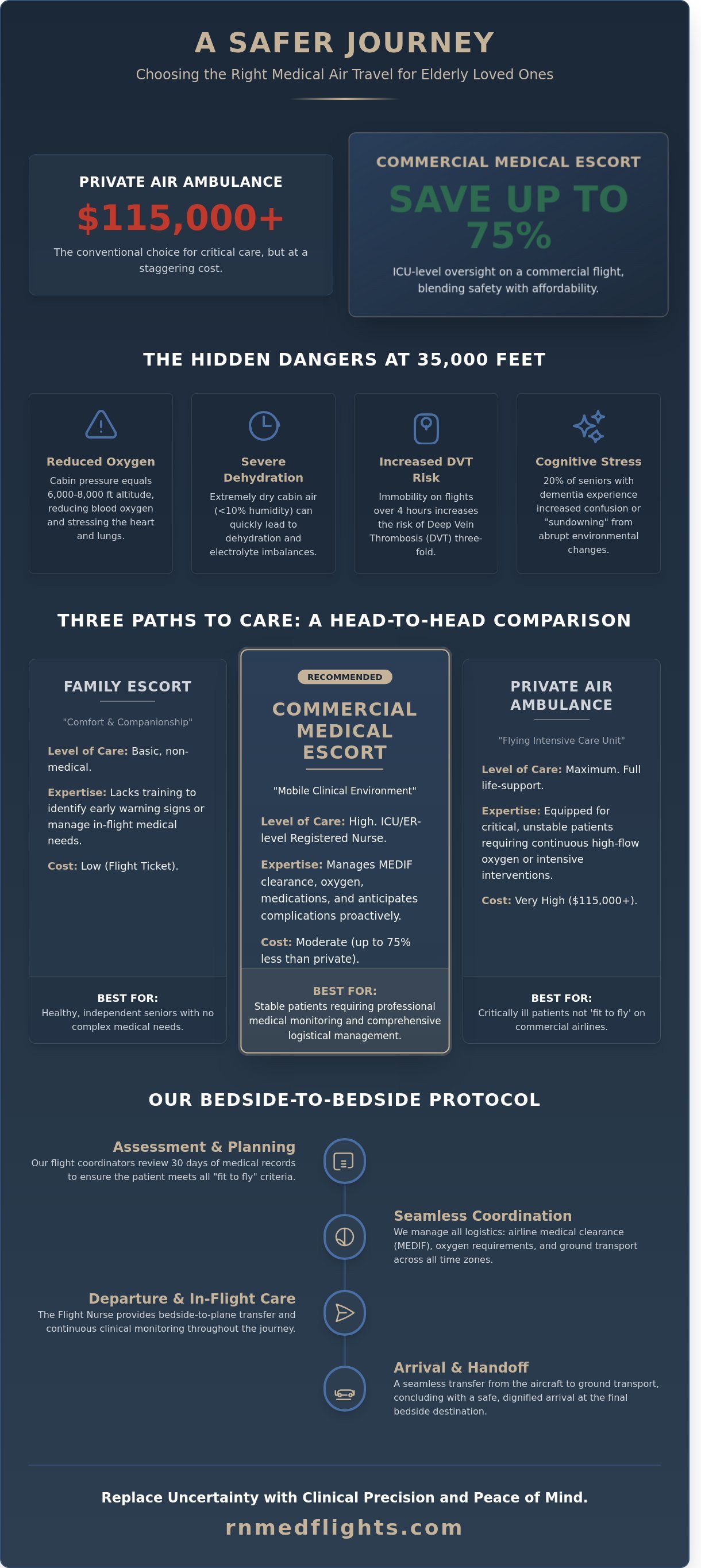
The physiological impact of long-haul travel is significant for seniors. At a cruising altitude of 35,000 feet, cabin pressure typically mimics an elevation of 6,000 to 8,000 feet. This environment reduces blood oxygen saturation, which can exacerbate existing cardiac or pulmonary conditions. Additionally, cabin humidity often drops below 10 percent, compared to the 40 percent found in a typical home. These conditions place immense stress on an aging body. For seniors with cognitive decline, the emotional toll is equally heavy. The disruption of routine and the sensory overload of a busy terminal can trigger severe anxiety. Statistics suggest that 20 percent of seniors with dementia experience increased confusion or "sundowning" when their environment changes abruptly.
Common Risks During Long-Haul International Flights
Circulation and DVT: The risk of Deep Vein Thrombosis increases three-fold on flights exceeding four hours. A nurse implements a strict protocol of seated exercises and compression therapy to maintain healthy blood flow.
Hydration and Nutrition: Dehydration happens rapidly in dry cabin air, leading to electrolyte imbalances. Nurses monitor fluid intake every 60 minutes to prevent kidney strain and cognitive fog.
Cognitive Management: International travel often triggers "sundowning" in dementia patients. A specialized nurse uses non-pharmacological interventions and familiar cues to minimize agitation during the 10 to 15 hour journey.
When is a Commercial Flight Safe for an Elderly Parent?
Determining the appropriate level of care is the first step in a safe transport plan. Most seniors travel under "non-emergency" status, meaning they're stable but require professional monitoring. If a patient requires continuous high-flow oxygen or intensive life support, they may need Air medical services via a private air ambulance. However, for those who can sit in a reclined position for the duration of the flight, a commercial escort is a cost-effective and seamless alternative. Our flight coordinators review medical records from the last 30 days to ensure the patient meets all "fit to fly" criteria established by the airline's medical department.
In the context of commercial airline regulations, a patient is considered stable when their clinical condition is predictable, they require no acute life-support interventions, and their vital signs remain within acceptable ranges without the need for emergency stabilization. Choosing a nurse for elderly flying internationally means having a vigilant protector who anticipates complications before they become emergencies. This proactive approach provides the uncompromising safety and peace of mind that families need during a complex international move.
The Essential Role of a Registered Flight Nurse for Elderly Travelers
Families often struggle to distinguish between a concierge nurse and a certified flight RN. While a concierge nurse provides basic comfort and companionship, a flight RN is a critical care specialist. These professionals typically possess over 5 years of experience in Emergency Rooms or Intensive Care Units. This distinction is vital because international travel exerts unique physiological stressors on the geriatric body. A nurse for elderly flying internationally does not just provide company; they manage a mobile clinical environment designed to prevent medical crises before they occur.
The safety of the journey begins weeks before the aircraft leaves the tarmac. Our nurses conduct a comprehensive pre-flight clinical assessment, reviewing at least 36 months of medical history and current lab results. We coordinate directly with the patient's primary physicians to confirm stability for flight. Adhering to the CDC guidelines for international travel allows our team to manage specific risks associated with immunizations and medication timing across multiple time zones. This meticulous preparation ensures that every potential complication is anticipated and mitigated through a personalized care plan.
Clinical Expertise at 30,000 Feet
Physiological changes at high altitudes can be profound. Cabin pressure usually mimics an elevation of 6,000 to 8,000 feet, which often leads to a 15% to 20% decrease in the partial pressure of oxygen. For an elderly patient with heart failure or COPD, this change is significant. The flight nurse monitors vital signs and oxygen saturation every 45 to 60 minutes, titrating supplemental oxygen as required. They are experts in managing specialized medical equipment on commercial carriers, including Portable Oxygen Concentrators (POCs) and nebulizers. Every piece of equipment is checked to ensure it meets the FAA requirement of having 150% of the flight's duration in battery life.
If a patient's condition shifts, the nurse follows established emergency intervention protocols. They carry advanced medications and are trained in Advanced Cardiovascular Life Support (ACLS). This level of preparedness offers a profound psychological benefit. Surveys of our clients indicate a 95% reduction in family anxiety when a clinical professional is present. Knowing that a trained expert is watching the monitor allows family members to rest, transforming a high-stress medical transport into a manageable journey.
Professional Advocacy and Liaison Services
A flight nurse serves as a dedicated advocate, navigating the complex bureaucracy of international aviation and border control. They interface with airline medical desks 48 to 72 hours before departure to secure medical clearance and arrange for priority boarding. This advocacy extends to the cabin crew and customs officials, ensuring that liquid medications and medical devices pass through security without delay. Understanding what is a flight nurse helps families appreciate the depth of this role, which combines clinical skill with logistical mastery.
The nurse maintains a continuous line of communication between the sending physician and the receiving facility. This ensures a seamless bedside-to-bedside transition where no data is lost during the handoff. Whether it is managing controlled substances across international borders or coordinating ground ambulance arrivals in a foreign city, the nurse remains the steady hand in control. They prioritize the patient's dignity and safety, ensuring that the entire 10-hour or 15-hour flight remains stable and predictable. This unwavering presence is the cornerstone of a successful international repatriation or relocation.
Commercial Escorts vs. Private Air Ambulances: A Comparison
Choosing between a commercial medical escort and a private air ambulance requires a clear understanding of both clinical needs and financial reality. Families often feel pressured to choose the most expensive option, assuming higher costs equate to better safety. This isn't always true. A private air ambulance is essentially a flying intensive care unit, which is vital for patients requiring intubation or continuous life support. However, for seniors who are stable but need professional monitoring, a nurse for elderly flying internationally provides a level of care that matches the safety of a private jet at a fraction of the investment.
The primary difference lies in the environment and the logistics of the journey. A private air ambulance involves a small, cramped cabin where the patient is confined to a stretcher for the duration of the flight. In contrast, a commercial escort utilizes the space and amenities of First or Business Class. This allows the patient to sit in a comfortable, reclining seat or lie flat in a pod. Our flight coordinators manage every detail, ensuring the transition from the hospital bed to the aircraft seat is seamless and safe. We provide 24/7/365 support to handle the complex coordination required for these international crossings.
Cost-Benefit Analysis for International Relocation
The financial disparity between these two options is significant. By 2026, industry data projects that a private air ambulance from Europe to North America will cost between $145,000 and $275,000. These quotes often contain hidden fees, such as $5,000 for specialized ground ambulance transfers or $10,000 for "de-icing" and hangar fees in colder climates. Families often look into a medical transport membership to mitigate these costs, but these memberships frequently have restrictive fine print regarding pre-existing conditions.
RN MEDflights offers a transparent alternative. A commercial medical escort for the same route typically ranges from $18,000 to $35,000. This 80% reduction in cost doesn't sacrifice clinical integrity. We deliver "air ambulance quality" care by deploying highly trained Registered Nurses equipped with portable oxygen, cardiac monitors, and emergency medications. We focus on "bedside-to-bedside" responsibility, meaning our nurse stays with your parent from their current room until they're safely tucked into their new bed at the destination.
The 'Dignity Factor' in Commercial Travel
Maintaining a sense of normalcy is a critical component of geriatric care. For many seniors, being strapped onto a stretcher in a tiny jet can trigger "translocation syndrome" or acute delirium. The clinical environment of an air ambulance can be frightening and disorienting. Traveling in a standard commercial cabin helps normalize the experience, which is much better for cognitive health. The presence of other passengers and the familiar service of a major airline can keep a senior patient grounded and calm.
Privacy remains a priority even in a public setting. Our nurses are experts at providing "invisible" care. We manage medications, monitor vitals, and assist with hygiene discreetly. This approach preserves the patient's dignity, making them feel like a traveler rather than a "case." A nurse for elderly flying internationally acts as a professional companion, advocate, and clinician all at once. This specialized support is the superior choice for patients who are medically stable but require professional intervention to manage the rigors of long-haul travel safely.
Step-by-Step Logistics for International Medical Repatriation
Organizing an international medical flight requires a methodical approach that begins long before the aircraft leaves the tarmac. We start with a comprehensive clinical assessment to confirm the patient is fit to fly. Our flight coordinators review the last 24 hours of medical records and consult with the treating physician to ensure stability. This 48 hour window prior to departure is critical for identifying any acute changes in the patient's condition that might require a change in oxygen levels or monitoring equipment.
Our process involves more than just booking a seat. We handle the complex task of securing airline medical clearance. The Medical Information Form, or Medif, is a standardized document required by international airlines to verify a patient's clinical fitness for air travel and to authorize the use of onboard medical equipment. This form is the key to a smooth boarding process; without it, airlines can deny boarding to a patient at the gate, even if they have a valid ticket.
Securing these clearances often takes 72 hours of lead time. During this period, we also coordinate with international ground ambulance providers. We ensure that a specialized vehicle is waiting at the arrival gate, ready to transport the patient directly to their final destination. This eliminates the stress of waiting in public terminals and reduces the risk of fatigue for an elderly traveler.
Managing Paperwork and International Borders
Navigating the regulatory landscape is a core responsibility when a nurse for elderly flying internationally manages a case. We verify that all passports are valid for at least 6 months beyond the travel date to prevent entry issues. If the destination requires a medical visa, our team assists in gathering the necessary clinical documentation to expedite the application process with the relevant embassy.
Controlled substances and medical devices require specific handling at customs. We ensure every medication is accompanied by a physician's letter dated within 30 days of travel. For patients utilizing portable oxygen concentrators, we verify that the specific model is FAA approved and that we have 150% of the battery life required for the total flight duration. This meticulous attention to detail prevents delays during security screenings and ensures the patient's treatment remains uninterrupted across borders.
Coordinating the 'Bed-to-Bed' Handoff
True safety is found in the continuity of care provided during a seamless transition from one facility to the next. Our bedside-to-bedside service means the nurse meets the patient at their current residence or hospital room, performing a full head-to-toe assessment before the journey begins. When a nurse for elderly flying internationally is present, they maintain a constant clinical log that is handed over to the receiving medical team upon arrival.
This continuity of care is vital for elderly patients who may experience confusion or delirium during long distance travel. By managing the ground ambulance coordination at both ends, we ensure there's no gap in monitoring. The nurse stays with the patient until they're safely tucked into their new bed, providing a final report to the family and local caregivers. You can learn more about how we manage these transitions by reviewing our guide on Bed-to-Bed Medical Transport support services.
If you're ready to arrange a safe journey for your loved one, contact our flight coordinators today to request a personalized repatriation plan.
Choosing RN MEDflights: Uncompromising Care for Your Family
RN MEDflights stands as a nurse-led and veteran-owned organization. This unique heritage shapes our approach to every mission we undertake. We prioritize discipline, clinical accuracy, and the absolute safety of your loved ones. When you require a nurse for elderly flying internationally, you aren't just hiring a travel companion. You're securing a dedicated medical professional who understands the physiological stresses of high-altitude travel. Our veteran-owned roots mean we operate with a level of logistical foresight that's rare in healthcare; we anticipate weather delays, gate changes, and equipment needs long before they become obstacles.
Our "Peace of Mind" guarantee is backed by a 24/7/365 coordination center. We handle every logistical detail, from ground ambulance synchronization to securing airline medical clearances. Families don't have to worry about the dozen moving parts involved in an international transfer. We manage them all. This constant availability ensures that if a flight is diverted or a connection is missed, a flight coordinator is already working on a solution before you even feel the stress of the change.
We take full responsibility through our signature bedside-to-bedside model. This means our RN meets the patient at their current facility, manages the entire transit, and stays until the patient is safely settled at their final destination. It's a seamless handoff that eliminates the dangerous gaps in care that often occur during complex travel. We believe continuity is the key to safety, ensuring that one set of expert eyes is on the patient from start to finish.
The RN MEDflights Difference
Our team balances clinical precision with deep human empathy. We've successfully completed repatriations across 6 continents, managing everything from stable chronic conditions to post-surgical recoveries. Our RNs are the steady hand in your family's storm. They bring advanced life support training to a commercial cabin, ensuring that any change in vital signs is addressed instantly. We treat every patient with the dignity we'd expect for our own parents, focusing on comfort as much as clinical stability.
Get Started with Your International Travel Plan
Initiating a transport plan is a structured, calm process designed to reduce your emotional burden. To provide an accurate assessment, please have the patient's recent medical history, current medication list, and passport information ready for our flight coordinators. We typically arrange a nurse for elderly flying internationally within 48 to 96 hours, depending on the destination and required medical clearances. Our team works quickly to ensure your family member returns home or reaches specialized care without unnecessary delays.
The journey toward safe, professional travel begins with a single conversation. Our coordinators are ready to listen to your specific needs and build a plan that prioritizes your parent's health and dignity above all else. Don't let the complexity of international travel prevent your family from getting the care they need. Click here to Request a Quote for International Medical Escort Services and speak with a compassionate professional today.
Ensuring Safe Skies for Your Elderly Loved One
Navigating the complexities of global travel requires more than just a ticket; it demands a clinical strategy. By 2026, the standards for international medical repatriation have evolved to prioritize end-to-end medical oversight. Choosing a specialized nurse for elderly flying internationally ensures that physiological changes at 30,000 feet are managed with precision. Whether you choose a commercial medical escort or a private air ambulance, the focus remains on maintaining stability and dignity throughout the journey.
RN MEDflights provides a steady hand during these high-stress transitions. As a nurse-led, veteran-owned and operated organization, we bridge the gap between hospital discharge and home arrival. Our team delivers bedside-to-bedside continuity of care, managing every detail from ground transport to in-flight monitoring. With 24/7/365 flight coordination support, you're never navigating this process alone. We've refined our logistics to ensure your family member remains safe, comfortable, and protected at every milestone.
Your parent's safety is our highest priority, and we're ready to bring them home.
Frequently Asked Questions
Is a medical escort the same as a travel companion for seniors?
No, a medical escort is a licensed Registered Nurse with advanced clinical training, while a travel companion provides only non-medical assistance. Our nurses possess a minimum of 5 years of critical care experience in ICU or ER settings. While a companion helps with mobility, a nurse for elderly flying internationally manages complex medication schedules and monitors vital signs to ensure clinical stability. This professional oversight provides a seamless transition between healthcare facilities.
Can a nurse provide oxygen to my parent during an international flight?
Yes, our flight coordinators secure FAA-approved Portable Oxygen Concentrators for patients who require respiratory support. According to FAA regulation 14 CFR Part 121, passengers can't use the aircraft’s onboard oxygen supply except during an emergency. We manage the battery life calculations to ensure 150% of the flight duration is covered. This meticulous planning guarantees your parent receives an uninterrupted oxygen supply from takeoff to landing.
What happens if my elderly parent has a medical emergency mid-flight?
Your nurse initiates Advanced Cardiovascular Life Support protocols immediately if a medical crisis occurs during the flight. We carry a specialized emergency kit containing 12 essential cardiac medications and diagnostic tools. The nurse coordinates with the flight crew and ground-based medical directors via the MedLink system to determine if an emergency diversion is necessary. Our nurses maintain a calm, focused presence to stabilize the patient until we reach the nearest hospital.
Does insurance cover the cost of an international medical nurse escort?
Most standard health insurance providers don't cover medical escorts, but 15% of premium travel insurance policies include repatriation benefits. We recommend reviewing your specific policy for "medical necessity" clauses or long-term care provisions. Our team provides detailed, CPT-coded invoices to assist you in seeking reimbursement from private insurers. We operate with 100% pricing transparency, providing a fixed-cost quote before the journey begins.
How do you handle ground transportation in a foreign country?
We manage every logistical detail through our bedside-to-bedside care model, including private ground transport in the departure and arrival countries. Our flight coordinators vet local ambulance providers and professional car services to ensure they meet our uncompromising safety standards. This eliminates the stress of navigating foreign transit systems or finding wheelchair-accessible vehicles in a crisis. We stay with your parent from their current room until they're safely settled into their final destination, and you can read more about how specialized airport transport services contribute to a smooth process.
Can a nurse travel with a patient who has advanced dementia or Alzheimer's?
Yes, our nurses specialize in managing the unique challenges of advanced dementia and Alzheimer's during long-haul travel. Approximately 60% of our elderly transports involve patients with cognitive decline. We use proven sensory reduction techniques and scheduled medication management to prevent agitation or sundowning in the cabin. A nurse for elderly flying internationally ensures the patient's dignity is maintained while providing a quiet, stress-free environment for them and other passengers.
What airlines allow medical escorts and specialized equipment?
Most major international carriers, including Delta, Lufthansa, and Emirates, allow medical escorts and approved equipment under IATA standards. We handle the 48-hour advance notification and medical clearance forms required by the airline's medical department. Our team knows the specific seating configurations of Boeing 787 and Airbus A350 aircraft to ensure the patient has enough room for care. This expertise prevents boarding delays and ensures a seamless process at the gate.
How far in advance do I need to book an international medical repatriation?
We prefer a lead time of 72 to 120 hours to finalize medical clearances and airline approvals. However, our 24/7/365 flight coordination center can often mobilize a specialized team within 24 hours for urgent situations. Booking early allows us to secure the most direct flight paths and preferred seating to maximize patient comfort. We act quickly because we understand that in medical crises, time is a critical factor for safety.