Domestic Medical Relocation Services for Patient Care
A medical move is more than a change of address. Domestic medical relocation services coordinate a patient’s journey around their clinical needs, care plan, and travel arrangements. This can include medical supervision during travel and coordination between the sending and receiving locations.
Families often know that safety and continuity matter, but may be unsure how to manage the practical details. Travel readiness, provider handoffs, airline arrangements, and timing all shape the plan. A patient transfer is not the same as moving hospital inventory: the priority is a coordinated journey focused on the patient’s care.
This guide explains how equipment is considered during patient travel, how treating and receiving providers coordinate, and what records and travel clearances may be involved. It also covers scheduling and the factors that shape costs. By understanding each part of the process, you can see how the arrangements work together and what to expect as the move is planned.
Table of Contents
Are your healthcare movers trained to handle hospital and clinical equipment?
Specialized medical relocation planning centers on patient readiness, clinical handoffs, and equipment needs. General commercial movers focus on transporting business or household property, which may not address the clinical coordination a patient’s journey requires. Domestic medical relocation services should plan around the person’s care, not treat the move as cargo alone.
For hospital equipment, start by listing devices and supplies, then identify what needs custom crating, heavy-duty dollies, or lifting equipment. Barcode labels and a detailed inventory can help teams track items at each handoff. Staging the move or scheduling equipment transport overnight or during off-peak hours may limit disruption to patient care.
Next, map equipment handling against clinical schedules. Coordinate it around treatment times and ensure essential items are available wherever care continues. A clear sequence shows healthcare teams what moves first, what stays in place, and when vendors need access. This can reduce avoidable stress for patients and staff.
Patient information needs its own secure handling plan. HIPAA is relevant to protecting patient information during a hospital move. Secure medical records and confidential files during transport and storage, and limit access to people who need the information for the transfer. Keep records separate from general equipment inventories so patient details aren’t exposed on routine labels.
Fitness to fly is a clinical decision, not a moving-company decision. The patient’s care team assesses whether the patient is medically stable and cleared by a physician to fly, and what support is needed during travel. Share relevant medical information with the transport team and receiving provider so the plan supports continuity of care.
For interstate moves, requirements depend on what is being transported and which states are involved. Hospitals must follow applicable health and safety requirements when transporting sensitive materials, including pharmaceuticals or laboratory specimens. Identify these materials early, then document the facility and state requirements that apply to their handling.
Insurance and liability planning should address equipment in transit, loading and unloading, and responsibility at each handoff. A written plan can specify who has custody at each stage and how loss or damage will be handled. Keep it separate from the patient’s clinical records and care arrangements.
When evaluating a service, first distinguish the need: patient travel, equipment movement, or both. For equipment, review how the plan handles schedules, inventories, records, and handoffs. For patient travel, focus on clinical coordination, transport arrangements, and the patient’s destination. A specific plan is more useful than a general promise to move items safely.
Coordination with treating and receiving providers
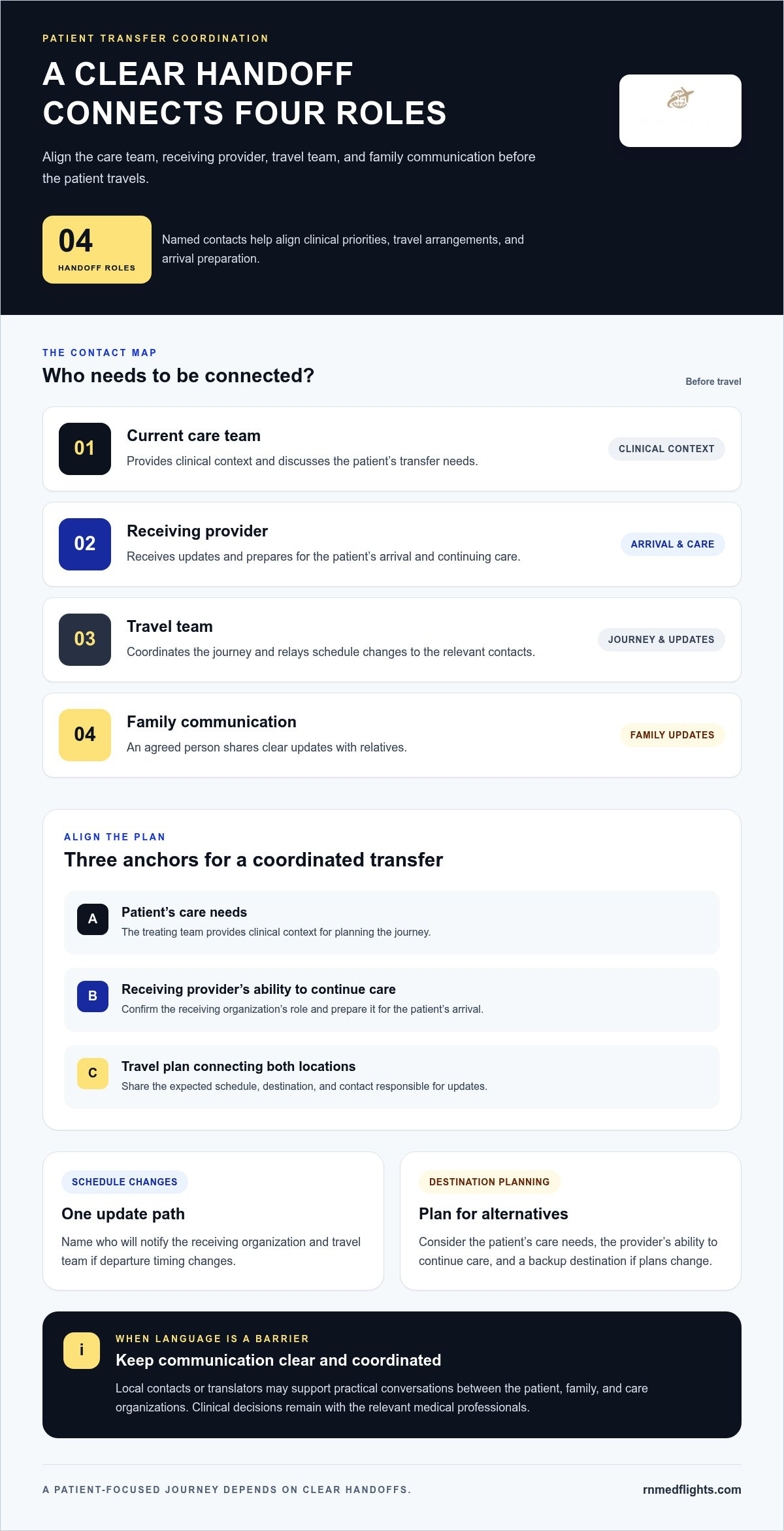
A patient transfer depends on clear handoffs between the current care team, the receiving provider, and the travel team. Identify a contact at each organization. These contacts can align clinical priorities, travel arrangements, and the receiving location’s role before the patient travels.
The treating team provides the clinical context for planning. The travel team can coordinate with current medical staff, while the flight nurse can communicate with the receiving facility. This helps both teams understand the transfer plan and prepare for continuity of care after arrival.
Make the handoff practical. Share the expected travel schedule, destination, and contact responsible for updates. Clarify who will update the family and communicate with each provider. If the departure time changes, for example, a named contact can promptly notify the receiving organization and travel team.
Choosing a suitable destination is another coordination task. A medical transport company may help arrange transfer to an appropriate receiving facility and identify alternative destinations. The important factors include the patient’s care needs, the receiving provider’s ability to continue that care, and the travel plan connecting both locations. A backup destination can help teams respond if the original plan changes.
Language differences can complicate sensitive conversations. Medical travel teams may use local contacts or translators to support communication across language barriers. A translator can help clarify practical details between the patient, family, and care organizations, while clinical decisions remain with the relevant medical professionals. Keep messages direct and share updates through the agreed contacts.
Before travel, organize a handoff plan that covers:
Current care team: the contact who can discuss the patient’s transfer needs.
Receiving provider: the contact who will receive updates and prepare for the patient’s arrival.
Travel team: the person coordinating movement and relaying schedule changes.
Family communication: the agreed person who will share clear updates with relatives.
These roles reduce confusion during a sensitive transition. They also help limit disruption when several organizations are involved, such as a hospital, a receiving facility, and travel personnel. Keep the plan concise, use consistent contact details, and update it when the route or destination changes.
For a transfer involving air travel, coordinated communication can connect the patient’s current team with the receiving facility throughout planning. Explore medical travel coordination as a next step when arranging those provider handoffs.
Medical records and travel clearances
Before arranging transportation, gather the records needed to communicate the patient’s current condition and travel needs. Decide who will collect the documents, who will receive them, and how they will be transferred securely. A transfer between facilities typically involves coordination among the current care team, travel personnel, and receiving provider.
Medical records support a clear clinical handoff. Organize relevant information so the receiving team understands the patient’s care and the travel team can plan the required support. Keep records separate from general moving paperwork, including equipment and household inventories. Limit access to people involved in care or transportation, and handle records securely during transfer and storage.
Travel clearances are a separate planning step. Medical repatriation may require obtaining records and clearances, then confirming that the patient meets travel requirements. For domestic travel, the care team’s assessment and the intended mode of transportation help shape which clearances are needed. The travel plan should reflect the patient’s condition, support needs, and any equipment required en route.
Use a clear sequence to prevent missing information:
Gather: collect the records relevant to the patient’s current care and planned transfer.
Coordinate: identify the treating contact and the receiving provider’s contact for clinical information.
Review: align the travel plan with the patient’s care needs and required medical equipment.
Transfer securely: send records through an agreed, protected process and document who receives them.
Prepare: keep the clearance and travel details accessible to the appropriate care and transport teams.
For example, if a patient needs oxygen or mobility support during travel, the care team’s information helps determine how those needs fit the transportation plan. The receiving provider also needs the information required to continue care after arrival. Clear coordination avoids relying on family members to carry messages between organizations.
Keep housing and personal belongings on a separate track from clinical documentation. Household movers may need an inventory and destination details, but those logistics do not replace patient records or travel arrangements. Assigning separate contacts for patient travel and household matters helps protect sensitive information and reduce confusion.
A final document review should confirm that the records, destination, travel arrangements, and receiving contact align. If anything changes, update the relevant care and transport teams before departure. This careful handoff helps keep medical information connected to the patient throughout the transfer.
Move scheduling and operational continuity
A hospital or clinic should build its relocation schedule around patient-care priorities, the travel plan, and the receiving provider’s readiness. Set a shared timeline, assign a contact for updates, and identify what must be in place before departure.
For patient travel, scheduling starts with the route and mode of transportation. Medical transport planning can include booking flights and coordinating arrangements with airlines and airports. The itinerary should also account for ground transfers, check-in, and the receiving facility’s ability to accept the patient.
Continuity depends on clear timing between each handoff. A departure time, for example, affects when the treating team prepares the patient and when the receiving provider expects arrival. Keep one schedule for the care team, travel personnel, and receiving organization, and record updates there so everyone uses the same version.
Use a sequence that connects clinical readiness with travel logistics:
Set the care window: identify treatment or care activities that affect when the patient can travel.
Coordinate the destination: align the arrival plan with the receiving provider and its readiness to continue care.
Arrange transportation: coordinate flights, airport logistics, and ground transfers as needed.
Confirm handoff roles: name who updates the treating team, receiving provider, and family if timing changes.
Share the final itinerary: distribute the current schedule and contact details to the people involved.
This process also keeps records and travel details aligned. If the route changes, update the itinerary and notify the relevant care contacts. A revised arrival time may affect the receiving provider’s preparations, so communicate changes promptly instead of relying on separate messages or assumptions.
Specialized planning matters when a patient needs medical support during transit. Identify those needs early, then coordinate them with the travel arrangements and receiving team. If airport mobility assistance is needed, for instance, include it in the itinerary rather than treating it as a separate detail.
Keep the patient and family informed through one designated contact. A concise update should state the current departure plan, expected arrival, and next handoff. This reduces uncertainty during a sensitive move and helps families understand what happens next without coordinating among multiple organizations themselves.
Build flexibility into communication rather than assuming a fixed travel duration. The schedule should show dependencies such as clinical readiness, airline arrangements, and the receiving provider’s acceptance. When each dependency has an owner, the team can manage changes while keeping continuity of care central to the plan.
Relocation cost factors
The cost of domestic medical relocation depends on the patient’s travel plan and required support. A commercial flight with a medical escort involves different arrangements from stretcher travel. Route, mode of travel, patient needs, ground transportation, and coordination all affect the plan. Request a quote based on the patient’s specific circumstances.
Start with the patient’s condition and required support. A person who can travel on a commercial airline with a medical escort has different arrangements from someone requiring stretcher travel. The care plan affects staffing, equipment, and coordination during the journey. The treating team’s assessment helps define those needs before travel is arranged.
Next, consider the route and each leg. A transfer may include ground travel to an airport, a flight, and transportation to the receiving facility. Each handoff requires coordination. A route with separate ground and air legs, for example, requires planning for each connection.
Medical needs also shape the plan. Identify what support the patient requires during transportation and how it fits the chosen mode. Needs during a flight can affect travel arrangements. Equipment or supplies moving separately may require their own handling plan, distinct from the patient’s journey.
Scheduling also affects logistics. Airline arrangements, airport coordination, and the receiving facility’s readiness must align. A change to departure or arrival may require updates across those parties. Clear itinerary records and assigned contacts help manage changes without losing sight of the patient’s care priorities.
Some families also need to account for related personal expenses, such as housing near the receiving facility or travel for relatives. Keep these separate from the patient’s transport plan. A simple cost worksheet can distinguish transportation, medical support, equipment handling, and family arrangements, making the overall budget easier to understand.
Patient travel: origin, destination, and preferred travel mode.
Care requirements: current support needs and equipment required during transit.
Ground legs: pickup and arrival locations, including facility handoffs.
Scheduling: travel constraints and receiving-facility coordination.
Additional arrangements: separate housing or family travel needs.
This information helps define the logistics before arrangements are made. To discuss a domestic medical relocation plan, share the route, care needs, and travel requirements for the patient.
RN MEDflights: Commercial Airline Medical Escort
RN MEDflights can coordinate domestic medical relocation when a patient needs support arranging travel between care settings. Its Commercial Airline Medical Escort service supports patients traveling by commercial flight with medical assistance during the journey. When the plan involves multiple legs, Bed-to-Bed Medical Transport and Ground Ambulance Coordination can help connect the transfer from one location to another.
This may be a suitable next step when the patient’s care team has assessed travel needs and the family needs help organizing the journey. The arrangements can be shaped around the patient’s condition, route, and receiving destination, keeping travel logistics connected to continuity of care.
Contact RN MEDflights to discuss the patient’s relocation and travel needs.
Prepare for the next step with a clear plan
A useful next step is to bring the patient’s travel needs into one concise relocation brief. Include the intended destination, the treating team’s guidance, the receiving contact, and any support the patient may need during travel. This gives everyone a shared starting point for planning and keeps the patient’s priorities central.
RN MEDflights provides Domestic Medical Relocation and Commercial Airline Medical Escort, as well as International Medical Repatriation. These services address different travel situations, so start with the patient’s destination and care needs. If you’re considering domestic medical relocation services, share those details when you get in touch.
Contact RN MEDflights about your relocation to discuss the next step. A thoughtful plan can make a difficult transition feel more manageable for the patient and family.
Frequently Asked Questions
Can healthcare relocations be performed after hours?
Equipment moves can be scheduled overnight or during off-peak hours when that helps limit disruption to hospital operations. Patient travel timing, however, depends on clinical readiness and transport arrangements, not a standard after-hours schedule. Plan these as distinct types of relocation: a facility may move equipment outside regular hours, while patient travel must align with care needs and receiving arrangements.
Do you coordinate directly with hospital or facility teams during the move?
Direct coordination between care teams is important during a patient transfer. The treating team can share relevant clinical information, and the receiving facility can prepare for arrival. For air travel, the travel team coordinates with current medical staff and the receiving facility. Agree on contacts and an update process so schedule changes reach the people responsible for care.
Do you follow HIPAA compliance standards during a healthcare move?
HIPAA is relevant to protecting patient information during a hospital move, but a general equipment-moving plan does not establish how records are protected. Keep clinical information separate from equipment inventories, limit access to people involved in the transfer, and handle records securely during transport and storage. The healthcare organizations involved should align their information-handling procedures with their applicable privacy responsibilities.
How Much Does Medical or Laboratory Relocation Cost?
There is no single universal cost for moving medical or laboratory equipment. Scope depends on the items, their handling needs, route, packing or crating, and any temporary storage. Sensitive materials, such as pharmaceuticals or laboratory specimens, may require specific handling arrangements. Patient medical travel is a different service from facility equipment relocation, so define the type of move before comparing plans.
How are patient records and data kept secure?
Assign responsibility for records separately from equipment and general moving documents. Use secure transfer and storage, restrict access to people who need the information for care or transportation, and record who receives the documents. For example, don’t put patient details on a public-facing equipment label. The treating and receiving organizations should agree on how to share clinical information for the handoff.
What are domestic medical relocation services, and what do they include?
Domestic medical relocation services coordinate non-emergency patient travel within the country when medical support is needed during the journey. Depending on the patient’s needs, arrangements may include a commercial airline medical escort, ground transport, and coordination between the sending and receiving care teams. This differs from moving hospital or laboratory equipment. First define whether the need is patient travel, facility relocation, or both.
What factors affect the cost and timeline of a medical facility move?
For a facility move, scope drives planning: the amount and type of equipment, packing needs, route, handling requirements, and storage arrangements all matter. The timeline also depends on how the facility sequences work around patient care and operational priorities. A detailed inventory helps identify what needs special handling and what can move in stages, making the plan more practical.
What risks can disrupt a medical relocation, and how can downtime be minimized?
Common planning risks include missed handoffs, unclear equipment inventories, schedule changes, and delays in preparing the receiving location. Reduce disruption by assigning a contact for each organization, tracking equipment in a shared inventory, and staging moves so essential items remain available for care. For patient travel, keep the treating team, travel contacts, and receiving provider aligned when the route or arrival plan changes.