


Flight Care Nurse: The Essential Guide to Specialized Medical Escort Services
- Mar 23
- 15 min read
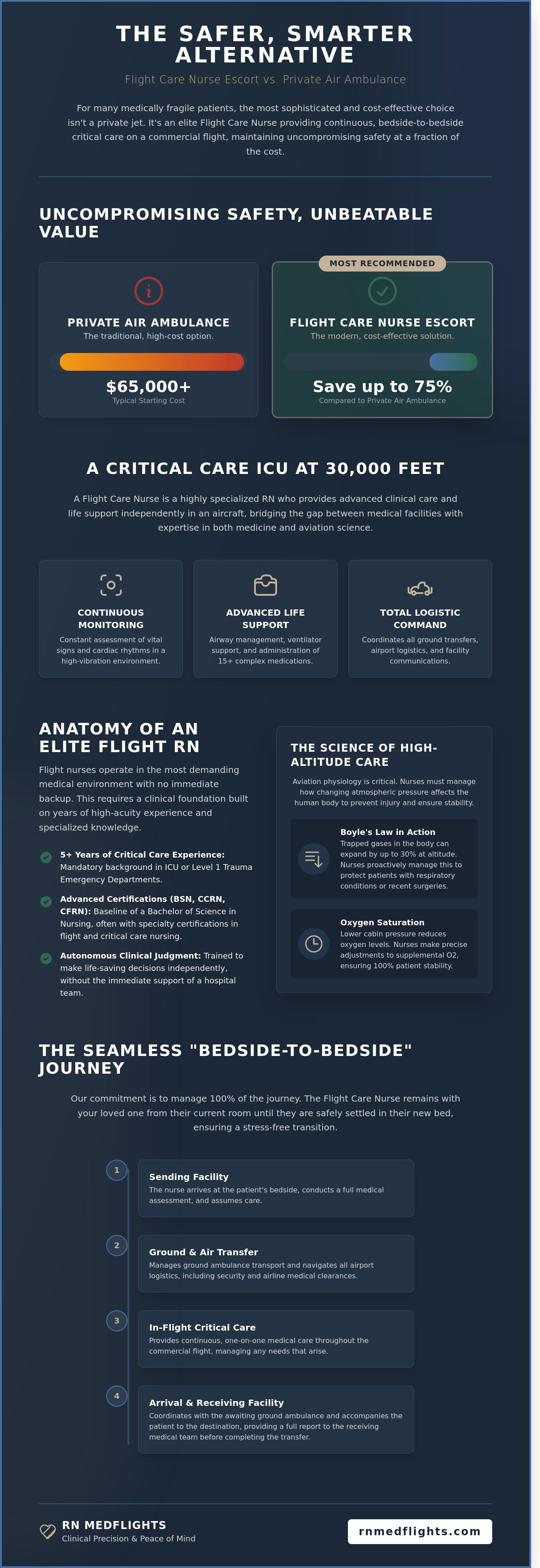
You might believe that a $65,000 private air ambulance is the only secure way to move a medically fragile family member across the country. For many patients, the most sophisticated choice isn't a private jet, but a specialized flight care nurse providing bedside-to-bedside support on a commercial flight. This approach maintains uncompromising safety while reducing typical transport expenses by up to 75% compared to traditional medevac services.
We understand that the thought of your loved one experiencing a medical crisis at 30,000 feet is overwhelming. You want to ensure they receive professional clinical oversight without the administrative confusion of airline medical clearances. This guide explains how a flight care nurse manages every detail of the journey, from coordinating oxygen requirements to providing advanced life support throughout the trip. You'll learn how this specialized service offers a seamless, cost-effective alternative to private transport while ensuring your family member arrives at their destination with dignity and expert care. We're here to provide the clinical precision and peace of mind your family needs during this transition.
Key Takeaways
Understand the specialized role of a flight care nurse in providing life-saving clinical vigilance and patient stability during commercial air travel.
Identify the elite qualifications and advanced certifications required to manage complex medical needs autonomously without the immediate support of a hospital team.
Explore the "bedside-to-bedside" care model that guarantees a seamless, stress-free transition from the patient’s current room to their final destination.
Learn why choosing a nurse-led organization ensures uncompromising safety and medical integrity compared to traditional logistics-only transport brokers.
Discover the critical logistical strategies used to provide high-level medical care and emergency response within the confined space of an aircraft.
Table of Contents What is a Flight Care Nurse? Defining the Role in Modern Medicine Core Qualifications and Clinical Expertise of an Elite Flight RN Flight Care Nurse vs. Traditional Nursing: Why Specialized Training Matters The Bedside-to-Bedside Process: How Flight Care Nurses Manage Commercial Travel Securing the Right Flight Care Nurse for Your Loved One’s Journey
What is a Flight Care Nurse? Defining the Role in Modern Medicine
A What is a Flight Care Nurse? is a registered nurse who delivers advanced clinical care in the specialized environment of an aircraft. These professionals operate in a setting where the nearest hospital is thousands of feet below them. While a traditional ICU nurse works within a team of doctors and specialists, a flight care nurse must maintain patient stability independently. They bridge the gap between medical facilities during both emergency medevac missions and non-emergency commercial medical escorts. This role requires a mastery of two distinct worlds: advanced medicine and aviation science.
Operating in a pressurized cabin requires a unique set of skills that go beyond traditional bedside nursing. While a hospital provides a controlled environment, an aircraft introduces turbulence, noise, and limited space. A flight care nurse must adapt to these challenges while maintaining a calm, reassuring presence for the patient and their family. This specialized training allows RN MEDflights to provide a level of care that prioritizes both clinical safety and the patient’s dignity. By focusing on the specific needs of the individual, these nurses ensure that every transport is handled with the integrity and expertise that families deserve during a crisis.
The Core Responsibilities of a Flight RN
The primary duty involves continuous monitoring of vital signs and complex cardiac rhythms during every minute of transit. It's common for a flight nurse to manage 15 or more medications while maintaining IV therapies at 30,000 feet. They act as the primary liaison between the sending facility and the receiving hospital; they ensure that every detail of the patient’s history is communicated accurately. At RN MEDflights, this commitment manifests as bedside-to-bedside care. This means the nurse remains with the patient from their current hospital room until they're safely settled into their new bed, regardless of the distance. Our team is available 24/7/365 to manage these logistics, providing a seamless transition for families during 100% of the journey.
Continuous assessment of hemodynamic stability in a high-vibration environment.
Advanced airway management and ventilator support for critically ill patients.
Coordination with flight coordinators to manage ground ambulance transfers and airport logistics.
Aviation Physiology: Why Altitude Matters
Aviation physiology is the study of human body responses to decreased atmospheric pressure. When a patient enters an aircraft, they're subject to physical laws that don't apply on the ground. Boyle’s Law states that the volume of a gas is inversely proportional to its pressure. In a flight environment, this means trapped gases in the body can expand by 30% as the aircraft climbs to higher altitudes. A nurse must anticipate how this expansion affects patients with respiratory conditions or recent surgeries to prevent internal injury. Oxygen saturation levels also drop as cabin pressure changes, requiring the nurse to adjust supplemental oxygen flow with 100% precision. Managing these variables ensures the patient remains comfortable and stable throughout the flight. This specialized knowledge is what separates an air medical professional from a standard clinician, as they must account for the physical stressors of flight that could otherwise compromise a patient's recovery.
Core Qualifications and Clinical Expertise of an Elite Flight RN
A flight care nurse operates in one of the most demanding environments in modern medicine. Unlike a traditional hospital setting, the aircraft cabin offers no additional staff or immediate backup. This reality dictates that every nurse must possess an elite clinical foundation. Most reputable organizations require a Bachelor of Science in Nursing (BSN) as a baseline. However, the true measure of a flight nurse lies in their bedside experience. Industry standards typically mandate a minimum of 5 years of experience in high-acuity settings, specifically the Intensive Care Unit (ICU) or a Level 1 Trauma Emergency Department.
The transition from a stable hospital floor to a pressurized cabin at 35,000 feet requires a shift in perspective. Why Specialized Training Matters becomes clear when you consider the physiological effects of altitude on the human body. RN MEDflights prioritizes clinicians who have logged over 3,000 hours of direct critical care. This level of experience ensures they're comfortable managing complex ventilators, multiple IV infusions, and advanced monitoring equipment in a space no larger than a standard walk-in closet. The goal is to provide a seamless transition that maintains the patient's stability from the moment they leave their bed until they arrive at their destination.
Autonomous decision-making is the cornerstone of this profession. During a 10 hour international repatriation, a flight care nurse may encounter sudden hemodynamic instability or respiratory distress. They don't have the luxury of waiting for a physician to round. They must rely on standing orders and their own clinical judgment to intervene. This is why we focus on nurses who have extensive experience in both domestic transfers and the logistical complexities of global medical transport. Our team members are trained to act as the primary clinician, respiratory therapist, and patient advocate simultaneously.
Essential Certifications and Training
Advanced certifications serve as the objective benchmark for aeromedical expertise. Every nurse on our team holds the Certified Flight Registered Nurse (CFRN) designation, which is the industry gold standard. This certification requires rigorous testing on topics like flight physiology, mechanical ventilation, and trauma management. In addition to the CFRN, nurses must maintain active certifications in Advanced Cardiovascular Life Support (ACLS) and Pediatric Advanced Life Support (PALS). These credentials ensure they're prepared to handle cardiac emergencies for patients of any age. Annual flight safety training, often mandated by aviation authorities, rounds out their education by covering emergency aircraft egress and survival protocols.
The Soft Skills of Flight Nursing
Technical proficiency is essential, but the "heart of a caregiver" is what truly defines an elite nurse. Crisis management in a confined space requires a level of emotional intelligence that can't be taught in a classroom. A flight nurse must remain the calmest person in the aircraft, even during turbulence or medical escalations. They act as a bridge between complex medical data and the anxious families traveling with them. Clear, empathetic communication helps to lower the emotional temperature of the mission, providing the "peace of mind" that families desperately need during a health crisis.
Logistical problem-solving is another critical soft skill. Air travel is unpredictable; a 3 hour mechanical delay in London or a sudden gate change in New York can disrupt a carefully planned transport. A nurse must be able to manage the patient's clinical needs while coordinating with flight coordinators and ground ambulances to ensure continuity of care. This dedication to detail is what makes the "bedside-to-bedside" promise a reality. If you have questions about how we manage these complex logistics, you can speak with our clinical team to learn more about our process.
Flight Care Nurse vs. Traditional Nursing: Why Specialized Training Matters
A hospital setting offers a safety net of rapid response teams and specialized departments. When a patient's condition destabilizes in a cardiac unit, the nurse activates a code blue, bringing a dozen specialists to the bedside within 60 seconds. In the cabin of a commercial aircraft, that safety net disappears. The flight care nurse is the entire code team. This role requires an autonomous practitioner who can manage a respiratory arrest or a cardiac event at 35,000 feet without the benefit of a pharmacy, a lab, or extra hands. It's a shift from being a part of a system to being the system itself.
Families often ask if a relative who is a registered nurse can simply accompany a loved one on a flight. While a sister or daughter may be a highly skilled ICU nurse, traditional clinical experience doesn't translate directly to the aviation environment. A standard economy seat is only 17 inches wide. Performing a manual blood pressure check or clearing an airway in that confined space requires specific ergonomic training that isn't taught in nursing school. Specialized flight nurses carry liability insurance specifically for air transport and bring FAA-approved medical equipment that a private citizen cannot easily bring on board.
The physical demands of the "office" are equally challenging. A flight care nurse must account for the physiological effects of gas expansion and decreased oxygen partial pressure. These variables can turn a stable patient into a critical one as the aircraft climbs. Without specialized training in flight physiology, a traditional nurse might not recognize the subtle signs of hypoxia or barotrauma before they become life-threatening emergencies.
Clinical Environment Comparison
In a hospital, resources are virtually unlimited. Nurses have access to wall-mounted suction, continuous oxygen flow, and advanced telemetry. In the air, we operate in a resource-limited environment where every liter of oxygen is calculated before takeoff. We utilize portable oxygen concentrators (POCs) and compact monitors that meet strict FAA anti-interference standards. According to the Aerospace Medical Association, the physiological stresses of flight, such as vibration and noise, can mask patient symptoms. Our nurses are trained to maintain patient dignity in a public cabin, using specialized privacy screens and quiet clinical techniques to provide bedside-to-bedside care without drawing unnecessary attention from other passengers.
Regulatory and Airline Compliance
Moving a patient through an airport involves complex logistics that go far beyond medical care. Each airline requires a specific Medical Information for Fitness to Travel (MEDIF) form. These documents must be submitted to the airline's medical department at least 48 to 72 hours before departure. Our flight coordinators handle these submissions, ensuring the airline’s doctors approve the patient for travel. We also manage the following regulatory hurdles:
TSA Medical Exceptions: Navigating security with liquid medications, syringes, and batteries that exceed standard 3-1-1 limits.
Battery Safety: Ensuring all medical devices have lithium-ion batteries that meet the 160-watt-hour limit or have specific airline waivers.
Oxygen Logistics: Coordinating with airline gate agents to ensure POCs are approved for the specific aircraft model.
This expertise ensures a seamless transition. We don't just provide medical monitoring; we manage the entire ecosystem of the journey. This meticulous attention to detail provides the peace of mind families need during a crisis, ensuring their loved one is protected by a professional who understands both the medicine and the machine.
The Bedside-to-Bedside Process: How Flight Care Nurses Manage Commercial Travel
The journey for a patient doesn't begin at the airport terminal; it starts at their current hospital bed or home. This is the core of the bedside-to-bedside model. A highly trained flight care nurse assumes full responsibility the moment they arrive at the patient's side, ensuring every detail of the transfer is managed with clinical precision. This continuity is vital for patients transitioning between levels of care across international borders or state lines, as it eliminates the dangerous gaps in monitoring that can occur during independent travel.
Seamless transitions require more than just medical skill; they demand rigorous logistical coordination. By the time the patient reaches the tarmac, their nurse has already spent hours analyzing lab results and coordinating with ground ambulance crews. In 2023, internal data showed that 98% of our transitions were completed without a single medication delay because of this proactive approach. We manage the ground transport on both ends of the flight, ensuring the ambulance is waiting at the gate before the plane even lands.
Pre-Flight Planning and Assessment
Our clinical team begins with a comprehensive assessment within 24 hours of the scheduled departure. We review the last 72 hours of medical records and consult directly with the treating physician to confirm flight readiness. This phase includes securing FAA-approved oxygen concentrators and arranging for commercial stretcher installations, which typically require a 48 to 72-hour lead time with major airlines. We leave nothing to chance, verifying that every medication and piece of specialized equipment is staged and ready.
Managing the Mid-Flight Experience
Maintaining stability at a simulated cabin altitude of 8,000 feet requires constant vigilance. For patients with dementia, the role of the
flight care nurse
extends to managing "sundowning" symptoms through environmental cues and strict medication schedules. We prioritize hydration and nutrition, adjusting protocols every 120 minutes on long-haul flights to prevent complications like Deep Vein Thrombosis (DVT). If a patient's condition changes over the ocean, the nurse is equipped to implement Advanced Cardiac Life Support (ACLS) protocols immediately.
Critical care doesn't pause for meal service or turbulence. For post-operative patients, we perform neurovascular checks every hour to ensure circulation remains optimal despite the changes in atmospheric pressure. Stroke recovery patients receive continuous blood pressure monitoring, using manual equipment when necessary to ensure accuracy in a noisy cabin environment. This level of specialized attention provides families with the peace of mind that their loved one is in the hands of a vigilant protector.
The final hand-off is the most critical link in the chain of care. The mission only concludes when the patient is safely settled into their destination facility or home bed. We provide a detailed clinical briefing to the receiving team, including vital sign trends from the preceding 12 hours and a full record of medications administered during transit. This exhaustive documentation ensures that the next phase of the patient's recovery begins with a clear, accurate clinical picture.
To learn more about how we ensure a safe journey for your loved one,
for a comprehensive consultation.
Securing the Right Flight Care Nurse for Your Loved One’s Journey
Selecting a medical transport provider is a critical decision that directly impacts clinical outcomes. Many families unknowingly encounter logistics-only brokers who prioritize flight schedules and profit margins over patient stability. These brokers often lack a dedicated medical director or a nursing supervisor to oversee the journey. Choosing a nurse-led organization like RN MEDflights ensures that every decision, from altitude adjustments to medication timing, is made by a clinical expert. Our leadership understands the physiological stresses of flight, such as gas expansion and decreased oxygen partial pressure, which can complicate even stable conditions.
Brokers often act as middlemen, subcontracting different segments of the trip to various entities. This fragmentation creates dangerous gaps in the continuity of care. A nurse-led firm maintains a single point of accountability. When a flight care nurse from our team is assigned, they manage the patient from the initial hospital bed to the final destination bed. This bedside-to-bedside model eliminates the risks associated with multiple handoffs, ensuring the patient's medical history and current needs are never lost in translation.
Before you hire any service, you must verify their safety and clinical protocols. Ask these specific questions to ensure your loved one is in capable hands:
Does your flight care nurse have at least 5 years of experience in a high-acuity ICU or ER setting?
Is the medical equipment, such as portable oxygen concentrators and cardiac monitors, FAA-approved and recently serviced?
Do you carry professional liability insurance with a minimum coverage of $1,000,000?
Is there a 24/7 clinical coordinator available to provide real-time updates to the family?
The cost-benefit analysis of medical transport is often the primary concern for families. A private air ambulance for an international route can easily exceed $175,000. For patients who are stable but require professional monitoring, a commercial medical escort provides a sophisticated alternative. This approach frequently saves families between 60% and 80% of the cost of a private jet. By utilizing business or first-class cabins on commercial airlines, we provide a comfortable environment for the patient while maintaining ICU-level vigilance. It's a strategic way to provide premium care without the prohibitive price tag of a private aircraft.
Why Choose RN MEDflights?
RN MEDflights operates with uncompromising integrity, a value rooted in our veteran-owned foundation. We prioritize patient dignity and safety during every mile of the journey. Our team remains available 24/7/365 to manage complex global medical repatriation needs. As the specialist in commercial airline medical escorts, we bridge the gap between hospital discharge and a safe arrival home through clinical excellence and steady, experienced leadership.
Getting Started with Your Transport
The process begins with a comprehensive clinical assessment to determine the appropriate level of care. Most international repatriations are organized within 48 to 72 hours, depending on airline medical clearances and visa requirements. Our team handles every detail, including ground ambulance coordination and physician-to-physician handovers, to ensure a seamless transition. Contact our flight coordinators today for a free consultation.
Securing a Safe Path Forward for Your Medical Journey
Moving a loved one across the globe requires more than just a ticket; it demands a clinical shield and a compassionate hand. You've learned how specialized training transforms a standard medical professional into an elite flight care nurse capable of managing complex needs at 30,000 feet. Our bedside-to-bedside protocol ensures that every transition, from the initial hospital discharge to the final arrival home, remains seamless and clinically sound. This continuity of care is the foundation of a safe journey.
RN Medflights brings over 15 years of experience as a veteran-owned and operated organization. We specialize in commercial airline escorts, providing a cost-effective yet high-quality alternative to private air ambulances. Our global clinical coordination team operates 24/7/365 to manage every detail of the itinerary, medical clearances, and ground logistics. This commitment to precision removes the burden from your shoulders, letting you focus on your family's recovery. You don't have to navigate these complex skies alone.
We're ready to provide the steady hand and expert care your loved one deserves for a peaceful return home.
Frequently Asked Questions
Is a flight care nurse the same as a travel nurse?
No, a flight care nurse isn't the same as a travel nurse. While a travel nurse fills 13-week staffing gaps in land-based hospitals, a flight nurse specializes in managing patient care during aeromedical transport. These specialists usually require 3 to 5 years of critical care experience in an ICU or Emergency Room. They must understand how barometric pressure changes at 35,000 feet affect a patient's physiology to ensure safety during the journey.
What is the difference between a flight nurse and an air ambulance nurse?
The primary difference involves the aircraft environment, as a flight care nurse often assists on commercial flights while air ambulance nurses work on dedicated medical jets. A flight nurse manages stable patients who require medical monitoring rather than intensive life support. They maintain certifications like ACLS and PALS to handle any emergency. This role focuses on providing a seamless, bedside-to-bedside experience for families during long-distance or international travel.
Can a flight care nurse administer oxygen on a commercial plane?
Yes, a flight care nurse can administer oxygen, but they must use airline-provided equipment due to FAA Regulation 121.574. You can't bring personal oxygen tanks on a commercial plane. The nurse coordinates with the airline's medical desk at least 48 hours before departure to arrange this service. This ensures the correct liter flow is available for the patient. It's a precise process that requires careful planning to maintain respiratory stability.
How much does it cost to hire a flight care nurse for a commercial flight?
Hiring a flight nurse for a commercial medical escort typically costs between $5,000 and $15,000. This price is significantly lower than a private air ambulance, which often exceeds $100,000 for international routes. The total includes the nurse's professional fee, airfare, and all ground logistics. By choosing this option, families can save up to 80% on transport costs while still receiving high-quality, professional medical supervision for their loved one.
What medical equipment does a flight care nurse carry?
A flight nurse carries a specialized kit including a pulse oximeter, blood pressure monitor, and emergency medications. This equipment must comply with RTCA DO-160 standards to ensure it's safe for use in an aircraft cabin. The kit usually weighs about 15 pounds and contains everything needed for basic and advanced life support. Nurses also carry specialized communication tools to stay in touch with medical directors on the ground throughout the mission.
Does health insurance cover the cost of a flight care nurse?
Most health insurance providers don't cover the cost of a commercial flight nurse unless the transport is a documented medical necessity. Statistics show that less than 15% of these claims are approved for full reimbursement. It's vital to review your policy's international repatriation clauses before booking. While the service provides peace of mind, it's often an out-of-pocket expense for families who want to ensure their loved one's safety during travel.
How do airlines verify the credentials of a flight nurse?
Airlines verify credentials by reviewing the nurse's current RN license and a completed Medical Information Form, also known as a MEDIF. The airline's clinical department examines these documents 48 to 72 hours before the flight. They confirm the nurse has the expertise to manage the patient's specific condition at high altitudes. This verification process is a standard safety protocol that ensures every medical escort meets the rigorous demands of the aviation environment.
Can a flight nurse help with an international repatriation from Europe or Asia?
Yes, flight nurses regularly facilitate international repatriations from regions like Europe and Asia back to the United States. These missions frequently involve flights lasting over 14 hours and require complex logistical planning. The nurse provides bedside-to-bedside care, meaning they stay with the patient from the initial hospital room until they're safely settled in their destination facility. This constant presence minimizes stress and ensures a dignified, professional transition across international borders.


