


Flight Nurse Positions: A Complete Guide to Careers in Medical Escort & Repatriation
- Mar 24
- 14 min read
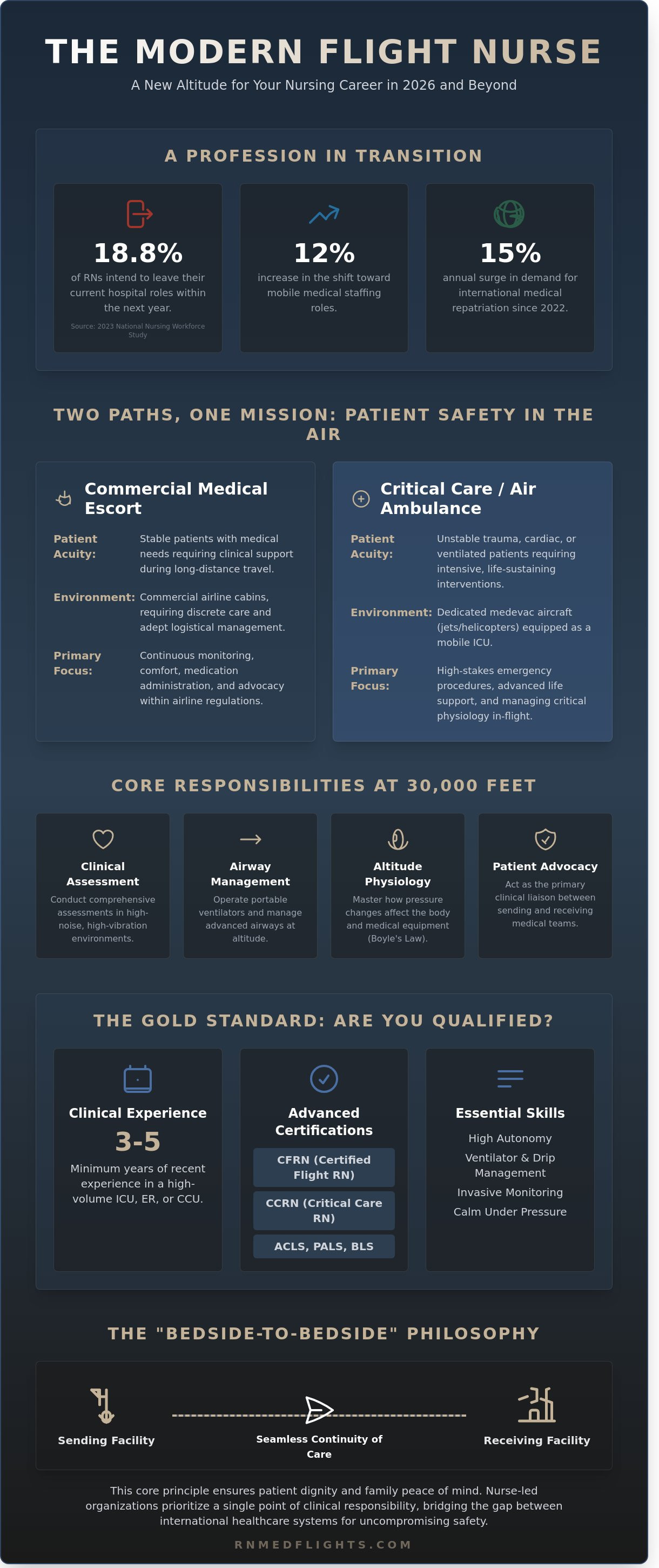
What if the solution to your clinical burnout isn't leaving the profession, but changing your altitude? The 2023 National Nursing Workforce Study found that 18.8% of registered nurses intend to leave their current roles within the next year. You likely feel the strain of high patient ratios and the lack of personalized care in traditional hospital settings. Exploring specialized flight nurse positions offers a way to utilize your advanced clinical skills in a focused, one-on-one environment. This path provides a unique opportunity to transition from the chaotic emergency room to the precise world of international medical repatriation.
You deserve clarity on the certification requirements and the distinct differences between high-stress medevac roles and non-emergency commercial escorts. This guide outlines exactly how to transition into this niche, detailing the daily responsibilities and the path to joining a reputable, nurse-led organization. We'll break down the five essential steps for clinical qualification and explain how bedside-to-bedside care provides the peace of mind families need during a medical crisis. You'll discover how to provide uncompromising safety while regaining your passion for patient-centered nursing.
Key Takeaways
Understand how flight nurse positions are evolving beyond traditional hospital care into specialized mobile medical escort roles for 2026 and beyond.
Identify the specific clinical backgrounds and advanced certifications, such as CCRN and CFRN, required to meet the industry's gold standard of care.
Learn the critical differences between managing stable patients in commercial cabins versus handling acute trauma cases in private air ambulances.
Gain strategic insights into tailoring your professional nursing resume and preparing for scenario-based clinical interviews in the air transport sector.
Discover the "bedside-to-bedside" philosophy that ensures continuity of care and why nurse-led organizations prioritize patient dignity during every transit.
Table of Contents What are Flight Nurse Positions and Why are They Growing? Essential Qualifications for Flight Nurse Positions Commercial Escort vs. Private Air Ambulance Roles How to Secure a Position in Flight Nursing Join the RN MEDflights Team: A Nurse-Led Mission
What are Flight Nurse Positions and Why are They Growing?
A flight nurse is a highly specialized registered nurse who delivers advanced clinical care while in transit via aircraft. These professionals manage patients in environments that are often cramped, pressurized, and constantly in motion. According to this Flight Nurse Overview, the role requires a unique blend of emergency medicine expertise and aviation knowledge. As we approach 2026, the healthcare industry is seeing a 12% increase in the shift from traditional hospital-based roles toward mobile medical staffing. This transition reflects a growing need for continuity of care that extends far beyond the walls of a stationary facility.
Flight nurses handle much more than basic monitoring. They must master altitude physiology, which involves understanding how gas expansion and decreased oxygen pressure at 30,000 feet affect a patient's respiratory and cardiovascular status. Their core responsibilities are intensive and require a steady hand. These include:
Comprehensive clinical assessments conducted in high-vibration, high-noise environments.
Advanced airway management and the operation of portable ventilator systems.
Pharmacological interventions specifically tailored to the physiological changes caused by flight.
Patient advocacy, acting as the primary clinical liaison between the sending and receiving medical teams.
The demand for international medical repatriation has surged by 15% annually since 2022. Families today prioritize the ability to move loved ones across borders to access specialized treatment or to return home for recovery. This global movement directly drives the availability of new flight nurse positions as providers expand their reach to cover more international territories. It's a field that demands uncompromising integrity and a commitment to bedside-to-bedside care.
The Evolution of Air Medical Transport
Air medical transport began with military evacuations during World War I and has evolved into a sophisticated commercial industry. Modern flight nurses use advanced telemetry and portable monitoring systems to track patient stability at 30,000 feet. These tools allow nurses to bridge the gap between disparate international healthcare systems. This ensures that a patient departing from a facility in London receives the same standard of care they will find upon arrival in New York. The focus has shifted from simple transport to providing a seamless, clinical journey that prioritizes the patient's dignity and safety.
Key Roles: Transport vs. Critical Care Flight Nursing
The environment and patient acuity define the specific flight nurse positions available in the current market. Critical care flight nursing involves high-stakes interventions for trauma or unstable cardiac patients, often in rotor-wing or dedicated medevac aircraft. In contrast, transport nursing focuses on the stable but complex logistics of long-distance repatriation. Both roles require a high degree of autonomy because the nurse is the primary decision-maker during the flight. A commercial medical escort is a non-emergency specialist who provides clinical support and monitoring for stable patients traveling on standard airlines. RN MEDflights maintains a constant, 24/7/365 presence to manage these diverse needs, ensuring that every patient remains in expert hands from the initial contact to the final destination.
Essential Qualifications for Flight Nurse Positions
Delivering critical care at 30,000 feet requires more than a degree; it demands a foundation built in the most intense clinical environments. The "Gold Standard" for those seeking flight nurse positions remains a minimum of three to five years of recent experience in a high-volume ICU, ER, or CCU. These environments prepare you for the high level of autonomy required when the nearest specialist is miles below you. You'll need to be comfortable managing complex ventilators, titration of multiple vasoactive drips, and invasive monitoring without the immediate backup found in a traditional hospital setting.
Understanding altitude physiology is a non-negotiable technical requirement. You must master how atmospheric pressure changes affect both the human body and medical equipment. For example, Boyle’s Law dictates that gas expands as pressure drops; this means an endotracheal tube cuff or an IV bag may behave differently at a cabin altitude of 8,000 feet than it does at sea level. RN Medflights prioritizes clinicians who can anticipate these physiological shifts to ensure uncompromising patient safety during every transport. Our team operates 24/7/365, requiring a mindset that is always prepared for the technical rigors of the flight environment.
Beyond clinical mastery, soft skills are the glue that holds a mission together. You'll act as a logistical problem-solver, coordinating with ground ambulances and flight crews to ensure a seamless bedside-to-bedside transition. Equally important is your ability to communicate with families. You must be a steady hand in a storm, providing a compassionate and authoritative presence that lowers the emotional temperature for loved ones during a crisis. If you're ready to bring this level of dedication to your career, you can view our current opportunities to see where your expertise fits best.
Clinical Requirements and Experience Thresholds
Most accredited air medical programs mandate 3 to 5 years of experience in a Level I or II trauma center. This threshold ensures you've encountered a wide breadth of pathologies and high-acuity cases. Mandatory certifications include Advanced Cardiac Life Support (ACLS) and Pediatric Advanced Life Support (PALS). For specialized transport, such as neonatal or geriatric cases, additional training in Neonatal Resuscitation Program (NRP) or specialized pharmacology is essential to maintain our standard of excellence.
The CFRN Certification Journey
The Certified Flight Registered Nurse (CFRN) credential is the pinnacle of professional validation in this field. Administered by the Board of Certification for Emergency Nursing (BCEN), the 150-question exam tests your knowledge of flight safety, survival, and advanced trauma care. Resources from the Air & Surface Transport Nurses Association (ASTNA) are invaluable for preparation, offering curriculum that aligns with industry standards. Earning this certification is a significant milestone that often results in a 10% to 15% increase in annual compensation and opens doors for leadership within flight nurse positions.
Commercial Escort vs. Private Air Ambulance Roles
Choosing between different flight nurse positions requires a clear understanding of the operational environment. Private air ambulances serve as flying intensive care units. These aircraft, such as the Learjet 45 or King Air 350, transport patients with acute conditions directly between airfields. The setting is controlled, private, and requires uncompromising clinical precision. In contrast, a commercial medical escort manages patients within the cabin of a standard airline. This role involves assisting stable individuals who need clinical oversight during long-distance repatriation. While the private jet offers a sequestered medical space, the commercial escort works in a public sphere, requiring a sophisticated blend of clinical skill and social diplomacy.
Logistics in the commercial sector are governed by strict international standards. Every piece of equipment, from a portable oxygen concentrator to a cardiac monitor, must comply with IATA Dangerous Goods Regulations and FAA 14 CFR Part 121.574. Unlike private flights that bypass major terminals, commercial escorts must navigate TSA checkpoints and customs alongside their patients. This requires a 24/7/365 readiness to manage complex paperwork and airline clearances. While the training of a U.S. Air Force Flight Nurse prepares clinicians for tactical environments, the civilian commercial escort must master the complexities of global travel infrastructure to ensure a seamless bedside-to-bedside journey.
The lifestyle of a commercial escort is distinctly international. These nurses often facilitate 10,000-mile transfers across multiple time zones. A typical mission might involve a 14-hour flight followed by a 48-hour mandatory rest period in a foreign capital. This schedule provides a unique opportunity for global travel that private air ambulance roles, which often focus on regional hospital transfers, cannot match. It's a career path for those who value autonomy and the challenge of maintaining clinical excellence in a dynamic, non-traditional setting. Our flight coordinators handle the heavy lifting of booking, allowing the nurse to focus entirely on the patient's stability and comfort.
The Unique Challenges of Commercial Escorting
Maintaining patient dignity in a public cabin is a specialized skill. Our nurses use strategic boarding processes to ensure the patient is settled before other passengers arrive. They coordinate closely with airline purser teams to manage meals, hygiene, and medication administration without drawing undue attention. Handling medical equipment also requires precision. Every device must be battery-operated and cleared for use at an altitude of 35,000 feet. The nurse acts as a vigilant protector, ensuring a seamless transition from the hospital room to the aircraft seat while keeping the patient's stress levels at a minimum.
Why Many RNs Prefer the Commercial Niche
Many professionals seek out these flight nurse positions because they offer a lower physical risk profile than rotor-wing operations. Helicopter emergency medical services (HEMS) often involve landing in unsecure zones or flying in marginal weather. Commercial aviation remains the safest transport method globally, with a fatal accident rate of near zero in 2023. This niche allows nurses to focus on long-form patient care. Instead of the brief, 30-minute bursts of activity seen in trauma flights, commercial escorts provide continuous monitoring and emotional support over several days. It's a role that prioritizes the human connection and the peace of mind that defines our service.
How to Secure a Position in Flight Nursing
Securing one of the competitive flight nurse positions requires a strategic shift in how you present your clinical expertise. You're moving from a controlled hospital environment to a dynamic, high-altitude setting where resources are limited and autonomy is absolute. RN Medflights looks for candidates who possess a minimum of five years of high-acuity experience in Emergency Departments or Intensive Care Units. This background ensures you can manage the 15% increase in complex physiological stressors that occur during long-haul medical transport. Candidates must prove they can function as a solo practitioner while maintaining the "bedside-to-bedside" continuity that defines our service.
Resume and Portfolio Optimization
Your resume should prioritize autonomous decision-making over task-oriented duties. Highlight specific instances where you led a resuscitation or managed a complex titration without immediate physician oversight. If you have experience with international repatriation, document your familiarity with customs protocols and your proficiency in languages like Spanish or Mandarin. Multilingual nurses are 25% more likely to be selected for global transport roles. Include certifications like the CFRN (Certified Flight Registered Nurse) to demonstrate your commitment to the specialized physics of aero-medical care.
The Interview Process for Flight Roles
Expect a rigorous clinical interview that utilizes scenario-based testing to evaluate your critical thinking under pressure. You might be asked to manage a patient experiencing a sudden tension pneumothorax or a ventilator equipment failure at 35,000 feet. These tests don't just measure your medical knowledge; they assess your ability to remain calm and methodical. Safety is the priority, so be prepared to discuss how you've handled safety violations or equipment checks in previous roles. A successful candidate demonstrates a "safety-first" mindset that aligns with our 24/7/365 operational readiness.
Networking within the medical repatriation industry provides a distinct advantage for those seeking flight nurse positions. Attend conferences hosted by the Air & Surface Transport Nurses Association (ASTNA) to meet industry leaders and understand current trends. Since 2022, the demand for private medical escort services has grown by 12% annually, creating a need for nurses who understand the logistical nuances of commercial and private air travel. Building relationships with flight coordinators and medical directors can often lead to unadvertised opportunities in this niche field.
Identify and target nurse-led organizations when applying for employment. Organizations founded and managed by Registered Nurses, like RN Medflights, prioritize clinical excellence and patient dignity over purely logistical efficiency. During your interview, ask specific questions about the organization's safety record and the level of support provided during long-distance missions. You should understand the "on-call" nature of the role, which often involves 12 to 24-hour shifts and the flexibility to deploy on short notice. A nurse-led team understands these demands and provides the necessary resources to prevent burnout and ensure patient safety.
Clinical Precision: Demonstrate mastery of advanced life support protocols.
Logistical Insight: Show you understand the transition from ground ambulance to aircraft.
Empathy: Explain how you soothe anxious families during a medical crisis.
Integrity: Provide examples of maintaining high standards in isolated environments.
Ready to take your career to the skies with a nurse-led team? Apply for flight nurse positions and join our mission of providing uncompromising bedside-to-bedside care.
Join the RN MEDflights Team: A Nurse-Led Mission
RN Medflights operates as a veteran-owned and nurse-led organization, a structure that fundamentally shifts the approach to medical transport. Since our establishment in 2012, we've prioritized clinical perspectives over purely logistical ones. This means every decision, from the specific equipment we carry to the flight paths we select, is filtered through the eyes of an experienced healthcare provider. Our founder's 20 years of military service instilled a culture of discipline and precision that defines our daily operations. We don't view patients as cargo; we view them as individuals requiring a seamless transition of care during their most vulnerable moments.
The "Bed-to-Bed" philosophy is the cornerstone of our mission. It represents a rigorous clinical standard where our team manages the patient's journey from the initial facility bedside to the final destination bed. This continuity of care is vital because it eliminates the dangerous gaps that often occur during traditional handoffs. By maintaining a single clinical team for the duration of the transport, we reduce patient anxiety and clinical risk significantly. We've completed over 4,500 successful transports using this methodology, ensuring that compassion and dignity remain at the forefront of every mission. Our nurses are trained to advocate for the patient at every step, providing a steady presence in a complex environment.
The RN MEDflights Culture of Excellence
Our organization maintains a commitment to uncompromising safety and integrity. We've achieved a 100% safety record over millions of air miles by adhering to strict clinical protocols and aviation standards. To support our frontline staff, we provide 24/7/365 logistical coordination. Our nurses aren't burdened with booking commercial flights, navigating international customs, or arranging ground ambulances. Specialized flight coordinators handle these complex details in real-time, allowing our medical teams to focus entirely on patient monitoring and advanced life support. Working as a commercial escort leader means you're part of a elite group that values specialized expertise. We provide a structured yet supportive environment where clinical excellence is the baseline for every interaction.
Ready to Take Your Nursing Career to New Heights?
We're currently inviting dedicated professionals to apply for our open flight nurse positions. We seek candidates who thrive in autonomous environments and possess the clinical confidence to manage high-acuity patients at 30,000 feet. Our medical escort candidates must have at least five years of recent experience in an ICU or Emergency Department setting. You'll need an active, unencumbered RN license along with current ACLS, PALS, and BLS certifications. We highly value nurses who've earned their CFRN or CTRN credentials, as these demonstrate a mastery of flight-specific physiology.
Minimum 5 years of critical care or ER experience required
Active RN license and advanced certifications (ACLS, PALS, BLS)
Strong communication skills for interacting with families and foreign medical staff
Ability to pass a comprehensive background check and medical screening
If you're ready to transition into a role that combines clinical mastery with global travel, contact our flight coordinators today at 800-555-0199. You can also submit your resume and cover letter through our secure online portal. Joining RN Medflights means you're joining a team with a 98% staff retention rate, where your skills are respected and your mission is clear. We're ready to help you begin the next chapter of your professional journey.
Take the Next Step in Your Aeromedical Career
Transitioning into the specialized world of medical escort and repatriation requires a unique blend of critical care expertise and logistical precision. You've learned that successful candidates possess strong backgrounds in ICU or ER environments and understand the vital differences between commercial escorting and private air ambulance missions. Since 2010, RN MEDflights has set the standard for bedside-to-bedside care through uncompromising clinical oversight and a commitment to patient dignity. Our veteran-owned organization provides 24/7/365 worldwide coverage for international repatriation. We prioritize safety above all else.
Securing flight nurse positions with a nurse-led team means joining a group of professionals who prioritize the patient's humanity. We provide the steady hand and specialized knowledge necessary to navigate complex global logistics while delivering advanced life support. If you're ready to apply your clinical skills in a high-impact environment where nurse leadership drives every decision, we invite you to join our mission. Your journey toward a rewarding career starts with a team that values your expertise and shares your dedication to excellence.
Explore Open Flight Nurse Positions with RN MEDflights and begin your professional advancement today.
Frequently Asked Questions
What is the average salary for flight nurse positions?
The average salary for flight nurse positions typically ranges from $85,000 to $110,000 per year, depending on your geographic region and years of critical care experience. According to 2023 industry data, senior flight nurses in high-demand metropolitan areas can earn upwards of $125,000 annually. This compensation reflects the specialized nature of the role and the requirement for advanced certifications like the CFRN or CTRN.
Do I need a special license to work as an international flight nurse?
You don't need a specific international nursing license, but you must maintain an active, unencumbered Registered Nurse license in your home jurisdiction. For international transport, RN Medflights requires a valid U.S. passport and specific immunizations as dictated by the 2024 CDC Yellow Book. Our flight coordinators manage the complex visa requirements for over 150 countries to ensure a seamless bedside-to-bedside transition for our patients.
What is the difference between a flight nurse and a travel nurse?
A flight nurse provides specialized advanced life support during air transport, while a travel nurse fills 13-week staffing gaps in traditional hospital settings. Flight nurses manage patients in a confined, high-altitude environment using portable medical technology. In contrast, travel nurses work within the established infrastructure of a brick-and-mortar facility. Our team focuses on the critical 24-to-48-hour window of transport rather than long-term bedside assignments.
Can I work as a flight nurse if I only have ER experience?
You can apply for flight nurse positions if you have at least 3 to 5 years of high-volume Emergency Room or Intensive Care Unit experience. RN Medflights prioritizes candidates who've managed Level 1 trauma or complex cardiac cases, as these skills are vital for autonomous practice. We require current certifications in ACLS, PALS, and BLS to ensure every patient receives an uncompromising standard of clinical care during their journey.
What kind of medical equipment do commercial escorts carry?
Commercial medical escorts carry a specialized kit that includes a portable cardiac monitor, pulse oximeter, and a customized formulary of emergency medications. We use the Zoll Z Vent or similar lightweight ventilators if respiratory support is required. This equipment is compact enough to fit in FAA-approved carry-on bags while providing the necessary tools to maintain patient stability across 10,000 miles of travel. It's a mobile ICU designed for safety.
Are flight nurse positions usually full-time or per diem?
RN Medflights offers both full-time and per diem opportunities, though 70 percent of our commercial escort roles are structured as per diem assignments. This flexibility allows our specialized nurses to maintain their clinical edge in hospital settings while accepting transport missions as they arise. Our 24/7/365 operations center coordinates these schedules to ensure we always have a vigilant protector ready to respond to a family's call for help.
How do flight nurses handle medical emergencies mid-flight?
Flight nurses follow standing orders and advanced life support protocols to stabilize patients during mid-flight emergencies. If a patient's condition changes at 35,000 feet, the nurse utilizes onboard diagnostic tools and communicates via satellite phone with our on-call Medical Director. This immediate access to physician oversight ensures that critical decisions are made with 100 percent clinical precision, even when miles away from the nearest hospital. We prioritize stability above all else.
Does RN Medflights provide training for new flight nurses?
RN Medflights provides a rigorous 40-hour orientation program for all new flight nurses, covering aviation safety, altitude physiology, and international logistics. This training includes hands-on simulation with our specialized transport equipment and a mentored flight period with a senior preceptor. We ensure every team member feels confident and prepared to deliver compassionate, stress-free care before they lead their first solo bedside-to-bedside mission. Your expertise is our greatest asset.


