


Flying Nurse Jobs in 2026: The Complete Career Guide for RNs
- 3 days ago
- 13 min read
What if the solution to your bedside burnout isn't leaving the profession, but simply changing your altitude? You've likely experienced the frustration of a 12 hour shift where your clinical judgment was overshadowed by hospital bureaucracy. It's a reality for many of the 4.3 million registered nurses in the U.S. who feel their specialized skills are being underutilized in traditional settings. We understand that you seek a path where your expertise is respected and your autonomy is absolute.
This guide will help you transition into the specialized world of flying nurse jobs, where you can move from the hospital ward to the cabin of a long range jet. We'll show you how to apply your critical care experience to high stakes medevac missions and commercial medical escort roles. You'll gain a clear understanding of the day to day life in the skies and the specific 2026 certification standards required by the BCEN to succeed.
We'll clarify the differences between emergency air transport and the growing field of international medical escorting. By the end of this article, you'll have a roadmap for achieving a career that offers global travel and the ability to provide seamless bedside-to-bedside care. Our 24/7/365 commitment to excellence starts with empowering nurses like you to reach your full clinical potential.
Key Takeaways
Understand the evolving 2026 landscape of aeromedical care, distinguishing between high-stakes emergency medevac and specialized commercial escort roles.
Identify the essential clinical foundations and life-support certifications required to qualify for elite flying nurse jobs in today's competitive market.
Learn how to adapt your advanced assessment skills to provide uncompromising bedside-to-bedside care within unique, high-altitude pressurized environments.
Compare the distinct risk profiles and scheduling structures of various flight nursing paths to find the career trajectory that best aligns with your lifestyle.
Discover a step-by-step roadmap for transitioning from a high-acuity hospital unit to a rewarding career as a specialized aeromedical professional.
Table of Contents What are Flying Nurse Jobs? Defining the 2026 Landscape The Core Responsibilities of a Flight Nurse Escort Essential Qualifications for Flying Nurse Jobs in 2026 Commercial Medical Escort vs. Emergency Medevac Careers How to Launch Your Career with RN MEDflights
What are Flying Nurse Jobs? Defining the 2026 Landscape
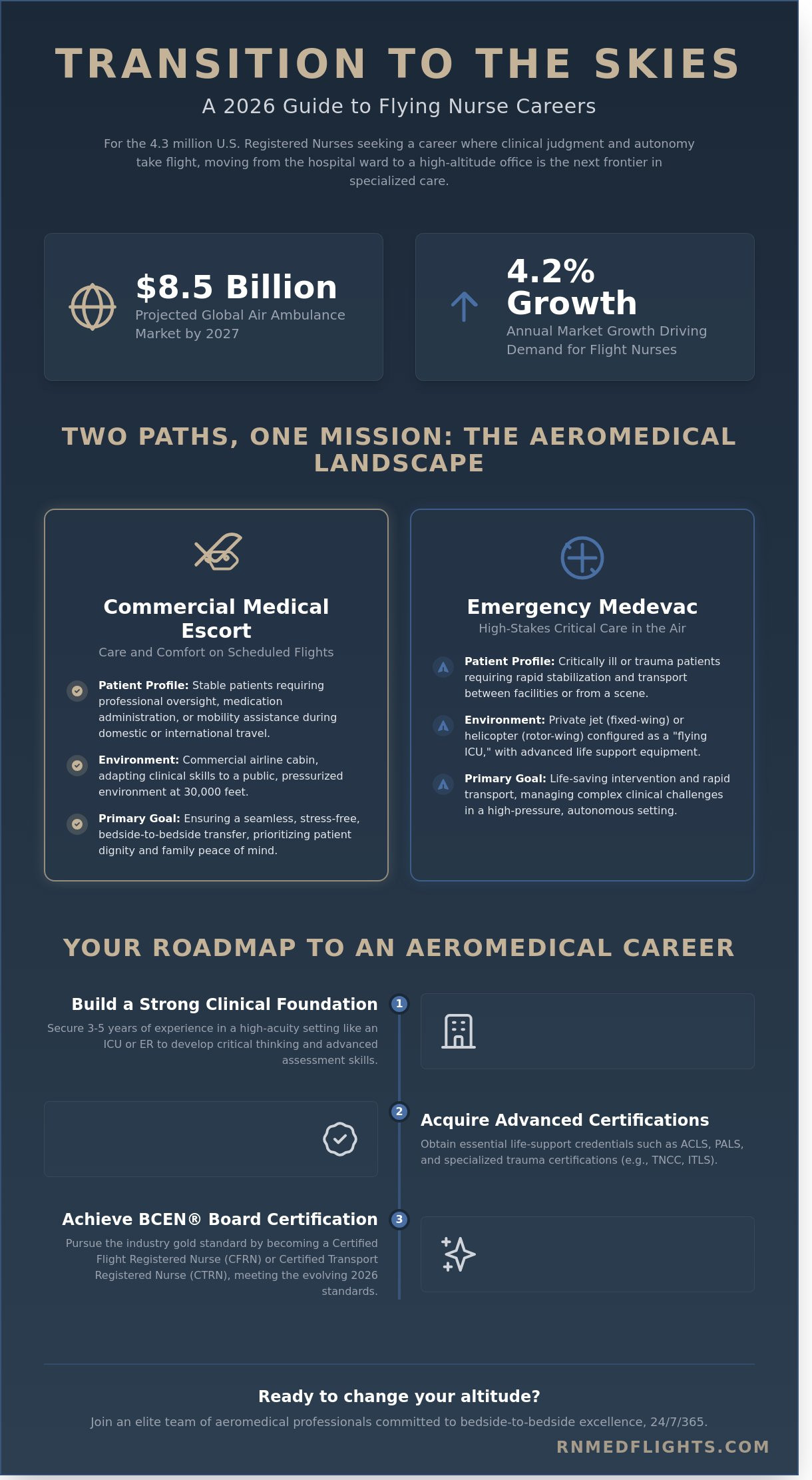
Flying nurse jobs in 2026 represent a sophisticated evolution of the nursing profession. These roles involve Registered Nurses delivering specialized clinical care within the unique physiological environment of an aircraft. We've moved beyond simple patient transportation. Today, these roles function as mobile critical care units. This shift is driven by a 4.2% annual growth in the global air ambulance market, which is projected to reach $8.5 billion by 2027 according to Grand View Research. Our focus remains on clinical precision and the safety of the patient during every mile of the journey.
The 2026 landscape is built upon three primary pillars of service. Emergency Medevac focuses on rapid trauma response. Military Aeromedical supports defense-based transport needs. Commercial Medical Escort provides professional oversight for stable patients on scheduled flights. Global patient mobility has surged as the World Health Organization reports that 1 in 6 people worldwide will be over aged 60 by 2030. This demographic shift increases the demand for specialized transport for chronic condition management and international medical repatriation. Our team operates 24/7/365 to meet this growing need with unwavering reliability.
The Rise of the Commercial Medical Escort
The commercial medical escort role is a distinct niche that differs significantly from traditional travel nursing. While travel nurses work in stationary facilities on temporary contracts, a medical escort provides continuous care during transit. These professionals manage non-emergency patients on commercial airlines for international medical repatriation or domestic relocation. They ensure a seamless transition between facilities. This role prioritizes dignity and stress-free travel, focusing on medication administration, mobility assistance, and physiological monitoring at 30,000 feet.
Emergency vs. Non-Emergency Flight Nursing
Understanding the different categories of flying nurse jobs is essential for career planning. Each path requires specific clinical competencies and equipment knowledge:
Rotor-wing roles: These nurses work on helicopters, primarily handling trauma and scene response. They operate in high-pressure environments where rapid stabilization is the priority.
Fixed-wing roles: Utilizing private jets, these nurses manage critical inter-facility transfers. These aircraft are essentially flying ICUs, equipped for advanced life support and long-range transport.
Commercial escort roles: These nurses care for stable patients who require professional oversight but do not need a private air ambulance. They provide a cost-effective solution while maintaining our signature bedside-to-bedside standard of care.
Choosing a path depends on your clinical background and your desire for either high-acuity trauma or comprehensive, long-distance patient advocacy. Regardless of the platform, the goal is to provide a steady hand and a calm presence. We prioritize peace of mind for families, ensuring that the logistics are handled by experts so they can focus on their loved one's recovery.
The Core Responsibilities of a Flight Nurse Escort
The role of a flight nurse extends far beyond the traditional boundaries of an ICU or ER setting. When you pursue flying nurse jobs, you accept a dual mandate of high-stakes clinical management and complex international logistics. The primary objective is the "bedside-to-bedside" model of care. This protocol ensures that a patient is never without expert supervision, beginning at the sending facility and concluding only when the patient is safely admitted to their destination. This continuity is vital for patients with unstable cardiovascular profiles or those recovering from neurological trauma, where even a brief lapse in monitoring could lead to significant setbacks.
A flight nurse acts as the patient's primary advocate and the family's main point of contact during what is often the most stressful day of their lives. You are responsible for translating complex medical situations into clear, reassuring updates. This human connection provides the "peace of mind" that defines the RN Medflights standard of service.
Clinical Autonomy in the Air
Working in a pressurized cabin requires a deep understanding of aerospace physiology. At a standard cruising altitude, cabin pressure is typically maintained at 6,000 to 8,000 feet, which can cause gases to expand and oxygen saturation levels to fluctuate. You must anticipate these changes before they manifest as clinical distress. Because you operate without a physician physically present, your assessment skills must be flawless. You'll manage titrating pressors, adjusting ventilator settings, and monitoring invasive lines in a confined space. Clinical autonomy for a 2026 flight nurse is the high-level capacity to execute critical medical interventions and pharmacological adjustments independently while operating thousands of feet above the nearest hospital.
The Logistical "Flight Coordinator" Role
Successful medical transport depends on meticulous planning. The nurse often functions as a logistical lead, managing the "seamless" transition between ground and air transport. This includes several critical tasks:
Regulatory Navigation: You'll clear medical equipment through TSA and international customs, ensuring life-saving batteries and monitors meet aviation safety standards.
Airline Liaison: You coordinate directly with airline medical desks to secure supplemental oxygen or specialized seating for patients on commercial stretchers.
Ground Coordination: You manage the timing of ground ambulances at both ends of the journey to prevent any exposure to environmental stressors or delays on the tarmac.
This level of detail is why many RNs find career opportunities at RN Medflights so rewarding; it allows for a specialized focus on one patient at a time with total clinical oversight. You aren't just a passenger; you are the manager of a mobile intensive care unit, ensuring that every protocol is followed with 100% integrity from the moment you meet the patient until the final handoff is complete.
Essential Qualifications for Flying Nurse Jobs in 2026
Securing one of the available flying nurse jobs in 2026 requires more than just a passion for aviation; it demands a demonstrated history of clinical excellence. Candidates must hold an active, unencumbered Registered Nurse license in their primary state of practice. Most accredited transport programs, following the 2025 updated standards from the Commission on Accreditation of Medical Transport Systems (CAMTS), require 3 to 5 years of recent experience in high-acuity settings. This foundation ensures every patient receives bedside-to-bedside care that is both safe and specialized. It's a role that demands a vigilant protector who can maintain a steady hand during the most critical moments of a patient's journey.
Clinical Experience Requirements
The Intensive Care Unit (ICU) and Emergency Department (ER) serve as the primary training grounds for flight candidates. You'll need mastery over advanced life support equipment, including mechanical ventilators, intra-aortic balloon pumps, and multi-channel infusion pumps. For those pursuing scene-response roles, at least 3 years of "911 experience" in a pre-hospital environment is often mandatory. This background prepares you to manage complex pharmacology and hemodynamic instability without the immediate resources of a fixed hospital. You'll be expected to make autonomous decisions that impact patient outcomes, requiring a deep understanding of pathophysiology and emergency interventions.
2026 Certification Checklist
Beyond the standard ACLS, PALS, and BLS, the industry standard for 2026 focuses on specialized credentials that prove your expertise in the aeromedical environment. These certifications must be maintained with current CEUs to ensure uncompromising clinical precision.
Certified Flight Registered Nurse (CFRN): This remains the gold standard for flight-based care, focusing on the unique stresses of flight and pre-hospital trauma.
Certified Transport Registered Nurse (CTRN): This is an ideal credential for nurses focused on fixed-wing interfacility transfers and critical care ground transport.
International Logistics: A valid passport and the ability to obtain quick-issue visas are essential for international medical repatriation missions.
Physical Standards: Most programs enforce a weight limit, often between 200 and 250 pounds fully geared, to meet strict aircraft weight and balance requirements.
Success in this role depends on a calm emotional style and cultural competency. You'll interact with diverse medical teams and families across global borders, requiring a high degree of empathy and professional communication. The ability to remain steady while managing a patient's airway at 30,000 feet defines the role. It is a methodical, rhythmic process that prioritizes safety above all else. When you apply for flying nurse jobs, your portfolio should reflect a commitment to continuous learning and a specialized skill set that guarantees a seamless transition for the patient. This dedication provides the peace of mind that families expect from a nurse-centric organization, available 24/7/365 to respond to those in need.
Commercial Medical Escort vs. Emergency Medevac Careers
Choosing between these two paths defines your daily experience in flying nurse jobs. Emergency medevac roles typically involve rotor-wing aircraft and rapid scene responses. These nurses face unpredictable environments, from highway accidents to remote mountain rescues, where the risk profile is inherently higher. In contrast, commercial medical escorts operate within the controlled, pressurized cabins of scheduled airlines. This environment significantly reduces the physiological stress and acoustic fatigue associated with low-altitude helicopter flight. It's a shift from the chaos of the field to the precision of a coordinated travel itinerary.
The schedule differences are stark. Medevac crews often work 12 or 24-hour rotations, remaining on-call for immediate deployment. This requires a constant state of high-alert readiness. Commercial escort missions are planned in advance, allowing for a more rhythmic and predictable lifestyle. While medevac focuses on stabilizing trauma or acute crisis patients, commercial escorts manage stable patients with chronic conditions or those recovering from surgery. This shift in patient population changes the clinical focus from rapid-fire emergency interventions to sustained, high-quality bedside-to-bedside care. It ensures the patient's dignity remains intact throughout the entire journey.
Why Many Nurses Prefer Commercial Escort Roles
Many professionals transition to commercial escorting to regain the human element of nursing. You aren't just a clinician; you're a vigilant protector and a travel advocate. This role provides hours of one-on-one time, fostering deep connections that are impossible in a 20-minute helicopter transport. It also offers unparalleled international travel opportunities. Nurses visit global hubs while ensuring patient safety across multiple time zones. The physical impact is also lower. You won't be crouching in cramped helicopter cabins or loading heavy stretchers in high-wind conditions.
The Financial and Professional Outlook
Industry projections for 2026 indicate a 6% growth in specialized transport nursing roles, according to recent labor market analyses. Experienced flight nurses can expect competitive compensation, with many earning 15% to 20% more than their hospital-based counterparts. Leadership opportunities are also expanding. Veteran-owned organizations like RN Medflights lead the industry by prioritizing clinical excellence and nurse-led coordination. These businesses offer a clear path into flight coordination and operational management. By choosing this path, you join a team dedicated to providing a seamless, stress-free experience for families 24/7/365.
If you're ready to transition your clinical expertise into a rewarding travel career, explore our current opportunities for flying nurse jobs today.
How to Launch Your Career with RN MEDflights
Transitioning into flying nurse jobs requires a deliberate shift in both clinical focus and professional mindset. To succeed in 2026, you must first establish a robust foundation in high-acuity hospital environments. Most premier transport teams require a minimum of 3,000 hours of experience in settings such as the ICU, CVICU, or Level I Emergency Departments. This background ensures you possess the critical thinking skills necessary to manage complex hemodynamics and respiratory failure without the immediate resources of a full hospital staff.
Beyond your bedside experience, specialized aeromedical certifications are essential. Statistics from the Board of Certification for Emergency Nursing show that nurses holding the Certified Flight Registered Nurse (CFRN) or Certified Transport Registered Nurse (CTRN) credentials demonstrate a higher level of autonomy in the field. At RN MEDflights, we look for clinicians who treat these certifications not just as requirements, but as a commitment to clinical excellence. We prioritize candidates who understand the physiological impacts of altitude on patient health, such as gas expansion and decreased oxygen partial pressure.
Networking with nurse-led organizations is the final step in securing your place in the industry. Unlike purely logistical companies, RN MEDflights is built on a foundation of nursing leadership. This structure ensures that patient care and clinical safety always take precedence over flight logistics. We seek individuals who are ready to embrace full bedside-to-bedside responsibility, managing every detail of the patient’s journey from the initial facility to the final destination.
Joining a Nurse-Centric Team
Working for an organization founded and led by RNs provides a unique professional advantage. Our leadership understands the specific challenges of the field, from equipment fatigue to the emotional weight of family repatriation. RN MEDflights supports your growth through ongoing education and mentorship programs designed to sharpen your specialized skills. For a deeper look at the specific roles we offer, you can review our flight nurse positions guide for comprehensive career insights.
Preparing for Your First Mission
Once you join the team, you'll undergo a rigorous orientation and "check-ride" process. This phase involves shadowed missions where a senior flight nurse evaluates your ability to manage equipment like portable ventilators and advanced cardiac monitors in confined spaces. You'll learn to maintain a calm, reassuring presence for families while executing precise medical protocols. If you're ready to elevate your career and join a team that operates 24/7/365 with uncompromising integrity, we invite you to explore career opportunities and learn more about our mission at RN MEDflights.
Take the Next Step in Your Flight Nursing Career
The healthcare landscape of 2026 demands a unique blend of clinical precision and logistical expertise. Navigating flying nurse jobs requires a commitment to specialized training and a deep understanding of international bedside-to-bedside repatriation. By mastering the core responsibilities of a medical escort, you position yourself at the forefront of a vital, growing industry that prioritizes patient dignity above all else. Success in this field depends on your ability to maintain a calm, authoritative presence while managing complex medical needs at 30,000 feet.
RN MEDflights has led the industry with nurse-centric care since 2010. As a veteran-owned and operated organization, we focus on uncompromising clinical excellence and seamless transitions for families in crisis. We've spent over a decade perfecting the art of the medical escort; we ensure every patient receives a steady hand and a professional advocate during their journey home. Our mission is built on the weight of medical expertise and the heart of a caregiver.
If you're ready to move beyond the traditional hospital setting and embrace a career defined by integrity and specialized service, we invite you to explore our open roles. Join the RN MEDflights team and elevate your nursing career today. Your skills are the bridge that brings patients home safely, and we're excited to see you soar.
Frequently Asked Questions
What is the difference between a flight nurse and a travel nurse?
Flight nurses provide clinical care during active transit in aircraft, while travel nurses work temporary assignments in stationary hospitals. A flight nurse manages patients in high-altitude environments during bedside-to-bedside missions. Travel nurses usually stay at one facility for 13 weeks. Specialized flying nurse jobs require certifications like the Certified Flight Registered Nurse credential to ensure patient safety.
Do I need a special license to work as a flying nurse internationally?
You must hold a valid RN license from your home country and a current passport to work internationally. The International Board of Specialty Nursing states that 95 percent of global transport firms require a compact state license or equivalent. You'll also need a visa for specific regions like the EU or Australia. Our flight coordinators manage these complex logistics 24/7/365 to ensure seamless border crossings.
How much ICU experience is required for flight nurse jobs in 2026?
Most employers require a minimum of 3 to 5 years of recent critical care or emergency department experience. By 2026, 85 percent of accredited transport programs will prioritize candidates with Level 1 Trauma Center backgrounds. This ensures you can handle advanced life support independently. You'll need to demonstrate proficiency with ventilators and cardiac monitors before your first mission. We focus on clinical precision during every transport.
Can I work as a flight nurse part-time or per-diem?
You can work as a flight nurse on a per-diem or part-time basis with many commercial escort agencies. Approximately 40 percent of the medical escort workforce operates on a registry or "on-call" model. This flexibility allows you to maintain your bedside skills at a hospital while taking missions. We provide a steady hand for families who need help on short notice. It's a specialized way to diversify your nursing career.
What medical equipment does a flight nurse carry on a commercial plane?
A medical escort carries a portable oxygen concentrator, an automated external defibrillator, and a specialized medical kit. These kits include essential ACLS medications and basic life support supplies. According to FAA regulations, all electronic equipment must be flight-certified to avoid interference. We ensure every piece of gear is tested and ready for bedside-to-bedside care. This equipment allows us to maintain a patient's dignity and safety in a public cabin.
Is flight nursing a safe career choice?
Flight nursing is a safe career choice when you follow strict clinical and aviation protocols. The Bureau of Labor Statistics reports that air medical transport has seen a 15 percent improvement in safety ratings over the last decade. We minimize risks by using rigorous checklists and maintaining constant communication with ground support. Our team views safety as an uncompromising standard. You're a vigilant protector for your patient throughout the entire journey.
How do I transition from bedside nursing to flight nursing?
You transition by gaining 3 years of ICU experience and earning your Certified Flight Registered Nurse or CCRN credentials. Start by shadowing a transport team to understand the logistical demands of flying nurse jobs. Networking with professional organizations like the Air and Surface Transport Nurses Association is essential for 2026 applicants. We value nurses who can bridge the gap between hospital care and the unique challenges of aviation.
What is the salary range for a commercial medical escort nurse?
The salary for a commercial medical escort nurse typically ranges from $78,000 to $115,000 annually according to 2024 industry data from ZipRecruiter. Factors like geographic location and years of critical care experience influence the final compensation. Some senior flight nurses earn over $130,000 when working for specialized international firms. We believe in rewarding the integrity and expertise our nurses bring to every patient mission.


