Flying with a Portable Oxygen Concentrator in 2026: The Comprehensive Medical Safety Guide
Updated: May 19
Imagine sitting in seat 12A, three hours into an eight-hour flight over the Atlantic, when your device emits a low-battery chirp that feels louder than the jet engines. For the 1.5 million Americans who rely on supplemental oxygen, the logistics of flying with a portable oxygen concentrator 2026 often feel like a high-stakes gamble rather than a routine trip. You're likely worried about conflicting airline policies or the terrifying possibility of respiratory distress while miles from the nearest hospital.
It's completely normal to feel overwhelmed by the technical demands of air travel when your health depends on a machine. We've spent years managing bedside-to-bedside transitions, and we know that meticulous preparation is the only cure for travel anxiety. This guide provides the clinical roadmap you need to master FAA regulations, calculate the mandatory 150% battery capacity for long-haul routes, and secure the specific medical clearances required by major carriers. We'll outline a 24/7/365 safety strategy that ensures your oxygen saturation remains stable, giving you the peace of mind that comes from expert-led planning and clinical precision.
Key Takeaways
Navigate the latest FAA SFAR 106 compliance requirements for 2026 to ensure your device meets uncompromising safety standards before arriving at the gate.
Understand the physiological impact of cabin altitude on oxygen saturation and why your prescribed flow rate requires clinical adjustment mid-flight.
Master the essential documentation and coordination steps required for flying with a portable oxygen concentrator 2026 to avoid travel delays and ensure patient safety.
Evaluate the clinical risks of DIY travel versus the peace of mind provided by a specialized bedside-to-bedside medical escort for international journeys.
Discover how expert flight coordinators manage complex airline negotiations and medical paperwork to ensure a dignified, stress-free experience for your family.
Table of Contents The 2026 Landscape: FAA Regulations for Portable Oxygen Concentrators Physiology at 35,000 Feet: Why Your POC Needs Change Mid-Flight DIY Travel vs. Professional Medical Escorts: A Risk Analysis The 2026 Pre-Flight Checklist for POC Users RN MEDflights: Expert Coordination for Oxygen-Dependent Travelers
The 2026 Landscape: FAA Regulations for Portable Oxygen Concentrators
Aviation safety standards for 2026 have become more stringent to accommodate increased air traffic and evolving medical needs. Compliance under SFAR 106 remains the primary regulatory framework, but a red "FAA Approved" sticker on your device is only the first step toward boarding. Airlines now demand verifiable documentation that your unit maintains oxygen purity at cabin altitudes reaching 8,000 feet. A Portable oxygen concentrator functions by filtering nitrogen from the air to provide a concentrated flow, yet its performance can fluctuate under pressure. It's vital to distinguish between supplemental oxygen and life-support oxygen. If your clinical stability depends entirely on a constant flow, the flight requires a higher level of oversight than a standard commercial trip. When flying with a portable oxygen concentrator 2026, you'll find that most carriers now prohibit the use of seat-back power outlets for medical equipment. This policy prevents a localized electrical failure from interrupting your respiratory support.
The List of FAA-Approved POCs in 2026
The current list of approved devices includes the Inogen One G5, the Caire FreeStyle Comfort, and the Philips SimplyGo. If your model predates 2021, it might have been removed from the approved registry due to updated battery safety or noise level requirements. For international repatriation, the stakes are higher. Global travel often requires adherence to ISO 80601-2-67 standards, which are more rigorous than domestic rules. Our nurse-led team confirms these technical details during our initial consultation to ensure your journey is stress-free and clinically sound.
Understanding the 150% Battery Rule
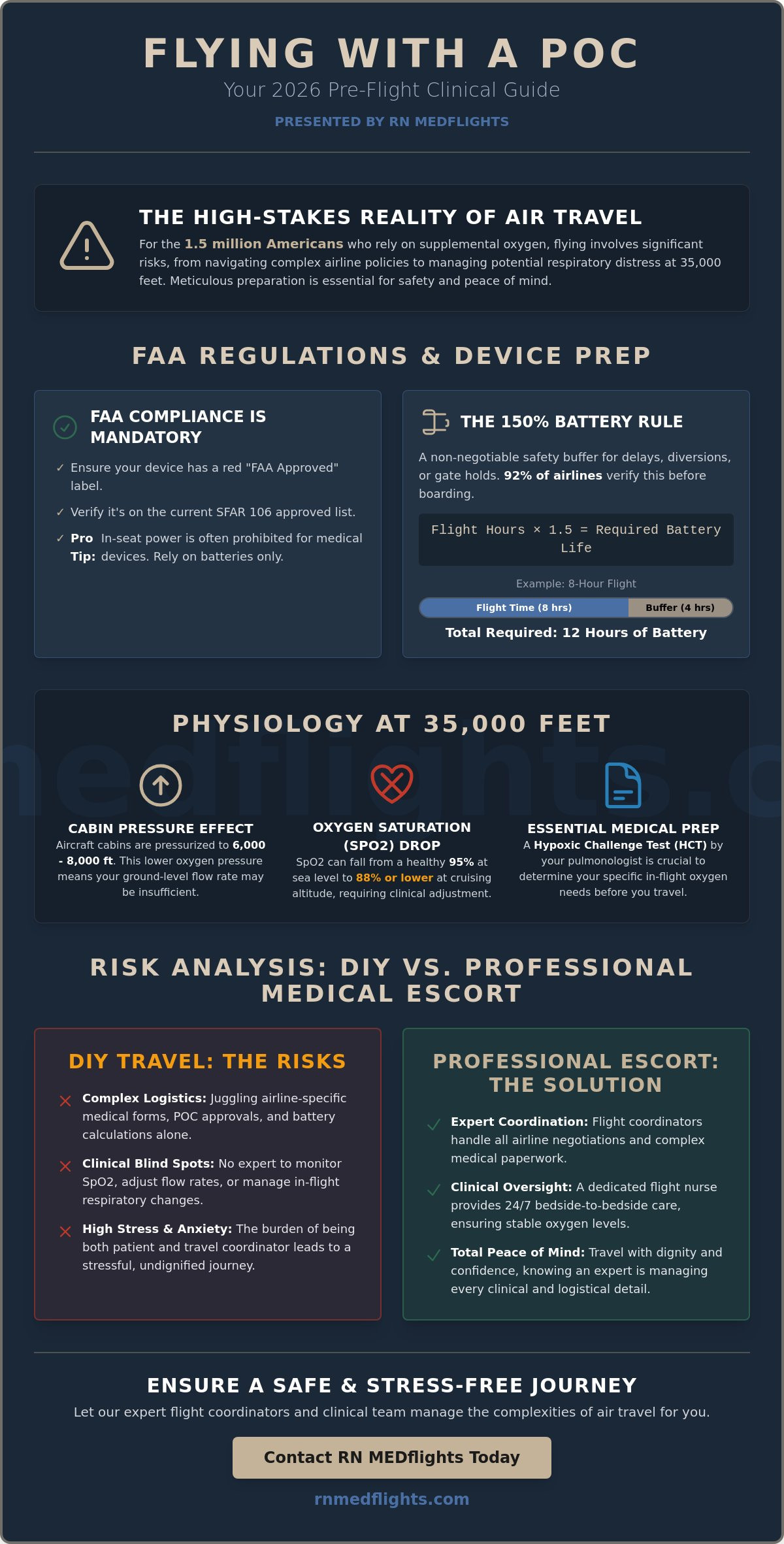
The 150% rule is the industry safety standard requiring passengers to carry enough battery power to cover 150% of their total scheduled flight time. Safety in the air relies on this calculated margin of error. The math is simple: multiply your flight hours by 1.5. A six-hour flight requires nine hours of battery life at your prescribed liter flow. This buffer accounts for unexpected tarmac delays, gate holds, or flight diversions. Data from 2025 shows that 92% of major airlines now verify this battery capacity before allowing a patient to board. We recommend checking your battery health months before departure, as lithium-ion cells can lose 15% of their capacity annually.
Physiology at 35,000 Feet: Why Your POC Needs Change Mid-Flight
Commercial aircraft cabins are pressurized to altitudes typically ranging between 6,000 and 8,000 feet. At these heights, the partial pressure of oxygen in the air drops significantly compared to sea level. For a healthy traveler, this change is negligible; however, for someone flying with a portable oxygen concentrator 2026, it's a critical physiological shift. Your blood oxygen saturation (SpO2) can drop from 95% at sea level to 88% or lower once the aircraft reaches cruising altitude. This is why a flow rate that maintains your stability on the ground often fails in the air.
To prepare for these changes, your pulmonologist must perform a Hypoxic Challenge Test (HCT). This clinical simulation exposes you to a 15.1% oxygen blend to mimic cabin conditions. It determines if you need an increase in liters per minute (LPM) during the flight. Before booking, verify your device meets the FAA acceptance criteria to ensure it's approved for use during all phases of flight. Managing these adjustments requires a proactive approach to prevent desaturation during the journey.
Boyle’s Law and the Respiratory Patient
Boyle’s Law states that gas volume is inversely proportional to pressure. As the plane climbs and cabin pressure drops, any gas trapped in your lungs or pleural space expands by approximately 25%. This expansion can cause chest tightness or restricted lung volume, which increases the work of breathing. Additionally, cabin humidity often hovers below 15%, which thickens respiratory secretions. This makes mucus clearance difficult and can reduce the efficiency of your POC’s filtration system. Patients should watch for a respiratory rate increase of more than 5 breaths per minute as a sign they need a higher flow rate during the ascent.
Signs of In-Flight Respiratory Distress
"Silent" hypoxia is a primary concern for high-altitude travelers. You might feel relatively comfortable while your SpO2 levels quietly dip into dangerous territory below 85%. Monitoring your levels with a pulse oximeter every 30 to 60 minutes is a standard safety protocol we recommend. If you experience sudden turbulence or emotional stress, your oxygen demand spikes immediately. For patients with complex needs, medical escort services provide a critical layer of safety by managing these fluctuations in real time.
Our flight coordinators at RN Medflights are available 24/7/365 to discuss how a bedside-to-bedside nurse can manage your oxygen needs during transit. We prioritize your peace of mind by handling the clinical logistics of flying with a portable oxygen concentrator 2026, ensuring every breath is supported by professional expertise.
DIY Travel vs. Professional Medical Escorts: A Risk Analysis
Managing a 10-hour international flight with a frail patient is a high-stakes clinical event that exceeds the capabilities of most family caregivers. When you're flying with a portable oxygen concentrator 2026 protocols require vigilant battery management and strict adherence to FAA regulations for portable oxygen concentrators. Families often find themselves overwhelmed by the logistical nightmare of navigating crowded terminals while managing a POC, multiple carry-on bags, and the physical needs of a patient who may have limited mobility.
The risks of DIY travel aren't just logistical; they're financial and medical. Consider the implications of an emergency diversion. If a patient experiences acute respiratory distress over the Atlantic, the pilot may decide to divert the aircraft. Industry data shows that an unscheduled landing for a wide-body jet can cost between $50,000 and $600,000 depending on fuel dumping requirements and airport fees. A planned medical escort acts as a safeguard against these catastrophic scenarios. Our flight nurses identify early signs of hypoxia or technical POC failures long before they become an in-flight emergency.
Technical failures are a reality of battery-powered medicine. If a POC malfunctions at 35,000 feet, a layman often lacks the tools or knowledge to troubleshoot the device. A flight nurse carries backup equipment and possesses the clinical expertise to manage oxygen delivery through alternative means, ensuring the patient's saturation levels remain stable throughout the journey.
The Role of a Flight Nurse with Oxygen Patients
A flight nurse provides a level of clinical oversight that a family member cannot. This involves continuous titration of oxygen flow based on real-time pulse oximetry readings, which is vital as cabin pressure changes. They also manage the complex "Physician Statement" and coordinate directly with airline medical desks to secure pre-flight approvals. You can learn more about the specialized role of a flight nurse and how they maintain safety in the unique environment of 2026 aviation.
Bed-to-Bed Continuity of Care
The flight itself accounts for only 30% of the total risk during medical travel. The most vulnerable moments often occur during ground transfers and the "last mile" of the trip. We eliminate these gaps by coordinating with non-emergency ambulance services for terminal-to-hospital transport. This ensures that the oxygen supply is never interrupted while moving through customs or waiting for ground transit. Our commitment to flying with a portable oxygen concentrator 2026 standards means we provide a seamless bridge of care from the patient's current bedside to their final destination.
The 2026 Pre-Flight Checklist for POC Users
The logistics of flying with a portable oxygen concentrator 2026 require a proactive approach to ensure a seamless transition from the terminal to the cabin. You must contact your airline's special assistance desk at least 48 hours before departure. This deadline isn't just a suggestion; it's a safety protocol that allows the carrier to verify your equipment's FAA compliance. During this call, confirm your device model and the number of batteries you're carrying. Most airlines require you to have 150% of the flight duration in battery life to account for unexpected tarmac delays or holding patterns.
Your "Paperwork Packet" serves as your medical passport. It should include a signed physician's statement dated within 30 days of travel, your current prescription, and the technical specifications of your batteries. When you arrive at the TSA checkpoint, notify the officer that you're traveling with a medical device. You don't need to disconnect your oxygen during screening, but the POC will undergo a specialized inspection or X-ray. Having your paperwork organized reduces stress and prevents delays during the security process.
Seating choice is a critical safety factor for respiratory patients. You'll likely be restricted from sitting in bulkhead rows or exit rows. Federal regulations require that oxygen devices be secured under the seat in front of you during takeoff and landing. Bulkhead seats lack this storage space, making them unsuitable for POC users. Choosing a window seat is often the best strategy to prevent the tubing from becoming a trip hazard for other passengers or crew members moving through the aisle.
Battery and Power Logistics
Every battery must clearly display its Watt-hour (Wh) rating. TSA agents look for this label to ensure compliance with the 160Wh limit for lithium-ion cells. Don't rely on under-seat power outlets. These ports are notorious for failing or providing insufficient voltage for medical-grade equipment. Charge your device to 100% at the gate using high-voltage stations, which are now standard in 85% of major international hubs as of 2025. This ensures you start the flight with maximum capacity.
Emergency Contingency Planning
If your POC alarms for "Low Oxygen" mid-flight, stay calm and check for kinked tubing first. Notify a flight attendant immediately if the issue persists. While airlines carry onboard therapeutic oxygen, accessing it often involves a fee exceeding $1,000 and requires a pre-existing medical file. If your respiratory status changes, our flight coordinators recommend a clear communication protocol: state your oxygen saturation level and your prescribed flow rate to the crew. For those who require a higher level of security, RN Medflights provides bedside-to-bedside medical escorts to manage these contingencies for you.
RN MEDflights: Expert Coordination for Oxygen-Dependent Travelers
Navigating the logistical hurdles of flying with a portable oxygen concentrator 2026 requires a specialized strategy that transcends simple equipment rental. RN MEDflights utilizes a "Zero-Stress" approach to international medical repatriation, designed to shield patients and their families from the complexities of modern air travel. Our flight coordinators take full responsibility for airline medical desk negotiations. This process includes the meticulous submission of FAA-required Physician Statement forms and verifying that your specific POC model aligns with the 150% battery duration mandates enforced by major carriers. We don't just provide a service; we provide a clinical safety net.
As a veteran-owned organization, our foundation is built on integrity and the preservation of patient dignity. We recognize that traveling while oxygen-dependent can feel vulnerable. Our team advocates for your comfort and privacy throughout the commercial travel experience. Every mission is handled with the weight of medical expertise and the heart of a caregiver. For those seeking the highest standard of safety, we provide comprehensive quotes for bedside-to-bedside respiratory transport. This ensures a seamless transition between healthcare facilities with no gaps in clinical monitoring.
Seamless International Repatriation
Moving across international borders with life-sustaining medical equipment involves navigating a labyrinth of customs and immigration protocols. When flying with a portable oxygen concentrator 2026, the technical requirements can change based on the destination country's specific aviation authority. Our team manages these interactions directly, ensuring that your portable oxygen concentrator and medical supplies are cleared without delay. We maintain a robust global network of ground ambulance partners, allowing us to provide total continuity of care across different jurisdictions. You can explore our detailed protocols in this guide to international medical repatriation services. By leveraging local partnerships in over 120 countries, we eliminate the friction points that often disrupt medical travel.
Peace of Mind for Families
The emotional toll on family members during a medical relocation is often overlooked. We aim to reduce this burden by serving as a vigilant protector for your loved one. Our flight coordinators and nursing staff are available 24/7/365 to manage urgent relocation needs, providing a steady hand during high-stress situations. We follow a methodical, rhythmic communication plan, ensuring you receive updates from the moment of bedside pickup to the final arrival. It's our mission to lower the emotional temperature of the journey through professional reliability. Contact RN MEDflights for a personalized medical travel plan and let our experts handle the complexities of your next flight.
Prioritizing Your Safety in the 2026 Air Travel Landscape
Navigating the requirements for flying with a portable oxygen concentrator 2026 involves more than just a basic equipment check. It demands an understanding of how 35,000-foot altitudes impact your respiratory physiology and a commitment to meeting updated FAA safety standards. Since 2010, RN MEDflights has bridged the gap between medical necessity and travel logistics. Our veteran-owned team provides RN-led clinical supervision to ensure your oxygen levels remain stable from takeoff to touchdown. We handle the complex coordination of bedside-to-bedside transport, so you can focus on your destination rather than the technicalities of your equipment.
You deserve a travel experience defined by dignity and uncompromising safety. Our flight coordinators are ready to manage every detail of your journey with the precision of a seasoned medical professional and the heart of a caregiver. Request a transparent quote for your bedside-to-bedside medical transport today and let us provide the peace of mind you need. You're not just a passenger; you're our priority, and we're with you every step of the way.
Frequently Asked Questions
Can I use the airplane’s power outlet to run my portable oxygen concentrator?
You shouldn't rely on the airplane’s power outlet to run your device during the flight. Most major airlines, including Delta and United, explicitly state that in-seat power isn't a guaranteed or reliable medical source. It can fail without warning. You must carry enough battery life to power your unit for 150% of your total flight duration to account for unexpected tarmac delays or diverted landings.
How many batteries do I need to bring for a 10-hour flight in 2026?
You need at least 15 hours of total battery life for a 10-hour trip when flying with a portable oxygen concentrator 2026. FAA regulations require you to have 150% of your scheduled flight time in battery power. If your unit lasts 5 hours per battery at your prescribed flow rate, you'll need three fully charged batteries. Check your manufacturer's specific battery duration charts, as higher liter flows drain power faster.
What paperwork does the airline require for me to fly with a POC?
Airlines require a completed Physician’s Statement or a Medical Authorization Form signed by your doctor within 10 days of your departure. This document must confirm your oxygen requirements and your physical ability to fly. We recommend keeping three physical copies: one for the check-in desk, one for the flight crew, and one for your personal records. Always verify the specific form required by your carrier at least 48 hours before boarding.
Does the TSA allow portable oxygen concentrators through security?
The TSA allows FAA-approved portable oxygen concentrators through security checkpoints once they pass a standard screening. You must notify the officer that you're traveling with medical oxygen before the process begins. Your device will undergo an X-ray or a manual inspection to ensure safety. If you can't be disconnected from oxygen, the TSA provides specialized screening procedures to ensure your flow remains uninterrupted during the inspection.
What happens if my POC fails while we are over the Atlantic Ocean?
If your POC fails during an oceanic crossing, you should immediately notify the cabin crew and switch to your backup battery or spare unit. While aircraft are equipped with emergency oxygen masks, these are designed for rapid decompression events rather than long-term medical support. Our flight coordinators ensure every client has a redundant power plan and a secondary device to prevent life-critical failures during long-haul travel.
Is there a difference between "Pulse Dose" and "Continuous Flow" for flying?
Pulse dose delivery releases oxygen only when you inhale, while continuous flow provides a steady stream regardless of your breathing pattern. Most portable units used for flying with a portable oxygen concentrator 2026 are pulse dose because they're lighter and extend battery life. However, if your medical condition requires a constant flow, you'll need a larger, FAA-approved continuous flow unit. Your pulmonologist must determine which setting maintains your saturation above 90% at high altitudes.
Can I fly with a POC if I also have a CPAP or BiPAP machine?
You can fly with both a POC and a CPAP or BiPAP machine, as these are considered essential medical equipment. These devices don't count toward your carry-on luggage limit under Department of Transportation (DOT) Part 382. You'll need to ensure your battery capacity covers the power needs of both units if you plan to sleep during the flight. Our clinical team often manages these complex setups to ensure seamless bedside-to-bedside respiratory support.
How much does it cost to have a flight nurse escort me with my oxygen?
The cost of a flight nurse escort varies based on the level of clinical care required and the total travel distance. According to 2024 industry reports from the Air Medical Physician Association, professional medical escorts are priced based on airfare, specialized equipment needs, and the duration of care. We provide personalized quotes that reflect your specific medical requirements and travel logistics. This ensures every patient receives the precise level of advocacy they need for a stress-free journey.