Getting a Sick Family Member Home from Overseas: The 2026 Repatriation Guide
Updated: May 19
Imagine standing in a sterile hospital corridor in Tokyo, trying to translate a complex discharge summary while your spouse waits in a room down the hall. You quickly realize that getting a sick family member home from overseas involves much more than a simple flight booking. It requires managing a fragile clinical status across multiple time zones and languages. You aren't alone in feeling overwhelmed by six-figure quotes for private medevac jets or the confusing web of airline medical clearance rules. Most families find themselves trapped between the fear of medical complications and the reality of limited financial resources.
We're here to provide the clarity and clinical expertise you need during this crisis. This 2026 guide outlines how to achieve a seamless, bedside-to-bedside transfer using professional medical escorts on commercial airlines. You'll learn how to secure specialized care that costs significantly less than a private charter while maintaining uncompromising safety standards. We'll walk through the specific steps of airline coordination, medical equipment logistics, and the continuous RN supervision that ensures your loved one arrives home with dignity.
Key Takeaways
Distinguish between emergency medevac and non-emergency medical relocation to determine the most appropriate and cost-effective transport method for your situation.
Compare the clinical benefits and significant cost differences between private air ambulances and specialized commercial medical escorts.
Master the "bed-to-bed" philosophy to ensure continuity of care and eliminate high-risk logistical gaps during the transfer process.
Gain expert insights into navigating the complex airline medical clearance process to ensure a smooth journey when getting a sick family member home from overseas.
Understand why a nurse-led model provides superior clinical outcomes and uncompromising safety compared to standard logistical transport services.
Table of Contents Understanding Medical Repatriation: What It Means for Your Family Air Ambulance vs. Commercial Medical Escort: Choosing the Right Level of Care The Bed-to-Bed Process: Managing Ground and Air Logistics Navigating Airline Regulations and Medical Clearance Why a Nurse-Led Repatriation Team is the Safest Choice
Understanding Medical Repatriation: What It Means for Your Family
Medical repatriation is the specialized, professional transfer of a patient back to their home country under clinical supervision. It's a complex process that ensures continuity of care during international travel. While the term is often used interchangeably with emergency medevac, there's a distinct difference. Emergency medevac typically involves private air ambulances for critical, time-sensitive interventions. In contrast, non-emergency medical relocation focuses on patients who are stable but still require professional oversight and specialized equipment.
Attempting the process of getting a sick family member home from overseas by booking a standard commercial ticket is a dangerous gamble. Standard airline staff aren't trained to manage clinical crises or monitor complex physiological changes that occur at 35,000 feet. A dedicated flight coordinator manages the entire journey from start to finish. They navigate international health regulations, secure airline medical clearances, and coordinate with foreign hospital discharge teams. This ensures the patient moves through a secure, bedside-to-bedside chain of custody. Our RN-led teams prioritize this continuity to eliminate gaps in care that often occur during independent travel.
When is Repatriation Necessary?
Families often choose repatriation when a patient requires specialized clinical monitoring that's unavailable in their current location. It's also a vital step for those moving into long-term recovery or rehabilitation programs near their support network in 2026. The emotional burden of foreign hospitalization is significant. Recovering in a familiar environment reduces stress. Clinical data suggests that patients in familiar settings often show improved engagement with physical therapy and recovery protocols. Moving a loved one closer to home provides the family with the ability to participate in the care plan directly.
The Stability Requirement
Before any flight, a patient must be deemed fit to fly. This is a formal clinical designation and the first step in any repatriation journey. For non-emergency commercial escort services, clinical stability is a strict requirement. Our team conducts a comprehensive medical assessment to verify the patient's vitals and current condition. This assessment ensures the patient can safely navigate the physiological demands of air travel, such as changes in oxygen saturation and cabin pressure. We operate 24/7/365 to facilitate these assessments, ensuring that every patient meets the safety thresholds required for a seamless transit. This meticulous preparation provides the peace of mind that your loved one is in expert hands.
Air Ambulance vs. Commercial Medical Escort: Choosing the Right Level of Care
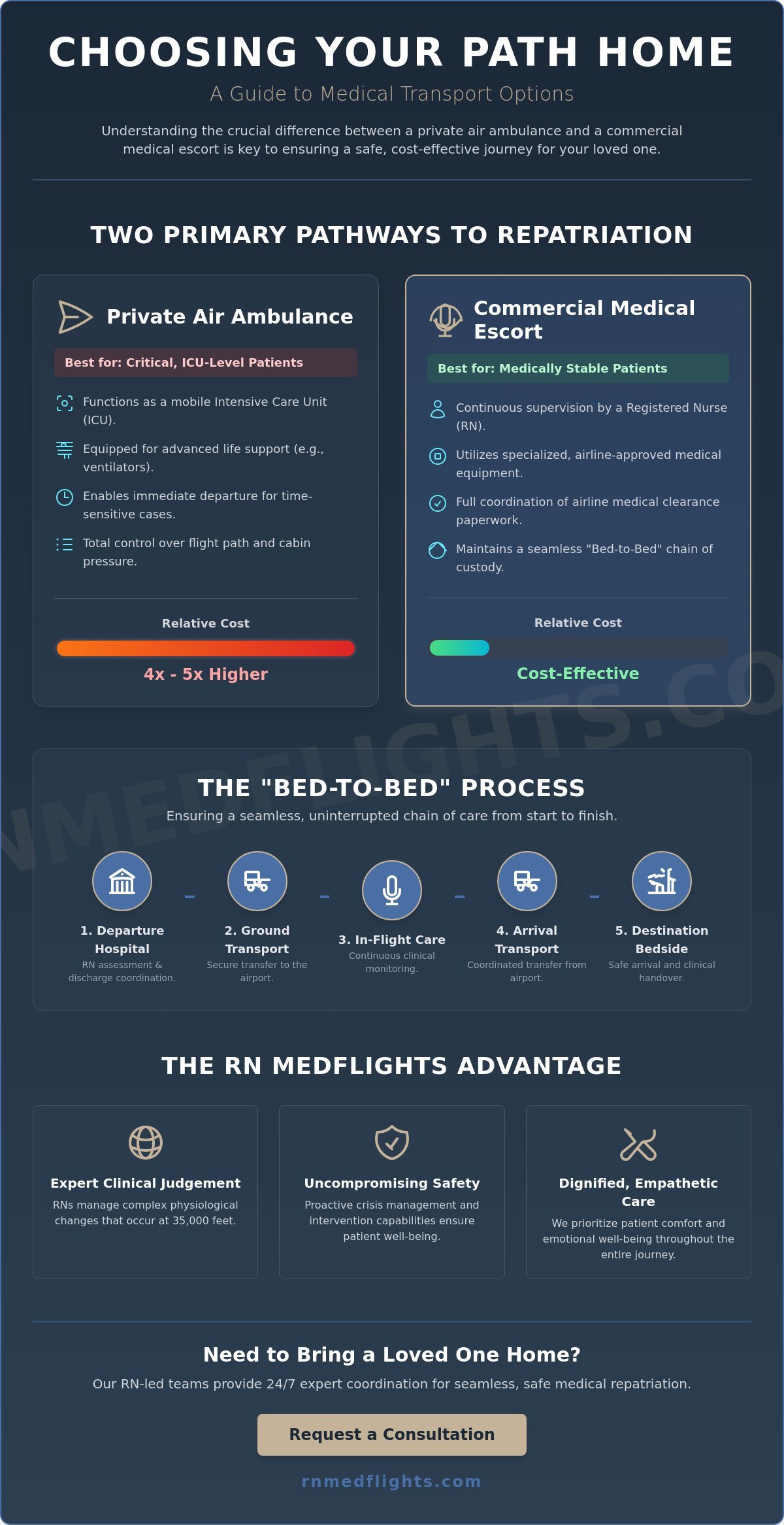
Determining the safest way of getting a sick family member home from overseas requires a clinical assessment of their stability. The medical repatriation industry offers two primary pathways: private air ambulances and commercial medical escorts. The decision isn't merely about preference; it's dictated by the patient's acuity level, which refers to the intensity of nursing care and equipment required during transit. While both methods prioritize patient safety, they differ significantly in logistics, speed, and financial commitment.
The cost disparity between these options is substantial. Private medevac flights involve the exclusive use of an aircraft, specialized flight crews, and a dedicated medical team, often resulting in costs that are four to five times higher than commercial alternatives. For families navigating a crisis, understanding these differences is the first step toward a successful bedside-to-bedside transfer.
The Private Air Ambulance Option
A private air ambulance is the necessary choice for patients requiring ICU-level care. This includes individuals on mechanical ventilators, those needing continuous titration of intravenous medications, or patients with unstable vitals. These aircraft function as mobile intensive care units, equipped with advanced life support technology. Speed and immediate departure are the primary drivers for this option. When a patient's condition is critical, waiting for commercial airline clearance isn't feasible. A private jet allows for a direct, controlled environment where the medical team has total authority over the cabin pressure and flight path.
The Commercial Airline Medical Escort Advantage
For patients who are medically stable but cannot travel alone, a medical escort service provides a sophisticated and cost-effective alternative. This method utilizes business or first-class seating on a commercial airline, providing the patient with a lie-flat bed and sufficient space for clinical monitoring. It's the preferred choice for those recovering from surgeries, managing stable chronic illnesses, or requiring oxygen support.
A flight nurse provides "icu-lite" monitoring in the commercial cabin. They handle medication administration, wound care, and physiological monitoring while managing all airport logistics. This approach maintains the patient's dignity and comfort while significantly reducing the financial burden on the family. Because the patient travels on a scheduled flight, the process remains organized and predictable. Our team at RN Medflights remains available 24/7/365 to help you decide which level of care fits your current situation. To understand the specific requirements for your case, you can contact a flight coordinator for a clinical consultation.
The Bed-to-Bed Process: Managing Ground and Air Logistics
The bed-to-bed philosophy represents our uncompromising commitment to continuity of care. It ensures that medical supervision never lapses during the complex journey of getting a sick family member home from overseas. Logistical gaps, which often occur during the transfer between a hospital ward and a waiting ambulance, pose the greatest risk to patient stability. Our flight coordinators bridge these gaps by conducting a formal clinical handoff with foreign medical staff before the patient even leaves their room. This synchronized approach prevents the fragmentation of care that often happens when families try to piece together separate transport providers. It's a method that prioritizes the patient's safety above all else, ensuring a steady pulse of care from one facility to the next.
Coordinating Ground Ambulance Services
Precision timing is the foundation of a successful medical transfer. Our team manages the entire ground sequence, from the initial pickup at a foreign facility to the final arrival at the home hospital. We utilize a specialized non-emergency ambulance service for the final leg of the journey to ensure the patient remains in a controlled, clinical environment until they reach their destination. This includes securing tarmac access permits, which allows our medical teams to bypass standard airport terminals and board the aircraft directly from the ambulance. This wing-to-wing transition minimizes physical exertion for the patient and maintains a sterile, quiet environment. Our coordinators track every vehicle via GPS 24/7/365 to ensure that no delays compromise the patient's comfort or the flight schedule.
In-Flight Clinical Management
Once airborne, the focus shifts to intensive monitoring and clinical precision. Our registered nurses manage every aspect of the patient's well-being, utilizing advanced medical equipment tailored to the specific diagnosis. Getting a sick family member home from overseas requires more than just transport; it requires active medical intervention. Our nurses provide the following essential services during the flight:
Continuous monitoring of vital signs, including heart rate and oxygen saturation levels.
Administration of all scheduled medications and proactive pain management.
Assistance with mobility, hygiene, and nutritional requirements to prevent complications like deep vein thrombosis.
Comprehensive clinical documentation to provide the receiving facility with an accurate record of the patient's status.
The role of the flight nurse extends beyond clinical tasks. They provide vital psychological support to help reduce the anxiety that naturally accompanies a medical crisis. By maintaining a calm, authoritative presence, our nurses ensure the patient feels safe and dignified. This nurse-led model provides families with the peace of mind that a highly trained professional is watching over their loved one, ready to intervene at a moment's notice.
Navigating Airline Regulations and Medical Clearance
Securing the necessary approvals for getting a sick family member home from overseas requires meticulous attention to airline-specific medical protocols. The central component of this process is the Medical Information Form, commonly known as a Medif. This document serves as a comprehensive clinical assessment that the airline medical department reviews to determine if a patient is fit to fly. It's vital to understand that commercial carriers maintain the final authority on boarding. Even with a primary physician's recommendation, an airline can deny transport if they believe the patient's condition poses a risk to safety or flight operations.
Technical logistics such as oxygen management and Portable Oxygen Concentrators (POCs) add layers of complexity. For a flight in 2026, most international carriers require POCs to be FAA-approved with a battery life lasting at least 150% of the total flight duration. This calculation must include potential ground delays and layovers. Coordination must begin at least 48 to 72 hours before the scheduled departure. This window allows for the clinical review of the Medif, equipment verification, and the arrangement of specialized seating. RN Medflights manages these details 24/7/365, ensuring that every technical requirement is met before the patient arrives at the airport.
Documentation and Customs Requirements
Clinical records must be translated into the language of the receiving facility to ensure a seamless transition of care. Navigating customs with advanced medical equipment or controlled medications requires specific declarations to avoid seizure or delays. Our flight coordinators manage these administrative hurdles, including emergency passport or visa issues, providing a bedside-to-bedside solution that removes the logistical burden from the family during a crisis.
Airline-Specific Medical Protocols
Carriers like Delta, Lufthansa, and Emirates have distinct requirements for medical passengers. Most international airlines mandate that a flight nurse or a qualified medical escort accompanies patients who require monitoring or medication administration. We also evaluate seating options based on the patient's stability. While Business Class offers necessary space for many, some cases require a commercial stretcher installation. This process involves removing several rows of seats to accommodate a patient in a supine position throughout the journey, a procedure that requires significant lead time for airline engineering teams.
To begin the medical clearance process for
getting a sick family member home from overseas
,
today for an immediate consultation.
Why a Nurse-Led Repatriation Team is the Safest Choice
When you're tasked with getting a sick family member home from overseas, the distinction between a travel escort and a clinical professional becomes a matter of life safety. Many commercial repatriation companies offer travel companions who focus on booking tickets and managing luggage. In contrast, a nurse-led team views the mission through a clinical lens. This model prioritizes patient stability and physiological outcomes over simple transportation logistics. We provide 24/7/365 expert oversight, ensuring that every decision is made by a licensed professional who understands the complexities of altitude physiology and medical monitoring.
Choosing international medical repatriation services led by Registered Nurses represents the gold standard for family safety. This approach transforms a high-risk journey into a managed medical transfer where the patient is treated with dignity and precision. Our nurses don't just sit with the patient; they actively manage hemodynamics, oxygenation, and comfort levels throughout the flight. This level of care provides a steady hand in a storm, offering families the peace of mind that their loved one is in expert hands.
The RN MEDflights Standard of Care
RN MEDflights is a veteran-owned and nurse-operated organization. We operate with uncompromising integrity, accepting full bedside-to-bedside responsibility for our patients. This means we're with you from the initial hospital room abroad until the patient is safely admitted to their destination facility. The RN advantage is defined by having advanced life support training in a civilian aviation environment. This expertise allows us to manage critical care needs at 35,000 feet with the same precision found in a ground-based ICU. Our nurses are trained to anticipate complications before they arise, providing a level of vigilant protection that a non-clinical escort cannot offer.
Getting Started: Your First Steps
The logistics of getting a sick family member home from overseas are complex, but the clinical safety of that individual remains our primary mission. Initiating the process is straightforward and designed to reduce your cognitive load. You'll first receive a comprehensive clinical assessment followed by a transparent quote. To help our team move quickly, please have the following information ready:
The patient's current medical diagnosis and stability status.
The name and contact details of the current treating facility.
The specific destination hospital or residence in the home country.
Once we have these details, our flight coordinators handle the rest of the coordination, from physician-to-physician handoffs to ground ambulance synchronization. We're here to ensure the journey is seamless and stress-free. Speak with a Flight Coordinator at RN MEDflights to begin the journey home.
Securing a Safe Return for Your Loved One
Navigating the complexities of international medical transport doesn't have to be an overwhelming burden for your family. Success depends on selecting the appropriate level of care, whether that's a specialized air ambulance or a commercial medical escort. You've learned that a seamless bed-to-bed transition is the gold standard for patient safety. This process ensures clinical continuity from the initial hospital room to the final destination, reducing the stress on everyone involved.
The logistical challenge of getting a sick family member home from overseas demands a team that prioritizes medical integrity. RN Medflights provides a nurse-owned and operated solution backed by over 15 years of specialized experience. Our 100% safety record for international repatriations reflects an uncompromising commitment to patient health. We manage every detail, including ground ambulance coordination and complex airline medical clearances, so you can focus on your family. Our flight coordinators are available 24/7/365 to begin the process of bringing your loved one back to familiar surroundings.
Take the first step toward a safe return today. Request a Free Clinical Assessment for Your Loved One. You don't have to manage this journey alone; expert help is ready to bring your family back together.
Frequently Asked Questions
Is it safe to fly a sick family member on a commercial flight?
Flying a patient on a commercial flight is safe when they're stable and cleared by the airline's medical department through a Fit to Fly certificate. Our registered nurses monitor vital signs and manage medications throughout the journey to ensure clinical safety. We coordinate directly with airline medical directors to confirm the patient meets all safety criteria for high-altitude travel.
How much does it cost to get a medical escort for an international flight?
The cost of a medical escort depends on the airline's current ticket prices, the patient's destination, and the specific level of clinical care required. Expenses typically include the nurse's professional fees, specialized medical equipment, and all ground transportation. Because these variables change daily, we provide a detailed, all-inclusive quote after reviewing the patient's latest medical report.
Will travel insurance pay for medical repatriation home?
Travel insurance usually covers the cost of getting a sick family member home from overseas if the policy includes emergency medical evacuation benefits. According to 2024 data from the U.S. Travel Insurance Association, standard evacuation coverage often ranges from $100,000 to $500,000. It's vital to check your policy for pre-existing condition exclusions that might affect your claim.
What is the difference between an air ambulance and a medical escort?
An air ambulance is a private jet configured as a mobile ICU for critical patients, whereas a medical escort accompanies a stable patient on a commercial airline. Air ambulances provide 100 percent privacy and immediate departure flexibility. Medical escorts offer a more cost-effective solution for patients who can travel in a seated or reclined position in a premium cabin.
How long does it take to arrange a medical flight from overseas?
Arranging the process of getting a sick family member home from overseas typically takes between 24 and 72 hours from the initial call. This timeframe allows our flight coordinators to secure medical clearances, book specialized equipment, and arrange ground transport. We operate 24/7/365 to minimize delays and ensure the patient returns home as quickly as their condition allows.
Can a patient fly if they need continuous oxygen therapy?
Patients requiring continuous oxygen can fly on commercial aircraft using FAA-approved Portable Oxygen Concentrators (POCs). Airlines require that the patient carries enough battery power to last 150 percent of the total flight duration to account for potential tarmac delays. Our clinical team manages all POC settings and battery rotations to maintain the patient's oxygen saturation levels during the flight.
What is bed-to-bed medical transport?
Bed-to-bed medical transport is our signature service where we take full responsibility for the patient from their current hospital bed to their destination bed. This seamless transition includes ground ambulance transfers, airport navigation, and the flight itself. It's designed to provide peace of mind by ensuring a single, qualified clinical team manages every logistical and medical detail of the journey.
Do I need to book the airline tickets for the patient and the nurse?
You don't need to handle any travel bookings or logistical arrangements yourself. Our flight coordinators manage all ticketing, including securing extra space or specific seating required for medical equipment. By handling these complex details, we reduce the cognitive load on your family during a crisis while ensuring the most efficient route is selected.


