How airfare and nurse accompaniment costs work
A commercial flight doesn’t have to mean your mother travels without medical support. The answer to “Can I hire a nurse to fly with my mother?” is yes. A nurse can accompany her, provide planned medical support during the journey, and help coordinate care from departure to arrival.
It’s understandable to want reassurance that your mother will have support throughout the trip. A medical escort can provide care during the flight and help coordinate the journey, including ground transportation and airport transitions. The right arrangement depends on her medical needs, mobility, and physician clearance to fly. This guide explains what a nurse escort can provide, how to plan the trip, and what information to share when requesting a quote.
Table of Contents
1. Medical monitoring and medication support during travel
Yes, a nurse can accompany your mother on a commercial flight and provide medical support during the journey. A registered nurse can monitor her condition, assist with care, and help with medication routines and mobility. The support plan should reflect her current health, mobility, and travel requirements. If she uses medical equipment, plan how it will be handled and kept accessible during the trip.
Before departure, a nurse or flight coordinator can review the traveler's condition and may coordinate with her doctor or primary care provider. The nurse can organize prescribed medications and equipment for the trip, then plan how those items will pass through airport security and remain accessible onboard. Flying Nurses International recommends keeping medications, medical devices, and documents in carry-on luggage. A clear medication schedule and organized documents can help the accompanying nurse follow the planned care during airport transitions and the flight.
During a commercial flight, the nurse provides planned medical support and monitors your mother’s needs. A medical escort can assist with medication routines, mobility, and reassurance within the travel plan. Support can also cover airport transitions and ground transportation, not just the time onboard. RN MEDflights’ flight companions are qualified medical professionals who accompany eligible patients on commercial flights.
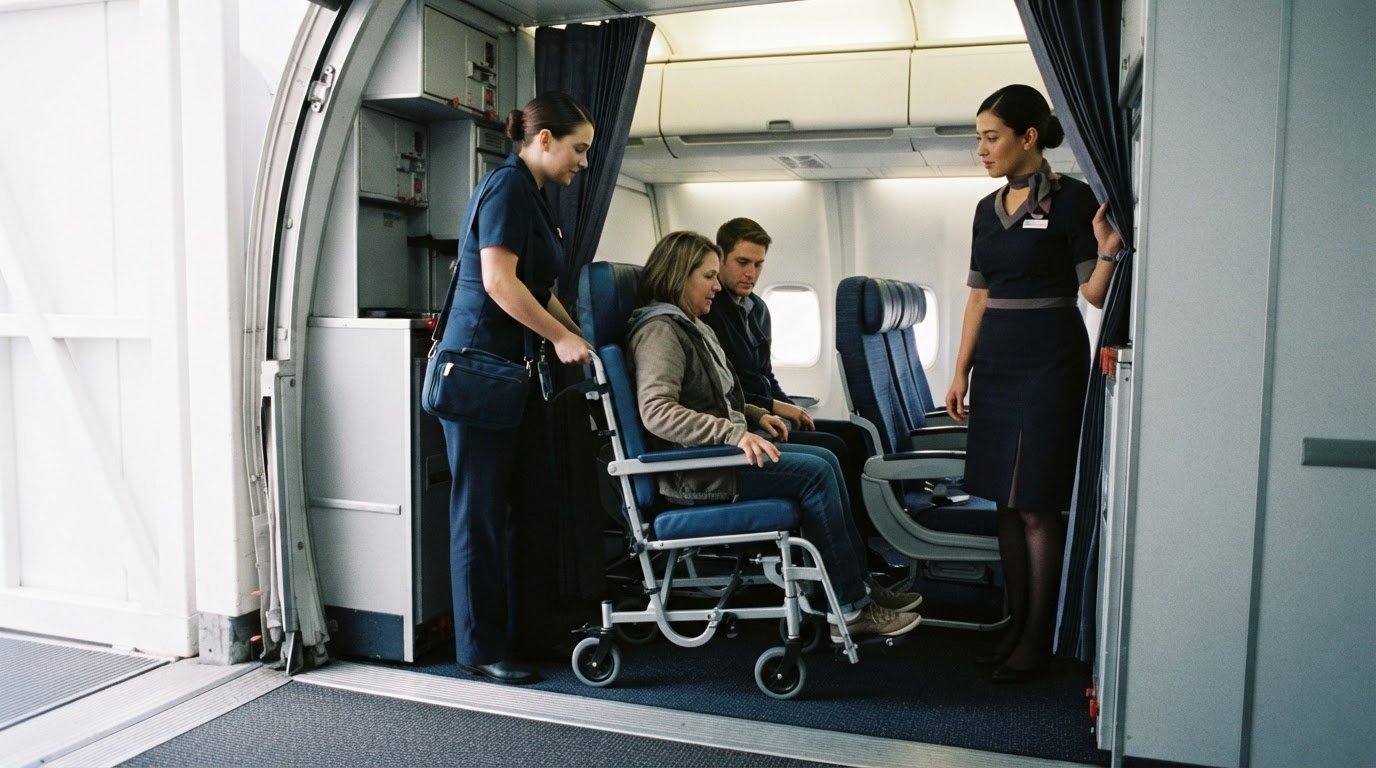
After landing, assistance may continue through the airport exit and transfer to ground transportation. For an older adult who walks slowly, needs a wheelchair, or is recovering from an injury, that transition can require careful coordination. A nurse can help her leave the plane, navigate the terminal, and reach the arranged vehicle. For example, the travel plan can account for assistance at both the departure and arrival airports, keeping care connected across each stage.
Commercial flights, private flights, and train journeys involve different arrangements. RN MEDflights provides commercial airline medical escorts for eligible patients who need professional medical supervision while traveling. The plan should fit your mother’s care needs and the full route, including transfers between vehicles and terminals. Map the journey from pickup through arrival and handoff before selecting an arrangement.
Travel nurses managing care for their own children face a separate planning challenge. A nurse accepting an assignment while raising an infant or toddler needs reliable childcare; school-age children also need an education and supervision plan. A traveling adult caregiver, such as a relative or partner, may help with childcare while the nurse works variable shifts. This is different from arranging medical support for a mother traveling as a patient, though both situations call for clear responsibilities.
2. When Is It Time to Consider Medical Transport?
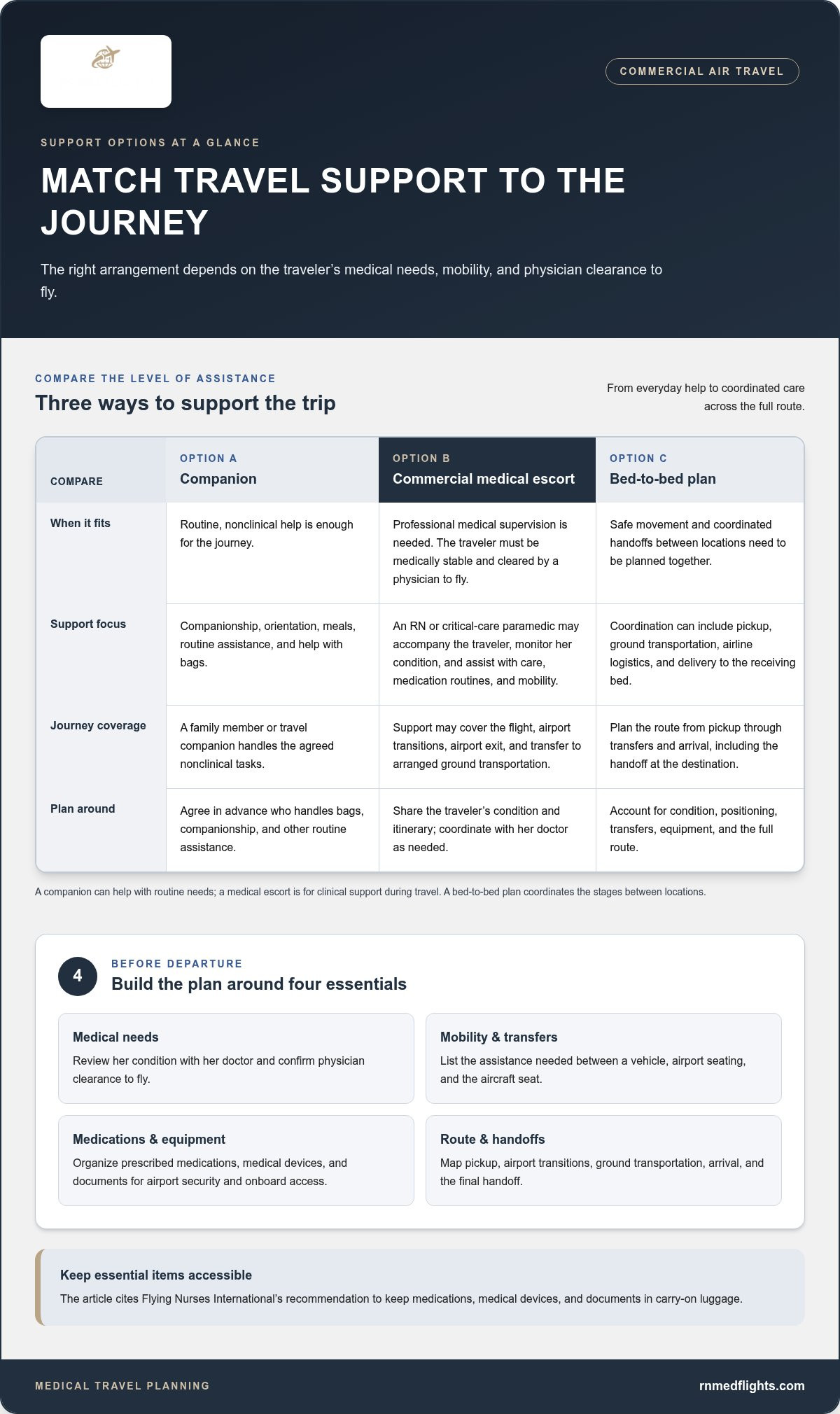
A nurse can accompany an older adult on a commercial flight when she needs clinical support during travel and is medically stable and cleared by a physician to fly. The key is matching her needs to the journey. For routine nonclinical help, a relative or travel companion may be enough; when professional medical supervision is needed, consider a commercial airline medical escort.
Start by listing the help your mother needs from pickup to destination. Can she move between a vehicle, airport seating, and an aircraft seat? Can she manage personal care and follow instructions during boarding? A family member may help with bags and companionship, while a nurse provides medical support. If she needs both, clarify who handles each task before travel.
Consider a flight nurse when your mother needs medical observation, medication support, or clinical assistance beyond ordinary companionship. An RN or critical-care paramedic can accompany her on a commercial flight, with the travel plan tailored to her needs. Share her condition and itinerary so the team can review the support required and coordinate with her doctor as needed.
Travel may need a different arrangement if your mother cannot safely manage the transitions involved. She may, for example, need help transferring between a wheelchair and aircraft seat or ground transportation. The plan should account for her mobility and care needs at departure, in transit, on arrival, and during the handoff. RN MEDflights’ commercial escort service is for medically stable patients cleared by a physician to fly.
A commercial-flight escort suits a medically stable traveler who has been cleared by a physician to fly and needs professional support during the journey. A bed-to-bed plan can coordinate pickup, ground transportation, airline logistics, and delivery to the receiving bed. The plan should account for your mother’s condition, positioning, transfers, equipment, and the full route.
The right support depends on what makes the journey difficult. A relative or travel companion can help with orientation, meals, and routine assistance when clinical support isn’t needed. A nurse escort is appropriate when the trip calls for medical supervision. If the main challenge is safe movement between locations, ground transportation coordination and a bed-to-bed plan can connect those stages.
Before choosing an arrangement, write down the care tasks, mobility support, equipment, and handoffs your mother will need. Share the outline with her doctor and use it to plan the route. This helps distinguish ordinary companionship from the need for a clinical escort or a more comprehensive bed-to-bed journey.
3. Coordination with doctors, airlines, and airports
For travel with a nurse, prepare your mother’s relevant medical records, medication list, equipment details, and journey information. Her doctor or primary care provider can review her condition and identify the support she needs during travel. A travel coordinator may also review her medical needs and coordinate with her doctor before departure. This preparation creates a shared picture of her care needs, rather than leaving important details to memory.
Start with the clinical plan. Gather current information about your mother’s condition, mobility, medications, and any medical devices she uses. Note medication timing and practical assistance she needs, such as help transferring into a seat. Her doctor can review whether she is medically stable and cleared to fly. The escort team can then use those details to plan support throughout the journey.
Keep essential records accessible throughout the trip. Store medications, medical devices, and documents in carry-on luggage, and organize them so they are easy to locate during airport transitions as well as onboard. Keep medication instructions with the medication and group relevant medical documents together. This makes the care plan easier to follow if travel arrangements change or information needs to be shared.
Next, coordinate the itinerary with the airline and airport arrangements. Share the practical travel needs, such as mobility assistance, equipment handling, and whether your mother needs help reaching the gate. A nurse can plan how she will accompany your mother through airport transitions and support her after landing. If the itinerary includes a connection, consider how the nurse and traveler will move between flights and where assistance is needed.
Medical records and a doctor’s review help establish the care plan; airline procedures address the travel arrangements. Keep these roles clear. The clinical plan describes your mother’s condition and needed support. The travel plan covers the route, boarding, equipment, and airport assistance. An RN flight coordinator may help connect the medical review with trip planning, including communication with her primary care provider.
Before departure, compare the plan with each stage of the itinerary. For a traveler using a wheelchair, account for movement from the drop-off point to boarding, then from the aircraft to ground transportation. For someone carrying medical equipment, plan how it travels and stays accessible. After landing, the nurse can assist with leaving the plane, navigating the airport, and reaching the arranged transport. A clear handoff identifies who receives your mother and what support continues next.
Keep a concise travel folder with the itinerary, medical documents, medication information, equipment details, and key care instructions. Share the information the nurse needs for the journey and keep copies with your mother’s carry-on belongings. An organized record helps align the doctor’s guidance, the escort’s care plan, and airport transitions.
4. Costs of airfare and caregiver accompaniment
Build the travel budget from separate components: your mother’s airfare, the escort’s airfare, and care arrangements. A nurse may need a ticket to your mother’s departure city, then a separate return flight after accompanying her. Flight nurses may return to their point of origin on another flight. That itinerary can involve more than the passenger’s ticket, especially when the journey includes separate outbound and return routes.
Start with the route and trip dates. A direct itinerary and a journey requiring connections create different travel plans for both passenger and nurse. If the nurse travels to meet your mother, include that positioning flight in the itinerary. Then account for the nurse’s onward journey after arrival. These steps help you distinguish the passenger’s airfare from the travel needed to place and return the escort.
Plan for the full journey, not only the time in the air. A bed-to-bed arrangement can include pickup, ground transportation, airline logistics, and delivery to the receiving bed. The route and the support your mother needs at each stage shape the plan. When requesting a quote, share her condition, itinerary, and mobility needs.
Ground transportation is another separate planning line. For example, list the trip from home to the departure airport, assistance at the destination, and the receiving vehicle. If your mother needs a transfer between locations, include that leg in the itinerary. Separating airfare, accompaniment, and ground arrangements makes it easier to see which parts relate to the flight and which support the journey before or after it.
Medicare or private health insurance coverage depends on the plan’s benefits and how the service is classified. Don’t assume airfare, a nurse’s accompaniment, and ground transportation are covered together. Review them as separate parts of the travel plan when considering potential coverage.
To organize estimates, create a simple itinerary-based worksheet. Include passenger tickets, the nurse’s travel to the departure city, the nurse’s onward or return flight, and ground transfers. Add the care period and any planned airport assistance. This is a planning framework, not a quote for medical escort services. The actual arrangement depends on the itinerary and the support your mother needs.
A final review can help prevent overlooked travel stages. Compare the planned route with the points where care begins and ends. For example, identify the pickup location, airport transfers, and receiving bed. RN MEDflights’ bed-to-bed coordination brings together ground transportation, airline logistics, and the final handoff.
5. What are airline rules for passengers traveling with a nurse or medical escort?
A nurse can accompany a passenger, but the nurse’s presence doesn’t replace airline travel arrangements. Plan the passenger’s needs and the escort’s itinerary together. Before booking, describe your mother’s mobility, medical equipment, and assistance needs to the airline. Ask which arrangements apply to boarding, seating, and carrying equipment on that specific journey. This helps align the care plan with the flight logistics.
Keep the roles clear. The nurse provides planned medical support, while airline staff manage airline operations and passenger procedures. For example, a nurse can assist your mother through travel transitions, but the airline determines how its boarding process works. Share relevant details early, especially if your mother needs mobility support or carries medical devices. The nurse and family can then plan around the airline’s guidance.
Medical equipment needs advance coordination. Make a list of each device, how it travels, and when your mother may need access. Keep medications, medical devices, and documents in carry-on luggage, as Flying Nurses International recommends. Tell the airline what equipment your mother will bring and ask about its handling for the booked flight. The nurse can help organize these items for airport security and onboard storage.
Seat and boarding arrangements also affect the care plan. Describe whether your mother can walk to her seat, needs assistance transferring, or requires help reaching the gate. For example, a wheelchair user may need support between airport drop-off and boarding. Coordinate the airline’s assistance with the nurse’s role, so everyone understands who supports each transition. Include arrival arrangements, not just departure procedures.
For connecting flights, plan each leg as a separate transition. Confirm that the itinerary gives your mother and nurse a workable route between gates, and account for assistance at each airport. Flight nurses may accompany travelers to their final destination, then return to their point of origin on another flight. That return journey affects the nurse’s itinerary and should be included when arranging travel.
Keep a concise travel file with the itinerary, medical documents, medication information, and equipment list. The nurse can use it to follow the care plan, while your family can use it to communicate essential details. Before travel, make sure the airline has the information it needs for your mother’s arrangements. If her mobility or equipment needs change, revisit the plan for every flight segment.
For a coordinated commercial journey, plan medical support for the flight around your mother’s care needs, airline arrangements, and airport transitions.
RN MEDflights: Commercial Airline Medical Escort
RN MEDflights provides Commercial Airline Medical Escort for medically stable patients cleared by a physician to fly who need professional medical support during a commercial flight. When your mother also needs coordinated pickup, ground transportation, airline logistics, and delivery to the receiving bed, RN MEDflights’ Bed-to-Bed Medical Transport and Ground Ambulance Coordination can support the full journey.
The right arrangement depends on your mother’s medical needs, mobility, and the full route. Share her condition, current location, destination, and travel requirements with RN MEDflights to discuss a suitable plan and request a quote.
Contact RN MEDflights to discuss your mother’s travel needs.
Plan the Next Step With Confidence
If you’re asking whether you can hire a nurse to fly with your mother, start with the support she needs and the journey she must make. A clear summary of her medical condition, mobility, and destination gives the travel plan a practical starting point. RN MEDflights can review those details and coordinate a bed-to-bed journey when that fits her needs.
RN MEDflights offers Commercial Airline Medical Escort, Domestic Medical Relocation, and International Medical Repatriation. These options address different travel situations, from supported commercial air travel to relocation within the country or repatriation between countries. Contact RN MEDflights to discuss your mother’s travel and the type of support her journey requires.
A thoughtful plan can make the next decision clearer for your family. You can take it one step at a time, with your mother’s care at the center.
Frequently Asked Questions
Can I Hire a Nurse to Fly With Me?
Yes, you can hire a nurse to fly with your mother when she needs medical support during a commercial flight. RN MEDflights provides this service for medically stable patients cleared by a physician to fly. Her medical needs and itinerary shape the care plan, and the service can coordinate the journey from pickup through delivery to the receiving bed.
When Is It Time to Consider Medical Transport?
Consider a medical escort when your mother needs professional support during travel. A family member may be suitable for routine assistance, while clinical supervision may call for an RN or critical-care paramedic. RN MEDflights’ commercial escort service is for medically stable patients cleared by a physician to fly. Share her care needs and itinerary when requesting a travel plan.
Can I hire a nurse to accompany my mother on a commercial flight?
Yes. RN MEDflights provides commercial airline medical escorts for eligible patients traveling with professional medical supervision. For example, this may help when your mother can travel on a commercial airline but shouldn’t make the trip alone. Her medical stability, physician clearance, mobility, and travel requirements inform the arrangement. A family member can share her current condition and itinerary when starting the planning process.
What types of medical professionals provide in-flight medical escort services?
RN MEDflights’ flight companions are U.S.-licensed registered nurses or critical-care paramedics. They hold current ACLS and BLS certifications and have a minimum of five years of clinical experience. Clinicians are matched to each patient’s medical needs, diagnosis, and travel requirements. The care plan can account for support during transfers and the flight.
How much does it cost to hire a nurse to fly with someone?
The price depends on the case and is provided after a quote request. Cost factors include the patient’s needs, ground transportation, and airline ticket cost. The route and travel arrangements also shape the plan. To support an estimate, have the passenger’s current location, destination, medical condition, and relevant travel details ready. This lets the service team review the trip and prepare a quote and travel plan.
What services does a medical flight escort provide during a trip?
A medical escort can connect clinical support with travel logistics. RN MEDflights coordinates bed-to-bed medical transport, including pickup, ground transportation, airline logistics, and delivery to the receiving bed. For example, the journey may include pickup at one care facility, a commercial flight with a nurse escort, and arrival at another facility, with a planned handoff at the destination.
What medical conditions require a nurse or medical escort to fly?
No single diagnosis automatically determines whether a passenger needs an escort. The decision depends on medical stability, physician clearance, mobility, and the support needed during travel. Someone recovering after hospitalization, for example, may need supervision or help managing care needs on the journey. RN MEDflights’ commercial escort services are for medically stable patients cleared by a physician to fly, rather than patients requiring emergency transport.
How do I arrange a nurse or medical escort for a flight?
Begin by sharing your mother’s condition, current location, and destination with RN MEDflights. The team reviews her travel needs and provides a quote and travel plan, then coordinates the journey’s logistics. Having her itinerary and a concise summary of her mobility and care needs ready can make the initial discussion more focused.