How to Book a Stretcher Flight and What It Costs
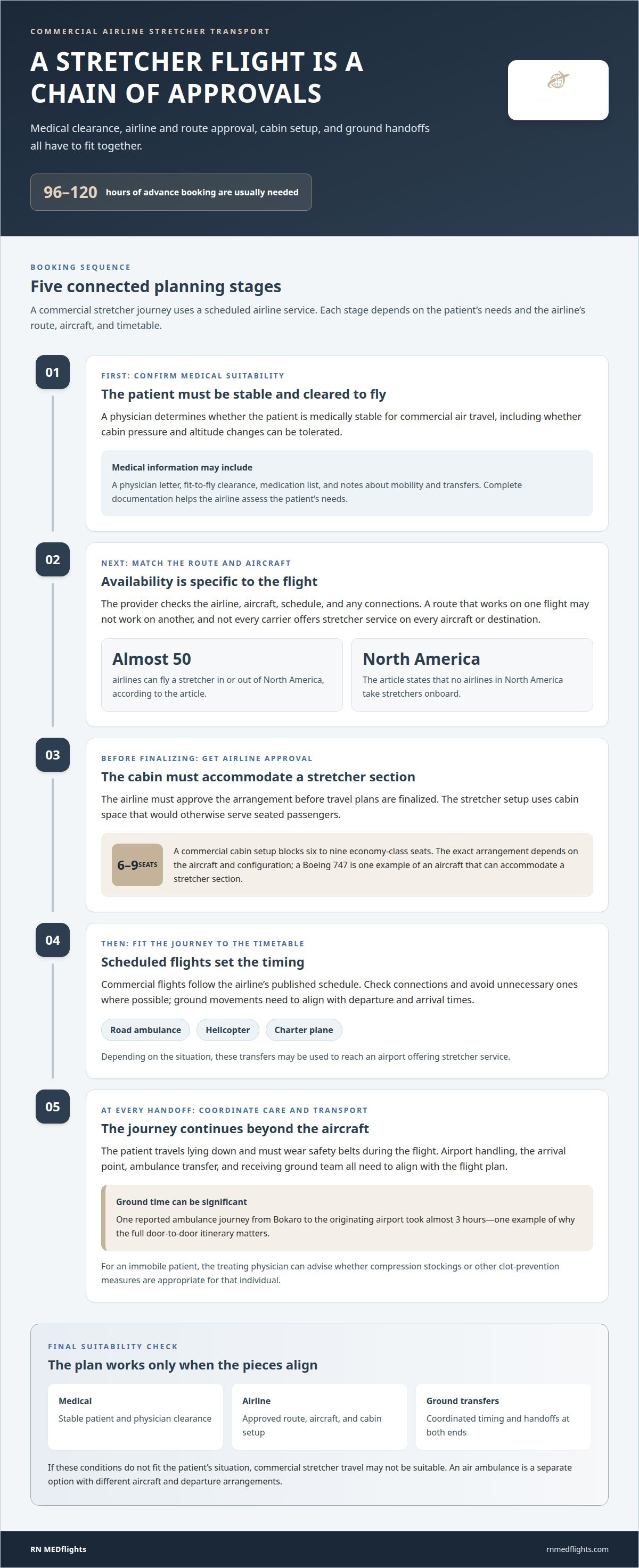
The stretcher is only one part of arranging a commercial flight. Knowing how to book a flight for a patient on a stretcher starts with medical clearance, followed by airline approval for the route and aircraft; arrangements usually need 96 to 120 hours of advance booking. The patient’s condition should be stable and cleared by a medical professional before travel.
It’s understandable to want a clear plan when a patient is managing a serious health concern. A stretcher flight uses a scheduled airline service, so the airline’s requirements and timetable shape how the journey is arranged.
This guide explains the steps involved in booking a flight for a patient on a stretcher, from medical review and airline approval to ground transfers. It also covers the main decisions to make and how RN MEDflights coordinates bed-to-bed medical transport, including airline logistics and ground ambulance arrangements.
Table of Contents
How does a provider arrange a commercial airline stretcher service?
A provider checks the route, aircraft, airline approval, medical clearance, and transfers before confirming a commercial stretcher flight. Almost 50 airlines can fly a stretcher in or out of North America, while no airlines in North America take stretchers onboard.
What Stretcher Service Includes
Commercial airline stretcher service reserves part of a scheduled aircraft cabin for a patient who must travel lying down. The installation blocks six to nine economy-class seats, so the airline must approve the cabin arrangement before travel plans are finalized. A Boeing 747 is one example of an aircraft that can accommodate a stretcher section. Ground transport and airport handling also need coordination. The total price depends on the case and is given after a quote request; airline arrangements, ambulance transfers, and airport handling affect the cost.
Airline Eligibility and Route Approval
Route approval means matching the patient’s journey to an airline, aircraft, and schedule that can accommodate a stretcher. Availability depends on all three, so a route that works on one flight may not work on another. The provider checks the flight, including any connections, and seeks the airline’s stretcher approval before finalizing the trip. Avoid unnecessary connections where possible. Scheduled flights follow the airline’s timetable, unlike air ambulances, which have different departure arrangements.
Medical Clearance and Physician Documents
Medical clearance establishes whether a patient is stable for travel on a commercial flight. The patient must be medically stable and cleared by a physician to fly. The provider coordinates the required medical information with the physician and airline. This may include a physician letter, fit-to-fly clearance, medication list, and notes about mobility and transfers. Complete documentation helps the airline assess the patient’s needs. Start the medical review early, since approval and stretcher installation affect the schedule.
Airlines Offering Stretcher Service
Stretcher service is available only on select airlines and routes. The provider identifies suitable scheduled flights, confirms airline approval, and coordinates the cabin setup with the flight schedule. Don’t assume a carrier offers stretcher service on every aircraft or destination. Each route needs its own assessment, so secure approval before booking the remaining travel arrangements. This helps avoid planning around a flight that cannot accommodate the stretcher.
How commercial aircraft stretcher transport works
A commercial stretcher journey combines a scheduled flight with coordinated ground transfers. The patient travels on an approved cabin stretcher, while the airline’s schedule and handling arrangements shape each stage.
Transport Process and Service Limits
For a stretcher setup, the airline removes rows of seats and installs a designated area in the aircraft cabin. The arrangement may require removing seats, depending on the aircraft and configuration. The patient travels lying down and must wear safety belts during the flight. The cabin setup uses space that would otherwise serve seated passengers.
The trip also includes travel between the patient’s location and the airport. Depending on the situation, transfers may involve a road ambulance, helicopter, or charter plane to reach an airport offering stretcher service. A scheduled flight follows its published timetable, so ground movements must fit its departure and arrival times. This makes a direct, coordinated itinerary important, particularly for international journeys.
Commercial stretcher travel has limits. The route, aircraft, and schedule must support the stretcher arrangement, and the patient must be medically stable and cleared by a physician to fly. If these conditions don’t fit the patient’s situation, commercial stretcher travel may not be suitable. An air ambulance is a separate transport option with different aircraft and departure arrangements.
Patient Comfort and Safety
Safety planning accounts for both the flight and transfers between care settings. The patient is secured with safety belts while aboard the aircraft. For someone who is immobile, the treating physician can advise whether compression stockings or other clot-prevention measures are appropriate. That advice should reflect the patient’s condition and travel needs, not a generic assumption.
Ground handoffs matter, too. The ambulance team needs a clear arrival point and transfer plan, while airport handling must align with the airline’s boarding process. At the destination, the receiving ground team should be coordinated with the flight’s arrival so the patient can continue to the next care setting. Each handoff links one part of the journey to the next.
Travel time can extend beyond the flight itself. In one reported example, an ambulance journey from Bokaro to the originating airport took almost 3 hours. That illustrates why planning considers the patient’s starting point, airport access, flight schedule, and onward transfer together. Coordinated ground ambulance transfers help avoid treating the airport as the only part of the journey.
How much does a commercial stretcher flight cost?
The cost depends on the patient’s needs and the arrangements required for the full journey. RN MEDflights provides a case-specific quote after reviewing the route, airline requirements, medical support, and ground transfers.
Medical Suitability Shapes the Transport Plan
Before considering a commercial stretcher, the patient must be medically stable and cleared by a physician to fly. The assessment considers whether the patient can tolerate cabin pressure and altitude changes. Spinal injuries, fractures, neurological issues, and post-surgical recovery may involve a need to lie down, but a diagnosis alone doesn’t determine the appropriate transport.
The treating physician, the assistance company’s doctors, and the airline’s medical department contribute to the decision between scheduled commercial travel and an air ambulance. They consider the patient’s stability, required support, and ability to travel within the airline’s arrangements. An air ambulance may be considered when a scheduled flight cannot meet the patient’s medical or transport needs.
Choosing the Level of Support
A stretcher is relevant when a patient needs to remain lying down throughout the flight. A medical escort may suit someone who can travel seated but needs professional support during a commercial flight. A lie-flat seat is not the same as an approved stretcher setup, so it can’t be assumed to meet a patient’s positioning or medical needs. The physician’s assessment helps determine which arrangement fits.
The choice also affects what needs to be coordinated. A commercial stretcher requires airline approval and a suitable aircraft; a medical escort requires a plan for the support needed during travel. An air ambulance uses a different transport model. These options aren’t interchangeable, and the patient’s condition and support requirements guide the decision.
Planning Medication, Oxygen, and Ground Transfers
Medication and oxygen arrangements must fit the airline’s rules and the patient’s medical plan. Essential medication should travel in carry-on baggage so it remains accessible during the journey. Oxygen provision follows the selected airline’s rules. The medical team incorporates these details into the plan rather than assuming every carrier handles equipment the same way.
Ground ambulance coordination adds another cost factor. The overall itinerary may need transport from the patient’s current location to the departure airport, then onward from the arrival airport. The route, ground distances, and transfer requirements influence the arrangements. Coordinating these movements with the scheduled flight helps avoid gaps between the patient’s care and each stage of travel.
Booking steps and flight coordination
Families asking how to book a flight for a patient on a stretcher need a coordinated plan, not just a seat reservation. The provider connects the medical review, airline process, flight schedule, and ground transfers into one itinerary.
Booking Process and Advance Planning
Start with the patient’s condition, departure point, and destination. RN MEDflights uses these details to review the patient’s needs and coordinate the airline’s medical review. Physician documentation supports the review, while information about mobility and transfers helps shape airport arrangements. Airline approval for the stretcher is required before the trip can be finalized.
Commercial airline stretcher transfers usually require 96 to 120 hours of advance booking. That time allows the airline to review the case and plan the cabin installation. The provider also coordinates airport handling and ground movements around the selected departure. The question of how to book a flight for a patient on a stretcher is therefore really about arranging each connected stage in the right sequence.
The provider coordinates the process in stages:
Gather the patient’s medical details and transfer requirements for airline review.
Assess the route, aircraft, and scheduled flight for stretcher suitability.
Obtain the airline’s stretcher approval before confirming the rest of the itinerary.
Coordinate departure and destination transfers around the approved schedule.
Each stage informs the next. For example, the ambulance pickup time depends on the departure airport and confirmed flight schedule.
Booking Timelines and Delays
Lead time includes medical review, airline approval, and stretcher installation. Preparing a commercial stretcher transfer generally takes longer than preparing an air ambulance because the airline must approve the arrangement and organize the cabin setup. If the patient’s condition changes, the medical assessment and travel plan may also need revision.
Airport access has a separate timing requirement. Clearance for an ambulance to access the originating airport should be arranged 1-2 days before travel. This is distinct from the 96 to 120 hours generally needed for stretcher booking. Keeping both timelines in view helps coordinate the patient’s arrival at the airport with the airline’s departure process.
The flight schedule can narrow the available options, especially when a connection is involved. Each segment adds another airport handoff to coordinate, so avoiding unnecessary connections can simplify the itinerary. If medical review, installation, airport access, or transfer timing changes, the provider adjusts the sequence before travel. Plans should follow the approved flight details rather than an earlier tentative schedule.
Stretcher flight cost factors
A stretcher-flight quote reflects more than the scheduled airline fare. RN MEDflights plans around the route, cabin setup, patient’s medical needs, support during travel, and transfers between care settings and airports. These elements interact: limited suitable flights can affect scheduling, while additional ground transfers require coordination.
Airline charges depend on the aircraft and the space needed for the stretcher installation. The airline’s cabin arrangement is therefore a central part of the estimate. The route matters too, since the airline, aircraft, and available schedule determine which flights can accommodate the setup.
Connections can affect both cost and complexity. Each additional flight segment requires suitable aircraft and compatible stretcher arrangements, plus coordination between departure and arrival points. A direct route can reduce the number of separate flight and ground handoffs. If a connection is needed, its timing and airport arrangements become part of the overall plan rather than simply another ticket detail.
Medical support is another factor. A stable patient may travel with a medical escort or require a stretcher, depending on the physician’s assessment and whether the patient can remain seated. The support needed during travel, medication, and any oxygen arrangements influence the plan. Airline rules apply to oxygen, so the selected carrier’s requirements must be taken into account.
Ground transport can be a substantial part of the itinerary. The plan may include ambulance transfers from the patient’s current care setting to the departure airport and from the arrival airport to the destination. Distance, airport access, timing, and handoffs affect coordination. Aligning transfers with the scheduled flight helps connect the airport journey with the rest of the trip.
Medical lift and airport handling can also contribute to the overall arrangement. For example, a patient who needs an ambulance to reach an airport offering stretcher service requires a coordinated transfer before boarding. The destination plan matters as well: the receiving ambulance and care handoff must align with the flight’s arrival, particularly when the patient is continuing to a hospital.
In practical terms, the clearest estimate separates airline and cabin arrangements, medical support, and ground transport. That breakdown shows which requirements are driving the plan and where a route or transfer change may affect it. To discuss coordinating a stretcher-flight journey, share the patient’s route and care needs.
RN MEDflights: Commercial Airline Stretcher Service
RN MEDflights arranges Commercial Airline Stretcher Service for patients who need to travel lying down on a scheduled flight. The team coordinates airline logistics, medical needs, and ground transfers as part of bed-to-bed transport, from pickup through delivery to the receiving bed.
This service may suit a medically stable patient who has been cleared by a physician to fly and whose route can accommodate an approved stretcher setup. If the patient can travel seated with support, Commercial Airline Medical Escort may be more appropriate. RN MEDflights also provides Domestic Medical Relocation, International Medical Repatriation, and private flight nurse services for different travel needs.
Share the patient’s route, current care setting, and travel needs when you contact RN MEDflights to discuss the next steps.
Plan the Next Step With Confidence
Understanding how to book a flight for a patient on a stretcher can help you start a focused conversation about the journey ahead. The next step is to connect the patient’s needs with the right support, from departure through arrival and handoff to the receiving care setting.
RN MEDflights provides Commercial Airline Medical Escort, International Medical Repatriation, and Domestic Medical Relocation. These services support different travel situations, whether a medically stable patient needs professional support on a scheduled flight or a coordinated move between locations. Sharing the patient’s circumstances and destination helps frame the discussion around the appropriate arrangements.
For a calm, clear conversation about the patient’s travel needs, contact RN MEDflights to discuss options. A thoughtful next step can make a difficult journey feel more manageable.
Frequently Asked Questions
How does it work in practice?
RN MEDflights coordinates medical arrangements with the airline and ground transport teams. For example, a patient moving between care settings needs a plan that connects pickup, airport arrival, the flight, and the destination transfer. Each handoff is timed around the scheduled departure and arrival. This bed-to-bed coordination helps families understand who is involved at each stage and how the patient moves between settings.
How far in advance does an airline stretcher need to be booked?
Commercial airline stretcher transfers usually require 96 to 120 hours of advance booking. The timeline allows for airline review and installation planning, but the process may take longer if the route or aircraft needs further assessment. A change in the patient’s condition can also affect medical clearance. Starting early gives the provider more opportunity to coordinate the flight and connected transfers before other travel arrangements are finalized.
How is it done?
RN MEDflights builds the travel plan around the patient’s medical details, origin, destination, and transfer needs. A physician letter, fit-to-fly clearance, medication list, and mobility or transfer notes may support the airline’s review. The team coordinates the airline’s decision with airport and ground arrangements. Medication and oxygen plans must also follow the selected airline’s rules.
Stretcher on a Scheduled Flight: How Does It Work?
For an approved patient, the airline arranges a designated stretcher area within the aircraft cabin. The patient travels lying down and uses safety belts during the flight. The cabin configuration and available aircraft determine whether the airline can accommodate the setup on a particular route. Airport handling and the flight schedule also shape boarding and arrival arrangements, so the stretcher plan must account for both ends of the journey.
What is the cost?
The cost depends on the individual journey, and RN MEDflights provides a case-specific quote after reviewing the request. The route and airline arrangement are part of the estimate, along with medical support and ground transfers. A journey requiring coordinated ground transport at both ends has different logistical needs from one with fewer transfers. The quote reflects the planned journey, not just the flight.
What is the process?
The process moves from medical review to airline coordination and then to the travel plan. RN MEDflights uses the patient’s condition and intended route to organize the arrangements, while the physician’s information supports the medical assessment. Once the airline has reviewed the stretcher request, ground transfers can be coordinated around the flight. Keep the receiving care setting informed so its handoff arrangements match the expected arrival.
Which patients qualify for an airline stretcher?
A patient who needs to remain lying down may be considered for a commercial airline stretcher if they are medically stable and a physician has cleared them to fly. A hip fracture or spinal injury may involve a need to travel lying down, but diagnosis alone doesn’t establish eligibility. The medical assessment considers the patient’s current condition and travel needs, while the airline separately reviews the stretcher arrangement.
Who is it suitable for, and who is it not?
A commercial stretcher may suit a medically stable patient who needs to lie down and is cleared by a physician to fly, provided the airline approves the arrangement. It may not suit someone who is not medically stable or has not been cleared to fly. The treating physician, assistance company’s doctors, and airline medical department consider the patient’s needs when comparing scheduled stretcher travel with other transport options.