Medical Repatriation Europe in Winter: A Family Guide
Winter changes the planning required for a medical repatriation from Europe. Shorter daylight hours, snow and ice on the roads to airports, and weather-related flight changes can each affect the timing and safety of a transfer. A patient who is medically stable may still need clinical supervision on a long flight home, and the choice between a dedicated air ambulance and a commercial flight with a registered nurse escort carries real consequences for cost and scheduling. This guide explains which decisions matter most and where winter conditions require additional time.
Table of Contents
Quick Takeaways
Key Insight | Explanation |
|---|---|
Confirm the receiving hospital before booking | A transfer should not depart until a hospital at home has accepted the patient and agreed to a handover time. |
Treat winter weather as a scheduling risk | Snow, ice, and fog can delay ground transfers at both ends of the journey, so each leg needs a buffer. |
Obtain written clinical clearance | The treating physician should confirm fitness to fly, and the escort plan should follow from that assessment. |
Match the escort level to clinical need | A stable patient who needs medication management, monitoring, or mobility support may travel on a commercial flight with an RN escort. |
Gather documents early | Medical summaries, medication lists, and any required entry, exit, or transport paperwork should be assembled before the travel date is fixed. |
Confirm insurance coverage in writing | Original Medicare generally does not cover care received outside the United States, so transport coverage must be verified before booking. |
Request a quote early | A free quote is available by phone at (210)-901-5226, which allows families to compare options while the timeline is still flexible. |
Why Winter Changes Medical Repatriation from Europe
Winter affects a repatriation at every stage, from hospital discharge to the arrival airport. Shorter daylight hours limit the window for ground movements, and snow or ice can slow the trip between a hospital and an airport. Flights may also be rescheduled because of weather, which can leave a patient waiting in a hospital or transit area longer than planned.

In practice, the most frequent problem is a schedule change rather than a medical one. A flight that moves from morning to evening can shift the handover at the destination hospital by many hours, and receiving staff may not be available at the new time. Families should request a plan that names an alternate departure date and confirms that the receiving hospital can accept the patient on either day.
Winter also affects the patient directly. Cold air, reduced mobility on icy surfaces, and limited time outdoors can increase the risk of falls during transfers between the ward, the ambulance, and the aircraft. Staff should plan for additional support at each handoff and confirm that wheelchairs or stretchers are available at both airports.
Fitness to Fly and Clinical Clearance
Fitness to fly is a clinical decision made by the treating physician, not by a transport provider. Repatriation planning should begin with a written assessment that addresses oxygen needs, cardiac and respiratory status, pain control, and whether the patient can remain seated or reclined for the full journey. For a transatlantic route, the assessment should reflect total travel time, including ground transfers in winter conditions.
Physician Clearance and Stability Assessment
A common mistake is to treat a patient as stable because the illness is improving. Stability for air travel is a narrower standard. A patient who is comfortable in a hospital bed may still need supplemental oxygen at cabin pressure, or may have a condition that worsens with prolonged immobility. The physician's statement should address these points directly rather than describing the patient in general terms.
Clinical Summary and Records to Carry
The clinical summary should list diagnoses, recent test results, current medications with dosages, allergies, and any devices such as catheters or infusion pumps. Airlines and receiving hospitals often request this information in advance. Printed copies should travel in hand luggage, and digital copies should be stored where the escort and family can access them during the journey.
Pro tip: Ask the discharging physician to write the medication schedule in English, with generic drug names listed alongside brand names. A clear schedule can shorten the handover at the receiving hospital and reduce the risk of dosing errors during transit.
RN Escort Versus Air Ambulance
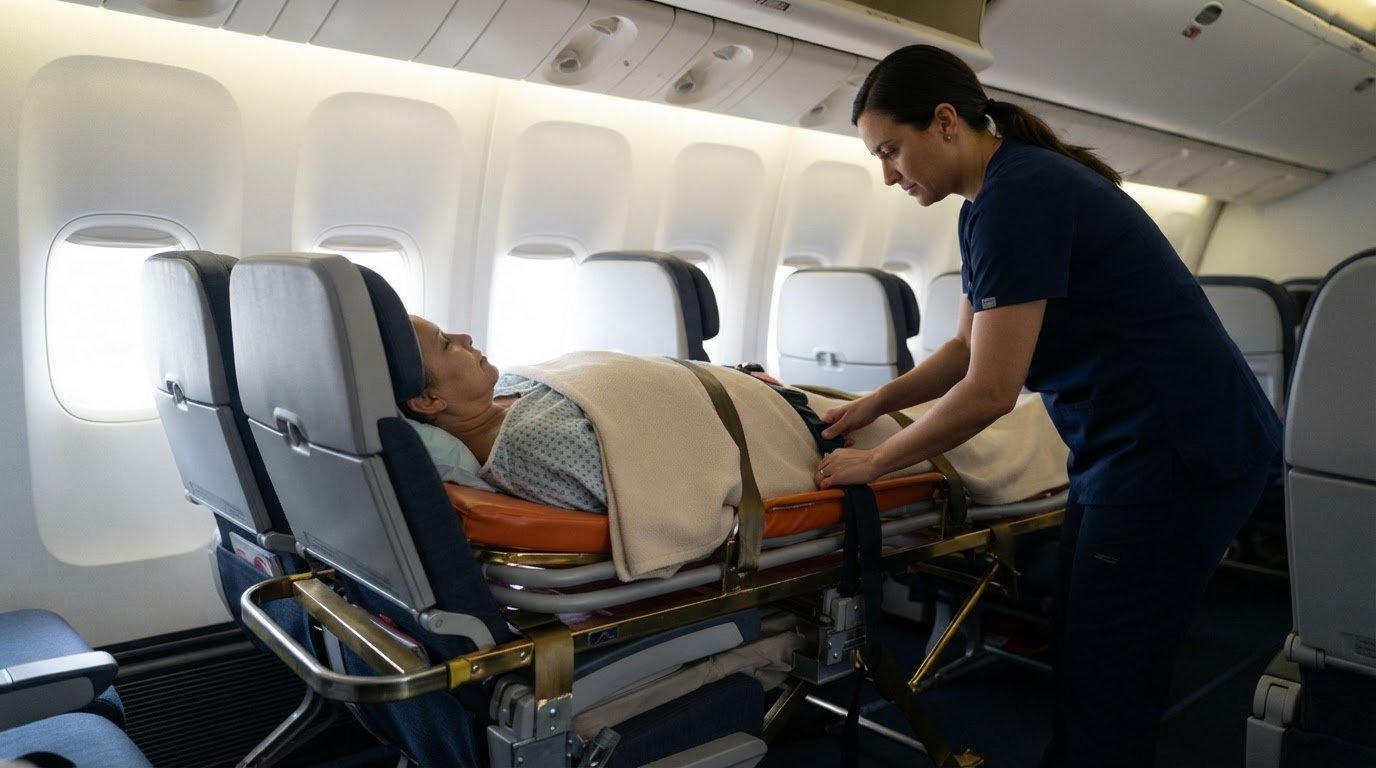
A dedicated air ambulance is designed for patients who need intensive care during transport, such as those on mechanical ventilation or receiving continuous critical care. For a patient who is stable but still needs clinical oversight, a commercial flight with a registered nurse escort is often a suitable alternative. The escort monitors the patient, manages scheduled medication, responds to changes in condition, and communicates with the flight crew.
When a Commercial Flight with an RN Escort Fits
This option suits patients who can sit or recline for the flight, do not require continuous life support, and whose medical team has confirmed that a commercial cabin can accommodate their equipment. Families often find that this route offers more departure options and a lower overall cost than a dedicated aircraft. RN MEDflights provides this service as an alternative to a traditional air ambulance, with a free quote available by phone at (210)-901-5226.
When a Dedicated Air Ambulance Is Required
Some patients need a critical care team, specialized onboard equipment, or a stretcher configuration that a commercial cabin cannot provide. In these cases, the level of care should not be reduced to lower cost. The decision should rest on the treating physician's clinical assessment rather than on budget alone.
Approach | Best Suited For | Key Considerations |
|---|---|---|
Commercial flight with RN escort | Stable patients who need monitoring, medication management, or mobility support | Requires confirmed fitness to fly, airline approval for equipment and seating, and flexibility on departure time |
Dedicated air ambulance | Critically ill patients who need intensive care or specialized onboard equipment | Greater onboard clinical capability, higher cost, and scheduling tied to the aircraft |
Commercial flight without clinical escort | Fully mobile patients who need no clinical supervision in flight | Lower cost, but no clinical staff on board to respond to a change in condition, so it is rarely suitable after a hospital stay |
Planning the Transatlantic Flight with an RN Escort
A transatlantic flight is long enough that the escort's role extends beyond the cabin. The escort typically meets the patient before boarding, confirms seating and oxygen arrangements with the airline, and reviews the medication schedule with the patient and family. In winter, boarding delays caused by de-icing or runway closures can extend the time the patient spends in airport areas, so the escort should plan for rest periods and access to restrooms.

Seating, Oxygen, and Equipment Coordination
Airlines maintain their own rules for medical equipment, portable oxygen, and advance notice. Requests should be submitted early, and the escort should confirm written approval for each item. A patient who relies on equipment that is not on the airline's approved list may need a different travel arrangement.
Timing the Flight Around Daylight and Arrival Hours
Arrival time matters for ground transport and hospital admission. A flight that lands late at night in winter may leave limited daylight for road transfers at the destination, and some receiving facilities operate with reduced overnight staffing. Families should confirm that the receiving hospital can admit the patient at the scheduled arrival time and that the onward ground transport has been booked.
Ground Transfers and Weather Contingencies
In winter, the ground legs of a repatriation carry as much risk as the flight. A transfer from a European hospital to the departure airport, and from the arrival airport to the receiving hospital, can be affected by snow, ice, and traffic. Each leg should have a named driver, a confirmed pickup time, and a fallback vehicle in case of delay.
Building a Buffer into the Schedule
A practical rule is to allow additional time before departure and after arrival, sized to the distance and the weather forecast. This buffer prevents a missed flight and avoids rushed handovers. If the buffer is not needed, the patient rests in a stable setting, which is preferable to an unplanned delay at the airport.
Contingency Plans for Cancelled or Rescheduled Flights
Weather-related cancellations are common enough to require a written contingency plan. The plan should identify the rebooking process, the accommodation or hospital that will hold the patient if the flight is delayed overnight, and the person responsible for updating the receiving team. Families often underestimate how much coordination a second departure date requires.
Documentation, Consent, and Hospital Coordination
A repatriation depends on documents that confirm who makes medical decisions, what care the patient needs, and whether the patient is permitted to enter and travel. Consent should be documented by the patient or by a legally authorized next of kin. Without it, a transfer may be delayed even when clinical readiness has been confirmed.
Entry, Exit, and Transport Requirements
Entry and exit requirements differ by country and can change without notice. Families should confirm each requirement in writing, including any travel forms that the departure country, the destination country, or the airline requires. Requirements should be checked again within days of departure, because a rule that applied at booking may have been updated.
Receiving Hospital Acceptance
The receiving hospital should confirm acceptance before the flight leaves. This includes the admitting department, bed availability, and any follow-up with specialists. A repatriation without this confirmation can leave a patient at the airport with no bed to go to. For a full sequence of planning steps, see the international medical escort checklist.
Most repatriation delays trace back to a missing document or an unconfirmed handover rather than to the flight itself.
Cost, Insurance, and Financial Planning
The cost of a medical repatriation depends on the level of care, the cabin or aircraft type, the route, and the number of escorts. Families should request an itemized quote that separates flight, escort, ground transport, and any stretcher or equipment charges. Comparing quotes is only useful when each one covers the same clinical scope.

Insurance Coverage Gaps
Original Medicare generally does not cover care received outside the United States, and many private health plans have limited foreign coverage. Families should confirm with the insurer whether transport home is covered, what the benefit limit is, and whether pre-approval is required. A denied claim discovered after the transfer is far harder to resolve than a question raised before booking.
Requesting a Quote and Comparing Options
A free quote is available by phone at (210)-901-5226. When requesting one, families should provide the departure location, the patient's clinical summary, the preferred travel window, and the destination hospital. Quotes based on incomplete information often change after booking, so providing complete details at the outset protects the budget.
Working with a Medical Repatriation Provider
A provider experienced in international transfers can coordinate the escort, airline, ground transport, and hospital handover within a single plan. RN MEDflights offers RN medical escort services for patients traveling on commercial airlines, along with air ambulance service, medical repatriation, case management, and stretcher services. Families and case managers can use these services for both domestic and international transfers.
Questions to Ask Before Booking
Useful questions include who will serve as the escort, which clinical tasks the escort is authorized to perform, how the provider communicates with the receiving hospital, and what happens if the flight is delayed. A provider should answer these questions clearly and in writing. Vague responses about escort duties are a reason for caution.
Pro tip: Ask the provider to name a single point of contact who remains available through the entire transfer, including the period before departure and after arrival. Continuous communication is often the factor that prevents avoidable delays.
We would love your feedback and any insights you would share with others. What perspective would you add?
Using Available Planning Resources
Families who want background before speaking with a coordinator can review the company's guide to medical repatriation and bringing a patient home safely. The 2026 guide to overseas patient transfer covers timing, documentation, and escort requirements in more detail. Reading these materials first helps families prepare focused questions for the planning call.
Frequently Asked Questions
How early should a family start planning a medical repatriation from Europe in winter?
Planning should begin as soon as the treating team considers discharge or transfer, and ideally before a discharge date is set. Early planning allows time for clinical clearance, airline approvals, document preparation, and an alternate travel date in case weather disrupts the first booking.
Can a patient travel on a commercial flight with a registered nurse escort?
Yes, for patients who are medically stable, can sit or recline for the flight, and have written clinical clearance from the treating physician. The escort monitors the patient and manages scheduled care during the flight. Patients who need intensive care usually require a dedicated air ambulance instead.
Does insurance cover medical repatriation?
Coverage varies by policy and plan. Original Medicare generally does not cover care received outside the United States, so families should confirm in writing with each insurer whether transport home is covered, what limits apply, and whether pre-approval is required.
What documents are needed for an international medical transfer?
Most transfers require a physician's fitness-to-fly statement, a clinical summary with diagnoses and medication lists, written acceptance from the receiving hospital, and consent from the patient or a legally authorized next of kin. Entry and exit paperwork depends on the countries involved and should be confirmed for each route.
How does winter weather affect the transfer schedule?
Snow, ice, fog, and reduced daylight can delay both ground transfers and flights. A realistic schedule includes buffers before departure and after arrival, an alternate departure date, and a named contact at each hospital involved in the transfer.
We welcome feedback from families, case managers, and hospital teams who have arranged a winter transfer from Europe, and we invite readers to share which steps proved most useful or most difficult.