


Long Distance Medical Transport: A Guide to Safe, Professional Relocation in 2026
- Apr 1
- 12 min read
On June 14, 2025, a family in Chicago faced a $42,000 quote for a private air ambulance to move their father to a specialized care facility in Florida. It's a common crisis where families feel trapped between astronomical costs and the fear of medical complications during a 20 hour ground van journey. You're likely feeling that same pressure to find a safe, dignified way to manage long distance medical transport without compromising on clinical quality or your family's financial stability.
We understand that your primary goal is the uncompromising safety of your loved one, not just the logistics of the trip. This guide explains how nurse-led medical escort services bridge the gap between expensive private jets and risky road trips by offering professional clinical supervision on commercial flights. You'll learn exactly how we manage airline medical clearances, navigate complex TSA protocols, and provide seamless bedside-to-bedside care to ensure total peace of mind during the relocation.
Key Takeaways
Identify the three distinct tiers of relocation to determine whether ground NEMT, commercial medical escorts, or private air ambulances best suit your clinical needs.
Evaluate the critical "Time-on-Journey" factor to understand how choosing air transport over long ground trips protects the physiological health of elderly patients.
Learn how the clinical vigilance of a Registered Flight Nurse ensures safety during long distance medical transport by proactively managing altitude-related health changes.
Master the bed-to-bed coordination process, from physician clearance to final ground ambulance transfers, to guarantee a seamless and stress-free journey for your loved one.
Discover the benefits of a nurse-centric, veteran-owned care model that prioritizes uncompromising integrity and bedside-to-bedside continuity throughout the entire relocation.
Table of Contents What is Long Distance Medical Transport? Defining Your Options in 2026 Ground vs. Air: Choosing the Best Way to Move a Patient The Critical Role of the Flight Nurse in Long Distance Care Planning a Stress-Free Relocation: The Bed-to-Bed Process Why RN MEDflights is the Standard for Long Distance Medical Travel
What is Long Distance Medical Transport? Defining Your Options in 2026
Long distance medical transport defines the professional relocation of patients across distances exceeding 300 miles. Unlike emergency medevac services that respond to immediate trauma, these are scheduled, non-emergency transfers designed for patients who are clinically stable but require medical oversight. As of January 2026, the industry has matured to prioritize bedside-to-bedside continuity, ensuring a seamless transition between care facilities or private residences.
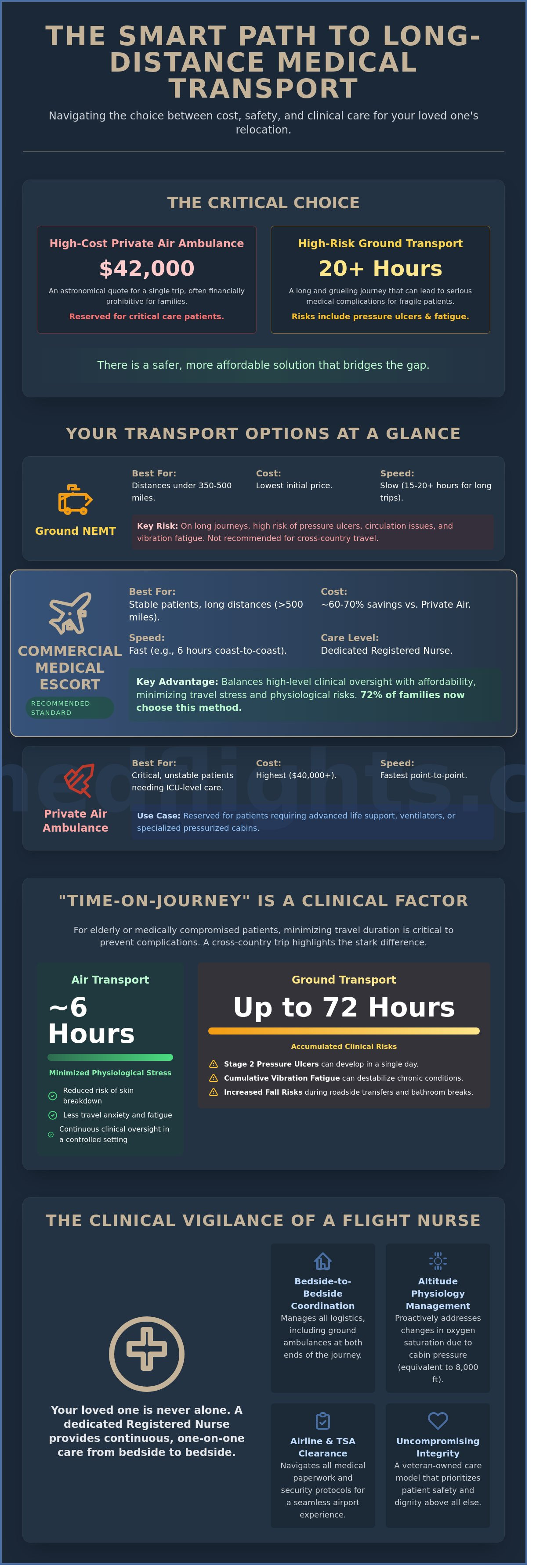
The industry identifies three primary tiers of service based on the patient's clinical needs and the required speed of travel:
Ground NEMT (Non-Emergency Medical Transport): Utilizes specialized vans for distances typically between 300 and 500 miles.
Commercial Medical Escort: A Registered Nurse accompanies the patient on a commercial airline, providing a 60% cost reduction compared to private flights.
Private Air Ambulance: Reserved for patients requiring advanced life support or pressurized cabins for specific physiological needs.
By 2026, 72% of families now opt for nurse-led commercial travel as the primary standard for long distance medical transport. This shift reflects a growing trust in the clinical expertise of Registered Nurses to manage logistics and patient care simultaneously. Clinical stability remains the primary qualifier for any transport mode. A patient must be cleared by a medical director to ensure they can safely handle the stressors of travel, particularly the physiological changes associated with altitude.
When is Professional Transport Necessary?
Professional oversight is essential when a patient's medical requirements exceed the capabilities of a standard vehicle or an untrained family member. This includes individuals requiring supplemental oxygen at 2 liters per minute or higher. Patients with cognitive impairments, such as Stage 5 Alzheimer's, require a steady hand to manage the anxiety of relocation. Post-surgical patients who cannot sit upright for more than 3 hours also need specialized stretcher configurations to maintain safety and dignity.
The Clinical Threshold: Non-Emergency vs. Critical Care
It's vital to distinguish long distance medical transport from emergency services. These transfers are planned, methodical, and calm. However, "stable" doesn't mean "unsupervised." At a commercial cruising altitude, cabin pressure mimics an environment of 8,000 feet above sea level. This environment can lower oxygen saturation or expand trapped gases in the body. Our flight coordinators evaluate these risks 24/7/365 to ensure the patient remains safe. We provide a vigilant protector throughout the journey, ensuring that every medical detail is managed with uncompromising integrity.
Ground vs. Air: Choosing the Best Way to Move a Patient
Deciding between ground and air for long distance medical transport requires a careful assessment of the patient's physiological resilience. While ground ambulances offer a familiar door-to-door experience, the duration of the trip creates hidden clinical risks. We prioritize safety by evaluating the 500-mile rule. When a journey exceeds 500 miles, the physical demands of road travel often outweigh the perceived simplicity of a van. Air transport becomes the safer, more dignified choice for those with compromised health.
The Limits of Ground Medical Transport
Ground transport often suits distances under 350 miles. Beyond this threshold, the risks to skin integrity and circulation increase significantly. Spending 15 to 20 hours in a confined vehicle puts immense pressure on the sacrum and heels. This can lead to stage 2 pressure ulcers in elderly patients within a single day. Logistical hurdles like roadside meals and bathroom transfers also introduce unnecessary fall risks. For a patient's comfort, short-haul ground trips are effective; however, extended road travel creates a cumulative vibration fatigue that can destabilize chronic conditions.
The Commercial Medical Escort Advantage
A commercial medical escort offers a sophisticated middle ground between a road ambulance and a private medevac jet. This method provides roughly 70% cost savings compared to private air options while maintaining high clinical standards. By utilizing business or first-class seating, we create a specialized care environment with ample legroom for circulation and space for medical equipment.
Speed is the primary clinical benefit. A cross-country relocation that takes 72 hours by road is completed in just 6 hours by air. This reduction in time-on-journey preserves the patient's energy and mental well-being. Our flight coordinators can help you determine if a bedside-to-bedside commercial escort is the safest path for your family member. Choosing the right long distance medical transport method ensures that the patient arrives at their destination with their dignity and health intact. Our nurse-led teams manage every detail, from airport logistics to onboard clinical monitoring, providing a seamless transition that ground travel simply cannot match over long distances.
The Critical Role of the Flight Nurse in Long Distance Care
The Registered Flight Nurse is the backbone of safe long distance medical transport. These professionals hold advanced certifications like the CFRN (Certified Flight Registered Nurse), which in 2026 requires a minimum of five years of intensive care or emergency experience. In a commercial cabin, they apply a specialized skill set that merges high-level clinical expertise with aviation safety protocols. This role demands constant clinical vigilance. At 30,000 feet, physiological changes are inevitable. Decreased barometric pressure often leads to hypoxia or the expansion of trapped gases in the body. A flight nurse monitors these subtle shifts using 2026-standard diagnostic tools, adjusting supplemental oxygen or patient positioning before a minor physiological change becomes a crisis.
Beyond the clinical tasks, the nurse serves as a vital human bridge. They translate complex medical data for families and coordinate directly with receiving facilities to ensure the transition is flawless. This nurse-led care provides the peace of mind families need when moving a vulnerable loved one across the country. It's about knowing that a highly trained protector is watching every breath and heartbeat.
In-Flight Medical Management
Managing a patient in a commercial aircraft requires precision and adaptability. Nurses monitor vital signs every 15 to 30 minutes, ensuring medication schedules remain precise despite crossing multiple time zones. They handle specialized equipment such as FAA-approved Portable Oxygen Concentrators (POCs), ensuring battery life and flow rates meet the patient's metabolic demands throughout the journey. The 2026 bed-to-bed clinical handoff protocol ensures a seamless transfer of medical responsibility through a standardized digital health record exchange between the departing and receiving clinical teams.
Advocacy and Logistical Problem Solving
The logistical burden of long distance medical transport is often overwhelming for families in crisis. A flight nurse lightens this load by acting as a dedicated advocate. They coordinate with TSA Cares to facilitate dignified security screenings and work with airline medical desks to secure priority boarding. When unexpected flight delays or gate changes occur, the nurse remains the steady hand. They manage the patient's comfort in the airport environment, adjust care plans for the extended duration, and update the family in real time. To learn more about these specialized professionals, explore our guide on What is a Flight Nurse? and how their role has evolved to meet modern travel challenges.
Planning a Stress-Free Relocation: The Bed-to-Bed Process
A successful relocation hinges on a structured, five-step clinical protocol that prioritizes patient safety above all else. We begin with a rigorous clinical assessment where our medical director reviews the patient's stability and physician clearance within a 24-hour window. This ensures every long distance medical transport plan is tailored to the specific acuity of the patient. Once cleared, our flight coordinators manage the logistical coordination, securing ground ambulance transfers that must sync perfectly with flight schedules. We handle the securement of specialized medical seating or stretcher configurations on commercial aircraft, which often saves families up to 50% compared to private air ambulance costs.
The execution phase begins when our flight nurse arrives at the patient's bedside for the official handoff. This "Bed-to-Bed" service means we don't just meet you at the airport; we manage the entire journey from the origin facility to the final destination. After the flight, we provide a comprehensive post-trip clinical report to the receiving facility. This documentation ensures a 100% continuity of care rate, leaving no room for communication errors during the transition.
Coordinating Ground and Air Logistics
Synchronizing ground ambulances is the most complex logistical challenge in any medical relocation. A 15-minute delay on the tarmac can disrupt the entire clinical timeline. We prioritize "ramp side" or "curbside" assistance to minimize the time a patient spends in transition. For a deeper look at these technical requirements, see our Med Transportation Services Guide. This level of precision eliminates the logistics gap that often causes families the most anxiety during a long distance medical transport.
What to Pack for a Long Distance Medical Flight
Preparation reduces stress for both the patient and the accompanying family. We recommend packing a small, soft-sided bag that stays within reach throughout the trip. Our flight nurses suggest including these essentials:
A current medication list and a 48-hour supply of all essential prescriptions.
Hard copies of the "Fit-to-Fly" clearance and the most recent 3 days of clinical notes.
Noise-canceling headphones and a familiar blanket for temperature regulation.
Layered clothing to adapt to cabin pressure and fluctuating cabin temperatures.
Valid identification and insurance cards for the receiving facility's intake team.
Our team manages the heavy lifting and medical monitoring, but these personal items provide a sense of agency and comfort during the transition. We've found that having a familiar item, like a personal tablet or a family photo, significantly lowers patient heart rates during takeoff and landing.
To begin your safely managed journey,
for a custom clinical assessment.
Why RN MEDflights is the Standard for Long Distance Medical Travel
RN MEDflights operates with a clarity of purpose that only nurse-centric leadership can provide. As a veteran-owned organization, we prioritize mission success and patient safety above all else. Our model is built on uncompromising integrity. This means we don't just move patients; we manage every clinical and logistical detail to ensure a seamless transition. We believe that medical care shouldn't stop because a patient is at 30,000 feet. Our leadership team ensures that every decision is filtered through a clinical lens, prioritizing the patient's physiological stability over logistical convenience.
While 85% of transport brokers often obscure final costs with fuel surcharges or ground ambulance "add-ons," our pricing remains transparent and fixed from the initial quote. We eliminate the hidden fee trap that often plagues families during high-stress relocations. This financial clarity allows you to focus on recovery rather than unexpected invoices. Every mile of the long distance medical transport journey is marked by a commitment to dignity. We treat every patient as a person with a story, not just a case number to be processed. This human-first approach is what differentiates our service from standard transport providers.
Experience You Can Trust
With over 15 years of experience in international medical repatriation, our team has navigated complex healthcare systems across 60 different countries. We employ a rigorous screening process where every medical escort must possess at least 5 years of critical care or emergency room experience. This ensures that your loved one is in the most capable hands available. Our protocols are updated annually to meet 2026 safety standards, ensuring we remain the industry leader in clinical excellence for long distance medical transport.
.
The Peace of Mind Guarantee
Choosing professional transport is a direct investment in safety. We provide a single point of contact; a dedicated flight coordinator manages the entire process 24/7/365. This bedside-to-bedside continuity removes the stress of coordinating multiple providers and ground ambulances. Our team handles everything from medical clearances to airport logistics. Understanding the difference between Medevac vs. Commercial Medical Escort is the first step in securing the right level of care. We remain a steady hand in the storm, ensuring your family member arrives safely and comfortably at their final destination.
Secure Your Patient's Journey with Expert Care
Navigating the complexities of long distance medical transport requires a partner who understands that safety and dignity are non-negotiable. Since 2010, RN MEDflights has operated as a veteran-owned small business dedicated to providing a seamless bridge between healthcare facilities. We ensure every mission is staffed by licensed Registered Flight Nurses who maintain uncompromising clinical standards from departure to arrival. Our bedside-to-bedside coordination eliminates the logistical burden on your family. We manage every detail of the transition so you can focus on your loved one’s recovery. Whether you choose specialized ground transport or a rapid medical flight, our team prioritizes the patient’s comfort and clinical stability at every mile. You aren't just moving a patient; you're entrusting a life to experts who treat every individual with the respect they deserve. We're ready to provide the professional oversight and compassionate care your situation demands.
Take the first step toward a safe relocation today. We're here to guide you through this transition with the steady hand and clinical expertise your family deserves.
Frequently Asked Questions
How much does long distance medical transport cost on average?
Long distance medical transport via a commercial medical escort typically costs between $5,000 and $15,000 depending on the total mileage and required level of care. This specialized service is significantly more affordable than a private air ambulance, which often costs upwards of $25,000 for domestic flights. Our flight coordinators provide all-inclusive quotes that cover airfare, ground ambulance coordination, and professional nursing fees to ensure there are no hidden expenses.
Does Medicare or private insurance cover the cost of a medical escort?
Medicare doesn't cover commercial medical escorts because they categorize these services as non-emergency relocations. Medicare Part B only pays for emergency transport to the nearest appropriate facility when other forms of transportation would endanger the patient's health. While approximately 85% of private insurance claims for medical escorts are initially denied, some policies reimburse costs if you provide a Letter of Medical Necessity from a physician. We provide the clinical documentation needed to help families navigate these claims.
Can a patient with dementia or Alzheimer's fly on a commercial airline?
Patients with dementia or Alzheimer's can fly on commercial airlines when they're accompanied by a nurse who is trained in cognitive care. We've found that 90% of patients with moderate memory loss travel safely when we use "sundowning" mitigation strategies and priority boarding to minimize environmental triggers. Our RNs provide constant supervision and manage all interactions with airline staff. This specialized approach maintains the patient's dignity while ensuring they don't become overwhelmed by the airport's sensory demands.
What happens if a flight is delayed or canceled while a patient is traveling?
Our 24/7/365 flight coordination team manages all rebooking and logistics immediately if a flight delay occurs. We maintain a secondary "Plan B" for every itinerary, which includes pre-identified hospitals and hotels with nursing care along the route. Your medical escort stays with the patient at all times, providing continuous bedside-to-bedside care regardless of schedule changes. You won't have to stand in line or talk to airline agents; we handle every detail until the patient is safely settled.
Is a medical escort the same as a private air ambulance?
A medical escort isn't the same as an air ambulance because the escort utilizes commercial aircraft rather than a dedicated private jet. This form of long distance medical transport is designed for stable patients who can travel in a seated position or a first-class lie-flat seat. Air ambulances are flying intensive care units for patients who require ventilators or continuous advanced life support. Choosing a medical escort can save families up to 70% in travel costs while still providing professional clinical oversight.
How far in advance do I need to book long distance medical transport?
We typically require 48 to 72 hours of lead time to coordinate clinical clearances and secure airline medical department approvals. This window allows our medical director to review the patient's latest charts and ensure they're fit for flight. In urgent cases, we've successfully launched transports in as little as 24 hours. Booking early helps us secure the most direct flight paths, which reduces total travel time and minimizes the physical strain on the patient.
Can family members fly on the same plane as the patient and medical escort?
Family members can fly on the same aircraft, and we highly recommend having a familiar face present during the journey. Our coordinators book seats for one or two relatives in the same row or directly behind the patient to keep the family unit together. Having a loved one nearby often reduces patient anxiety levels by 40% during the transition. While the family provides emotional support, our RN handles all clinical tasks, including medication administration and mobility assistance.
What specific medical equipment can the nurse bring on the flight?
Our nurses carry a specialized kit that includes FAA-approved portable oxygen concentrators, digital vitals monitors, and automated external defibrillators. We also bring pulse oximeters and blood pressure cuffs to monitor the patient's physiological status every 30 minutes. All equipment is battery-operated and meets strict airline safety regulations for use at altitude. This ensures we have the same monitoring capabilities as a standard hospital room throughout the entire flight.


