Medical Clearance for Airline Travel Process: The 2026 Essential Guide
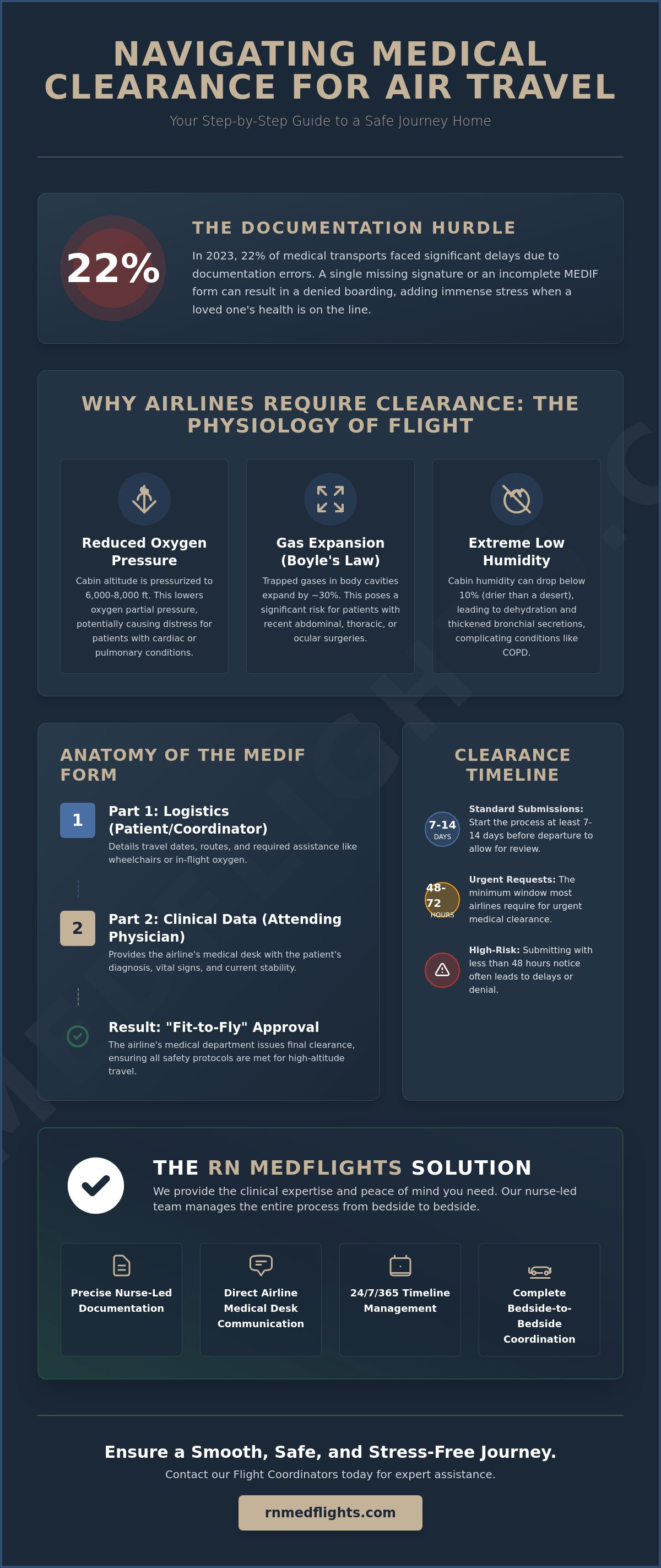
A single missing signature on a MEDIF form can halt a medical journey before it even begins. In 2023, industry reports indicated that approximately 22% of medical transport requests faced delays due to documentation errors. You're likely feeling the weight of this responsibility, worrying that a small oversight might lead to a denied boarding at the gate. It's natural to feel anxious about the medical clearance for airline travel process, especially when a loved one's health and safety are on the line.
At RN Medflights, we believe you deserve a steady hand to manage the clinical complexities of high-altitude travel. We'll help you master this intricate system through professional coordination and precise nurse-led documentation. This guide provides a clear roadmap for securing airline approval, managing specialized oxygen requirements, and ensuring patient stability. You'll learn exactly how our flight coordinators handle the logistics from bedside to bedside. We're here to provide the clinical excellence and peace of mind you need to bring your loved one home safely.
Key Takeaways
Distinguish between a standard physician's note and the formal "fit-to-fly" authorization required for safe air travel.
Explore how physiological factors like Boyle’s Law and cabin altitude affect patients with recent surgeries or cardiac conditions.
Master the medical clearance for airline travel process by following a structured, step-by-step guide to clinical summaries and MEDIF forms.
Learn how specialized RN-led advocacy simplifies complex logistics and handles critical communication with airline medical departments.
Identify the specific clinical milestones and healing timelines necessary to secure airline approval for high-risk patients.
Table of Contents Understanding the Medical Clearance for Airline Travel Process Why Airlines Require Clearance: The Physiology of Flight Common Medical Conditions Requiring Airline Approval Step-by-Step: Navigating the Airline Medical Desk How RN MEDflights Manages the Clearance for You
Understanding the Medical Clearance for Airline Travel Process
The medical clearance for airline travel process is a specialized clinical protocol designed to ensure patient safety at 35,000 feet. It's a formal "fit-to-fly" approval that goes far beyond a simple recommendation. This process functions as a safety mandate rather than a bureaucratic hurdle. High-altitude environments present unique physiological challenges, including decreased oxygen partial pressure and gas expansion. By adhering to the standards found in the IATA Medical Manual, carriers ensure that patients with complex needs don't face unnecessary risks during transit. This global framework relies on the principles of Aviation medicine to protect both the individual traveler and the flight crew.
A common misconception is that a standard prescription pad note from a family doctor is sufficient for travel. It isn't. Official airline clearance requires a structured assessment of a patient's current clinical status against the specific stressors of flight. While a doctor's note expresses an opinion, the airline's medical department makes the final determination based on liability and operational safety. At RN Medflights, we view this step as the foundation of our bedside-to-bedside care model. It provides the necessary peace of mind for families, ensuring that every logistical detail is backed by clinical integrity.
What is a MEDIF Form?
The Medical Information Form, or MEDIF, is the primary document used in the medical clearance for airline travel process. It's divided into two distinct sections to ensure a seamless flow of information. Part 1 is typically completed by the patient or a flight coordinator, focusing on travel dates, routes, and required assistance like wheelchairs or oxygen. Part 2 requires the attending physician's input, detailing the patient's diagnosis and vital signs. You'll often see specific terminology on these forms:
Stable: The patient's condition hasn't changed or deteriorated in the last 30 to 90 days.
Ambulatory: The patient can walk and move independently within the cabin.
Non-ambulatory: The patient requires a stretcher or specialized seating for the duration of the flight.
The Timeline: When to Start the Process
Timing is a critical factor in securing a successful clearance. Most major international carriers like Delta, Lufthansa, or Emirates require medical documents at least 7 to 14 days before the scheduled departure. Starting early prevents the stress of a last-minute denial, which often occurs if the airline's medical officer requires additional clinical data. For urgent medical situations, airlines typically require a 48-72 hour window for urgent medical clearance requests to allow their internal medical departments to review clinical stability. Attempting to clear a patient faster than this often leads to high-risk delays. Our nurse-led team manages these timelines 24/7/365 to ensure no detail is overlooked during the transition home.
Why Airlines Require Clearance: The Physiology of Flight
Commercial aircraft cabins are pressurized to an equivalent altitude of 6,000 to 8,000 feet. At this height, the partial pressure of oxygen drops significantly, causing blood oxygen saturation (SpO2) to decrease in even the healthiest passengers. For a patient with underlying pulmonary or cardiac conditions, this physiological shift can lead to acute respiratory distress. This unique environment is the primary reason the medical clearance for airline travel process is so rigorous and data-driven.
Physics also plays a critical role through Boyle's Law. As cabin pressure decreases, gases trapped within body cavities expand by approximately 30 percent. This expansion poses a severe risk to patients who've had abdominal, thoracic, or ocular surgeries within the previous 14 days. If a pocket of air remains in a surgical site, it can cause tissue damage or wound dehiscence at 35,000 feet. Additionally, cabin humidity levels often drop below 10 percent, which is drier than the Sahara Desert. This leads to rapid dehydration and thickening of bronchial secretions, complicating matters for those with chronic obstructive pulmonary disease (COPD). Following CDC guidance for travelers with chronic illnesses is essential to mitigate these specific environmental stressors before departure.
The "Fit-to-Fly" Clinical Threshold
A patient who appears stable in a living room may not remain stable in a pressurized tube. Airlines define "fit-to-fly" based on hemodynamic stability and the ability to breathe independently without taxing the aircraft's limited emergency oxygen supply. A patient with a resting SpO2 of 92 percent at sea level might see that number drop to 82 percent once the aircraft reaches cruising altitude. The airline holds significant liability, and the Captain has the final legal authority to refuse any passenger they deem a safety risk. Our flight coordinators manage these complex negotiations to ensure every clinical detail is pre-approved before arrival at the gate.
Oxygen Requirements and POC Approval
The FAA maintains strict regulations regarding Portable Oxygen Concentrators (POCs). The medical clearance for airline travel process requires translating a "liters per minute" prescription into total battery life for the entire journey. Airlines enforce a 150 percent battery rule. If a flight is 4 hours, you must carry 6 hours of battery power to account for taxiing, gate delays, and potential diversions. This ensures the patient is never without life-sustaining support during unforeseen logistical hurdles.
Common Medical Conditions Requiring Airline Approval
Airlines prioritize cabin safety and the well-being of every passenger. The medical clearance for airline travel process identifies individuals who might experience physiological distress at a cabin altitude of 8,000 feet. For post-operative patients, wound healing and gas expansion are the primary concerns. Abdominal or thoracic surgeries generally require a minimum 10-day waiting period. This delay ensures that internal gases, which expand by approximately 25% at cruising altitude, don't rupture sutures or cause internal barotrauma.
Cardiac stability is non-negotiable for air travel. Patients who suffered an uncomplicated myocardial infarction must typically wait 7 to 10 days before flying. If a patient received a coronary stent, airlines usually mandate a 48-hour observation period to ensure no immediate complications arise. For those with unstable angina, travel is strictly prohibited until the condition is stabilized. These requirements align with U.S. regulations on medical certificates for air travel, which allow carriers to require medical documentation when a passenger's condition could result in an emergency diversion.
Respiratory issues like COPD or recent pneumonia require careful screening. Patients must demonstrate they can maintain oxygen saturation above 90% in a pressurized environment. If supplemental oxygen is necessary, it must be coordinated through the airline's approved portable oxygen concentrator (POC) list. Neurological concerns, including Traumatic Brain Injury (TBI) or advanced dementia, present unique challenges. Altitude-induced hypoxia can exacerbate cognitive confusion or agitation. Our flight coordinators ensure that every detail, from bedside-to-bedside, is managed with clinical precision to maintain patient dignity and safety.
The Commercial Stretcher Clearance Process
A commercial stretcher service is a specialized solution for patients who cannot sit upright for takeoff and landing. This process differs from a medical escort because it involves significant aircraft modification. The airline removes 6 to 9 economy seats to install an FAA-approved stretcher unit and a privacy curtain. Because of the complex engineering and staffing logistics, these services require a minimum 7-day lead time. It's a highly coordinated effort that ensures the patient remains stable throughout the journey.
Psychiatric and Behavioral Health Considerations
Airlines maintain strict policies regarding agitation and self-harm risks to protect the safety of the flight. To navigate the medical clearance for airline travel process for behavioral health, a professional medical escort is almost always mandatory. You must provide documentation proving the patient has been stable for at least 48 hours and doesn't pose a flight risk. Our RN-led teams provide the authoritative presence needed to reassure the airline while offering the compassionate care the patient requires during a difficult transition.
Step-by-Step: Navigating the Airline Medical Desk
Navigating the medical clearance for airline travel process requires meticulous attention to detail. This isn't a standard booking; it's a clinical evaluation by the airline’s specialized medical department. Our team manages this interaction daily, ensuring that every piece of data aligns with international aviation medicine standards.
Step 1: Obtain a comprehensive clinical summary. Your treating physician must provide a document dated within 10 days of the flight. It needs to outline the diagnosis, recent surgical interventions, and current medication list.
Step 2: Request the specific MEDIF or medical form. Every carrier, such as Delta, Lufthansa, or Emirates, uses a proprietary Medical Information Form. Don't use a generic note; the airline's medical desk will only accept their specific 2026 version.
Step 3: Submit documentation to the dedicated Medical Desk. These departments are staffed by flight surgeons and specialized nurses who review the patient's fitness to fly. We recommend submitting these at least 48 to 72 hours before departure.
Step 4: Manage the Inquiry Phase. Airlines often ask for more data, such as the patient's ability to navigate a 90-degree turn in a narrow aisle or their specific oxygen flow requirements during ascent.
Step 5: Secure the final Clearance to Fly code. Once approved, the airline issues a specific code linked to the passenger record. You must verify this code is visible to the gate agents and the cabin crew before boarding.
The Physician Preparation Checklist
Success depends on the quality of the data provided by the treating physician. Vague descriptions like "patient is doing better" lead to immediate denials. The airline needs objective data to assess risk at 35,000 feet. Key metrics include baseline heart rate, blood pressure, and SpO2 levels on room air. If the patient requires supplemental oxygen, the physician must specify the exact liters per minute (LPM) and whether the need is continuous or PRN. It's vital that the clinical summary explicitly states the patient is hemodynamically stable for air travel at a pressurized cabin altitude of 8,000 feet.
Ground Logistics and Bed-to-Bed Continuity
The medical clearance for airline travel process must account for the transition from the hospital to the airport. Safety doesn't start at the gate; it starts at the bedside. Coordinating long distance medical transport ensures that the patient remains under professional supervision during the entire journey. We arrange for ground ambulances to meet the aircraft upon landing, providing a seamless transfer that maintains clinical stability. Our flight coordinators also handle airport assistance, securing tarmac access or "meet and greet" services to bypass crowded terminals, which reduces patient fatigue and stress.
If you need expert assistance managing these complex requirements, contact our flight coordinators today for a seamless experience.
How RN MEDflights Manages the Clearance for You
RN MEDflights simplifies the medical clearance for airline travel process by acting as a clinical bridge between the treating hospital and the airline's medical department. Families often find the technical requirements of a MEDA form or the specific oxygen flow rate documentation overwhelming during a crisis. Our team manages 100% of this logistical paperwork, ensuring every detail meets the stringent 2026 aviation safety standards. We don't just fill out forms; we advocate for the patient. This professional advocacy involves our senior clinicians speaking directly to airline medical directors to explain the patient's stability and the safety protocols we provide through our medical escort service.
Our "Bedside-to-Bedside" promise ensures that clinical oversight begins the moment we meet the patient at their current facility and continues until they're safely settled into their final destination. This continuity of care is vital for patient safety and family peace of mind. By handling the complex coordination, we allow families to focus on their loved one's recovery rather than administrative hurdles. Our process includes:
Direct communication with airline medical officers to clarify clinical status.
Verification of all inflight medical equipment and oxygen requirements.
Coordination of ground ambulance transfers at both ends of the flight.
Real-time updates to the family throughout the clearance journey.
The Advantage of Nurse-Led Coordination
Our flight nurses serve as the primary point of contact for airline medical departments because they possess the specialized vocabulary needed to address concerns about cabin altitude or pressurized environments. In the context of international medical repatriation services, we navigate different time zones and language barriers to secure approvals. If an airline issues a denial, we don't stop. We handle medical appeals in real-time, providing additional clinical data or adjusting the transport plan to meet safety standards within hours of the initial decision.
Start Your Safe Journey Home Today
Managing the medical clearance for airline travel process requires a steady, experienced hand. Initiating your clearance starts with a single phone call or online inquiry. Our flight coordinators are available 24/7/365 to provide a detailed quote and begin the clinical assessment within 60 minutes of contact. We understand that medical relocation needs are often urgent, so we prioritize a rapid response without compromising our uncompromising safety standards. Contact RN MEDflights for a professional medical travel consultation to secure your peace of mind and begin the journey home today.
Secure Your Medical Journey with Clinical Precision
Managing the medical clearance for airline travel process requires a deep understanding of how pressurized cabins affect patient stability. Since airlines operate at effective cabin altitudes of 6,000 to 8,000 feet, physiological changes like gas expansion and oxygen fluctuations are critical factors to monitor. Our 2026 guide highlights that successful transport depends on early coordination with airline medical desks and comprehensive clinical documentation. You don't have to navigate these complex requirements alone. RN Medflights serves as a vigilant protector, utilizing veteran-owned and nurse-led leadership to manage every detail. We specialize in commercial stretcher services, ensuring that patients receive 24/7/365 attention throughout their transit.
Our commitment to bed-to-bed continuity of care means we take full responsibility for the patient from the first mile to the last. This methodical approach reduces the emotional load on families while maintaining uncompromising safety standards. It's our mission to provide the peace of mind you deserve during a medical transition. Request a Professional Medical Travel Assessment today to begin your journey with a team that values both clinical excellence and human compassion. We're ready to guide you home safely.
Frequently Asked Questions:
How long does the medical clearance for airline travel process usually take?
The medical clearance for airline travel process typically takes between 48 and 72 hours to complete once the airline receives all documentation. Most international carriers require these forms at least 48 hours before the scheduled departure time. This window allows the airline's medical department to review the clinical data and coordinate any necessary in-flight resources for the patient.
Can an airline deny a passenger even if they have a doctors note?
Yes, an airline maintains the final authority to deny boarding even if you possess a private doctor's note. Under the Air Carrier Access Act 14 CFR Part 382, carriers may refuse transport if they determine a passenger poses a direct threat to the health or safety of others. Their internal medical teams prioritize the aircraft's environment over external recommendations to ensure a safe flight for everyone on board.
What is the difference between a MEDIF and a Fit-to-Fly certificate?
A Medical Information Form (MEDIF) is a standardized document defined by IATA Standard 700 that provides specific clinical details to the airline's medical department. In contrast, a Fit-to-Fly certificate is a less formal letter from a treating physician stating the patient is stable for travel. Airlines usually require the structured MEDIF to assess oxygen needs or stretcher requirements rather than a simple letter from a clinic.
Do I need medical clearance if I only need a wheelchair?
You don't need formal medical clearance if your only requirement is a wheelchair for mobility assistance through the terminal. Major carriers provide three levels of wheelchair service based on your ability to navigate stairs or cabin aisles. However, if your mobility limitation stems from a recent surgery within the last 14 days, the airline will likely trigger the medical clearance for airline travel process to ensure you can fly safely.
Who pays for the medical clearance and associated airline fees?
The passenger or their private insurance provider is responsible for all costs related to obtaining medical clearance and any additional airline service fees. Medicare and most standard health plans cover 0% of the costs for non-emergency commercial medical escorts or extra seating. You'll need to pay for physician assessments, diagnostic tests, and airline-specific charges like supplemental oxygen or stretcher installation before the flight is confirmed.
What happens if my medical clearance is denied?
If your clearance is denied, you must either wait for your clinical condition to stabilize or arrange for a private air ambulance. Airlines often require a 7 to 14-day waiting period before you can re-apply after a denial due to an acute event like a stroke or recent surgery. Our flight coordinators can help you pivot to a higher level of care, such as an ICU-configured jet, if commercial travel isn't an option.
Does medical clearance guarantee that the flight will be safe for the patient?
Medical clearance doesn't guarantee a complication-free journey; it simply indicates that the patient meets the airline's minimum safety criteria for transport. Changes in cabin pressure at 35,000 feet can reduce blood oxygen saturation by 10% or more, even in stable patients. This is why our bedside-to-bedside service includes continuous monitoring by a Registered Nurse to manage physiological shifts that the airline's clearance doesn't account for.
Is medical clearance required for domestic flights within the US?
Yes, medical clearance is required for domestic US flights if you need supplemental oxygen, a stretcher, or have a contagious disease. FAA regulations mandate that airlines vet any passenger whose condition might require extraordinary in-flight assistance or medical equipment. While a simple broken leg might not need paperwork, any condition requiring a ventilator or specialized monitoring will trigger a full clinical review by the carrier's medical desk.


