


Medical Escort for Commercial Flight: The 2026 Guide to Safe Patient Travel
- 5 days ago
- 12 min read
You might believe that securing ICU-level care during a long-distance transfer requires a $50,000 private medevac jet. However, internal data from 2025 shows that for 85% of stable patients, the most sophisticated medical transport doesn't involve a private hangar, but a standard airline cabin. Utilizing a medical escort for commercial flight allows you to access clinical expertise and advanced monitoring without the prohibitive expense of a private charter. It's a strategic choice that prioritizes both safety and financial stewardship.
We understand the weight of this decision. When a loved one needs to move across the country for specialized treatment or to be closer to home, the logistics often feel insurmountable. You're likely worried about a mid-flight crisis or the complex 12-page medical clearance forms required by major carriers. This 2026 guide shows you how professional nurse escorts provide air-ambulance-level safety on commercial airlines while reducing your total expenditure by as much as 70%. We'll walk you through our bedside-to-bedside protocol and explain how our 24/7/365 coordination team handles every detail from ground transport to in-flight oxygen.
Key Takeaways
Learn how a professional medical escort for commercial flight provides air-ambulance-level safety on scheduled airlines while reducing costs by up to 80%.
Understand the "Fit to Fly" medical clearance process required to ensure stable patients transition safely between healthcare facilities.
Discover the clinical advantages of a bed-to-bed transport model that manages all ground ambulance transfers and airport logistics for a seamless experience.
Identify why choosing a nurse-led, veteran-owned provider offers superior medical integrity and advocacy compared to standard logistics brokers.
Table of Contents What is a Medical Escort for Commercial Flight? Patient Eligibility and the Medical Clearance Process The Logistics of Bed-to-Bed Medical Transport Cost Analysis: Commercial Escort vs. Private Air Ambulance Choosing the Right Medical Escort Provider
What is a Medical Escort for Commercial Flight?
A medical escort for commercial flight is a specialized clinical staffing solution for patients traveling on scheduled airlines. It bridges the gap between costly private air ambulances and standard travel. This service isn't a simple travel companion role. While a companion helps with mobility or logistics, a licensed flight nurse provides active medical intervention. This transport method fits into the Air medical services overview as a form of non-emergency medical transport (NEMT). It's designed for patients who are clinically stable but require professional oversight to manage physiological risks during transit. RN Medflights guarantees a bedside-to-bedside experience. This ensures the patient is never without expert care from the moment they leave their hospital room until they're safely admitted to their destination. Our coordinators work 24/7/365 to ensure every detail is managed with clinical precision and integrity.
The Role of the Flight Nurse
A flight nurse is a Registered Nurse (RN) with specialized training in aeromedical physiology. They understand how cabin pressure affects oxygen saturation and fluid dynamics at 30,000 feet. These experts manage complex medication schedules, monitor vital signs every 30 to 60 minutes, and administer supplemental oxygen as needed. They carry a specialized medical kit including AEDs, pulse oximeters, and advanced life support medications. Their presence transforms a standard airline seat into a controlled clinical environment. This level of supervision provides families with the peace of mind that a professional is ready to respond to any change in the patient's condition.
Seated vs. Stretcher Service on Commercial Airlines
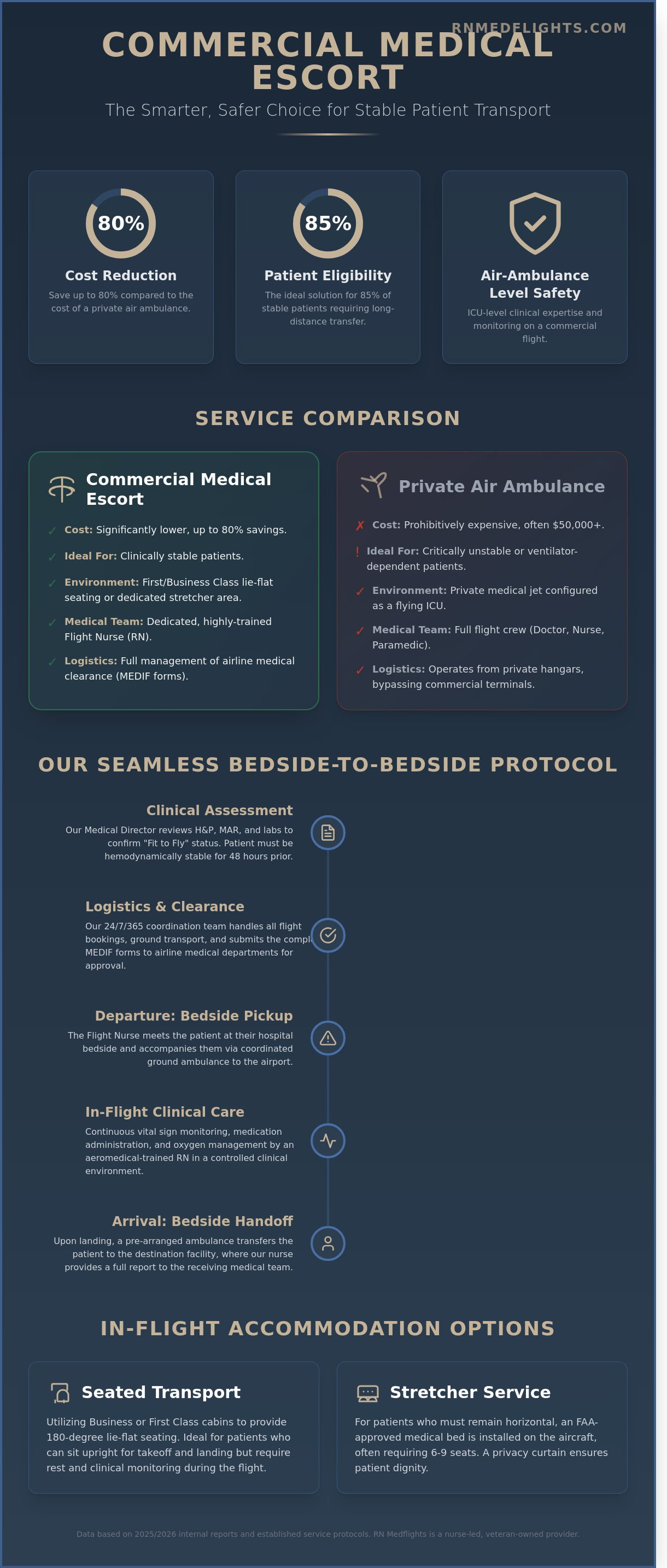
Choosing the right level of care depends on the patient's physical stability and stamina. Seated transport typically utilizes Business or First Class cabins to provide 180 degree lie-flat seating. This is ideal for patients who can sit upright for takeoff and landing but require clinical monitoring during the cruise. For patients who must remain horizontal for the entire journey, international commercial stretcher service is available. This involves a technician removing 6 to 9 rows of seats to install a FAA-approved medical bed and a privacy curtain. A flight coordinator analyzes the patient's most recent 24 hour clinical chart to determine which configuration ensures the highest level of safety. Whether seated or on a stretcher, the focus remains on maintaining the patient's dignity and comfort throughout the transition.
Patient Eligibility and the Medical Clearance Process
Determining if a patient is fit for a medical escort for commercial flight involves more than a cursory glance at a chart. Our Medical Director requires a patient to be hemodynamically stable. This means their heart rate, blood pressure, and oxygen levels must remain within safe, predictable parameters for at least 48 hours prior to transport. We look for a clear clinical trajectory where the physiological stress of cabin pressure, which can mimic altitudes of 8,000 feet, won't trigger a respiratory or cardiac crisis. Safety isn't a suggestion; it's our uncompromising standard.
Families often ask what happens if a loved one’s condition changes hours before departure. We maintain a vigilant, 24/7/365 monitoring protocol. If a patient’s status destabilizes within 24 hours of the flight, our clinical team halts the mission immediately. We don't force a flight that compromises patient integrity. This honest, safety-first approach is why we've maintained a 100% safety record over thousands of flight hours. To begin this rigorous vetting, we require a specific set of documents during the initial consultation:
A History and Physical (H&P) report completed within the last 24 hours.
A current Medication Administration Record (MAR).
Recent laboratory results, specifically focusing on hemoglobin levels above 8.0 g/dL.
The treating physician’s signed discharge summary or "Fit to Fly" letter.
Navigating Airline Medical Departments
Airlines operate specialized medical desks to vet high-needs passengers. Our flight coordinators manage the entire submission of the Medical Information for Fitness to Travel (MEDIF) form. This complex document requires precise clinical data that most families find overwhelming. We handle every technical dialogue with the airline to ensure your loved one is cleared for boarding. This process aligns with CDC guidelines for travelers with chronic illnesses, which emphasize that detailed pre-travel coordination is the only way to prevent mid-air emergencies. Our team acts as the steady hand, managing the bureaucracy so you can focus on your family.
Special Considerations: Dementia, Mobility, and Post-Surgery
Patients with Alzheimer’s or dementia require specialized environmental management to prevent "sundowning" or agitation in a crowded cabin. Our RN escorts utilize proven de-escalation techniques and maintain a calm, dignified atmosphere. For post-surgical patients, we focus on Deep Vein Thrombosis (DVT) prevention, implementing leg exercises and compression protocols every 2 hours. If a patient is oxygen-dependent, we facilitate the use of FAA-approved Portable Oxygen Concentrators (POCs). We ensure battery life exceeds the total flight duration by 150% to account for any unexpected ground delays. If you're unsure about your loved one's specific needs, our coordinators can provide a preliminary clinical review to determine the best path forward.
The Logistics of Bed-to-Bed Medical Transport
A seamless journey requires more than just a ticket; it demands a rigorous, five-step clinical protocol. At RN Medflights, we view the bedside-to-bedside promise as a sacred commitment to continuity. The process begins with a comprehensive clinical assessment at the origin facility. Our flight coordinators review the patient’s latest 24-hour vitals and physician notes to secure medical clearance. This data ensures the patient is stable enough for high-altitude travel and allows us to prepare the necessary medications and equipment.
Ground Ambulance Coordination
Data suggests that nearly 65% of transport-related complications occur during the transition between a facility and the airport. This makes ground transport the most vulnerable phase of the trip. We mitigate this risk by syncing ground ambulance arrivals with precise flight windows, ensuring the patient doesn't wait on a drafty tarmac or in a crowded terminal. The medical escort for commercial flight remains at the patient's side during the entire transfer, maintaining a steady chain of care. We coordinate with local Advanced Life Support (ALS) teams to ensure the patient moves with dignity and clinical oversight. This isn't just a ride; it’s a clinical bridge where oxygen levels and cardiac rhythms are monitored without interruption.
Airport Navigation and Security
Navigating a busy terminal requires a steady hand and quiet confidence. We utilize "wheelchair assist" and, when available, private lounge access to keep the patient in a calm, temperature-controlled environment away from the general public. Our nurses are experts in the 2026 TSA guidelines for medical equipment. We contact TSA Cares at least 72 hours before departure to arrange for specialized screening of medical devices. This protocol includes:
Device Clearance: Pre-verifying portable oxygen concentrators (POCs) for FAA compliance.
Discreet Screening: Managing the inspection of PICC lines, monitors, and insulin pumps to avoid physical stress.
Layover Management: Ensuring the patient remains hydrated and comfortable during any necessary connections.
Once at the gate, we utilize priority boarding to settle the patient before the main cabin fills. During the flight, the nurse provides active clinical management, including medication administration and vital sign monitoring every 30 to 60 minutes. The journey concludes only when a formal hand-off occurs at the receiving facility or the patient's home. We deliver a detailed clinical report to the next care team, ensuring the transition is as seamless as the flight itself. Our 24/7/365 operations center tracks every mile, providing families with real-time updates. This level of detail is why a specialized medical escort for commercial flight is the safest choice for long-distance recovery.
Cost Analysis: Commercial Escort vs. Private Air Ambulance
Families often feel overwhelmed by the financial weight of medical repatriation during a crisis. Choosing a medical escort for commercial flight typically reduces expenses by 60% to 80% compared to a private medevac jet. While a private air ambulance might cost $40,000 for a domestic relocation, a commercial escort usually ranges between $5,000 and $12,000. This comprehensive price includes the airline tickets for the patient and the nurse, professional clinical fees, ground ambulance coordination, and necessary medical equipment like portable oxygen concentrators or cardiac monitors.
Several factors influence the final quote, including the distance traveled and the specific level of care required. Our flight coordinators provide a transparent breakdown of these costs to ensure there are no surprises. We focus on bedside-to-bedside responsibility, meaning the price covers every transition from the sending facility to the final destination. Most insurance providers consider these services an out-of-pocket expense, though our team can provide the documentation needed to seek potential reimbursement from long-term care policies.
Why Private Air Ambulances Are Often Overkill
Private medevac jets are vital for patients who are hemodynamically unstable or require intubation. For many others, a private jet is an unnecessary expense. A first-class or business-class cabin on a commercial airline provides a clinical environment that is often superior in terms of space and comfort. With lie-flat seating and 70+ inches of pitch, the patient receives high-quality care in a dignified setting. You can learn more about the specific differences in our guide on medevac jet vs commercial medical escort options to see which fits your needs.
Calculating the ROI of Peace of Mind
The return on investment for a medical escort for commercial flight extends beyond the initial invoice. If an unescorted patient suffers a medical emergency mid-flight, the airline may divert the aircraft to the nearest suitable airport. These diversions can cost the family between $20,000 and $150,000 in airline fees and emergency ground care. By having a registered nurse present, you mitigate these risks through constant monitoring and immediate intervention.
Domestic Repatriation: Typically ranges from $5,000 to $12,000.
International Repatriation: Usually falls between $15,000 and $25,000.
Logistics Management: Our team handles all airline medical clearances, saving families dozens of hours of administrative stress.
Our clinical staff is available 24/7/365 to discuss your specific situation and provide a precise estimate. We believe that professional medical travel should be accessible without compromising on safety or clinical excellence.
Choosing the Right Medical Escort Provider
Selecting a medical escort for commercial flight is a decision that impacts both patient safety and family peace of mind. You'll find two primary types of providers in this industry: clinical organizations and logistics brokers. Brokers often lack the medical infrastructure to handle emergencies; they act as middlemen who outsource care to independent contractors. RN MEDflights operates differently. We're a nurse-led organization where clinical leadership guides every logistical choice. This structure ensures that the person planning your flight understands the physiological impacts of cabin altitude and the complexities of acute medication management.
Integrity is the cornerstone of our operations. As a veteran-owned business, we bring a disciplined, mission-first approach to every transport. We maintain 24/7/365 availability because medical crises don't follow a standard schedule. Whether it's a holiday or a weekend, our global repatriation team is ready to respond within hours. Our commitment to uncompromising safety involves a rigorous multi-step verification process. In 2026, we updated our protocols to include a 12-point clinical risk assessment for every passenger. This ensures that every medical escort for commercial flight mission meets the highest standards of critical care nursing.
The RN MEDflights Difference
Our signature "bed-to-bed" promise means we take full responsibility for the patient's entire journey. We don't just meet you at the airport terminal. We manage the transition from the hospital bed to the ground ambulance, through security, and into the receiving facility at the destination. This seamless continuity is essential for successful long distance medical transport. Our RN flight coordinators are available now to provide a free clinical assessment and help you understand the best options for your family's specific situation.
Preparing for Your Flight: Next Steps
The first 24 hours after booking are the most critical for coordination. During this window, our team completes several vital tasks to ensure a smooth journey:
Securing official medical clearance from the airline's specific medical department.
Coordinating specialized ground transportation at both the origin and destination cities.
Assigning a dedicated flight nurse with the specific clinical background, such as ICU or ER experience, required for the patient's condition.
Communication remains our priority throughout the mission. We provide families with regular status updates during the transport process, offering a steady hand during a stressful time. To begin the process, Request a Quote for Medical Flight Transport and let our experts handle the logistics, so you can focus on your loved one's recovery.
Planning Your Safe Transition Home
Navigating the logistical hurdles of a cross-border medical transfer requires more than just a plane ticket. It demands a clinical strategy that prioritizes patient dignity and safety at every altitude. Selecting a medical escort for commercial flight provides a sophisticated, cost-effective alternative to private air ambulances, typically reducing total transport expenses by 50 to 70 percent without compromising on care quality. Our veteran-owned and operated team delivers 100 percent bed-to-bed clinical continuity. This means a specialized Registered Nurse manages every phase of the journey, from the initial bedside discharge to the final arrival at the destination facility.
We leverage our deep expertise in international repatriation to manage the rigorous 2026 medical clearance protocols required by major global airlines. You don't have to navigate these complex decisions in isolation. Our flight coordinators remain available 24/7/365 to provide the professional clarity and calm your family needs during this high-stress period. We're here to ensure your loved one returns home with the uncompromising care they deserve.
Speak with a Flight Coordinator Now for a Free Medical Assessment
Frequently Asked Questions
Is a medical escort for a commercial flight the same as an air ambulance?
No, a medical escort for a commercial flight isn't the same as a private air ambulance. While an air ambulance provides a dedicated ICU environment on a private jet, our escort service utilizes commercial airlines, which often saves families between 60% and 75% in total transport costs. We provide a specialized Registered Nurse to manage care in First or Business Class, ensuring a seamless bedside-to-bedside transition for stable patients.
What medical equipment can a flight nurse bring on a commercial plane?
Our flight nurses carry a specialized kit of FAA-approved medical equipment tailored to the patient's specific needs. This typically includes a portable oxygen concentrator like the Inogen One G5, an automated external defibrillator, and a Welch Allyn ProBP 3400 digital blood pressure monitor. We also manage all necessary medications and emergency supplies to maintain clinical stability throughout the journey. It's a standard of care that prioritizes safety without the need for a private jet.
How far in advance do I need to book a medical escort for an international flight?
You should ideally book an international medical escort 7 to 10 days before your desired departure date. This timeframe allows our flight coordinators to secure airline medical clearance, which involves a 48-hour review process by carrier physicians. For urgent situations, our 24/7/365 intake team can often expedite domestic arrangements within 48 to 72 hours, though international logistics require more rigorous coordination to ensure a stress-free experience.
Can family members fly on the same commercial flight as the patient and escort?
Yes, family members can and often do fly on the same aircraft as the patient and our medical team. We encourage 1 or 2 relatives to travel nearby to provide emotional support while our RN manages all clinical responsibilities. Our flight coordinators handle these ticketing logistics simultaneously. This ensures your family remains together from the initial bedside pickup until the final arrival at the destination facility.
What happens if the flight is delayed or cancelled during a medical transport?
If a flight is delayed or cancelled, your RN medical escort remains with the patient at all times to provide continuous care. We maintain a 24/7/365 operations center that immediately reroutes travel or secures local medical-grade accommodations if an overnight stay is required. Our bedside-to-bedside promise means we don't leave the patient's side until they're safely admitted to their final destination. You won't have to manage these logistics alone.
Does a medical escort provide care for dementia or Alzheimer’s patients?
Yes, we specialize in transporting patients with cognitive impairments, including dementia and Alzheimer's disease. Statistics show that 40% of our commercial transports involve patients who require specialized behavioral management and redirection during travel. Our RNs use proven de-escalation techniques and clinical protocols to ensure the patient remains calm and dignified. We handle every detail to minimize the agitation often caused by changing environments.
Are medical escort services covered by Medicare or private health insurance?
Medicare Part B currently covers 0% of non-emergency medical escort for commercial flight services, as they're classified as pre-scheduled transports. However, some private policies from providers like Blue Cross Blue Shield may reimburse costs if the transport is deemed medically necessary by a physician. We provide detailed clinical documentation and itemized coding to help families pursue these claims. Our team works to make the financial process as transparent as possible.
What are the physical requirements for a patient to fly commercially with an escort?
A patient must be hemodynamically stable and capable of sitting upright at a 45-degree angle during takeoff and landing. We conduct a comprehensive clinical assessment 24 hours before the flight to verify the patient's oxygen saturation levels are above 92% on supplemental flow. If a patient is completely bed-bound, we can often arrange a commercial stretcher configuration on specific international carriers. It's our job to determine the safest seating arrangement for the patient's condition.


