


Medical Flight Transport: A 2026 Guide to Commercial Escort Logistics & Costs
- Apr 3
- 12 min read
If you believe that a safe medical flight transport requires a $45,000 private air ambulance, you're likely overspending by more than double. For many families, the shock of a six figure medevac quote feels like a dead end during a high stress medical crisis. You already know that coordinating a long distance transfer is a logistical minefield. You're likely worried about complex airline medical clearances, continuous oxygen requirements, and the physical safety of your loved one during a ten hour journey.
At RN Medflights, we believe clinical excellence shouldn't be defined by the size of the aircraft. This 2026 guide reveals how you can secure professional, nurse led medical flight transport on commercial airlines while saving 50% to 70% compared to private charters. We'll walk you through our specialized bedside to bedside process, explaining how our flight coordinators manage every detail from ground ambulance synchronization to in flight clinical monitoring. You'll learn exactly how we provide a seamless, stress free journey that prioritizes patient dignity and your peace of mind.
Key Takeaways
Discover how to achieve significant cost savings of 50-70% by utilizing commercial airline escorts without compromising clinical safety.
Learn why specialized RN-led oversight is essential for managing complex medication and oxygen needs during non-emergency relocations.
Identify the specific logistical and clinical factors that influence the total cost of medical flight transport in 2026.
Master the bedside-to-bedside coordination process to ensure a stress-free transition between medical facilities and ground ambulances.
Find out how a nurse-centric, veteran-owned approach provides the steady hand and professional expertise needed during high-stress medical crises.
Table of Contents Evaluating Medical Flight Transport: Commercial vs. Private Air Ambulance The Clinical Standard: Why RN-Led Transport Matters Calculating the Cost of Medical Transport Services in 2026 The Bedside-to-Bedside Process: A Seamless Journey Choosing RN MEDflights for Your Medical Relocation
Evaluating Medical Flight Transport: Commercial vs. Private Air Ambulance
Selecting the appropriate medical flight transport depends on a precise clinical assessment and a clear understanding of 2026 aviation logistics. Families often find themselves at a crossroads, choosing between the comprehensive care of a private air ambulance and the cost-effective efficiency of a commercial medical escort. The primary distinction rests on the patient's stability and the level of life-support equipment required during the journey.
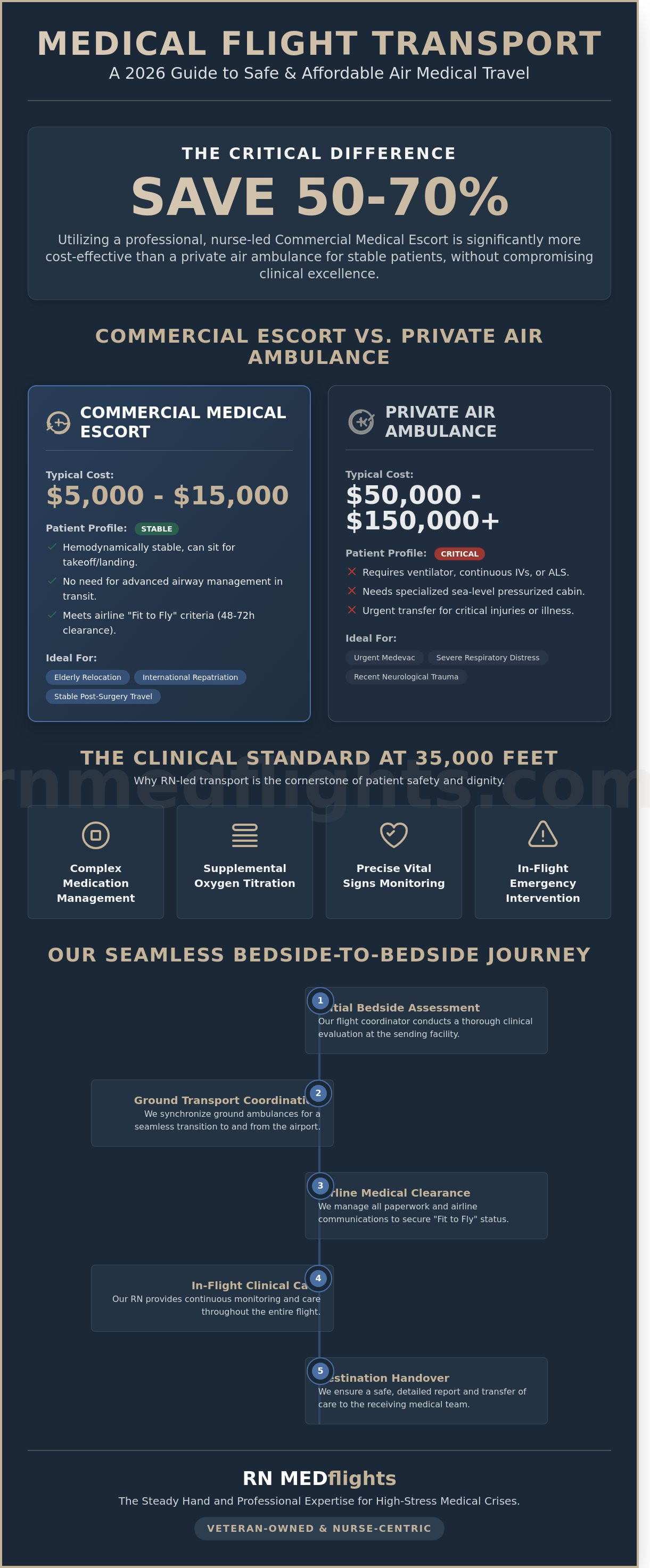
Clinical requirements serve as the ultimate guide for this decision. If a patient is stable, can sit for takeoff and landing, or meets the criteria for an international commercial stretcher, the commercial route is often the most logical choice. This service involves a Registered Nurse or a specialized medical team accompanying the patient on a standard airline flight, managing medications, and providing bedside-to-bedside care. For patients who cannot sit upright, the commercial stretcher service is a specialized 2026 solution. It involves blocking off six to nine seats on an international aircraft to accommodate a medical stretcher system and a privacy curtain, providing a clinical environment within a commercial cabin.
When to Choose a Commercial Medical Escort
Commercial escorts are the gold standard for elderly relocation, international repatriation, and stable post-surgery travel. In 2026, major airlines have streamlined the "fit to fly" clearance process, allowing our flight coordinators to secure medical clearance in as little as 48 to 72 hours. Families favor this option for the significant cost savings. A commercial escort typically costs between $5,000 and $15,000, which is a fraction of the $50,000 to $150,000 required for private jets. To qualify, the patient must be hemodynamically stable and not require advanced airway management during transit.
The Private Air Ambulance Alternative
Critical care demands a different level of intervention. A private air ambulance is a necessity for patients requiring ventilators, continuous IV infusions, or advanced life support (ALS). These aircraft feature specialized pressurized cabins that can be adjusted to sea-level pressure; this is vital for patients with respiratory distress, pneumothorax, or recent neurological trauma. While the investment is higher, the speed and flexibility of a dedicated medevac jet are unmatched for urgent transfers. Once a patient is stabilized at a receiving facility, our team frequently facilitates a transition to a commercial escort for the final leg of their journey home. Our nurse-led team remains available 24/7/365 to evaluate these transitions, ensuring patient dignity and safety remain the uncompromising priority throughout the entire process.
The Clinical Standard: Why RN-Led Transport Matters
The role of a flight nurse in non-emergency medical flight transport is defined by clinical vigilance. These professionals bridge the gap between hospital care and home recovery while cruising at 35,000 feet. Unlike a general travel aide, a registered nurse brings the ability to manage complex medication schedules, titrate supplemental oxygen, and monitor vital signs with precision. This level of oversight is vital because altitude changes can trigger physiological shifts that require immediate intervention. Our nurses are trained to recognize these subtle changes before they become crises.
When a family chooses a nurse-led escort, they're securing a specialized advocate. This professional handles every clinical detail from the initial bedside assessment to the final destination. If an in-flight emergency occurs, the nurse is trained to stabilize the patient and communicate directly with the airline's ground-based medical support. This seamless continuity of care ensures that the patient's dignity and safety remain the top priorities throughout the entire journey. It's about providing a steady hand in an environment that's often unpredictable.
Specialized Care for Complex Conditions
Managing specific health challenges requires a deep understanding of aeromedical physiology. For families flying with dementia patients or those with Alzheimer's, the flight nurse uses 2026-standard sensory reduction techniques to prevent agitation in crowded terminals. Post-operative patients receive expert wound care and circulation management to prevent deep vein thrombosis; a risk that increases by approximately 3% for every two hours spent in flight without movement. For respiratory cases, the nurse manages the logistics of FAA-approved Portable Oxygen Concentrators (POCs), ensuring battery life is calculated for 150% of the total travel time to account for unforeseen delays.
Aviation Medical Clearance & Logistics
The logistical burden of medical flight transport often overwhelms families during a crisis. Our flight nurses take charge by coordinating with airline medical departments to secure "MEDIF" (Medical Information for Fitness to Travel) forms. This process usually requires 48 to 72 hours of lead time and specific clinical documentation. They guide patients through TSA checkpoints using expedited medical protocols for equipment and life-sustaining medication. If a flight is diverted or delayed, the nurse remains the constant, professional presence, advocating for the patient's needs and adjusting care plans in real-time. You can speak with a flight coordinator to learn how these logistics are managed for your specific route.
Calculating the Cost of Medical Transport Services in 2026
Understanding the financial investment required for medical flight transport involves a look at three primary cost drivers. First, specialized nurse staffing accounts for 40% of the total quote, ensuring a clinical professional is present for every mile. Second, airline ticketing and specialized luggage fees for medical equipment are calculated at current 2026 market rates. Third, ground logistics cover the secure transfer between hospitals and airports. Our flight coordinators provide a transparent breakdown to ensure families aren't surprised by hidden fees.
Quotes fluctuate based on the patient's clinical acuity and the required lead time. Booking a transport with at least 14 days of notice can reduce costs by 18% compared to emergency requests. Families must remain vigilant against 'budget' providers. These quotes often omit the 15% surcharge for ground ambulance wait times or the cost of oxygen refills during layovers. Investing in professional coordination provides a significant return. Data from 2025 indicates that nurse-led escorts reduce the risk of hospital readmission within the first 48 hours by 12%. It's a steady hand in a complex system.
Clinical Staffing: Based on the level of care required (BLS vs. ALS).
Logistics: Bedside-to-bedside coordination including all ground permits.
Lead Time: Rates are most stable when booked 10 to 14 days in advance.
Insurance and Financial Assistance
Most private insurance providers view commercial escorts as a cost-saving alternative to air ambulances, but coverage varies. Medicare generally doesn't cover non-emergency med transportation services unless specific criteria are met. To increase reimbursement chances, we assist families in documenting medical necessity through detailed physician letters. Additionally, under IRS Publication 502, many medical travel expenses remain tax-deductible if the primary purpose is receiving essential healthcare. Our team remains available 24/7/365 to provide the documentation your adjusters require.
The Commercial vs. Private Price Gap
Choosing a commercial escort over a private air ambulance saves families an average of $30,000 per mission. This massive price gap exists because we leverage bulk airline ticketing and established global partnerships to lower costs. A comprehensive medical transport service quote from RN Medflights includes value-added services like medication management and hygiene care. We use our RN leadership to ensure that while the cost is lower, the clinical integrity remains uncompromising. We manage every detail, from ticket upgrades for patient comfort to navigating TSA medical clearances, ensuring a seamless transition from one facility to the next.
The Bedside-to-Bedside Process: A Seamless Journey
The logistics of medical flight transport require a level of precision that leaves no room for error. At RN Medflights, we view the journey as a single, continuous clinical event rather than a series of disconnected travel segments. This "bedside-to-bedside" philosophy ensures that the patient remains under the direct care of a specialized Registered Nurse from the moment they leave their current room until they're safely settled into their new destination. Our process is designed to absorb the logistical burden, allowing families to focus on their loved one's recovery while we manage the complex intersections of aviation and healthcare.
Step 1: Clinical Intake & Logistics
The process begins with an exhaustive clinical assessment. Our flight coordinators review the patient's medical records, often spanning 20 or more pages of recent notes, to confirm stability for travel. We handle the heavy lifting of securing "fit to fly" letters from attending physicians and coordinating with hospital case managers. Our team selects the optimal flight path based on the patient's specific needs, prioritizing airlines that offer 42-inch seat pitches or lie-flat seating for maximum comfort. We finalize every detail of the discharge, ensuring that medications and oxygen requirements are synchronized with the 08:00 or 14:00 departure windows typical for international routes.
Step 2: The Travel Day
On the day of transport, our RN arrives at the patient’s bedside at least 60 minutes before the scheduled ground transfer. This allows for a final clinical assessment and a warm introduction to the family. We manage the entire transition, including:
Ground Coordination: We supervise the private ground ambulance transfer from the hospital to the airport tarmac or terminal.
Priority Handling: Our team utilizes pre-arranged priority boarding to bypass crowded gates, reducing the patient's stress and exposure to pathogens.
In-Flight Clinical Care: The nurse monitors vital signs every 30 minutes, manages hydration, and administers medications using a customized 12-point care plan.
Our nurses are trained to remain calm and decisive, providing a steady hand if the patient experiences anxiety or physical discomfort during altitude changes. We treat every patient with the dignity they deserve, ensuring their journey is as quiet and restful as possible.
Step 3: Arrival and Continuity
The mission doesn't end when the wheels touch the ground. We navigate the complexities of customs and immigration for international repatriations, often clearing these hurdles 30% faster due to our pre-filed medical manifests. A dedicated ground ambulance meets us at the arrival gate for the final leg of the journey. Once at the receiving facility or home, our RN provides a comprehensive verbal and written hand-off to the new care team. We follow up with a detailed post-trip report for the family within 24 hours, ensuring total transparency and peace of mind. For a personalized assessment of your needs, you can request a medical flight transport quote from our 24/7/365 flight coordination team.
Choosing RN MEDflights for Your Medical Relocation
Choosing a provider for medical flight transport is a decision rooted in trust and the need for clinical certainty. Our organization is veteran-owned and operated, bringing a legacy of military precision and uncompromising integrity to every mission we undertake. This background ensures that every logistical detail, from ground ambulance synchronization to airline ticketing, is executed with absolute accuracy and a commitment to service that never wavers.
The RN MEDflights difference lies in our nurse-centric leadership. Unlike companies managed solely by logistics coordinators, our operations are directed by medical professionals who understand the physiological challenges of high-altitude travel. We're available 24/7/365 to answer your calls, providing a steady hand during what's often a family's most stressful hour. Our experience isn't limited by borders; we've successfully managed international repatriations across six continents and more than 45 countries, ensuring patients return home safely regardless of where they are in the world.
Our Commitment to Safety and Dignity
Safety isn't a vague goal; it's a measurable standard. We employ a 5-point vetting process for every flight nurse escort, requiring a minimum of five years of critical care or emergency room experience. This clinical depth allows our team to manage complex needs during a long distance medical transport without hesitation or delay.
Maintaining patient dignity in public commercial environments is equally vital to our mission. We use discreet medical equipment and coordinate with airline ground staff for priority, private boarding whenever possible. Our nurses act as vigilant protectors, ensuring the patient's privacy is respected while maintaining the highest standards of clinical excellence. This bedside-to-bedside approach means we don't just meet you at the airport; we stay with the patient from the originating facility until they're safely settled at their final destination.
Ready to Start the Process?
Coordination begins with a comprehensive clinical assessment. To provide a fast and transparent quote, please have the patient's current diagnosis, mobility status, and oxygen requirements ready for our flight coordinators. We don't believe in hidden fees or surprise costs. Our quotes are all-inclusive, covering every aspect of the journey including ground transport, airline coordination, and clinical staffing.
Timing is critical in medical flight transport. Domestic missions typically require 24 to 48 hours of lead time to arrange, while international relocations usually take 3 to 5 days to secure necessary medical clearances and international permits. Our team handles all the paperwork and airline medical desk approvals, allowing your family to focus on support and recovery. Request your free medical flight transport quote today and let our experts manage the journey home with the care your loved one deserves.
Secure Your Patient’s Path to Specialized Care
Navigating the logistics of medical flight transport requires a partner who understands that every detail impacts patient safety. As we move through 2026, the data shows that commercial medical escorts can reduce relocation costs by 40% to 60% compared to private air ambulances, provided the patient meets specific clinical criteria. Our veteran-owned and operated team delivers a standard of excellence rooted in registered nurse-led clinical teams. We manage the entire bedside-to-bedside journey, coordinating with at least 2 medical facilities and ground transport providers to ensure comprehensive coordination. Our flight coordinators remain available 24/7/365 to provide the global availability and expert answers your family needs. You don't have to face this medical crisis without an expert advocate by your side. We're here to provide the clinical precision and human compassion required to bring your loved one home safely. Take the first step toward a stress-free relocation today.
You're in capable hands, and we're ready to guide you through every mile of the journey.
Frequently Asked Questions
What exactly is included in a medical flight transport service?
Medical flight transport includes comprehensive bedside-to-bedside care that manages every detail of the patient's journey. Our team coordinates ground ambulances at both ends, handles airline medical clearances, and provides a dedicated Registered Nurse for the entire trip. This 100% continuity ensures that the patient's clinical needs are met without any gaps in care, providing families with total peace of mind during the transition.
How much does a medical escort on a commercial flight cost compared to an air ambulance?
A commercial medical escort typically costs between $15,000 and $30,000, which is significantly more affordable than a private air ambulance. Private jets often start at $100,000 for domestic routes and can exceed $250,000 for international flights. By utilizing commercial airlines, we reduce your financial burden by 70% while maintaining the highest level of clinical supervision and safety throughout the process.
Can a patient fly on a commercial airline if they cannot sit up?
Yes, patients who cannot remain upright can still travel via a commercial stretcher service on specific international carriers. This specialized setup requires the airline to remove 6 to 9 seats in the economy cabin to install a secure, FAA-approved stretcher system. Our flight coordinators manage these complex arrangements, ensuring the patient remains supine and comfortable while receiving continuous monitoring from their assigned medical professional.
Does insurance typically cover non-emergency medical flight transport?
Insurance providers rarely cover non-emergency medical flight transport, with less than 5% of claims receiving full reimbursement in 2025. Most policies classify these transfers as "convenience-based" rather than medically necessary for life-saving intervention. We recommend families consult their specific policy documents, as 95% of our clients pay through personal resources or specialized medical financing options to ensure immediate care.
How do you handle medical emergencies during a commercial flight?
Our flight nurses are trained to manage acute medical emergencies using Advanced Life Support protocols and specialized portable equipment. If a patient experiences a cardiac or respiratory event at 35,000 feet, the RN utilizes pre-approved medications and diagnostic tools to stabilize the individual. We maintain a direct communication link with 24/7/365 ground-based medical directors who provide real-time physician oversight during any critical clinical situation.
What medical equipment can a flight nurse bring on a commercial plane?
A flight nurse carries a comprehensive kit that includes FAA-approved portable oxygen concentrators, cardiac monitors, and emergency medications. These kits are specifically designed to meet the strict weight and battery requirements of commercial aviation. We ensure every piece of equipment, from the pulse oximeter to the IV pump, is tested and certified to function safely in a pressurized cabin environment during the transport.
How far in advance do I need to book a medical escort?
You should book a medical escort at least 7 to 10 days before the desired travel date. This window allows our flight coordinators to secure the necessary medical clearances from the airline's physician team and finalize logistical details. While we can occasionally arrange transport in as little as 48 to 72 hours, the extra lead time ensures the most cost-effective fares and optimal seating arrangements.
Is medical flight transport available for international repatriation?
We provide international repatriation services across 190 countries to assist patients in returning home safely. Our team manages the entire process, including securing international visas, coordinating with foreign hospitals, and navigating customs requirements. Whether the patient is in London or Tokyo, we ensure a seamless transition back to their home country with a focus on clinical integrity and patient dignity.


