


Non-Emergency Patient Transport Options: A Comprehensive Guide for 2026
- 5 days ago
- 12 min read
Updated: 1 day ago
The most expensive medical flight isn't always the safest choice for a stable patient. While a private air ambulance quote can easily exceed $25,000 for a domestic trip, many families don't realize that commercial medical escorts often provide the same clinical safety for a fraction of that cost. We understand the heavy emotional weight of this decision. You want your loved one moved to a specialized facility, but the fear of a medical complication during transit feels overwhelming. Evaluating your non-emergency patient transport options shouldn't feel like a choice between financial strain and patient safety.
It's true that the logistics of medical travel are complex, but they don't have to be confusing. This guide clarifies the different levels of care available in 2026, from ground transport to our signature bedside-to-bedside commercial flight coordination. You'll learn how specialized nursing teams maintain clinical integrity without the need for a private jet. We'll break down the realities of insurance coverage and show you how to secure a seamless, stress-free journey. This roadmap provides the clinical clarity you need to move your family member with absolute confidence and peace of mind.
Key Takeaways
Distinguish between emergency 911 services and NEMT to ensure your loved one receives the appropriate level of specialized medical supervision and care.
Evaluate the most efficient non-emergency patient transport options by weighing distance, medical acuity, and budget through our expert selection framework.
Discover how professional commercial medical escorts provide a sophisticated and cost-effective alternative to private air ambulances for long-distance relocation.
Utilize our comprehensive provider checklist to navigate the logistics of medical travel with absolute confidence and clinical precision.
Learn the advantages of a nurse-centric, bedside-to-bedside protocol that guarantees a seamless transition and a single point of accountability throughout the journey.
Table of Contents What is Non-Emergency Patient Transport (NEMT)? Ground-Based Transport Options: When to Stay on the Road Air-Based Transport Options: Commercial Escorts vs. Private Air Ambulances Selection Framework: How to Choose the Right Patient Transport The RN MEDflights Advantage: Seamless Long-Distance Relocation
What is Non-Emergency Patient Transport (NEMT)?
Non-emergency patient transport (NEMT) is a specialized service designed for individuals who require medical support or supervision during travel but aren't facing an immediate, life-threatening crisis. Unlike 911 emergency services, which focus on rapid intervention and stabilization during acute trauma, NEMT prioritizes a controlled, seamless journey between clinical settings. It's a vital component of the broader patient transport ecosystem, ensuring that those with chronic conditions or mobility challenges can access care without compromising their safety.
To utilize these non-emergency patient transport options, a patient must meet the requirement of clinical stability. This means they're hemodynamically stable, with heart rates, blood pressure, and respiratory levels that aren't in active flux or crisis. We focus on maintaining this stability through bedside-to-bedside care. This protocol is the gold standard for patient safety. It means our clinical team takes full responsibility from the moment they meet the patient in their current room until they're safely transferred to their destination bed, eliminating the risks associated with uncoordinated handoffs.
Common Scenarios for Non-Emergency Transport
Families often seek professional transport during pivotal transitions in a loved one's care. Data from 2024 healthcare logistics reports show that hospital discharges to skilled nursing facilities or home care remain the most frequent drivers of NEMT. Other common scenarios include:
Relocating an elderly parent across the country to be closer to family members who can provide daily support.
Transporting patients to receive specialized treatments, such as advanced oncology care or clinical trials, in distant cities.
Moving a resident between long-term care facilities to access specific memory care or rehabilitation services.
The Role of Clinical Supervision in NEMT
Even when a situation isn't an emergency, clinical supervision is essential for peace of mind and physical safety. A licensed professional, such as a Registered Nurse or Paramedic, provides more than just a watchful eye. They're trained to monitor vital signs, manage complex medication schedules, and handle the mid-journey anxiety that often accompanies medical travel. This level of expertise is what distinguishes a professional medical escort service from a simple travel companion.
Our nurse-centric approach ensures that the patient is viewed with dignity and compassion rather than as a logistical task. By providing 24/7/365 coordination, we ensure these non-emergency patient transport options remain a reliable lifeline for families. The presence of a clinician ensures that any subtle change in a patient's condition is identified and managed immediately, maintaining the integrity of the care plan throughout the entire journey.
Ground-Based Transport Options: When to Stay on the Road
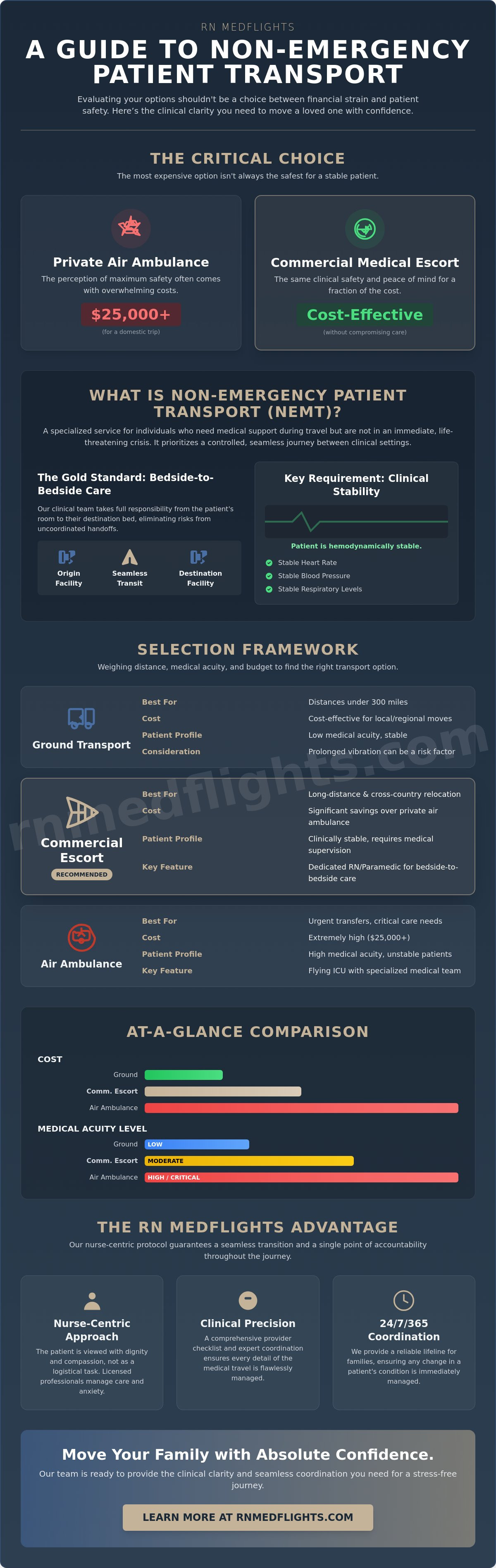
Ground transport remains the primary solution for patient transfers involving distances under 300 miles. It offers a predictable, cost-effective way to move patients between rehabilitation facilities, private residences, or specialized clinics. Choosing the correct non-emergency patient transport options depends heavily on the patient's level of mobility and the clinical supervision required during the trip. While road travel is convenient for local needs, the physical impact of prolonged vehicle vibration and sitting can become a risk factor for patients with specific orthopedic or cardiovascular conditions. Our clinical team prioritizes a thorough assessment to ensure the route and vehicle type align with the patient’s safety needs.
For many families, ground logistics are the first point of contact with medical transit. These services provide a bridge to care that would otherwise be inaccessible. Access to these services is often facilitated through the Medicaid NEMT benefit, which supports millions of individuals in reaching essential appointments. This infrastructure ensures that logistical barriers don't prevent a patient from receiving life-sustaining treatments like dialysis or chemotherapy.
Ambulatory and Wheelchair Van Services
Ambulatory transport is designed for patients who can walk and sit upright but require professional assistance with logistics and safety. This service is significantly more cost-efficient than specialized medical coaches, making it ideal for routine local appointments. For family members or highly stable individuals seeking a premium, non-medical experience, Sedanz offers executive-level chauffeured transportation as a reliable alternative for local travel. For those who cannot transfer from a chair, wheelchair vans are equipped with hydraulic lifts and ISO-certified securement systems. These vehicles allow the patient to remain in their own wheelchair, maintaining their dignity and comfort while ensuring they're safely locked into the vehicle's chassis during transit.
Long-Distance Medical Coaches and Ground Ambulances
The medical coach model serves as a specialized alternative for multi-state travel. These modified vehicles function like mobile clinical suites, featuring hospital-grade beds, onboard restrooms, and kitchenettes to accommodate long durations. However, when a patient is bed-bound or requires continuous oxygen therapy, a non-emergency ambulance service is the industry standard. These Basic Life Support (BLS) units are staffed by professionals who monitor vitals and manage the patient’s stability throughout the drive.
Ground transport reaches its practical limit when a journey exceeds 24 hours or 300 miles. Beyond these markers, the fatigue of road travel can compromise a patient's recovery. If your move involves crossing several time zones or requires an uncompromising level of clinical speed, our expert flight coordinators are available 24/7/365 to discuss whether an air-based solution might offer better peace of mind.
Air-Based Transport Options: Commercial Escorts vs. Private Air Ambulances
Choosing between different non-emergency patient transport options often forces families to weigh financial constraints against clinical safety. For long-distance relocations, especially those spanning over 500 miles or crossing international borders, air travel provides the most stable environment. It minimizes the physical exhaustion associated with extended ground travel. While families often assume a private jet is the only way to move a patient by air, more cost-effective, medically sound alternatives exist for stable individuals.
Commercial Airline Medical Escorts
A commercial medical escort is a specialized service where a highly trained flight nurse or paramedic accompanies the patient on a standard airline flight. This option typically utilizes first-class or business-class seating to ensure the patient remains comfortable and receives continuous monitoring. It's a bedside-to-bedside service that maintains clinical continuity from the sending facility to the final destination.
Logistical coordination is the backbone of this service. A dedicated flight coordinator manages every detail, including:
Securing airline medical clearance (MEDIF forms).
Coordinating supplemental oxygen and FAA-approved battery-powered equipment.
Arranging ground ambulance transfers at both ends of the journey.
Managing TSA notifications to ensure a dignified and stress-free security process.
For patients who cannot sit upright for the duration of the flight, some international carriers allow for commercial stretcher services. This involves removing several rows of seats to install a FAA-approved stretcher and privacy curtain. Choosing a commercial escort or stretcher service can reduce the financial burden by 50% to 70% compared to a dedicated medevac jet, making it a viable solution for families managing long-term care budgets.
Private Air Ambulances (Medevac)
Private air ambulances are mandatory when a patient's condition is unstable or requires intensive care. These aircraft function as flying ICUs. They carry advanced life support equipment including ventilators, cardiac monitors, and specialized medication pumps. This is the gold standard for non-emergency patient transport options when the patient is ventilator-dependent or requires continuous IV medication titration.
The high cost of private aviation stems from the dedicated flight crew, fuel, and the specialized medical team required 24/7/365. Families should reserve this option for critical needs or when commercial airline schedules don't align with the urgency of the transfer. Private jets offer unmatched flexibility; they can fly into smaller regional airports and depart on the family's schedule. This level of control provides peace of mind when dealing with complex clinical timelines or extreme patient fragility.
Selection Framework: How to Choose the Right Patient Transport
Choosing between various non-emergency patient transport options requires a structured approach to ensure clinical integrity and patient comfort. We recommend a three pillar framework focused on Distance, Medical Acuity, and Budget. A 2,000 mile journey across state lines requires vastly different resources than a 50 mile local transfer. Similarly, a stable patient moving to a skilled nursing facility has different requirements than one requiring continuous cardiac monitoring or advanced respiratory support. Decisions made during this phase directly impact the safety and "peace of mind" of the family involved.
Clinical continuity is the most vital component of a successful transfer. We prioritize bedside-to-bedside care because it eliminates the risks associated with multiple handoffs. Industry data suggests that nearly 80 percent of serious medical errors occur during transitions of care. By ensuring a single clinical professional remains with the patient from their current room to their final destination, we maintain a seamless environment that protects the patient's dignity and health. For those facing a medical crisis outside their home country, international medical repatriation services provide a critical lifeline, managing complex customs logistics and language barriers while providing ICU level care.
Assessing the Patient’s Clinical Needs
Start by evaluating the patient's physical and cognitive limitations. Can the patient sit in a standard seat for 4 or more hours? If they can't, a stretcher based transport is necessary to prevent pressure ulcers or extreme fatigue. Does the patient require continuous oxygen or IV medications? These needs dictate the level of nurse staffing and equipment required. Finally, consider cognitive health. Patients with Dementia or Alzheimer’s face a high risk of agitation or "sundowning" during travel. They require a specialized clinical escort who understands behavioral intervention and can provide a calming, authoritative presence throughout the journey.
Vetting the Transport Provider
Selecting a provider is about verifying credentials and ensuring uncompromising transparency. You should ask for proof of flight nurse certifications, such as ACLS (Advanced Cardiac Life Support), and professional liability insurance. A reputable company handles every logistical detail, including the ground ambulance coordination at both ends of the trip. Transparency is equally vital. Ask for a comprehensive quote that includes oxygen, meals, and extra luggage. Hidden fees shouldn't be a surprise during a high stress medical event. Our RN led team ensures every detail is accounted for before the transport begins.
Family Interview Checklist:
Are the flight nurses currently licensed and experienced in critical care or emergency medicine?
Does the provider offer 24/7/365 communication with a dedicated flight coordinator?
Is the price "all inclusive" with no surcharges for medical supplies or ground transport?
Do they provide a detailed clinical report to the receiving facility upon arrival?
How does the company handle unexpected travel delays or weather diversions?
Practical planning reduces the emotional burden on the family. By following this framework, you ensure the transport isn't just a flight or a drive, but a carefully managed clinical procedure. Safety and reliability are the results of meticulous preparation and expert execution.
Contact our clinical coordination team to discuss your specific transport needs and receive a comprehensive assessment today.
The RN MEDflights Advantage: Seamless Long-Distance Relocation
RN MEDflights stands apart among non-emergency patient transport options by prioritizing clinical oversight over simple logistics. As a veteran-owned small business, we recognize that long-distance medical relocation isn't just about moving a person from point A to point B; it's about preserving human dignity during a vulnerable transition. Our model focuses on commercial airline solutions. These provide a cost-effective and comfortable alternative to private air ambulances for stable patients who require professional medical supervision. We utilize a proprietary bed-to-bed protocol that ensures a single point of accountability. One dedicated team manages every detail from the moment we arrive at the origin facility until the patient is safely tucked into their new bed. This continuity of care eliminates the risks associated with multiple handoffs and provides the family with a consistent point of contact.
Nurse-Led Clinical Excellence
Having a Registered Nurse as the primary escort fundamentally changes the level of care provided during transit. Our flight nurses aren't just medical professionals; they're specialists in the aeromedical environment. Every nurse undergoes rigorous training to manage physiological changes that occur at high altitudes, such as gas expansion and oxygen saturation shifts. This clinical expertise allows for real-time adjustments to care plans during the flight. We don't just react to issues; we anticipate them. Our nurses provide a range of specialized services, including:
Continuous monitoring of vital signs and oxygen levels.
Administration of scheduled and PRN medications.
Assistance with mobility and personal hygiene to maintain patient comfort.
Direct, professional communication with the receiving facility to ensure a seamless clinical handoff.
Navigating the Logistics of Commercial Flight
The complexities of modern aviation require a specialized, detail-oriented touch. We manage the entire administrative burden, including securing airline medical clearances and coordinating with TSA for the transport of life-sustaining medical equipment. When families face international border crossings, we handle the intricacies of medical visas and customs documentation. This comprehensive logistics management eliminates the heavy lifting for the family. Our flight coordinators work 24/7/365 to ensure every connection is timed perfectly. We provide a steady hand in what can often feel like a storm. Our goal is to provide uncompromising safety and peace of mind for every client we serve. Request a transparent quote for your medical relocation today and let our experts handle the journey.
Secure a Safe Journey for Your Loved One
Navigating the complexity of non-emergency patient transport options requires a balance of logistical precision and clinical expertise. Whether you choose ground-based travel for shorter distances or a private air ambulance for long-distance relocation, the priority remains the patient's dignity and safety. Since 2010, our veteran-owned team has specialized in managing these transitions with uncompromising integrity. We provide Licensed Registered Flight Nurses who maintain a bed-to-bed continuity guarantee. This ensures your family member is never left without professional medical oversight during the journey.
Our coordinators are available 24/7/365 to handle every detail of the transition. You don't have to manage this stress alone. Get a Professional Medical Transport Quote from RN MEDflights to begin your journey toward a safe and seamless relocation today. You can trust that your loved one is in the most capable and compassionate hands.
Frequently Asked Questions
Does Medicare or private insurance cover non-emergency patient transport?
Medicare Part B covers non-emergency patient transport options only when a physician certifies that transport is medically necessary to prevent health deterioration. Usually, the patient is responsible for 20% of the Medicare-approved amount after meeting the annual deductible. Private insurers like Aetna or UnitedHealthcare evaluate coverage based on specific policy language regarding medical necessity, often requiring clinical documentation at least 48 hours before the trip.
How much does a commercial medical escort cost compared to a private air ambulance?
A commercial medical escort typically costs between 25% and 40% of the price of a private air ambulance mission. This significant price difference exists because the escort utilizes existing commercial airline infrastructure rather than a dedicated private jet. By choosing this cost-effective solution, families receive high-level clinical care and bedside-to-bedside coordination while avoiding the heavy overhead of private aviation fuel and specialized flight crews.
What medical equipment can be brought on a commercial flight with an escort?
We manage the transport of FAA-approved medical devices including portable oxygen concentrators (POCs), small cardiac monitors, and pulse oximeters. Every piece of electronic equipment must have a battery life that covers 150% of the total flight duration to ensure safety. Our flight coordinators handle all airline approvals for these devices, ensuring your specialized medical gear is ready for use from the moment we begin the journey.
Can a family member fly with the patient during a medical escort mission?
Yes, one family member can typically fly alongside the patient to provide emotional support and maintain family unity. We coordinate the ticketing so you're seated in the same row or directly adjacent to the patient's seat. Having a familiar face nearby helps lower the patient's anxiety and provides a sense of security while our RN medical escort focuses on the clinical aspects of the transfer.
What happens if a patient has a medical emergency during a commercial flight?
Your RN medical escort is a vigilant protector trained to manage acute clinical changes using the specialized medical kit we carry on board. We maintain 24/7/365 communication with ground-based medical directors and have immediate access to the airline's Emergency Medical Kit (EMK). If a condition shifts, our nurses use their advanced life support training to stabilize the patient, ensuring a steady hand is always in control during the flight.
How far in advance do I need to book non-emergency medical transport?
Most non-emergency patient transport options require a lead time of 48 to 72 hours to secure necessary airline medical clearances and coordinate ground logistics. While we can occasionally facilitate a mission in as little as 24 hours, the three-day window allows for a more seamless transition. This timeframe ensures our flight coordinators can finalize every detail of the bedside-to-bedside plan, including physician-to-physician handoffs and specialized equipment approvals.
What is the difference between a medical escort and a concierge nurse?
A medical escort focuses on the complex logistics and clinical safety of a patient during transit, while a concierge nurse typically provides extended bedside care in a fixed location like a home. Our RN medical escorts are experts in aerospace medicine and the physiological effects of altitude on the human body. They manage everything from oxygen titration to medication administration within the specific constraints of the aviation environment to ensure a stress-free journey.
Are there specific requirements for a patient to fly on a commercial airline stretcher?
Patients must be in stable condition and have a physician's "fit to fly" certificate to utilize a commercial airline stretcher. This service is generally limited to international carriers who remove 6 to 9 passenger seats to accommodate the specialized stretcher equipment. The patient must not require a ventilator or have a contagious condition that would compromise the safety of the other 200 to 300 passengers on the aircraft.


