


Patient Transport from Hospital to Another State: A Complete Guide to Safe Relocation
- Mar 23
- 14 min read
Why pay $35,000 for a private air ambulance when a commercial medical escort provides the same clinical safety for 60% less? Most families facing an interstate transfer feel trapped between the physical exhaustion of a 15 hour ground journey and the astronomical costs of private medevac. We know the pressure you're under. Coordinating patient transport from hospital to another state requires managing complex logistics between two medical teams while ensuring your loved one remains stable. It's a high-stakes transition that demands both medical expertise and a steady, compassionate hand.
You deserve a relocation plan that prioritizes safety without exhausting your life savings. This guide outlines how to navigate a seamless, nurse-monitored transfer using commercial airlines and specialized bedside-to-bedside care. We'll walk you through the exact steps to secure a cost-effective solution, manage hospital discharge paperwork, and ensure a continuous chain of medical integrity. By the end of this article, you'll have a clear roadmap for a stress-free relocation that keeps your loved one's health and dignity at the center of every decision.
Key Takeaways
Learn the critical differences between transport methods to choose the safest and most efficient path for your loved one’s relocation.
Discover how a commercial medical escort transforms a standard flight into a monitored clinical environment, offering a faster and more affordable solution than long-distance ground travel.
Master the logistics of patient transport from hospital to another state through a comprehensive bed-to-bed transfer process that prioritizes continuity of care.
Identify how clinical leadership and veteran-owned integrity provide families with the peace of mind and transparent pricing necessary during a medical crisis.
Understand the eligibility requirements for air travel, including how specialized nursing care supports patients with complex oxygen or mobility needs.
Table of Contents Understanding Patient Transport from Hospital to Another State The Commercial Airline Medical Escort: A Clinical Alternative Comparing Your Options: Cost, Speed, and Patient Comfort Coordinating a Seamless Bed-to-Bed Transfer Why Families Trust RN MEDflights for Multi-State Relocation
Understanding Patient Transport from Hospital to Another State
Patient transport from hospital to another state involves a specialized category of healthcare logistics known as non-emergency medical transport (NEMT). This service provides a clinical bridge for patients who require ongoing medical monitoring but don't need immediate, life-saving intervention during transit. While air medical services often handle critical trauma cases, NEMT focuses on the safe, planned relocation of stable patients across state lines. Our nurse-led teams ensure that every mile is managed with the same precision found in a high-acuity hospital ward. We prioritize a bedside-to-bedside approach, ensuring the patient is never left without professional clinical supervision during the transition.
The distinction between an emergency medevac and a non-emergency medical relocation is vital for families to understand. Emergency medevacs utilize "lights and sirens" protocols for time-sensitive crises like organ failure or acute trauma. In contrast, non-emergency patient transport from hospital to another state is a scheduled event. It's designed for patients who are clinically stable but too fragile to travel via standard commercial means. This process requires a sophisticated blend of aviation logistics and advanced life support capabilities to maintain patient dignity and safety throughout the journey.
Local municipal ambulances are rarely equipped for these multi-state journeys. Data from 2023 indicates that 88% of municipal EMS providers are restricted by county or state operational boundaries. These vehicles lack the ergonomic features and long-range fuel capacity needed for a 500-mile or 1,500-mile trip. Furthermore, local crews are trained for short-burst emergency response rather than the sustained, hours-long clinical management required during a state-to-state transfer. Our specialized transport utilizes aircraft and vehicles outfitted with advanced monitoring technology, providing a seamless environment that mirrors a hospital intensive care unit.
When is State-to-State Transport Necessary?
Relocating for specialized care is a primary driver for inter-state transfers. As of 2024, approximately 14% of patients seeking advanced neurological or cardiac treatments travel outside their home state to reach centers of excellence. Another frequent scenario involves moving a loved one closer to family for long-term recovery or hospice care. Clinical studies show that patients with strong family support systems experience a 15% faster recovery rate in post-acute settings. We also facilitate transfers from acute care hospitals to skilled nursing facilities (SNF) across state lines, ensuring that the patient transport from hospital to another state remains stress-free for the family.
Legal and Medical Requirements for Inter-State Moves
The transition begins with a rigorous "stable for transport" clinical assessment. A flight physician or lead RN must certify that the patient's vitals are consistent and that their condition won't deteriorate during the journey. HIPAA compliance is a cornerstone of our integrity; we secure medical records through encrypted channels to protect patient privacy during the handoff. Both the sending and receiving physicians must authorize the move, ensuring a seamless bed-to-bed transition. Our flight coordinators manage these 24/7/365 logistics, removing the administrative burden from the family and ensuring all legal mandates are met with uncompromising detail.
The Commercial Airline Medical Escort: A Clinical Alternative
For many families, arranging patient transport from hospital to another state feels like an insurmountable logistical hurdle. A commercial medical escort offers a sophisticated solution by transforming a standard first-class or business-class seat into a temporary clinical environment. This approach is often 60% more cost-effective than a private air ambulance while providing a level of care that exceeds standard travel assistance. It's a bridge between high-level medical oversight and the efficiency of modern aviation.
The clinical environment is maintained through a meticulous selection of portable technology. Our flight nurses carry specialized kits that include pulse oximeters, automatic blood pressure monitors, and FAA-approved medical supplies. These tools allow for real-time monitoring of a patient's stability throughout the journey. This service is ideal for several patient profiles, including:
Patients recovering from orthopedic or neurological surgeries who require mobility assistance.
Individuals with chronic respiratory conditions who need continuous oxygen.
Post-surgical patients who've been cleared for travel but require professional wound care or IV maintenance.
Elderly patients who experience high levels of anxiety or confusion during travel.
The psychological benefit of this method cannot be overstated. A flight from New York to Florida takes approximately 3 hours, whereas a ground ambulance might require 18 to 22 hours of travel. This 85% reduction in travel time significantly lowers the risk of pressure sores and physical exhaustion. It provides peace of mind, knowing the journey will be measured in hours rather than days.
The Role of the Registered Flight Nurse
The flight nurse manages the complex interaction between a patient's condition and "altitude physiology," where changes in cabin pressure can impact oxygen saturation levels. They're trained to recognize subtle shifts in vital signs that a layperson might miss. Every clinical detail is handled with precision, from administering scheduled medications to maintaining IV lines. The flight nurse serves as the clinical bridge of continuity, ensuring that the high standards of a hospital setting remain intact until the patient reaches their new facility.
This nurse-centric approach is what defines our standard of care. Our RNs bring years of intensive care or emergency room experience to the cabin, ensuring they're prepared for any situation. They provide a steady hand and a calm presence, which is essential when a patient is in a vulnerable state far from home.
Managing In-Flight Medical Needs
Coordination is the backbone of a successful patient transport from hospital to another state. We work directly with airlines to ensure all portable oxygen concentrators (POCs) meet 14 CFR Part 382 requirements. Beyond the technical, we prioritize the patient's dignity in a public space. This includes discreetly managing dietary needs and providing mobility assistance during layovers. Following established interstate patient transfer guidelines ensures that every step of the process adheres to national safety benchmarks.
Managing patient anxiety is just as vital as managing their physical health. The public nature of a commercial flight can be stressful for someone who's ill. Our team utilizes "bedside-to-bedside" protocols to shield the patient from the chaos of the airport. We handle the boarding process, security clearances, and ground transportation on both ends. If you're weighing your options for a loved one, speaking with a flight coordinator can help clarify the most appropriate level of care for your specific situation. We're available 24/7/365 to provide the answers you need during a difficult transition.
Comparing Your Options: Cost, Speed, and Patient Comfort
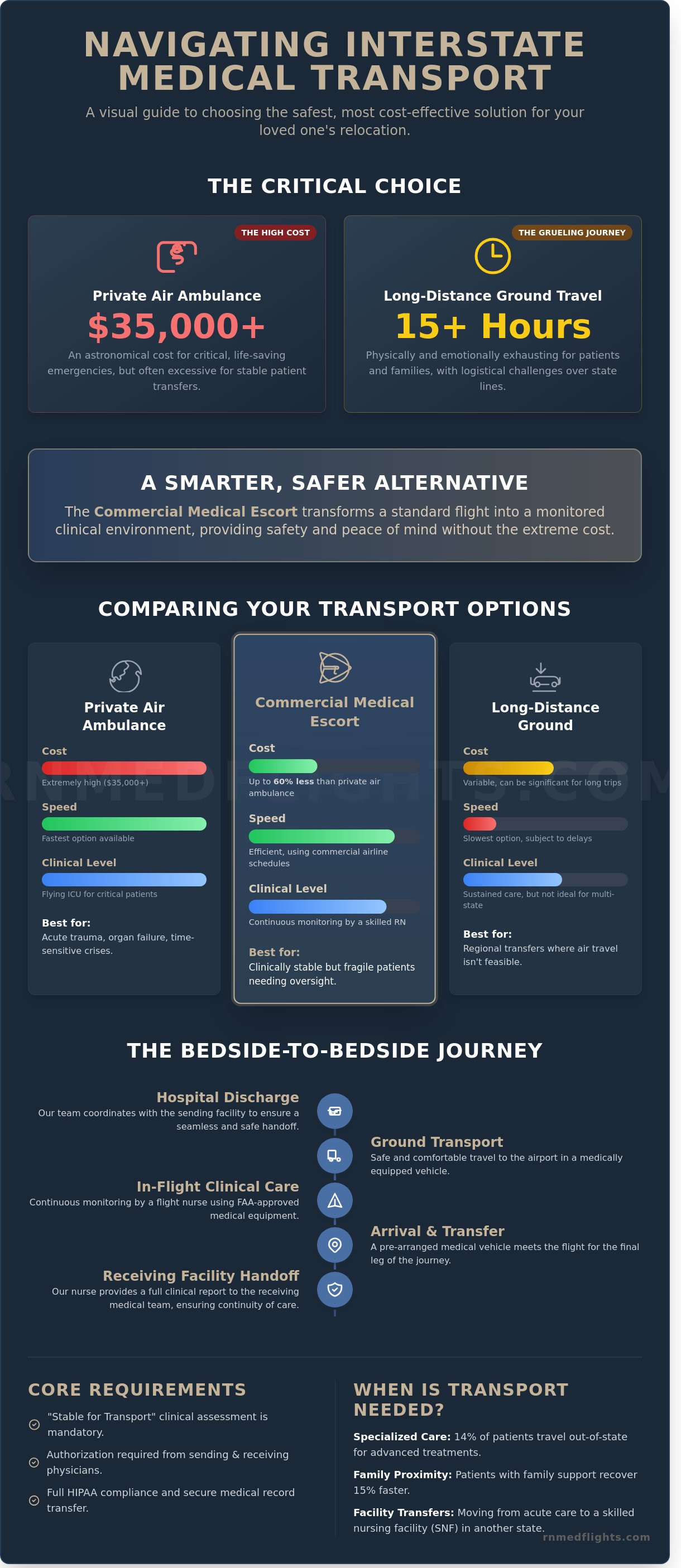
Selecting the right method for patient transport from hospital to another state requires balancing clinical necessity with financial reality. Families often feel overwhelmed by the logistics, but the decision usually boils down to three primary modes of travel. Ground ambulances serve as the traditional choice for shorter distances, yet they become grueling for journeys exceeding 500 miles. A private air ambulance offers the highest level of care for ICU patients, though the cost often reaches between $25,000 and $55,000. For stable patients, a commercial medical escort provides a sophisticated middle ground, combining the speed of flight with professional nursing care at a fraction of the cost.
Several variables dictate the final price and feasibility of the move. Distance is the most obvious factor, but the patient's acuity level and the required lead time are equally influential. If a patient requires advanced life support or a ventilator, a private jet is the only safe option. If the patient is stable but needs oxygen and mobility assistance, a Commercial airline medical escort is often the most logical choice. We prioritize a bedside-to-bedside approach, ensuring a seamless handoff between facilities regardless of the transport mode selected.
Ground vs. Air: Which Is Right for Your Patient?
The "fatigue factor" is a critical clinical consideration. Spending 15 or 20 hours in a ground ambulance is physically exhausting for a healthy person; for a recovering patient, it can be dangerous. Highway travel involves constant vibrations, sudden braking, and noise that can elevate heart rates and increase cortisol levels. In contrast, a commercial jet offers a pressurized, climate-controlled environment with minimal turbulence. However, ground transport remains the safer clinical choice for certain conditions. Patients with a recent pneumothorax or certain trapped gas conditions may not tolerate altitude changes well. Our clinical team evaluates these risks during the initial intake to ensure the chosen path doesn't compromise the patient's recovery.
Analyzing the ROI of Medical Escort Services
Choosing a commercial medical escort can save families significant financial resources, often reducing the total bill by 60% to 70% compared to a private air ambulance. As we look at typical price ranges for 2026, a domestic state-to-state commercial escort generally costs between $5,800 and $12,500. This price typically includes the nurse's professional fees, all travel arrangements, and basic medical supplies.
Families should stay vigilant regarding hidden costs that can inflate the final invoice. While the escort service covers the flight, you must account for ground ambulance surcharges at both the departing and arriving cities. These can add $1,200 to $2,500 to the total. Additionally, airline ticketing fees fluctuate based on how quickly the transport is booked. Booking with at least seven days of lead time can save up to 40% on airfare costs. Our goal is to provide a transparent, all-inclusive quote so you can focus on your loved one's healing rather than unexpected expenses. We manage every detail of the patient transport from hospital to another state with the precision of a medical procedure and the heart of a caregiver.
Ground Ambulance: Best for under 300 miles; cost-effective but slow.
Commercial Escort: Best for stable patients; saves 60% over private jets.
Private Air Ambulance: Necessary for critical care; costs $25k-$55k+.
Coordinating a Seamless Bed-to-Bed Transfer
Organizing patient transport from hospital to another state requires a level of clinical precision that leaves no room for error. The process is a sequence of highly orchestrated movements, each designed to maintain the patient's stability and dignity. This journey begins with a comprehensive clinical intake. Our flight coordinators, who are experienced medical professionals, perform a deep-dive assessment of the patient's current status. We review oxygen saturation levels, cardiac rhythms, and mobility limitations to determine the exact level of care required during the transit.
Once the medical baseline is established, we move into the logistical coordination phase. This involves five distinct steps:
Step 1: Clinical Intake. We conduct a thorough review of the patient's medical records, focusing on the last 24 hours of vitals and any specialized equipment needs such as ventilators or infusion pumps.
Step 2: Case Manager Collaboration. We work directly with the discharging hospital's case manager to synchronize the discharge orders. This prevents the patient from waiting in a hallway or lobby, which can be physically taxing.
Step 3: Airline Medical Clearance. For commercial escorts, we manage the complex Medical Information Form (MEDIF) process. Airlines typically require these documents 48 to 72 hours before departure. We handle all physician signatures and airline approvals to ensure a guaranteed seat.
Step 4: Ground Logistics. We secure Advanced Life Support (ALS) or Basic Life Support (BLS) ambulances at both the departure and arrival cities. These vehicles are scheduled to meet us exactly when the flight lands, minimizing time spent on the tarmac.
Step 5: The Clinical Handover. The journey ends only when our flight nurse provides a detailed bedside report to the receiving medical team, ensuring they have a complete picture of the patient’s condition during the flight.
Navigating Hospital Discharge Logistics
Successful patient transport from hospital to another state depends on the cooperation of the facility's social workers. We bridge the gap between hospital administration and transport logistics. Our team ensures that at least 24 hours of necessary prescriptions and a full medical summary are physically with the flight nurse before leaving the room. We manage the timeline so that the transition from the hospital bed to the airport is a single, fluid motion. This eliminates the 15 to 20 percent delay often seen in non-coordinated transfers.
The 'Bed-to-Bed' Guarantee Explained
Continuity of care is our uncompromising standard. Our bed-to-bed guarantee means the same medical professional who meets the patient in their current room stays with them until they're tucked into their new bed. This constant presence allows for immediate intervention if vitals fluctuate. We provide families with real-time updates every 60 minutes, offering peace of mind that their loved one is safe. This specialized approach reduces the physiological stress of travel, which research shows can spike by 30 percent during unmonitored transitions.
If you need to move a loved one safely across state lines,
to start the assessment process today.
Why Families Trust RN MEDflights for Multi-State Relocation
Choosing a provider for patient transport from hospital to another state is a decision that impacts both clinical outcomes and family peace of mind. RN MEDflights isn't just a transport company; we're a clinical solution led by medical professionals. We've refined our processes over 1,500 successful missions to ensure that every patient receives uncompromising care during their relocation. As a veteran-owned business, we operate with a level of integrity that's rare in the aviation industry. We provide transparent, fixed-price quotes that eliminate the stress of hidden fees or sudden fuel surcharges. Our 24/7/365 coordination center serves as your constant point of contact, ensuring you're never left wondering about your loved one's status during a medical crisis.
Our expertise extends beyond simple domestic moves. We manage complex state-to-state transfers and international repatriations from over 40 countries with the same steady hand. We understand the logistics of "bedside-to-bedside" care, which means we take full responsibility for the patient from the moment we arrive at the sending hospital until they're safely tucked into their new bed. This continuity of care reduces the risk of medical errors during transitions. We've built our reputation on being a vigilant protector for those who can't advocate for themselves, treating every individual with the same dignity we'd expect for our own parents or children.
Clinical Expertise Meets Compassionate Logistics
Safety starts with the quality of the medical staff on board. Every RN MEDflights mission is staffed by flight nurses who hold specialized CFRN (Certified Flight Registered Nurse) or CTRN (Certified Transport Registered Nurse) credentials. Our clinicians bring a minimum of five years of experience in high-acuity ICU or Emergency Department settings. This deep clinical background allows them to manage advanced life support equipment and respond to physiological changes in real-time. You can learn more about our flight nurses and their commitment to providing a seamless, stress-free journey for every patient under their watch.
Getting Started: Your Free Consultation
Initiating a patient transport from hospital to another state is a straightforward process when you work with our flight coordinators. To provide an accurate quote within 60 minutes, we'll need the patient's current location, the destination facility name, and a brief summary of their medical stability. We typically move from the initial call to wheels-up in 24 to 72 hours, depending on the urgency of the case. Our team handles all the paperwork, physician clearances, and ground ambulance coordination so you can focus on your family. Don't wait to secure the specialized care your loved one deserves. Request a customized quote for state-to-state transport today and let our experts handle the logistics of your relocation.
Take the Next Step Toward a Safe Medical Relocation
Navigating the logistics of moving a medically fragile family member across state lines requires more than just transportation; it demands clinical oversight. You've learned how commercial airline medical escorts provide a cost-effective alternative to private air ambulances without sacrificing safety. Our process ensures every detail is managed through comprehensive bed-to-bed medical coordination, removing the logistical burden from your shoulders during a stressful time. By choosing a nurse-led path, you ensure that medical monitoring continues without interruption from the moment we leave the bedside until the patient is settled at their destination.
RN Medflights stands as a veteran-owned and nurse-operated small business dedicated to uncompromising care and integrity. We manage every mile of the patient transport from hospital to another state, ensuring a seamless transition between facilities. Our team remains available 24/7/365 to respond to urgent relocation needs, providing the authoritative expertise required for complex cases. You don't have to navigate these medical and aviation regulations alone when a dedicated flight coordinator is ready to help. We prioritize the patient's dignity and your peace of mind throughout the entire journey.
We're ready to bring your family member home with the clinical precision and heart they deserve.
Frequently Asked Questions
How much does it cost to transport a patient to another state?
The cost for patient transport from hospital to another state typically ranges from $3,000 to $30,000 depending on the required level of care. A commercial medical escort generally costs between $3,000 and $7,500 for a 1,000-mile trip. Private air ambulance services start at $15,000 for similar distances. These figures include the flight coordinator's fees, clinical staff, and all necessary medical supplies for the journey.
Will insurance or Medicare pay for state-to-state medical transport?
Medicare typically pays 0% for state-to-state medical transport unless the move is to the nearest facility capable of providing life-saving care. Private insurance providers like UnitedHealthcare or Aetna may cover 50% to 100% of the costs if the transfer is deemed medically necessary. Our team reviews your specific policy 24/7/365 to determine your out-of-pocket responsibility before we begin the bedside-to-bedside coordination process.
Can a family member fly with the patient and the medical escort?
Yes, one family member can almost always fly with the patient and our medical escort on commercial flights at no extra service cost. On private air ambulance missions, we typically accommodate 1 to 2 passengers depending on the aircraft's 500-pound weight limit for extra cargo. This allows you to remain by your loved one’s side, providing emotional stability while our RNs manage the clinical details.
What happens if the patient's condition changes mid-flight?
Our flight nurses are certified in Advanced Cardiovascular Life Support and follow strict clinical protocols to stabilize patients immediately. We carry a specialized medical kit with 15 different emergency medications and advanced monitoring equipment to manage vitals in real-time. If a condition deteriorates, the medical escort coordinates with the pilot to divert to the nearest hospital with an ICU, ensuring 100% commitment to patient safety.
How do you coordinate with the hospitals involved in the transfer?
We manage the entire bedside-to-bedside process by establishing direct communication with the 2 primary physicians at the sending and receiving facilities. Our flight coordinators handle the 12-page medical record transfer and confirm bed availability 24 hours before departure. We also secure the 2 ground ambulance teams required for the transition. This methodical approach ensures a seamless handover of care without placing the logistical burden on the family.
Is a commercial airline stretcher service available for patients who can't sit up?
Domestic airlines like Delta and American Airlines currently offer 0 stretcher services for patients who must remain horizontal during flight. For domestic patient transport from hospital to another state where a patient cannot sit, we utilize private aircraft equipped with FAA-approved stretcher systems. International carriers like Lufthansa still provide stretcher options, which our team can coordinate with 7 to 10 days of lead time for global transfers.
What medical equipment is the flight nurse allowed to bring on the plane?
Our flight nurses carry a comprehensive medical kit that includes a portable pulse oximeter, a blood pressure monitor, and a FAA-approved portable oxygen concentrator. We also bring a specialized bag containing IV supplies and 10 essential emergency medications. Each piece of equipment undergoes a 20-point safety check 24 hours before the flight. This ensures we maintain the same clinical integrity found in a hospital setting while at 30,000 feet.
How far in advance do I need to book a medical escort service?
You should ideally book our medical escort services 3 to 5 days before the desired travel date to ensure optimal flight pricing. However, our 24/7/365 operations center can often launch an emergency transport in as little as 24 hours if a patient's status becomes critical. Booking early allows our RN leadership to conduct a thorough 48-hour clinical assessment to ensure the patient is stable enough for high-altitude travel.


