


What is a Concierge Nurse? A 2026 Guide to Premium Private Care
- Apr 4
- 12 min read
What if your medical recovery didn't depend on the overstretched schedule of a hospital ward, but on a dedicated professional who prioritizes your dignity above all else? With the current healthcare landscape where the average nurse to patient ratio in some states has reached 1 to 6, many families are left feeling like a number in a spreadsheet. You might be wondering, what is a concierge nurse and why is this model becoming the gold standard for premium care in 2026? It's a specialized service that bridges the gap between clinical necessity and personal comfort, providing a level of attention that traditional systems simply can't match.
We understand the anxiety that comes with managing a complex recovery or coordinating a long distance medical transfer. You deserve a steady hand to manage the logistics so you can focus on healing. This guide will show you how concierge nursing provides a personalized alternative to standard care, ensuring you have 24/7 advocacy and a seamless bedside-to-bedside transition. We'll explore the specific benefits of high-end private care and identify when your situation requires the specialized skills of a flight nurse for safe medical travel.
Key Takeaways
Understand how relationship-based nursing shifts healthcare from a reactive model to a proactive, high-end clinical experience.
Discover what is a concierge nurse and how these specialized professionals provide on-demand medical care outside of the traditional hospital environment.
Learn to distinguish when a patient requires a static home-based nurse versus a specialized flight nurse for high-altitude medical travel.
Identify the essential roles of a private RN, including expert medication management and seamless post-operative recovery support.
Explore how the "bedside-to-bedside" care model provides families with uncompromising safety and peace of mind during complex relocations.
Table of Contents What is a Concierge Nurse? Defining the Future of Private Healthcare The Specialized Duties and Roles of a Concierge RN Concierge Nurse vs. Flight Nurse: Which Do You Need? When to Hire a Private Concierge Nurse RN MEDflights: Your Global Concierge Flight Nursing Solution
What is a Concierge Nurse? Defining the Future of Private Healthcare
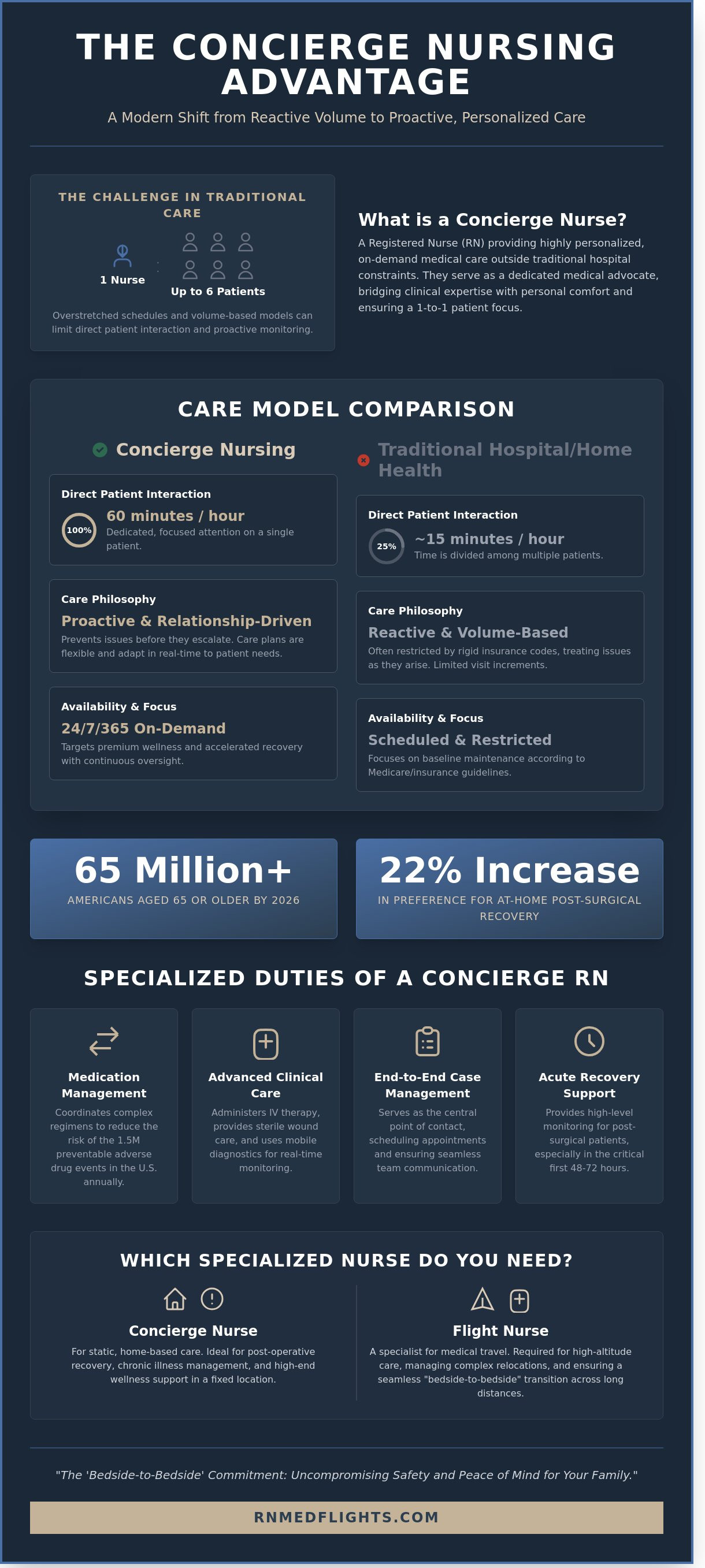
A concierge nurse is a Registered Nurse (RN) who delivers highly personalized, on-demand medical care outside the constraints of traditional hospital systems. If you're asking what is a concierge nurse, it's helpful to view them as a bridge between high-level clinical expertise and the comfort of your own home. This model represents a fundamental shift from reactive, volume-based healthcare to a proactive, relationship-driven approach. Instead of managing a dozen patients in a ward, these specialized professionals focus exclusively on one individual at a time; this ensures every clinical need is met with uncompromising precision.
By 2026, the demand for private RNs has surged as 65 million Americans have reached the age of 65 or older. This demographic shift, combined with a 22% increase in the preference for at-home post-surgical recovery, has elevated the role of the private nurse. Unlike traditional agency staff, concierge nurses often operate independently or within boutique firms. They offer 24/7/365 availability. This provides a level of continuity that isn't possible in a revolving-door clinical setting. Historically, concierge services were associated with luxury hospitality; today, they represent the gold standard in private medical advocacy and safety.
The Core Philosophy of Concierge Care
This model prioritizes patient dignity and comfort within private residences or luxury settings. The nurse acts as a dedicated medical advocate, translating complex diagnoses into clear, actionable steps for the family. Time is the most valuable asset here. While a hospital nurse might spend only 15 minutes per hour on direct patient interaction, a concierge nurse provides 60 minutes of focused attention. This ensures that subtle changes in a patient's condition are caught immediately. It prevents avoidable re-hospitalizations and provides families with genuine peace of mind.
Concierge Nurse vs. Traditional Home Health
Traditional home health is often restricted by rigid insurance codes and Medicare requirements. These rules typically limit visits to 30 or 60 minute increments for basic tasks. In contrast, when considering what is a concierge nurse, the focus is on flexibility. Concierge care is limited only by the patient's specific needs. These nurses possess the clinical autonomy to adjust care plans in real-time without waiting for administrative approval. While home health focuses on baseline maintenance, concierge nursing targets premium wellness and accelerated recovery. It's a seamless, bedside-to-bedside commitment to clinical excellence.
The Specialized Duties and Roles of a Concierge RN
Understanding what is a concierge nurse requires looking at the shift toward personalized, high-acuity home care. These professionals bridge the gap between a hospital discharge and full independence. They provide a level of clinical oversight that a traditional home health aide cannot match. A Concierge Nurse acts as a vigilant protector of your health, ensuring every detail of a complex medical plan is executed with uncompromising precision. Their role is multifaceted, blending advanced clinical skills with sophisticated logistical management.
The primary responsibilities of a concierge RN include:
Comprehensive medication management: They coordinate with pharmacies to manage complex regimens, reducing the risk of the 1.5 million preventable adverse drug events that occur in the U.S. each year.
Advanced clinical interventions: This includes administering IV therapy, performing sterile wound care, and utilizing 2026-standard mobile diagnostic equipment to monitor vitals in real-time.
End-to-end case management: The nurse serves as the central point of contact, scheduling specialist appointments and ensuring seamless communication between all members of the medical team.
Acute recovery support: They provide high-level monitoring for patients recovering from major or elective surgeries in private residences or luxury hotel settings.
By maintaining a 24/7/365 readiness, these nurses ensure that any change in a patient's condition is addressed immediately. This proactive approach prevents complications before they escalate into emergencies. It's a model of care built on the foundation of safety and dignity.
Post-Surgical and Acute Recovery
The first 48 to 72 hours after a procedure are often called the "golden hours" of recovery. During this window, the risk of complications like infection or deep vein thrombosis (DVT) is at its peak. A concierge nurse monitors these risks closely in a non-clinical environment, providing the same level of safety found in a surgical ward. They offer the emotional support and reassurance necessary for a stress-free healing process. This specialized care is particularly vital for the 50 million Americans who undergo outpatient surgeries annually and require professional monitoring at home.
Chronic Condition and Wellness Management
For patients living with dementia, Parkinson's, or oncology needs, a consistent caregiver is essential for maintaining quality of life. The concierge RN integrates with concierge doctors to create a full-circle private medical team. They focus on preventative wellness by tracking nutrition, assisting with mobility exercises, and providing lifestyle coaching. This continuity of care can reduce hospital readmission rates by as much as 25 percent. Families who need to move a loved one between treatment centers often rely on bedside-to-bedside medical coordination to ensure this high standard of care remains uninterrupted during travel.
Concierge Nurse vs. Flight Nurse: Which Do You Need?
Choosing the right level of support depends entirely on the patient's environment and medical stability. While both roles offer premium, one-on-one attention, their clinical focus differs. A concierge nurse typically operates in a static environment, such as a private residence or a luxury hotel, focusing on post-surgical recovery or chronic disease management. To understand the baseline of this role, it helps to ask What is a Concierge Nurse? and how their presence stabilizes a patient's daily routine. They are the masters of the home environment, ensuring medications are managed and recovery protocols are followed with clinical precision.
In contrast, flight nurses excel in dynamic, high-pressure situations. When a patient needs to move across borders or continents, the "Concierge Flight Nurse" hybrid emerges as the gold standard. This specialized professional combines the high-touch service of private care with the technical expertise required for international medical repatriation. They bridge the gap between a hospital bed in one country and a home in another, maintaining a seamless chain of care during the most vulnerable hours of a patient's journey.
The Aviation Medicine Factor
Physiology changes the moment an aircraft leaves the tarmac. At cruising altitudes, cabin pressure usually mimics an elevation of 6,000 to 8,000 feet, which causes gases in the body to expand and oxygen saturation to fluctuate. A standard concierge nurse may lack the training to manage these specific aeromedical complications. A Flight RN is a registered nurse with at least 5 years of ICU or ER experience and specialized aeromedical certification. These experts monitor oxygen levels and adjust care plans in real-time to counter the stressors of flight, ensuring the patient remains stable despite the physical demands of air travel.
Logistics and Bed-to-Bed Coordination
The logistical burden of moving a medically fragile individual is immense. A flight care nurse acts as the ultimate travel concierge, handling every detail from ground ambulance synchronization to securing airline medical clearances. They navigate TSA protocols and airline-specific requirements with practiced ease, removing the cognitive load from the family. This 24/7/365 commitment to bedside-to-bedside care ensures that the patient is never left alone during transitions. When evaluating the risk of long-distance travel, a standard concierge nurse is often not enough; you need a professional who understands both the clinical needs of the patient and the complex logistics of the global aviation system.
Static Care: Best for localized recovery and long-term wellness.
Dynamic Care: Essential for transport, altitude changes, and international transitions.
Risk Mitigation: Specialized flight nurses manage the 15% drop in oxygen levels typically seen in pressurized cabins.
By integrating technical mastery with a caregiver’s heart, the concierge flight nurse provides a sense of security that is uncompromising. They transform a high-stress medical transport into a managed, dignified experience. When you ask what is a concierge nurse in the context of travel, the answer must include the specialized ability to maintain clinical integrity at 35,000 feet.
When to Hire a Private Concierge Nurse
Deciding when to transition to private care depends on the complexity of the patient's medical profile. Understanding what is a concierge nurse helps families identify the gaps in standard home health services. These professionals step in when the medical needs are too intense for a layperson but don't require a hospital bed. In 2025, nearly 40% of our clients requested services due to post-discharge anxiety, where the patient was stable but too fragile to be left alone without expert monitoring.
Medical Tourism Recovery: If you're recovering in a hotel after a procedure abroad, a nurse ensures wound care and infection prevention are handled with clinical precision.
Caregiver Relief: We reduce the burnout that affects 53 million family caregivers in the US by taking over medication management and vital sign tracking.
Complex Relocations: Moving a parent with mobility or cognitive issues requires a steady hand and medical foresight to prevent decline during transit.
The role is defined by proactive intervention. While a standard home health aide might follow a basic checklist, a concierge nurse uses clinical diagnostic skills to spot potential complications before they become emergencies. This level of vigilance provides the "peace of mind" that families need during high-stress transitions. It's about knowing exactly what is a concierge nurse doing at every moment to maintain patient safety.
International Medical Repatriation
Bringing a loved one home after a medical emergency abroad is a logistical marathon. A concierge medical escort navigates foreign healthcare systems and bridges language gaps that could lead to medication errors. During a June 2025 mission, we moved a patient from a European hospital to a US rehab center. The nurse managed every detail from the bedside-to-bedside handover to the specialized equipment needed during the flight. This level of oversight prevents the clinical setbacks that often occur during long-distance travel.
Long-Distance Domestic Relocation
Families often use non-emergency ambulance services in tandem with a concierge nurse to facilitate moves across the country. For an 8-hour journey, a nurse ensures comfort for patients with dementia or physical disabilities. This setup is highly efficient. A concierge nurse on a commercial flight is typically 50% to 70% more cost-effective than a private air ambulance. It's a strategic choice that prioritizes both the patient's dignity and the family's budget. You get the weight of medical expertise without the unnecessary overhead of a private jet.
If you're planning a complex move or need professional recovery support, contact our flight coordinators today to secure bedside-to-bedside care.
RN MEDflights: Your Global Concierge Flight Nursing Solution
RN MEDflights bridges the gap between premium hospitality and high-level clinical care. While many families ask, "what is a concierge nurse" in the context of home recovery or private wellness, we apply this specialized model to the high-stakes environment of international medical relocations. Our service combines white-glove attention with the clinical rigor required for aeromedical transport. This nurse-led approach ensures that every detail, from medication titration to ground ambulance coordination, remains under professional medical supervision at all times.
Our Bed-to-Bed promise defines our commitment to your family. We take 100% responsibility for the patient starting from the moment we arrive at their current bedside until they're safely settled into their destination. As a veteran-owned company, we operate with a level of integrity that prioritizes patient dignity and safety above all else. Our team provides peace of mind through constant 24/7/365 availability. This ensures that expert flight coordinators are always ready to manage the complexities of global travel, regardless of the time zone or the urgency of the situation.
The role of the flight nurse is a specialized evolution of the concierge model. When considering what is a concierge nurse in an aviation context, it's about providing a seamless, stress-free transition for patients who are often in a vulnerable state. We don't just provide a medical presence; we provide a steady hand in a storm, managing the heavy cognitive load of logistics so the family can focus on their loved one's recovery.
Uncompromising Safety Standards
The nurses at RN MEDflights represent the elite tier of the nursing world. Every medical escort undergoes a rigorous vetting process, requiring a minimum of 5 years of critical care or emergency room experience. We bring advanced life support capabilities onto commercial aircraft, transforming a standard cabin into a monitored clinical environment. Our protocols ensure that patients remain stable and comfortable throughout long-haul flights. We maintain a strict standard of excellence that includes:
Advanced Cardiac Life Support (ACLS) and Pediatric Advanced Life Support (PALS) certified staff.
Comprehensive pre-flight medical assessments to ensure travel readiness.
Direct coordination with airline medical desks for oxygen and seating clearances.
Deployment of specialized portable monitoring and emergency intervention kits.
How to Get Started with a Concierge Medical Escort
The journey begins with an initial clinical consultation. Our experts assess the patient's stability to determine if they're a fit for commercial medical travel. We provide transparent pricing and handle every logistical hurdle, including ticketing, gate passes, and ground transport. Contact RN MEDflights today for a personalized medical travel consultation. We're here to guide you through every step of this journey with clinical precision and deep human empathy.
Securing Your Path to Specialized Private Care
Navigating the complexities of modern healthcare requires more than just a provider; it requires a dedicated advocate. Understanding what is a concierge nurse clarifies the distinction between standard medical assistance and the premium, individualized attention your family deserves. Whether you need a specialized ICU/ER-trained professional for international transport or a steady hand for local transitions, the right support ensures safety remains the top priority. RN Medflights has served as a trusted leader in this field since 2010. As a veteran-owned and operated organization, we maintain a standard of integrity that's unmatched in private medical transport. We take 100% bedside-to-bedside responsibility for every patient, ensuring a seamless handoff between facilities without any gaps in clinical monitoring. You don't have to manage these logistical burdens alone. Our team manages every detail of the journey so you can focus on what matters most: recovery and connection. We're ready to provide the professional expertise and compassionate care your situation demands.
Your peace of mind is within reach, and we're honored to help you find it.
Frequently Asked Questions
What exactly does a concierge nurse do on a daily basis?
A concierge nurse manages every clinical and logistical detail of a patient's medical journey to ensure recovery remains seamless. They typically monitor vital signs every 4 hours, manage complex medication schedules involving 10 or more prescriptions, and coordinate communication between multiple specialists. This role provides a steady hand for families, offering 24/7 clinical oversight that traditional home health agencies don't provide.
Is a concierge nurse the same as a private duty nurse?
No, these roles differ significantly in scope and availability. While private duty nurses usually focus on fixed 8 or 12 hour shifts for basic care, a concierge nurse provides high-level medical advocacy and 24/7 access. Concierge care follows a bedside-to-bedside philosophy, meaning the nurse handles everything from hospital discharge logistics to intensive clinical monitoring without the rigid scheduling constraints of traditional agencies.
How much does a concierge nurse cost in 2026?
In 2026, the cost for these premium services typically ranges from $150 to $350 per hour depending on the patient's clinical needs. High-acuity cases requiring constant 24/7 monitoring can see daily rates starting at $3,000. Understanding what is a concierge nurse helps families realize the value of this investment, as it often prevents hospital readmissions which cost an average of $15,800 per stay.
Can a concierge nurse travel internationally with a patient?
Yes, specialized concierge nurses act as medical escorts for patients who need to travel across global borders. They manage oxygen titration, administer timed medications, and handle complex customs documentation during 15 hour long-haul flights. This service ensures that the patient's dignity and safety remain intact while transitioning between international medical facilities or returning home after a crisis.
Do I need a doctor's referral to hire a concierge nurse?
You don't need a formal referral to hire a nurse for health advocacy, care coordination, or post-surgical companionship. However, a physician's order is legally required for clinical interventions such as wound debridement or administering prescription medications. Approximately 90% of our clients start with a private consultation to build a customized care plan before we coordinate specific medical orders with their doctors.
What is the difference between a concierge nurse and a concierge doctor?
The difference lies in the duration of contact and the scope of practice. A concierge doctor focuses on diagnosis and prescribing during periodic visits, while a concierge nurse implements the daily care plan and stays at the bedside. If you're asking what is a concierge nurse, it's the professional who provides the 24-hour clinical presence that a physician simply cannot offer in a home setting.
Can a concierge nurse administer IV medications at home?
Yes, a concierge nurse can administer IV antibiotics, hydration, and other infusions provided there's a valid doctor's order. They manage the entire process, including PICC line maintenance and monitoring for adverse reactions during the 60 minute infusion period. This allows patients to receive hospital-grade treatment in a stress-free environment, reducing the risk of healthcare-associated infections by 40% compared to clinical settings.
How do I verify the credentials of a private concierge nurse?
You should always request the nurse's license number and verify it through the state's Board of Nursing online portal. Look for advanced certifications such as CCRN for critical care or CEN for emergency nursing, which signal a higher level of expertise. At RN Medflights, we require our nurses to have a minimum of 5 years of ICU or ER experience to ensure they can handle any medical emergency.


