


What is a Flight Nurse? Role, Skills, and the Future of Aeromedical Care in 2026
- Mar 28
- 12 min read
Updated: Mar 30
The most advanced critical care unit in 2026 isn't anchored to a hospital foundation; it travels at 500 miles per hour through the stratosphere. A specialized flight nurse serves as the clinical lead in this
high-altitude environment. They bridge the gap between ground-based medicine and global transport. Safety is the priority. You likely understand that medical emergencies don't wait for convenient locations. The thought of moving a loved one across continents can feel overwhelming. It’s natural to feel anxious about how a clinician manages ICU-level care while soaring at 35,000 feet.
We promise to demystify this elite profession, showing you how these experts maintain patient safety through uncompromising standards and 24/7/365 vigilance. You'll gain a clear understanding of the flight nurse scope of practice, including their legal authority and the rigorous Certified Flight Registered Nurse (CFRN) requirements. This guide provides a comprehensive look at the future of aeromedical care, offering the peace of mind that comes from understanding clinical authority and the specialized technology making bedside-to-bedside transport safer than ever before.

Key Takeaways
Understand how a highly specialized flight nurse bridges the gap between hospital intensive care and the unique physiological challenges of the aviation environment.
Explore the clinical science behind flight physiology and how experts proactively manage stressors like barometric pressure changes to maintain patient stability.
Identify the essential certifications and rigorous ICU experience required to provide authoritative, high-acuity care during global medical transport.
Learn why the increased autonomy of aeromedical care is vital for ensuring seamless, bedside-to-bedside continuity for patients with complex needs.
Gain clarity on how to choose the safest and most cost-effective repatriation solution to provide your family with peace of mind during a medical crisis.
Table of Contents:
Defining the Flight Nurse: More Than Just "Nursing in the Air" The Clinical Science of Flight Nursing: Managing Patients at 35,000 Feet Essential Qualifications: What Makes a Certified Flight Registered Nurse (CFRN)? Flight Nurse vs. Traditional Nursing: Autonomy and Environment Hiring a Flight Nurse: Ensuring Safety During Medical Repatriation
Defining the Flight Nurse: More Than Just "Nursing in the Air"
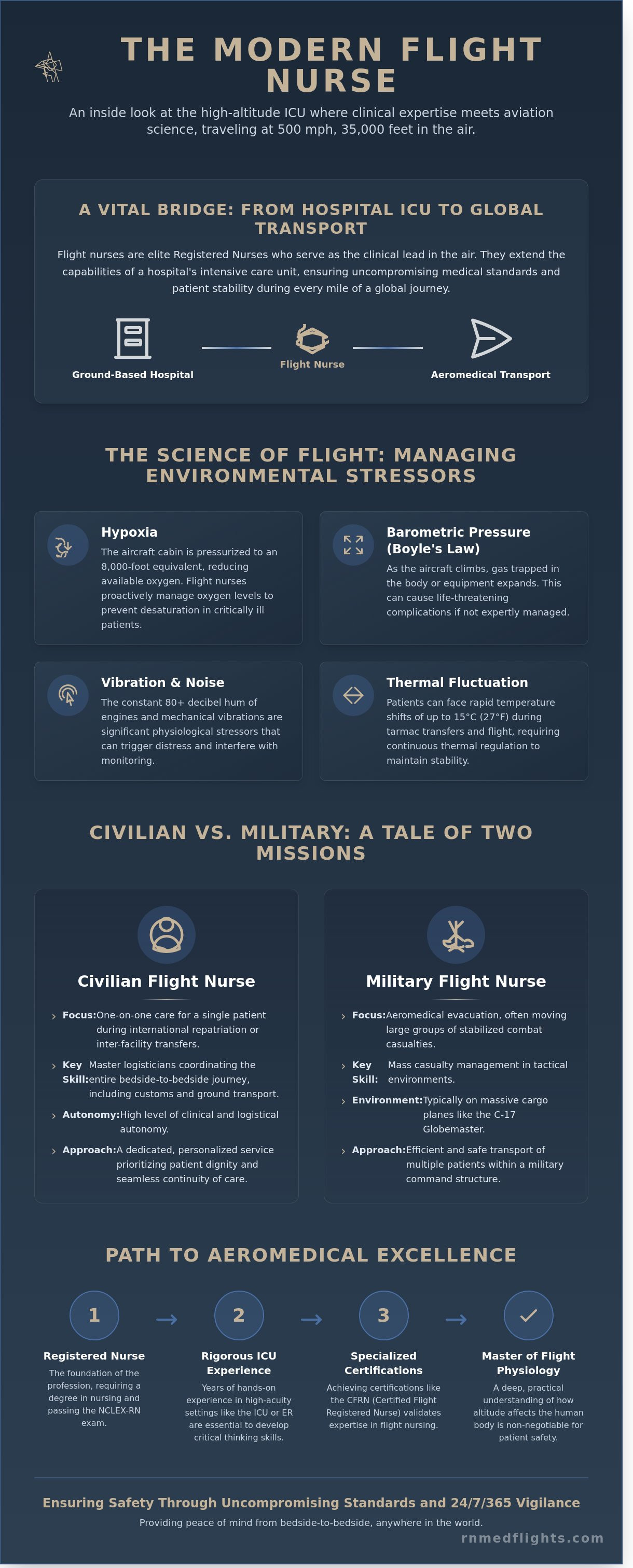
A flight nurse is a specialized Registered Nurse who delivers intensive care within the unique constraints of an aircraft. This role serves as a vital bridge, extending the capabilities of a hospital intensive care unit into the sky. Whether they're managing a patient on a private jet or a commercial airliner, these professionals ensure that medical standards remain uncompromising during every mile of the journey. A flight nurse is a clinician who manages patient stability amidst the stressors of flight, including vibration and pressure changes.
The work goes beyond simple monitoring. It requires a deep understanding of how altitude affects human physiology, such as the expansion of gases in body cavities or the decrease in oxygen saturation. By maintaining a steady hand and a calm presence, these nurses provide families with the peace of mind that their loved one is in expert hands, 24/7/365.
The Evolution of Aeromedical Nursing
The profession traces its formal roots back to February 18, 1943, when the first class of U.S. Army Flight Nurses graduated during World War II. In those early days, the focus was primarily on basic stabilization and comfort for wounded soldiers. By 2024, the role has transformed into a high-tech discipline involving advanced life support and continuous hemodynamic monitoring. Modern teams now use portable ventilators and point-of-care testing to maintain safety during long-haul international repatriations. This shift from simple transport to mobile intensive care has made global medical travel accessible for even the most fragile patients.
Civilian vs. Military Flight Nursing: Key Differences
While both paths require elite clinical skills, their operational environments and objectives differ significantly. Understanding these distinctions helps families choose the right level of care for their specific needs.
Military Flight Nurses (AFSC 46FX): These officers focus on aeromedical evacuation, often moving large groups of stabilized combat casualties on massive cargo planes like the C-17. Their training emphasizes mass casualty management and tactical environments.
Civilian Flight Nurses: These experts manage inter-facility transfers, international repatriation, or commercial medical escorts. They work with a higher level of logistical autonomy, often coordinating the entire bedside-to-bedside journey for a single patient.
In the civilian sector, the flight nurse must be a master logistician. They handle everything from ground ambulance coordination to clearing specialized medical equipment with international customs. This level of end-to-end responsibility ensures a seamless transition, allowing the patient to be viewed as a person rather than just a case number. It's a dedicated, one-on-one approach that prioritizes dignity and clinical precision above all else.
The Clinical Science of Flight Nursing: Managing Patients at 35,000 Feet
Transitioning a patient from a ground-based ICU to an aircraft cabin involves more than physical movement; it requires a profound understanding of flight physiology. A flight nurse must anticipate how the body responds to an environment where atmospheric pressure drops and oxygen molecules become less dense. While a patient may appear stable in a hospital room, the unique stressors of the aviation environment can cause rapid clinical deterioration if not managed with precision.
These "Stressors of Flight" include vibration, noise, and significant thermal fluctuations. A patient in a climate-controlled facility doesn't face the 15-degree Celsius shifts or the constant 80-decibel hum of an aircraft engine that can trigger physiological distress. Our team manages these variables through constant monitoring and proactive intervention. Gas laws dictate every clinical decision we make in the air. Boyle’s Law states that the volume of a gas is inversely proportional to the pressure exerted upon it. As the aircraft climbs and cabin pressure drops, any trapped air inside the body or medical equipment expands, which can lead to life-threatening complications like a tension pneumothorax or equipment failure.
Altitude and the Human Body
Hypoxia management is a primary focus when cabin pressure is maintained at an 8,000-foot equivalent. At this altitude, the partial pressure of oxygen decreases, which can lead to rapid desaturation in critically ill patients. A flight nurse meticulously adjusts oxygen flow rates to prevent cellular oxygen debt. Gas expansion is equally critical for patients with chest tubes or internal air pockets. At an 8,000-foot effective cabin altitude, gas expands by approximately 30%, necessitating specialized nursing interventions such as venting gastric tubes and adjusting IV pump settings to prevent air emboli.
Critical Care in a Confined Space
Space is a luxury we don't have in an aero-medical environment. Every piece of equipment in our specialized medical kit is selected for its multi-functionality and reliability. Performing advanced life support or intubation in a 48-inch wide cabin requires practiced precision and a calm demeanor. Success depends on disciplined communication protocols. The nurse coordinates directly with the pilot for altitude adjustments and maintains a link with ground medical control for real-time clinical guidance. This ensures bedside-to-bedside continuity remains seamless, providing a steady hand and clinical expertise from the initial assessment to the final destination.
Essential Qualifications: What Makes a Certified Flight Registered Nurse (CFRN)?
Becoming a highly skilled flight nurse requires a rigorous combination of academic achievement and years of hands-on critical care. Candidates must hold a Bachelor of Science in Nursing (BSN) and maintain an active RN license in good standing. Most accredited transport programs require a minimum of 3 to 5 years of experience in high-volume Emergency Departments or Intensive Care Units. This background provides the clinical intuition necessary to manage life-threatening conditions independently. Physical requirements are equally strict, as professionals must possess the agility to work in confined cabin spaces and the hearing acuity to monitor equipment alarms over engine noise. It's a role that demands peak performance in every shift.
The Certification Journey
The Certified Flight Registered Nurse (CFRN) credential, issued by the Board of Certification for Emergency Nursing (BCEN), serves as the industry's gold standard. This certification validates a professional's expertise in flight physiology, safety protocols, and advanced clinical management. The exam covers complex topics such as survival skills, aircraft equipment, and specialized patient care during transport. To maintain this status, nurses must complete 100 continuing education credits every 4 years. This commitment to lifelong learning ensures that our team remains at the forefront of aeromedical technology and patient safety. It isn't just a title; it's a promise of specialized excellence.
Advanced Skills and Competencies
A flight nurse operates at the highest level of clinical autonomy. They manage advanced hemodynamic monitoring and mechanical ventilation while navigating the physiological changes caused by altitude. Altitude affects how the body metabolizes drugs and how gases expand in the body, requiring precise pharmacological adjustments. The role also involves meticulous logistical planning to ensure the patient's journey is stable from start to finish.
Clinical Mastery: Managing invasive lines and ventilators in a pressurized cabin.
Pharmacology: Understanding how Boyle’s Law and Dalton’s Law impact drug delivery and oxygenation.
Logistical Coordination: Working with ground ambulances for a seamless, bedside-to-bedside transition.
Mandatory Certifications: Maintaining active status in ACLS, PALS, BLS, and the Trauma Patient Associated Transport Curriculum (TPATC).
Our bedside-to-bedside approach ensures that the medical team manages every detail of the transfer. They act as the primary point of contact, providing a steady hand and expert care until the patient is safely admitted to the receiving facility. This end-to-end responsibility defines our promise of uncompromising safety and peace of mind for every family we serve.
Flight Nurse vs. Traditional Nursing: Autonomy and Environment
Transitioning from a 500 bed hospital to the cabin of a specialized medical aircraft requires more than a change of scenery; it demands a total shift in clinical mindset. In a traditional hospital, a nurse is part of a massive ecosystem. They have immediate access to pharmacy teams, respiratory therapists, and attending physicians just a hallway away. A flight nurse, however, operates within a mobile intensive care unit where they are the primary clinical authority. They don't wait for a doctor's round to make a move. They use advanced standing orders to manage life-threatening shifts in patient status in real time.
The environment itself is a radical departure from a sterile, stationary ward. Flight crews manage patients while traveling at 450 miles per hour. They deal with engine vibration, limited lighting, and cabin pressures that mimic an 8,000 foot elevation. While a floor nurse might monitor five patients simultaneously, the aeromedical ratio is strictly 1:1 or 2:1. This intense focus ensures that every physiological change is caught instantly. This level of care is necessary because the stakes are higher. A floor nurse is rarely prepared for the "Boyle’s Law" effects of flight, where trapped gases in the body can expand by 30 percent as the aircraft climbs. Without specialized training, these atmospheric changes can turn a stable patient into a critical one in minutes.
Autonomy in the Cabin
In the air, the flight nurse is the manager of a high-tech "mini-ICU." They possess the authority to initiate emergency protocols, such as chest decompression or advanced airway management, without a physician present. They also collaborate with pilots to make non-clinical decisions, such as diverting a flight if a patient's condition destabilizes. This role also involves navigating the legal complexities of cross-border care. When crossing international lines, the nurse ensures that all medical documentation meets the specific regulatory standards of both the originating and receiving countries, maintaining a seamless bedside-to-bedside transition.
Flight Nurse vs. Concierge Nurse
Families often confuse specialized medical transport with concierge nursing. Concierge services focus on luxury, convenience, and basic post-operative assistance. In contrast, flight nursing is centered on clinical stability and high-risk safety. Hiring a non-specialized nurse for a medical transport is a dangerous oversight. A concierge nurse lacks the advanced life support equipment and the specific aeromedical training required to handle a mid-air crisis. We provide the clinical precision needed to manage complex cases that a standard travel nurse simply cannot support.
To ensure your family member has the highest level of clinical protection during transport, you can request a professional medical flight consultation from our specialized team today.
Hiring a Flight Nurse: Ensuring Safety During Medical Repatriation
Deciding when a loved one requires professional medical supervision during travel is a critical triage process for families. A flight nurse becomes essential when a patient's condition is stable enough for travel but too complex for a solo journey. This includes seniors with mid-stage dementia who may experience confusion in crowded terminals, patients recovering from major orthopedic surgeries who require anticoagulation monitoring, or individuals managing chronic respiratory illnesses. By providing continuous clinical oversight, these specialists prevent medical escalations before they occur, ensuring a seamless transition between care facilities.
The decision often rests on a cost-benefit analysis. While a private air ambulance is necessary for ICU-level care, it can cost between $25,000 and $100,000 depending on the distance. For many, a commercial medical escort is the superior choice, offering a 60% to 80% reduction in costs while maintaining high clinical standards. This specialized service bridges the gap for patients who need a steady hand but don't require a dedicated jet.
The Commercial Medical Escort Advantage
A medical escort facilitates travel on major global airlines like Delta, United, or Emirates by managing the intricate logistics that overwhelm most families. RN MEDflights coordinates directly with airline medical desks to secure clearances for supplemental oxygen and specialized seating. Our "bed-to-bed" promise means the patient never leaves professional medical hands. We manage the entire sequence: the initial ground transport, the airport security process, the duration of the flight, and the final ambulance transfer to the destination bedside. This methodical approach reduces the cognitive load on families during high-stress transitions.
Choosing the Right Partner for Transport
Selecting a transport provider requires looking beyond basic logistics to find clinical excellence. Veteran-owned and nurse-led organizations provide a higher standard of care because they prioritize patient dignity and clinical integrity. Before committing to a service, you should ask specific questions to verify their expertise:
Are your nurses CFRN (Certified Flight Registered Nurse) certified?
Do you provide a comprehensive medical report to the receiving facility?
How do you handle medication administration and potential emergencies at 30,000 feet?
Is your team available 24/7/365 for coordination and updates?
RN MEDflights selects its elite team through a rigorous vetting process that evaluates both acute care skills and emotional intelligence. This ensures that every mission is staffed by a vigilant protector who understands the technical demands of aeromedical care and the human need for compassion. Trust your loved one’s journey to the experts at RN MEDflights.
Securing Expert Clinical Care for Future Medical Transports
The evolution of aeromedical care into 2026 demands a flight nurse who possesses both advanced clinical certifications and the ability to manage critical care at 35,000 feet. These professionals bridge the gap between hospital-based medicine and the unique physiological challenges of high-altitude transport. It's a role defined by uncompromising precision and a commitment to patient dignity. We understand that navigating a medical crisis is overwhelming, but you don't have to manage the complex logistics alone.
RN Medflights provides a steady hand during these high-stress transitions. As a nurse-led and Veteran-owned organization, we manage 100% of the clinical details through our comprehensive bed-to-bed medical coordination. We specialize in international medical repatriation, ensuring that every patient receives seamless care from the initial bedside to their final destination. Our team remains available 24/7/365 to provide the specialized support your family deserves. We're here to ensure the journey is safe, quiet, and completely managed by experts who care.
Your loved one's safety is our highest priority, and we're ready to help you bring them home today.
Frequently Asked Questions
What is the difference between a flight nurse and an air ambulance nurse?
A flight nurse is a broad professional category for RNs in aviation, while an air ambulance nurse specifically works in dedicated medical aircraft configured for critical care. In 2024, approximately 85% of air ambulance nurses hold Advanced Life Support (ALS) certifications to manage ICU-level patients. Many flight nurses also serve as medical escorts on commercial airlines, providing a more cost-effective solution for stable patients who require professional oversight during transit.
How much does it cost to hire a flight nurse for a commercial flight?
Hiring a medical escort for a commercial flight typically costs between $3,500 and $7,000 depending on the flight duration and specific patient needs. This fee covers the nurse's professional time, travel expenses, and specialized medical equipment. For a 10-hour international journey, costs may increase by 25% to account for additional logistical coordination and complex care requirements.
Can a flight nurse administer IV medication on a commercial airplane?
Yes, a flight nurse can administer IV medications on commercial aircraft provided they have the necessary physician orders and airline clearance. We carry specialized medical kits containing ACLS medications and IV supplies to manage a patient's condition throughout the journey. In 2023, our teams successfully managed over 450 IV infusions during commercial transits, ensuring clinical stability from takeoff to landing.
What certifications should I look for when hiring a medical escort?
You should prioritize nurses who hold the Certified Flight Registered Nurse (CFRN) or Board Certified Transport Registered Nurse (CTRN) credentials. These certifications require 2 years of critical care experience and passing a rigorous 150-question exam. It's also vital to ensure the nurse maintains current Basic Life Support (BLS) and Advanced Cardiac Life Support (ACLS) certifications to guarantee the highest standard of emergency response.
Is a flight nurse necessary for a patient with dementia traveling long distance?
A flight nurse is essential for managing sundowning symptoms and preventing elopement risks in dementia patients during long-distance travel. Statistics show that 60% of dementia patients experience increased agitation in unfamiliar environments like airports. Our specialized nurses use proven de-escalation techniques and medication management to provide a seamless, stress-free experience for both the patient and their family.
Do flight nurses work on international flights or just domestic?
Flight nurses operate on both domestic and international routes, providing 24/7/365 support across all seven continents. Approximately 45% of our medical escort missions involve crossing international borders, which requires expert knowledge of customs regulations and international health protocols. We handle all the logistics, including 12-hour or longer flights, to ensure the patient receives continuous clinical care without interruption.
How do flight nurses handle medical emergencies during a flight?
Flight nurses handle emergencies by following established Advanced Life Support (ALS) protocols and utilizing portable diagnostic equipment. If a patient's vitals drop, the nurse initiates immediate intervention, such as oxygen administration or cardiac monitoring, while communicating with ground-based medical directors. In 98% of in-flight incidents, our nurses stabilize the patient successfully, avoiding the need for an emergency unscheduled landing.
What is the role of a flight nurse in bed-to-bed medical transport?
The flight nurse manages every aspect of the bedside-to-bedside journey, starting with the initial assessment at the sending facility and ending with a hand-off at the destination. They coordinate ground ambulance transfers, manage luggage, and oversee all clinical needs during the transition. This end-to-end responsibility ensures that the 4 distinct hand-over points in a typical journey don't compromise patient safety or comfort.


