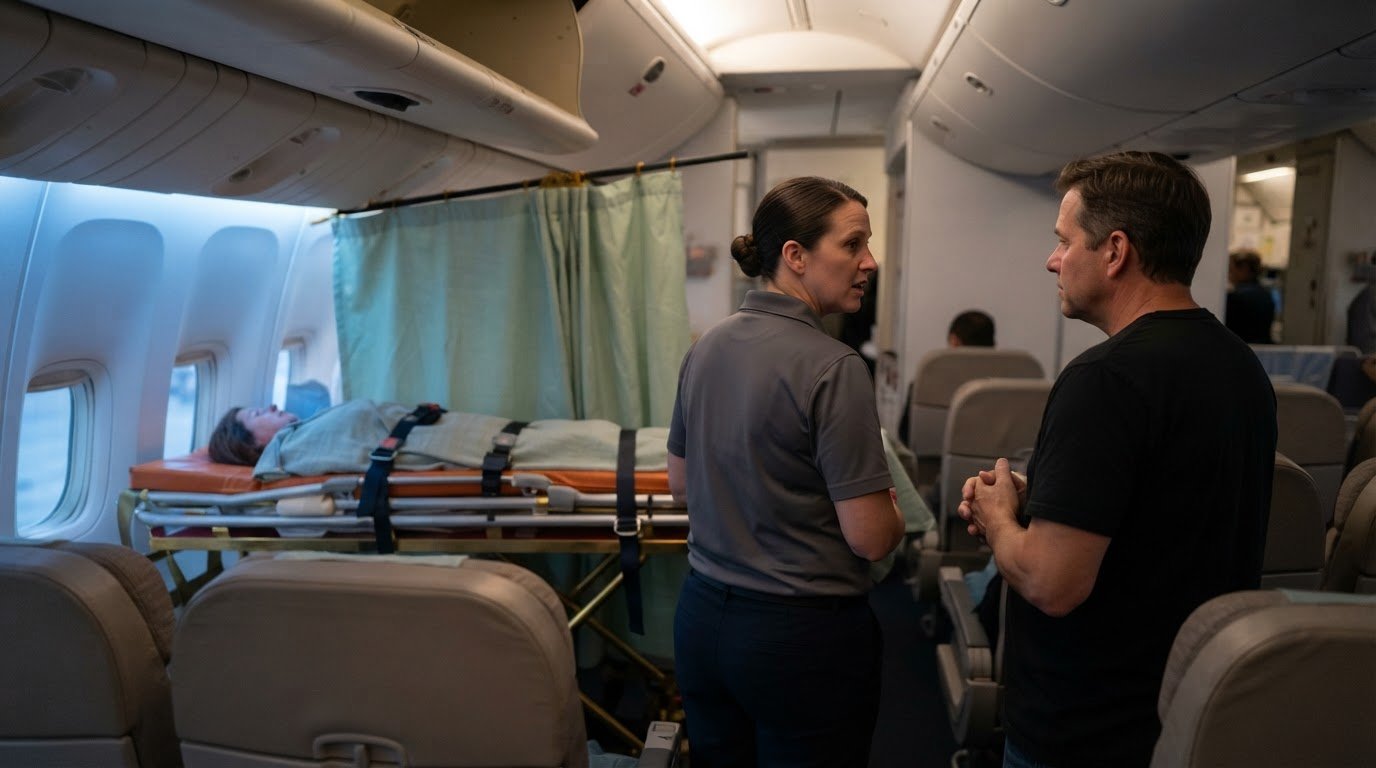
5 Signs Your Loved One Needs a Professional Medical Escort
Families often assume that a patient who can board a commercial flight can also manage the journey alone. For some travelers, that assumption holds. For others, the demands of air travel, including long walks through terminals, medication timing across time zones, and limited access to clinical support, create risks that relatives are not equipped to address. Recognizing the signs patient needs medical escort support before departure allows families, hospitals, and case managers to plan appropriately. This article outlines five indicators that a registered nurse escort may be a more suitable arrangement than travel without clinical support, and it explains how to evaluate each one.
Table of Contents
Quick Takeaways
Key Insight | Explanation |
|---|---|
Test walking tolerance before booking | Measure how far the patient can walk and how long they can stand, using a route similar to the planned trip. Frequent rests in a short corridor indicate that a full airport route will exceed their capacity. |
Map every dose to local time | Write out each medication with its due time at both origin and destination. Confirm with the prescribing clinician how delays and time-zone changes affect each dose. |
Treat disorientation as a safety issue | Confusion at connections or gate changes can escalate quickly. Limit connections where possible and assign a responsible person to each transfer. |
Plan for the discharge window | Patients who have recently left a hospital or rehabilitation facility may need monitoring that exceeds general companionship. Obtain a fitness-to-fly opinion from the treating physician. |
Inventory all equipment and power needs | Oxygen, infusion pumps, and other devices require approval, battery planning, and supply contingencies. List each device with its power and oxygen requirements in the care plan. |
Define the observation level in advance | Decide whether the patient needs occasional help or continuous clinical observation. The answer determines whether a relative, airline assistance, or a registered nurse escort is appropriate. |
Mobility Limits That Make Airports Hard to Manage
Mobility is often the first factor that families overlook. A traveler who moves comfortably through a home may find an airport far more demanding, because terminals involve long corridors, security screening, crowded gates, and unannounced gate changes. Aboard the aircraft, boarding and deplaning can require narrow aisles and extended periods of standing.

Airlines provide wheelchairs and guided assistance on request, and this service is valuable for many travelers. However, airline personnel are assigned to move passengers through specific points of the journey. They do not provide continuous personal care from check-in to arrival, and they are not positioned to respond if a passenger becomes unsteady between those points.
Walking Distance and Standing Tolerance
A useful starting point is to measure how far the patient can walk without rest and how long they can stand in a queue. If the patient needs to stop several times within a short corridor, a full airport route is likely to exceed their tolerance. Families should test this on a route resembling the planned trip, such as a long hospital corridor or a large shopping center, and record the result.
In practice, a recent fall, dependence on a walker or cane, or a need for a wheelchair at all times are strong indicators that the patient will need hands-on support throughout the journey. These needs are not resolved by a single wheelchair handoff at the curb.
Pro tip: Ask for the airline's assistance request to be recorded on the booking, but do not rely on it as the only support plan. Airline assistance moves the passenger between points, and it does not replace a companion who remains with the patient.
Transfers Into and Out of an Airplane Seat
Moving from an aisle chair to a seat, and from a seat to the lavatory, can present the greatest physical risk during a flight. Aircraft seats are narrow, armrests may be fixed, and the aisle can be occupied by other passengers and carts. A patient who needs help to stand, sit, or reposition should be accompanied by someone who understands safe transfer techniques and can act without delay.
A need for help using the restroom is a clear sign that a general travel companion may be insufficient. This assistance involves privacy, dignity, and safety, and it should be provided by someone prepared for that responsibility. Families should answer the question of who will provide this help before the trip begins, not during the flight.
Medication Schedules That Are Difficult to Keep in Transit
Medication problems during travel usually arise from schedule disruption rather than from the medication itself. Delayed flights, connections, time-zone changes, and meals served at unusual hours can shift when a dose is due. A schedule that works at home may not fit a journey that spans several time zones.
Families should not assume that a dose can simply be moved by a few hours. Timing guidance should come from the prescribing clinician before departure, and the plan should specify what to do if the flight is delayed. Medicines should remain in carry-on luggage, accompanied by a current medication list and the patient's relevant medical information.
A medication plan that is accurate at the departure gate may require adjustment before arrival, so it should be reviewed at each stage of the journey.
Doses Administered During the Journey
Some patients need medication given during the flight, including injections or scheduled oral doses that must be taken at specific intervals. Self-administration may be impossible for a patient who is weak, sedated, or unable to follow a written schedule. When a dose must be given by someone with clinical training, a relative without that training is not an adequate substitute.
A registered nurse escort can review the medication list, confirm timing against the care plan, and document each dose. This documentation is useful to receiving clinicians if the patient's care continues after arrival.
Time Zone Changes and Delayed Departures
Time-zone shifts and delays are common causes of missed or duplicated doses. A patient who has waited through a long overnight delay may be less alert when a dose falls due, and that is when errors are most likely to occur. Families planning an international trip should calculate the full schedule in advance, showing both the origin and destination times for every dose.
Where a patient takes several medications at different times, a written timetable with local times reduces the risk of confusion. The timetable should be shared with the escort, the patient, and any receiving facility.
Cognitive Changes and Unfamiliar Settings
Cognitive change is one of the less visible reasons a patient may need professional support in transit. Confusion, memory loss, or disorientation can be manageable at home, where routines and familiar surroundings provide cues. A commercial flight removes many of those cues within a short period, and the patient may be asked to make quick decisions, such as following announcements, locating a gate, or presenting a boarding pass.
Families sometimes underestimate this risk because the patient appears capable in conversation. Changes are often harder to recognize in a noisy terminal than in a quiet room, and a patient may appear calm until a schedule change occurs.
Disorientation at Connections
Connections are the most demanding part of many itineraries. Passengers must move between gates, read new departure boards, and respond to changes in boarding times. A patient who becomes disoriented at a connection may wander, miss a flight, or become distressed, and a companion without clinical training may not recognize the early signs.
A practical safeguard is to limit the number of connections when possible and to request direct routing where it is available. Where a connection cannot be avoided, the escort should know the planned gate, the expected transfer time, and the contact details of the people responsible for the patient's care.
Recognizing Early Signs of Decline
Early changes in alertness, speech, or behavior may signal a medical problem rather than ordinary fatigue. A trained escort can distinguish between expected travel tiredness and changes that require action. Family members cannot always make that distinction in real time, particularly when they are also managing luggage and travel documents.
Pro tip: Record the patient's usual speech patterns, sleep habits, and orientation cues before travel. A written baseline makes it easier for an escort or receiving clinician to identify a meaningful change.
Recent Discharge and Ongoing Treatment Needs
A patient who has recently left a hospital, rehabilitation facility, or skilled nursing setting may still be in a fragile stage of recovery. Discharge instructions are written for the home environment, and travel introduces variables that those instructions may not address. Clinical teams commonly advise a conversation about fitness to fly before a trip, and that conversation should cover the specific care the patient will need in transit.

Families should not assume that discharge marks the end of clinical oversight. Wound care, monitoring of vital signs, and follow-up instructions may continue for some time after the patient returns home. A flight during this period requires a plan for the same level of care.
Timing After a Hospital or Rehabilitation Stay
The period immediately after discharge is when complications are most likely to surface without warning. A patient who appeared stable before departure may develop fatigue, pain, or a change in breathing during a flight. Because the cabin limits access to equipment and staff, the patient needs someone who can recognize symptoms and act on the care plan.
Where the discharge summary lists follow-up tasks, each task should be assigned to a named person for the duration of the trip. Assigning responsibility in advance avoids the gaps in care that occur when family members assume someone else is monitoring the patient.
Oxygen, Infusions, and Other Equipment
Patients who use oxygen, infusion pumps, or other medical equipment face practical constraints in flight. Devices must be approved for use on the aircraft, batteries must be managed, and oxygen supply must be planned for possible delays. Each device adds a set of checks that a family member may not have performed before.
A registered nurse escort can help coordinate these checks, confirm that equipment is functioning, and respond if a device alarms. This arrangement reduces the number of decisions the family must make while the patient is traveling.
Need for Continuous Clinical Observation
The final sign concerns the level of observation the patient requires from departure to arrival. Some travelers need occasional help, while others need someone who watches for changes throughout the journey. When the patient's condition could change quickly and the consequences would be serious, periodic check-ins are not sufficient.
Continuous observation differs from general companionship. A companion may stay close to the patient, but without clinical training that companion may not know which changes require action. The central question is not only whether someone will be present, but whether that person can recognize and respond to a medical event.
What a Companion Can and Cannot Assess
A family member or friend can provide valuable practical support, including carrying luggage, managing documents, and offering reassurance. These roles are important, but they do not include assessing symptoms, interpreting changes in vital signs, or administering care under a clinical plan. Families should be realistic about which of these tasks the companion is prepared to perform.
A registered nurse is trained to observe a patient, identify concerning changes, and follow an established plan. This training is the main reason an RN escort on a commercial flight can serve as a lower-cost alternative to a dedicated air ambulance for patients whose needs are medical but do not require emergency transport.
Documenting a Care Plan Before Departure
A written care plan is the foundation of any medical escort arrangement. The plan should list diagnoses relevant to travel, current medications and timing, equipment, known triggers for concern, and contact details for the treating physician. It should also state what the escort should do if symptoms change and when emergency care is required.
Families should obtain the physician's written input before the trip, particularly where questions about fitness to fly or medication timing remain open. The plan should be shared with the escort, with the airline where appropriate, and with the receiving facility or family member at the destination.
Comparing Escort Options for Air Travel
Families typically consider several options when a patient needs help during air travel. Each option differs in clinical support, cost, and suitability. The table below summarizes three common approaches so that the decision can be matched to the patient's documented needs.
Option | Clinical Support Provided | Typical Fit |
|---|---|---|
Family member or friend | General practical assistance. Clinical training is generally not present. | Patients with stable conditions and mainly practical support needs |
Airline assistance on request | Wheelchair and guided movement between points of the journey. No continuous personal or clinical care. | Patients whose only need is mobility help through the airport |
Registered nurse escort on a commercial flight | A registered nurse accompanies the patient from departure through arrival, monitors condition, and follows an established care plan. | Patients with medication, equipment, or observation needs who do not require a dedicated air ambulance |
A common mistake is to select an option based on mobility alone. A patient who walks slowly but has stable medical needs may be well served by airline assistance and a capable companion. A patient with ongoing medication, equipment, or observation needs usually requires a clinically trained escort, even when mobility is manageable.
Some families also compare a registered nurse escort on a commercial flight with a dedicated air ambulance. The RN escort option is designed for patients who need clinical oversight in transit but do not require the dedicated aircraft and stretcher configuration of an air ambulance. Further service details are available on the air ambulance service page.
Planning a Medical Escort Arrangement
Once the signs described in this article have been assessed, planning should begin as early as possible. Flight schedules, seat availability, and equipment approvals take time to arrange, and late requests leave fewer options. Hospitals, case managers, and families generally achieve better outcomes when the escort is arranged in parallel with the medical clearance rather than after it.

Gathering Documentation Before Booking
Documentation should include the physician's clearance or recommendation, the current medication list, relevant discharge paperwork, and a description of each device with its power requirements. Case managers often find that a single consolidated file reduces delays at each stage of the booking.
Families should also confirm identification and travel documents early, since missing paperwork can delay boarding for both the patient and the escort.
Requesting a Quote and Scoping the Escort
A quote should reflect the actual scope of the journey, including door-to-door transfers, hospital-to-hospital movement, or support at the destination. Scope affects both cost and staffing, so the request should describe the full route rather than only the flight segment. The service team can then match the level of clinical support to the documented needs.
A free quote is available by phone, and it is advisable to request one as soon as the signs in this article are identified. Early contact allows the team to review the plan before travel dates are fixed.
Pro tip: Send the complete itinerary, including ground transfers and connection times, with the initial request. Ground movement and connections often determine the escort's workload more than the flight itself.
Frequently Asked Questions
What are the most common signs that a patient needs medical escort?
The most common signs include limited walking tolerance, medication that must be given during travel, cognitive changes in unfamiliar settings, a recent hospital discharge, and equipment such as oxygen. Any one of these may justify an escort, and several together usually make the case stronger.
When should a family hire a medical escort instead of traveling alone?
A family should consider a medical escort when the patient needs clinical observation, scheduled treatment during the flight, or hands-on help that a relative cannot reasonably provide. The decision should be based on the treating physician's guidance and the patient's documented needs.
Does an airline provide medical escort services?
Airlines provide wheelchair and guided assistance on request, but they do not provide continuous personal or clinical care. A medical escort is a separate arrangement that stays with the patient from departure through arrival.
How far in advance should a medical escort be arranged?
Arrangements should begin as early as possible once travel is being considered, ideally in parallel with the medical clearance. Late requests may limit flight options and staffing choices.
Is a registered nurse escort the same as an air ambulance?
No. A registered nurse escort accompanies a patient on a commercial flight and provides clinical oversight in transit. An air ambulance is a dedicated aircraft service with a different scope and cost structure, and it is generally selected for patients whose condition requires that level of transport.
Families, case managers, and clinicians who have arranged air travel for a patient are invited to share which of these signs proved most useful in their planning decisions.
We would love your feedback and any insights you would share with others. What perspective would you add?