Privacy Considerations During Medical Transport: How PHI Is Protected
A patient’s privacy doesn’t pause during a medical journey. Privacy considerations during medical transport start with understanding that HIPAA, the federal law passed in 1996, protects health information, according to the U.S. Congress. The U.S. Department of Health and Human Services Office for Civil Rights explains that HIPAA applies primarily to healthcare providers, health plans and clearinghouses, as well as business associates handling protected health information for covered entities.
It’s natural to want clear answers about who can receive a patient’s information, especially when family members help coordinate care. This article explains how HIPAA may apply to medical transportation, how to handle information with care, and when it may be shared with family or others involved in care. It also covers staff responsibilities and how patients can request limits on certain uses or disclosures. Understanding these boundaries can help you support a patient while respecting their privacy and keeping necessary coordination on track.
Table of Contents
What is HIPAA Compliance and Why is it Important?
HIPAA sets rules for protecting health information during care, including transport involving a covered healthcare organization. Whether it applies depends on who handles the information and why.
HIPAA Coverage and Privacy Requirements
The Health Insurance Portability and Accountability Act (HIPAA) is a United States federal law passed in 1996 to protect the privacy and security of personal health information, according to U.S. Congress. U.S. Congress identifies the Health Insurance Portability and Accountability Act, Public Law 104-191, as the federal legal framework for protecting patient privacy in United States healthcare settings.
HIPAA primarily applies to healthcare providers, health plans, clearinghouses, and business associates handling protected health information for covered entities, according to the U.S. Department of Health and Human Services Office for Civil Rights. A transport provider contracted by a hospital and receiving patient details for treatment may be a business associate. Direct payment alone does not establish the same relationship if the provider isn’t working for a covered entity.
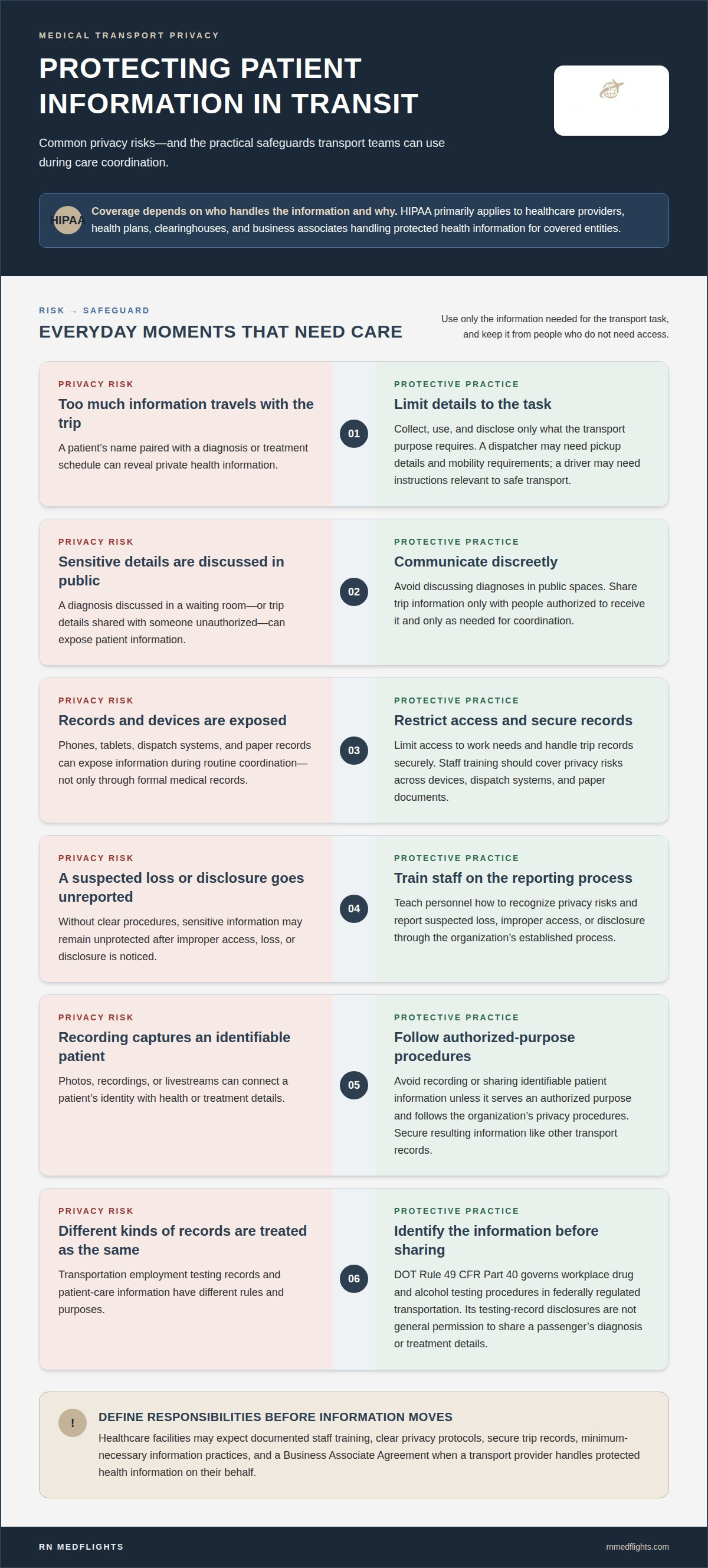
For patients, the practical point is that a name paired with a diagnosis or treatment schedule can identify private health information. Providers should collect, use, and disclose only what the transport purpose requires, and protect records from unauthorized access.
Privacy Training for Transport Staff
Privacy training helps transport staff recognize protected information and handle it appropriately. Drivers and dispatchers may encounter a patient’s name, destination, appointment details, or discharge information, so training should cover discreet communication and access limited to work needs.
For example, staff should avoid discussing a diagnosis in a public waiting room or sharing trip details with someone who isn’t authorized. Training also helps personnel recognize risks involving phones, tablets, dispatch systems, and paper records. Information can be exposed during routine coordination, not just through a formal medical record.
Awareness training should explain how staff report suspected loss, improper access, or disclosure through the organization’s established process. Clear procedures help personnel respond promptly instead of leaving sensitive information unprotected.
HIPAA and DOT Regulatory Overlap
HIPAA and Department of Transportation rules address different privacy contexts. In the United States, DOT Rule 49 CFR Part 40 governs workplace drug and alcohol testing procedures in the federally regulated transportation industry and can require disclosure of testing information.
DOT drug and alcohol testing information may be disclosed to employers and medical professionals involved in testing without the employee’s authorization. This applies to testing records, not as general permission to share a passenger’s diagnosis or treatment details during transport.
That distinction matters when transportation employment records and patient-care information arise in the same setting. Staff should identify the type of information they’re handling and follow the applicable process, rather than treating every record as interchangeable.
Recording and Photographing Patients
Recording, photographing, or livestreaming can capture a patient’s identity alongside health or treatment details. Staff should avoid recording or sharing identifiable patient information unless it serves an authorized purpose and follows the organization’s privacy procedures. Any resulting protected information should be secured like other transport records.
HIPAA provides a federal privacy framework, while state-specific requirements depend on the jurisdiction and information involved. Patients can ask which state rules govern their transport and how those rules affect recording or disclosure.
If a patient suspects a privacy violation, they can report it to the transport company’s compliance contact. If the issue remains unresolved, they can also file a complaint with the HHS Office for Civil Rights.
Staff privacy training and transport credentials
Privacy training helps transport workers recognize health information and handle it confidentially. A driver may see a discharge paper, hear a diagnosis, or receive a destination tied to treatment. In each situation, staff must consider what information is needed for the task and who may receive it.
Privacy Training and Facility Expectations
Healthcare facilities may expect transport teams to document staff training and follow clear privacy protocols. They may also require a Business Associate Agreement when a provider handles protected health information on their behalf. These expectations help define responsibilities before patient details pass between facility staff, dispatchers, and drivers.
Facility expectations may include a minimum-necessary information policy, secure handling of trip records, and professional conduct around patients and staff. For example, a dispatcher may need a pickup location and mobility requirement, while a driver may need only instructions relevant to safe transport. Limiting details reduces unnecessary sharing across the team.
Transport credentials and privacy training address different concerns. Credentials relate to a worker’s assigned role, while training prepares them to handle sensitive information appropriately. A facility may request documentation of training and enforcement, but that does not replace practical procedures for daily work.
Workforce Privacy Training
Effective workforce training covers how to recognize protected health information, share it appropriately, and respond to privacy risks. Staff should understand that a patient’s name paired with an appointment type or destination can reveal health information. The Health Insurance Portability and Accountability Act provides the privacy framework, while workplace instruction turns it into clear routines.
Training should use transport-specific examples. A driver should avoid discussing a patient’s condition in a lobby, elevator, or public sidewalk. Dispatch staff should share trip details only with personnel who need them for their work. A worker who notices an unattended document or misdirected message should promptly follow the organization’s reporting process.
Digital handling also needs practical instruction. Staff should use business-controlled systems when possible, protect devices with passwords and encryption, and restrict access by role. A tablet containing trip details should not be left open where unauthorized people can view it. These habits protect information during dispatch, pickup, travel, and handoff.
Consistent staff practices make privacy easier for patients to understand throughout a transfer. They help ensure that each person involved receives relevant information without turning a care-related conversation into unnecessary disclosure. Facilities and transport teams can reinforce this standard through documented training, clear access limits, and procedures staff can use on real trips.
Disclosures permitted without patient authorization
Patient authorization isn’t required for every disclosure, but that doesn’t make health information freely shareable. During medical transport, the purpose, recipient, and applicable rule determine whether information may be shared. Staff should distinguish details needed to coordinate a trip from records governed by a separate legal process.
Healthcare providers and dispatch staff may need relevant details to coordinate transport. A pickup location, appointment time, mobility need, or receiving facility can support the trip. A diagnosis or complete medical history may reveal more than the transport task requires. Limiting each disclosure to its purpose helps prevent unnecessary exposure.
Electronic systems require the same care as spoken updates. Before sending trip details, staff should identify the recipient and confirm the information is relevant to that person’s role. For example, a dispatcher coordinating a pickup may need a destination and timing, while an unrelated employee does not need the patient’s treatment history. Messages and records should remain protected from unauthorized access.
Some disclosures arise under transportation-specific rules rather than routine patient-care coordination. In the United States, DOT Rule 49 CFR Part 40 governs workplace drug and alcohol testing procedures in the federally regulated transportation industry and can require disclosure of testing information. Drug and alcohol testing information may be disclosed to employers and medical professionals involved in testing without the employee’s authorization.
Regulatory oversight can also permit disclosures. Employers and service agents may release DOT testing information to federal, state, and local agencies with regulatory authority over them or their employees. That permission applies to relevant testing information and authorized oversight. It isn’t a blanket reason to disclose unrelated passenger health details or appointment information.
Other situations have distinct limits. DOT drug and alcohol testing history may be shared with a new employer if the individual agrees to its release. In litigation following a commercial motor vehicle accident, a claimant can request the involved driver’s DOT physical information and medical examiner certificates. A request does not mean unrestricted access to every health record.
Patients can ask what information is being shared, with whom, and for what transport or legal purpose. Staff can explain the recipient and reason in plain language. If a request concerns testing records, a regulator, or litigation, the team should use the appropriate process instead of sending records through ordinary dispatch. This distinction keeps necessary coordination moving while separating passenger care details from transportation compliance records.
Disclosures to family members and people involved in a patient's care
Family members may help coordinate a medical journey, but their relationship alone doesn’t establish permission to receive trip details. Drivers should share information only with people authorized by the patient or coordinating healthcare entity. This protects the patient while allowing necessary communication to continue.
Before sharing an update, staff should identify the recipient and the purpose. A patient might authorize a daughter to receive the pickup time but not discuss treatment details. Another patient may direct all updates through a hospital case manager. Clear instructions help drivers and dispatch staff avoid assumptions based on who arrives or calls.
Useful updates can be limited to what the recipient needs. For example, an authorized family member may need to know that the vehicle has arrived or that the patient reached the receiving facility. A diagnosis, medication list, or full medical record may not be needed to convey that progress. Each disclosure should remain relevant to its purpose.
Police, bystanders, and nearby family members can create privacy risks during an emergency or routine transfer. People may overhear a patient’s name, destination, or treatment details, while an unsolicited request can prompt accidental disclosure. Staff can reduce exposure by speaking discreetly, moving conversations away from crowds when practical, and directing updates to authorized contacts.
The Health Insurance Portability and Accountability Act (HIPAA) provides a privacy framework for health information, but transport communication also depends on the patient’s stated preferences and coordination instructions. If a relative asks for records, staff shouldn’t treat the request as proof of authorization. They should follow the established process and share only information appropriate to that person’s role.
Patients and families can clarify communication by identifying a preferred contact during transport planning. They can specify which updates that person may receive and whether staff should avoid discussing particular details in front of others. A coordinating healthcare entity can also provide relevant instructions, helping the transport team keep communication consistent from pickup through handoff.
When instructions are unclear, staff should pause nonessential disclosure and seek direction through the coordination process. For example, if two relatives make conflicting requests, a driver should not choose between them based on family role. The team can clarify the patient’s preference or the healthcare entity’s instructions before sharing additional details.
Good privacy practice doesn’t require excluding families. It means involving the right people, sharing relevant updates, and handling records with care. A calm, direct explanation can help relatives understand why staff limit details while keeping the patient’s dignity and communication preferences at the center of the journey.
Requesting restrictions on PHI use and disclosure
Patients can express preferences about how protected health information is used or shared during transport. A clear request helps staff understand which details are sensitive, who may receive them, and what communication the patient wants limited. Clear privacy considerations during medical transport begin with expressing those preferences in specific, practical terms.
Make the request specific. For example, a patient might ask that appointment details not be discussed in public areas or that trip updates go only to a named family contact. Identify the information, the people involved, and the situation where the restriction matters. A broad request to “keep everything private” may not give staff enough direction to coordinate care.
Share the request with the healthcare department coordinating the trip and the transport team handling communication. If several organizations are involved, such as a hospital and transport provider, ask how the instruction will be passed between them. This helps reduce gaps between scheduling, pickup, and handoff.
Patients can also ask whether a requested limit applies to spoken updates, electronic messages, trip records, or all three. For instance, a patient may prefer that a driver confirm arrival without mentioning the treatment destination in front of bystanders. Describing the situation gives staff a practical boundary to follow.
A restriction request should distinguish privacy preferences from information needed for safe coordination. A transport team may need pickup and destination details to complete the trip, while a family member may not need the patient’s diagnosis. Ask which information is essential for the stated purpose and which details can remain undisclosed. These privacy considerations during medical transport help patients communicate boundaries without losing sight of coordination needs.
For clarity, patients can provide the request in writing and keep a copy with their transport documents. Include the patient’s name, the requested limit, the authorized contact, and the relevant communication scenario. Ask the coordinating department to record the instruction and explain how staff will use it during the journey. These steps create a clear reference without assuming the requested restriction applies to every organization.
HIPAA compliance involves handling protected information according to applicable privacy practices. If a patient believes staff shared sensitive details improperly, they can describe what happened, when it occurred, who received the information, and how the disclosure took place. The transport company’s compliance contact can receive the concern; unresolved issues may also be raised with the HHS Office for Civil Rights.
Clear preferences can support discreet communication throughout a transfer. For help discussing a medical journey with defined handoff and communication needs, discuss bed-to-bed medical transport.
RN MEDflights: Bed-to-Bed Medical Transport
RN MEDflights provides Bed-to-Bed Medical Transport for patients who need coordinated support between care settings. This service can suit a planned transfer where continuity between pickup and arrival matters. Ground Ambulance Coordination supports the ground portions of a journey, while Commercial Airline Medical Escort or Domestic Medical Relocation may suit other transport needs.
As you plan, share the patient’s communication preferences and identify who may receive travel updates. These details help keep coordination clear while respecting the patient’s privacy. The right transport arrangement depends on the patient’s needs, route, and care plan.
To discuss a medical transfer and available transport options, contact RN MEDflights.
Plan the Next Journey With Privacy in Mind
Keeping privacy considerations during medical transport in view can help families and care teams plan communication before a journey begins. Agree on who should receive updates, what information is useful, and how the patient’s preferences will guide conversations during the transfer. A clear plan gives everyone a shared starting point.
For patients who need help arranging travel between care settings or locations, RN MEDflights offers Commercial Airline Medical Escort, International Medical Repatriation, and Domestic Medical Relocation. The right option depends on the patient’s transport needs and journey.
Contact RN MEDflights to discuss the next step for your medical transport. With a plan in place, you and your family can move forward with greater clarity and confidence.
Frequently Asked Questions
What privacy laws apply during medical transport in the United States, including HIPAA?
HIPAA is the federal privacy framework for health information handled by covered healthcare organizations and their business associates. Whether a transportation provider is covered depends partly on its relationship with a covered entity and the information it handles. State privacy laws may also apply, and their requirements can vary. For a trip crossing state lines, the organizations coordinating care should account for the rules that apply to their roles and locations.
When does HIPAA allow ambulance crews to share patient information without consent?
HIPAA doesn’t give ambulance crews blanket permission to share patient information. Where HIPAA applies, disclosure must have a permitted purpose and should be limited to what that purpose requires. Information needed to coordinate a patient’s care or transport, for example, is different from details shared out of curiosity. Staff should follow their organization’s privacy procedures and not treat a family relationship, uniform, or request alone as authorization to disclose patient information.
How should EMS providers protect patient conversations and medical records during transport?
EMS providers should speak discreetly and keep records and electronic devices from public view. For example, crews can avoid discussing a patient’s condition where bystanders may overhear, secure paperwork during movement, and restrict digital access to personnel who need it for their work. If a handoff requires sharing information, communicate details relevant to continued care rather than exposing unrelated records. These habits help protect the patient’s dignity during a stressful journey.
Can patients request a private ambulance ride or limit who receives transport information?
Patients can communicate who may receive updates and what details they prefer staff not to share. A request for a private ambulance ride is separate from those privacy preferences and doesn’t itself guarantee an exclusive vehicle. Patients can state their communication preferences during planning, name an authorized contact, and ask the coordinating team to record the instructions. For travel involving a medical escort, RN MEDflights offers Commercial Airline Medical Escort and Bed-to-Bed Medical Transport.


