


Flying with an Elderly Parent with Dementia: A Clinical and Practical Guide (2026)
- 20 hours ago
- 15 min read
Imagine standing in a crowded terminal at Dallas/Fort Worth in 2026, watching your mother's face cloud with the sharp confusion of a sundowning episode while the final boarding call echoes overhead. You aren't just worried about the flight; you're managing the weight of her safety and the fear of a public medical crisis. Flying with an elderly parent with dementia is one of the most complex logistical challenges a family caregiver can face. It's natural to feel overwhelmed by the intricate TSA disability policies or the anxiety of a medical emergency at 30,000 feet.
We understand that your primary goal is a dignified, safe journey that protects your loved one's well-being. This clinical guide outlines exactly how to navigate these hurdles, providing you with a detailed safety plan and clear criteria for when a specialized flight nurse is required. You'll learn how a structured bedside-to-bedside transition can eliminate the chaos of travel. We'll walk you through the essential medical preparations and airline protocols to ensure a seamless, stress-free experience for your entire family.
Key Takeaways
Understand the physiological impact of high-altitude hypoxia and why the aircraft cabin acts as a "deliriogenic" environment for those with cognitive impairment.
Navigate the logistical complexities of flying with an elderly parent with dementia by mastering essential documentation and specialized TSA Cares security protocols.
Recognize the critical "red flags" that signal when a standard commercial flight requires the clinical expertise of a licensed Flight Nurse to ensure patient safety.
Explore how a comprehensive "Bed-to-Bed" medical escort service eliminates caregiver stress by managing every detail from ground transport to airline coordination.
Gain peace of mind by learning to implement medication safety strategies and routines that mitigate sensory overload and preserve the dignity of your loved one.
Table of Contents The Reality of Flying with an Elderly Parent with Dementia Clinical Risks: Managing Delirium and Medication Safety The Caregiver’s Practical Checklist for Commercial Flights When to Hire a Commercial Medical Escort RN MEDflights: Seamless Bed-to-Bed Medical Transport
The Reality of Flying with an Elderly Parent with Dementia
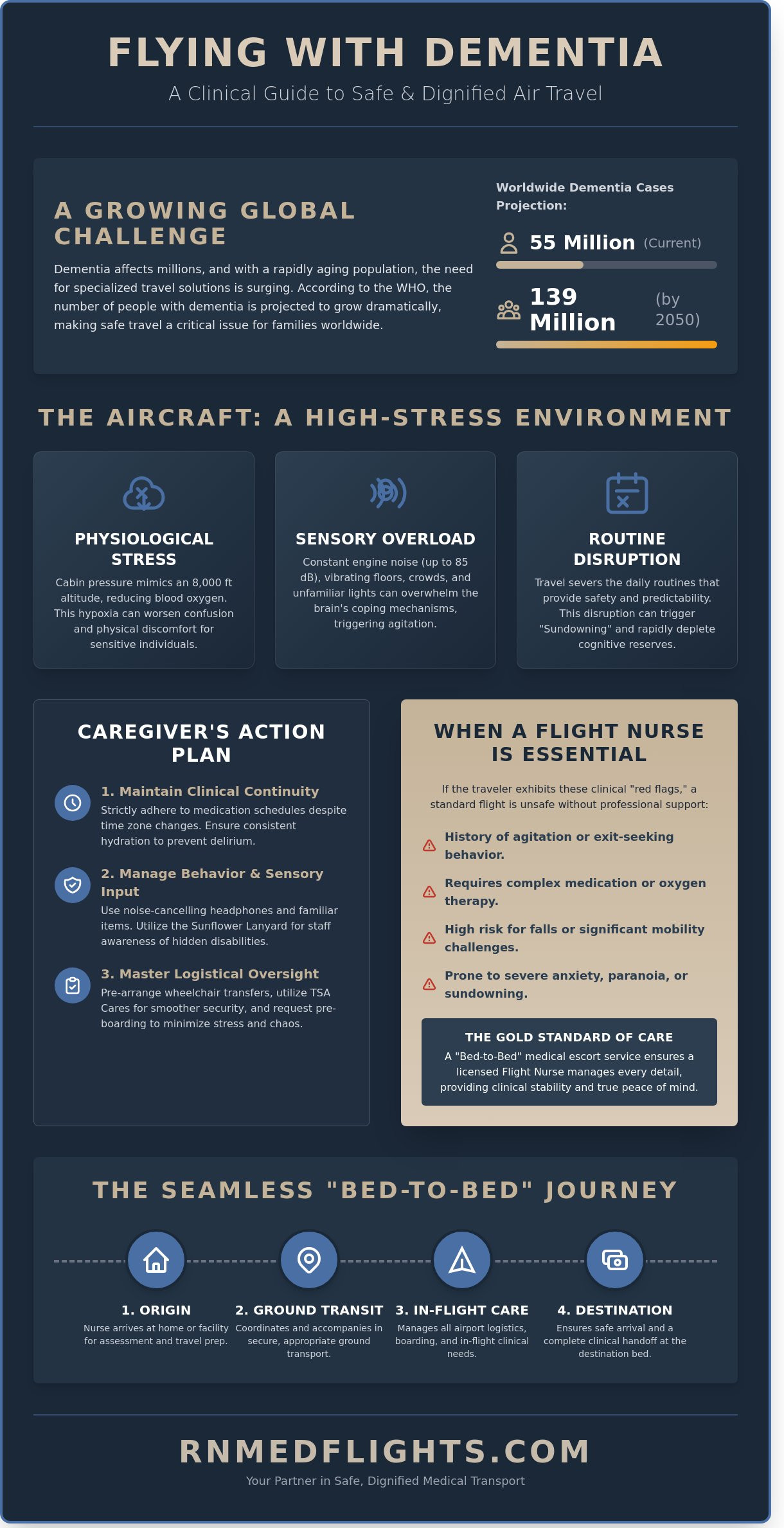
Flying with an elderly parent with dementia involves navigating a complex intersection of medical necessity and logistical precision. It's a journey that demands more than just a ticket and a suitcase; it requires a deep understanding of how neurological decline interacts with the stressors of modern aviation. According to the World Health Organization, Dementia currently affects approximately 55 million people worldwide. This number is projected to surge to 139 million by the year 2050, making specialized travel solutions a growing necessity for families across the globe. This condition isn't merely a lapse in memory. It's a progressive clinical state that impairs a person's ability to process sensory information and maintain emotional regulation in unfamiliar settings.
Air travel acts as a catalyst for confusion, placing the patient in a high-stakes environment where every sound, light, and crowd becomes a potential trigger. For the caregiver, the stakes are equally high. You're balancing the physical safety of your loved one against the rigid requirements of airline protocols. Our primary objective is to establish a "Peace of Mind" framework that prioritizes clinical stability and dignity from takeoff to touchdown. Achieving this often requires moving beyond standard commercial travel. A professional medical escort represents the gold standard for long-distance relocation, providing a seamless, bedside-to-bedside transition that ensures the patient remains medically and emotionally secure throughout the flight.
The challenges of flying with elderly parent with dementia require a proactive clinical strategy. We focus on three core pillars of care:
Clinical Continuity: Maintaining medication schedules and hydration despite time zone shifts.
Behavioral Management: De-escalating agitation caused by the "Sundowning" effect or sensory overload.
Logistical Oversight: Managing wheelchair transfers, security screenings, and boarding without causing distress.
Why Familiarity Matters: The Disruption of Routine
For a patient with cognitive impairment, daily routines act as "anchors" that provide a vital sense of safety. These anchors are severed during airport transitions. Security checkpoints, changing gates, and boarding queues strip away the familiar markers of a patient's day. This disruption frequently triggers the "Sundowning" effect, a phenomenon where confusion and agitation intensify during the late afternoon and evening. Scheduling a flight during these hours can exacerbate symptoms significantly. Cognitive reserve is the brain's ability to improvise and find alternate ways of completing a task; travel depletes this reserve rapidly. Once this mental energy is exhausted, the patient's ability to cope with even minor changes vanishes, leading to distress or withdrawal.
Sensory Overload in the Aviation Environment
The aviation environment is a relentless storm of sensory triggers. Cabin pressure changes cause physical discomfort that a patient with advanced cognitive decline may not be able to articulate. Constant white noise, which often reaches levels of 85 decibels during flight, combined with the visual chaos of crowded terminals, creates a state of hyper-arousal. These triggers often lead to exit-seeking behavior or intense physical agitation. To mitigate these risks, recognizing "hidden disabilities" is essential. The Sunflower Lanyard program, now recognized in over 200 international airports, alerts staff that the traveler may need extra time or specialized support. Utilizing these tools, alongside a trained medical professional, helps maintain a calm environment and prevents the escalation of behavioral crises during the journey.
Clinical Risks: Managing Delirium and Medication Safety
Air travel is inherently deliriogenic. This clinical term describes an environment that actively promotes acute confusion and disorientation. While a healthy brain can filter out the constant 80-decibel drone of jet engines, a brain affected by neurodegeneration often lacks this sensory gatekeeping. When flying with elderly parent with dementia, the combination of vibrating floors, confined seating, and unfamiliar faces creates a perfect storm for a "sundowning" event, regardless of the time of day.
Physiological stressors amplify these environmental factors. At cruising altitudes, aircraft cabins are pressurized to mimic an elevation of approximately 8,000 feet. This leads to a natural decrease in blood oxygen saturation. For a cognitively impaired patient, even a 4% drop in oxygen levels can impair executive function and trigger a rapid onset of delirium. We prioritize stabilizing these variables to ensure the patient remains grounded in their surroundings. Families should consult the Alzheimer's Association travel guide to understand the baseline behavioral expectations before addressing these complex clinical safety needs.
Medication management requires a sophisticated approach. We strictly adhere to the 2023 Beers Criteria, a clinical gold standard that identifies medications potentially inappropriate for older adults. Many "standard" travel aids fall into this high-risk category. Our specialized flight coordinators work with your existing medical team to review every prescription, ensuring that the flight plan prioritizes neurological stability over simple sedation.
The Danger of Paradoxical Reactions
Common over-the-counter sleep aids like Benadryl or certain benzodiazepines often produce the opposite of their intended effect in dementia patients. Instead of sleep, these drugs can trigger a paradoxical reaction characterized by extreme agitation, vocalizations, and physical lashing out. You should schedule a consultation with a geriatrician at least 21 days before your departure to trial any new medications in a controlled home environment. Anticholinergic medications pose a severe risk of triggering sudden delirium and physical restlessness during flight.
Hydration and Nutrition Management
Dehydration is a primary catalyst for increased confusion in the elderly. Aircraft cabins typically maintain humidity levels below 20%, which is lower than the average desert. This dry air rapidly depletes the body's fluid reserves. When flying with elderly parent with dementia, a lack of fluids can lead to a urinary tract infection (UTI), which is a leading cause of sudden behavioral decline in seniors. We recommend a structured intake plan:
Offer 4 to 6 ounces of water or electrolyte-balanced fluids every 60 minutes.
Maintain steady glucose levels with small, protein-rich snacks every 2 hours to prevent "hangry" agitation.
Use high-absorbency incontinence products to manage bathroom logistics with dignity, as aircraft lavatories are often too cramped for assisted transfers.
Limit caffeine and sugar, which can disrupt sleep-wake cycles and increase anxiety.
Our nurse-led teams focus on these minute details to maintain a steady clinical baseline. By managing hydration and nutrition with a rhythmic, methodical approach, we reduce the cognitive load on the patient. This proactive care model ensures that the journey remains a seamless transition rather than a medical crisis. We provide a constant, unwavering presence that is ready to respond 24/7/365 to any shift in the patient's status.
The Caregiver’s Practical Checklist for Commercial Flights
Preparation is the foundation of a safe journey when you are flying with elderly parent with dementia. Your medical documentation must be organized and accessible at every transition point. You need a "Fit to Fly" letter from a primary care physician dated within 14 days of your departure. This letter confirms the patient is stable for pressurized cabin environments and outlines any specific triggers. Carry a printed list of all medications, including exact dosages and administration times, to ensure continuity of care. You should also keep a detailed copy of the Healthcare Power of Attorney (POA) in your carry-on to ensure you have the legal authority to make medical decisions during a crisis.
Seat selection significantly impacts the sensory environment for someone with cognitive impairment. Avoid the back of the aircraft. Engine noise in the rear of a Boeing 737 can reach 85 decibels, which often triggers agitation or "sundowning" symptoms. Selecting a seat in the front third of the cabin provides a quieter experience and allows for faster egress upon landing. While being near a lavatory seems logical, the constant foot traffic and the sound of the vacuum-flush system can increase confusion and anxiety. A window seat is often the most therapeutic option; it provides a visual anchor and limits the number of people passing by the patient.
Your "Dementia Travel Kit" should be a curated collection of familiar sensory inputs. Clinical experience shows that tactile engagement reduces the risk of behavioral escalations. Pack the following essentials:
Noise-canceling headphones: High-quality models like the Bose QuietComfort can reduce ambient engine noise by 30 decibels.
Fidget tools: A specialized fidget blanket or a simple piece of soft fabric provides a calming repetitive activity.
Hydration and nutrition: Pack familiar, easy-to-chew snacks to maintain blood sugar levels and prevent irritability.
Clothing: Include two sets of comfortable, layered clothing in case of incontinence or temperature fluctuations.
Navigating the Airport: Security and Boarding
Contact TSA Cares at 855-787-2227 at least 72 hours before your flight. This service provides a passenger support specialist to guide you through security checkpoints, which reduces wait times that often lead to sensory overload. When you arrive at the gate, speak privately with the agent. Use a printed "disability card" that explains your parent has a memory impairment. This approach maintains their dignity while ensuring the crew is aware of potential needs. Request early boarding only if your parent feels calmer in a settled environment. If they are prone to wandering, boarding last minimizes the time spent in the confined space of the cabin.
In-Flight Management Strategies
Managing a flight requires active observation and redirection. If you are flying with elderly parent with dementia and notice increasing restlessness, use redirection techniques immediately. Offer a familiar photo album or a simple tablet-based game to provide a cognitive distraction. If the patient becomes fixated on leaving the seat, use a firm but gentle touch on the arm to ground them. Alert the flight attendants if you observe a sudden change in behavior, such as increased combativeness or extreme lethargy. Flight crews are trained in basic first aid, but they rely on your knowledge of the parent's baseline to provide effective support during the flight.
When to Hire a Commercial Medical Escort
Deciding when to transition from a family-led trip to professional medical transport is a pivotal moment for any caregiver. While your dedication is absolute, the physiological and cognitive stressors of air travel often exceed what a family member can safely manage. When flying with elderly parent with dementia, the environment shifts from a familiar home to a high-stimulus, pressurized cabin. This change can trigger unpredictable behaviors that require clinical intervention. Hiring a commercial medical escort isn't a sign of failure; it's a commitment to uncompromising safety and patient dignity.
Red Flags for Family-Led Travel
Clinical data indicates that 60% of individuals with dementia will wander at some point. If your parent has a history of wandering or experiences aggressive outbursts in crowded spaces, the risk in a busy terminal is critical. Incontinence issues that require two-person assistance for safe transfers in a cramped aircraft lavatory also signal a need for professional help. Additionally, if the patient manages complex medication schedules for heart or lung conditions, the altitude-induced hypoxia of a commercial flight can exacerbate these issues. You shouldn't have to manage a medical crisis at 35,000 feet alone.
The Value of Clinical Supervision
A licensed Flight Nurse brings a level of expertise that a layperson cannot replicate. These professionals are trained to identify the subtle signs of medical distress before they escalate into full emergencies. They manage everything from oxygen saturation monitoring to the administration of PRN medications for anxiety or agitation. By securing a professional, the family transitions from being a stressed medical coordinator to a supportive companion. You can focus on holding your parent's hand while the RN handles the logistics. Learn more about Who Needs a Medical Escort for Commercial Flights? to see if your situation qualifies.
Choosing between a commercial medical escort and a private air ambulance often comes down to medical stability and budget. A commercial escort typically costs between $5,000 and $12,000, whereas a private air ambulance can easily exceed $35,000 for domestic routes. If the patient is stable but requires clinical supervision, the commercial option provides a seamless, bedside-to-bedside solution without the extreme cost of a private jet. It's a specialized service that ensures integrity throughout the journey while keeping the patient in a standard first-class or business-class seat for comfort.
Guilt often weighs heavily on families when they delegate care. However, providing your parent with a Flight Nurse is an act of deep compassion. It protects their dignity during vulnerable moments, such as managing hygiene in public or dealing with sudden confusion. Professional care ensures a stress-free environment, which is the greatest gift you can offer during a difficult transition. Our team remains available 24/7/365 to provide the steady hand you need during these high-stress moments. When flying with elderly parent with dementia, having a professional advocate ensures that the patient is always viewed as a person rather than just a case.
If you're ready to ensure a safe journey, contact our flight coordinators to
today.
RN MEDflights: Seamless Bed-to-Bed Medical Transport
Relocating a loved one with cognitive impairment requires more than just a plane ticket; it demands a continuous chain of clinical custody. At RN MEDflights, we operate under a strict "Bed-to-Bed" philosophy. This means our responsibility begins at the patient's current bedside and doesn't end until they're safely tucked into their new home or facility. When you're flying with elderly parent with dementia, the gaps between transport stages are where risks escalate. We close those gaps by providing a single, unbroken line of care that prioritizes safety and emotional regulation.
Our team manages the entire logistical architecture of the trip. We don't expect families to coordinate ground ambulances or negotiate with airline special assistance desks. Instead, our flight coordinators synchronize every moving part. We schedule the ground transport at both ends, manage TSA medical clearances, and handle boarding priorities. This comprehensive oversight ensures that transitions are quiet, quick, and clinical. By removing the logistical burden from the family, we allow you to focus on being a supportive presence rather than a travel agent.
The relocation process follows a disciplined, five-step sequence to ensure nothing is left to chance:
Clinical Intake: Within 24 hours of your first contact, our medical team conducts a thorough assessment of the patient's current health status and specific dementia triggers.
Logistical Mapping: We design a custom itinerary that minimizes layovers and utilizes airports with the quietest sensory environments.
Ground-to-Air Transition: A licensed Flight Nurse arrives at the point of origin to stabilize the patient and oversee the initial ambulance transfer.
In-Flight Care: Our nurses provide constant monitoring, medication administration, and "environmental buffering" to keep the patient calm in the cabin.
Final Bedside Handoff: We accompany the patient into their new residence, providing a full clinical briefing to the receiving caregivers.
The Bed-to-Bed Promise
The most dangerous moments for a patient with memory loss occur during hand-offs. Moving from a bedroom to an ambulance, or an ambulance to a crowded terminal, can trigger a "fight or flight" response. Our Bed-to-Bed promise ensures that the same medical professional who greets the patient at their home is the one who helps them settle at the destination. This consistency builds a vital sense of familiarity. Our dedicated flight coordinators are available 24/7/365 to manage every logistical variable, ensuring you never face a scheduling crisis alone.
A Nurse-Led Approach to Dignity
We believe that flying with elderly parent with dementia should be a journey defined by respect, not just medical necessity. Our nurses are trained to see the person beyond the diagnosis. They use de-escalation techniques that preserve the patient's dignity, avoiding chemical restraints whenever possible in favor of environmental adjustments. Having a clinical advocate is also essential when interacting with airline personnel. Our RNs speak the language of aviation and medicine, ensuring that flight crews understand the patient's needs without causing a scene. It's about providing a steady hand in a complex environment.
We're ready to help you plan a safe, dignified relocation for your family member. Request a transparent quote for your loved one's journey today.
Taking the Next Step Toward a Safe Arrival
Navigating the complexities of flying with elderly parent with dementia requires a meticulous approach to both clinical safety and logistical planning. You've learned how to identify the risks of travel-induced delirium and the necessity of maintaining a rigorous medication schedule during transit. While a commercial flight remains possible with the right preparation, the cognitive and physical load on a family caregiver can be overwhelming. Since 2010, our veteran-owned team has specialized in bridging this gap by providing licensed Registered Flight Nurses who manage every medical detail. We handle the entire process through comprehensive bed-to-bed coordination, ensuring your parent never faces a transition alone. This professional oversight transforms a high-stress event into a managed, clinical procedure centered on dignity and patient comfort. Our flight coordinators are available 24/7/365 to discuss your specific needs and build a custom transport plan. You don't have to carry the weight of this transition by yourself. Ensure a safe, nurse-led journey for your parent; Contact RN MEDflights. We are here to provide the steady hand and expert care your family deserves.
Frequently Asked Questions
Can someone with advanced dementia fly on a commercial airline?
Yes, individuals with advanced dementia can fly on commercial airlines, but it requires meticulous planning and often a professional medical escort. The International Air Transport Association (IATA) notes that cognitive impairment doesn't automatically disqualify a passenger; however, the airline can deny boarding if they believe the patient poses a safety risk to themselves or others. You'll need to ensure they have 1-to-1 supervision throughout the entire journey to manage disorientation and ensure they don't wander into restricted areas of the aircraft.
Do airlines provide special assistance for passengers with Alzheimer's?
Airlines provide basic logistical support under the Air Carrier Access Act (ACAA), such as priority boarding and wheelchair assistance to the gate. However, airline staff aren't trained to provide clinical care or constant supervision for a passenger with Alzheimer's. When flying with elderly parent with dementia, you must arrange for a dedicated companion because flight attendants cannot assist with medication administration, toileting, or emotional de-escalation during the flight. It's your responsibility to provide the continuous care they need.
What medications can I give my parent to keep them calm during a flight?
You should only administer medications that have been specifically prescribed and "test-run" at home at least 72 hours before the flight. Physicians often prescribe low-dose benzodiazepines like Lorazepam or antipsychotics like Quetiapine to manage travel-induced agitation. It's vital to document the exact dosage and timing in a written log. Never try a new sedative for the first time at 30,000 feet, as paradoxical reactions occur in approximately 15% of elderly patients, potentially increasing agitation instead of reducing it.
How do I handle a dementia meltdown in the middle of a flight?
Stay calm and use short, reassuring phrases to redirect their attention to a familiar object, like a photo album or a favorite snack. If the agitation escalates, notify the flight crew immediately so they can provide extra space or assistance. Use noise-canceling headphones to reduce the 80-decibel engine hum, which often triggers sensory overload in patients. Having a professional nurse present ensures that clinical interventions are handled discreetly and safely without disrupting other passengers or compromising the flight's integrity.
Is a medical escort covered by Medicare or private insurance?
Medicare Part B generally doesn't cover non-emergency medical transport or commercial medical escorts. While 95% of private insurance policies view these services as elective, some long-term care insurance providers may reimburse a portion of the costs if the travel is medically necessary for a change in care levels. We recommend contacting your provider to request a "Letter of Medical Necessity" review. Most families pay for these specialized services through private funds or health savings accounts to ensure bedside-to-bedside safety.
What is a 'Fit to Fly' letter and how do I get one for dementia?
A 'Fit to Fly' letter is a formal document signed by a physician within 10 days of travel that confirms the patient's stable condition. It must explicitly state that the passenger is cleared for high-altitude travel and list any required medical equipment. To get one, schedule a clinical assessment with your parent's neurologist. This letter protects you from being denied boarding and ensures the airline is aware of the specific needs of your elderly parent with dementia. It acts as a vital safety clearance for the crew.
What are the benefits of hiring a flight nurse instead of flying alone?
Hiring a flight nurse provides a 100% safety net by placing a clinical expert at your side from bedside to bedside. These professionals manage all logistics, from navigating TSA checkpoints to monitoring vital signs and administering medications mid-flight. This specialized care reduces the risk of "sundowning" or wandering in crowded terminals. It allows family members to focus on emotional support while the nurse handles the complex medical and rhythmic demands of the journey, providing true peace of mind.
How does RN MEDflights handle international medical repatriation for dementia patients?
RN MEDflights manages international repatriation through a seamless, 24/7/365 coordination process that includes securing all necessary medical clearances and ground transport. Our flight coordinators arrange every detail, ensuring a nurse-led transition across borders and time zones. We maintain a strict protocol for medication timing and hydration to combat the effects of jet lag on cognitive function. This end-to-end responsibility guarantees that your loved one moves with dignity and uncompromising safety across every mile of their journey home.