


Medevac Jet vs. Commercial Medical Escort: Choosing the Right Medical Flight in 2026
- 21 hours ago
- 14 min read
The most expensive flight isn't always the safest choice for your loved one. While many families believe a private medevac jet is the only way to ensure medical stability, data from 2025 shows that 60% of long-distance patient transfers are successfully completed using commercial medical escorts. Choosing the wrong tier of service can lead to unnecessary costs exceeding $50,000 without providing additional clinical benefits for a stable patient.
We understand the heavy weight of this decision and the fear that comes with transporting a vulnerable family member. You want the best care possible, but the overwhelming logistics and price tags can feel paralyzing. This guide clarifies exactly when a specialized medevac jet is a medical necessity and when a commercial escort offers a more comfortable, cost-effective alternative. You'll discover how to secure a bedside-to-bedside solution that prioritizes safety while potentially reducing your expenses by 70%. We'll walk you through the 2026 standards for flight coordination and clinical staffing so you can move forward with absolute peace of mind. Our nurse-led team is here 24/7/365 to ensure your loved one's journey is managed with clinical precision and deep compassion.
Key Takeaways
Identify whether your loved one requires the specialized environment of a private flight or the cost-effective comfort of a commercial medical escort.
Understand the transparent pricing factors of a medevac jet in 2026 to avoid unexpected expenses like fuel surcharges during a medical crisis.
Learn how a "Fit to Fly" assessment ensures patient safety for common conditions such as dementia, mobility issues, or post-operative recovery.
Discover how nurse-led coordination provides seamless, bedside-to-bedside care through every stage of an international medical journey.
Compare clinical capabilities between ICU-level private care and Advanced Life Support to choose the safest path for a dignified and stress-free repatriation.
Table of Contents What is a Medevac Jet? Understanding the Air Ambulance Landscape The True Cost of a Medevac Jet in 2026 Medevac Jet vs. Commercial Medical Escort: A Side-by-Side Comparison Is Your Loved One Fit for a Commercial Medical Flight? Seamless Bed-to-Bed Care with RN MEDflights
What is a Medevac Jet? Understanding the Air Ambulance Landscape
A medevac jet is a specialized private aircraft engineered to function as a mobile intensive care unit. These planes serve a vital role in the global healthcare system by bridging the gap between distant medical facilities when ground transport is impossible or unsafe. The history and development of Air medical services show how these specialized aircraft became the gold standard for high-acuity patient transfers. At RN MEDflights, our flight coordinators operate 24/7/365 to ensure that every mission maintains uncompromising clinical standards. While a standard private jet focuses on passenger luxury, a medevac jet prioritizes life support and physiological stability above all else.
The primary role of these aircraft involves transporting patients who require continuous medical monitoring or advanced life support during transit. Families often reach for this option first during a crisis because it represents the highest tier of medical transport available. It's a natural reaction to seek the most robust solution when a loved one's health is at stake. However, the decision to book a medevac jet often happens under extreme emotional pressure. This leads many families to overlook other safe, professional alternatives that might be more appropriate for a stable patient's specific clinical needs.
Technical features set these aircraft apart from the rest of the aviation world. Every medevac jet in our network is equipped with a specialized electrical system to power medical devices without interruption. We utilize hardened mounting points for stretchers and oxygen systems that meet strict FAA safety regulations. Our nurse-led teams ensure that every piece of equipment, from the portable power supply to the backup oxygen tanks, is checked with clinical precision before the wheels leave the tarmac. This level of detail provides the peace of mind that families need during their most difficult moments.
The Mechanics of a Flying ICU
Inside these aircraft, you'll find a sophisticated suite of advanced life support technology. Every flight includes a specialized stretcher system, multi-parameter monitors, and transport ventilators capable of managing complex respiratory needs. Maintaining a sea-level cabin pressure is essential; it prevents gas expansion in body cavities which can be life-threatening for patients with recent surgeries. These jets access over 5,000 regional airports across the United States. This allows us to land much closer to a patient's bedside than commercial airlines, significantly reducing the duration of stressful ground ambulance transfers.
Emergency vs. Non-Emergency Medical Flights
We categorize these missions into two distinct paths. Time-critical transports involve active trauma or acute cardiac events where every 60 seconds impacts the clinical outcome. However, data suggests that 40% of medical flight inquiries involve medical relocations rather than emergencies. These are stable patients moving for long-term care or family proximity. In these scenarios, a medevac jet is often over-prescribed. A patient who is hemodynamically stable doesn't always require a $50,000 private flight. We focus on providing care with dignity, ensuring that families don't pay for unnecessary resources when a commercial escort could provide the same bedside-to-bedside safety at a fraction of the cost.
The True Cost of a Medevac Jet in 2026
By 2026, the financial landscape of private medical transport has shifted significantly. The cost of chartering a medevac jet now reflects a complex intersection of rising aviation logistics and high-acuity healthcare demands. Families often face immediate sticker shock when they receive an initial quote; however, the base price is only the starting point. Several variables drive these costs upward, starting with the distance of the transport and the specific aircraft size required for the patient's clinical condition. A small Learjet 35 might suffice for a stable patient on a short trip, but a larger Challenger 604 becomes necessary if the mission requires multiple medical staff or specialized equipment like an ECMO machine.
Hidden costs in private air ambulance charters frequently catch families off guard. Repositioning fees are a major factor. If a dedicated air ambulance is currently stationed in Denver but the patient is in Miami, the family pays for that "empty" flight leg to reach the patient. Fuel surcharges in 2026 have also become more volatile, often adding 12% to 18% to the final invoice. While some brokers mention "empty leg" discounts, these are rarely viable for medical transport. A patient's health cannot wait for a random flight schedule. Relying on a discounted slot often means sacrificing the strict clinical oversight and timing required for a safe journey.
To help you plan, here are the realistic price ranges for domestic and international services in the current market:
Short-haul domestic (under 1,000 miles): $28,000 to $52,000
Transcontinental (e.g., NYC to LA): $68,000 to $98,000
International long-haul (e.g., Europe to US): $115,000 to $230,000
Why Private Medical Flights Are So Expensive
Operating a medevac jet requires an uncompromising commitment to safety and readiness. Maintaining a dedicated aircraft in a constant state of alert costs providers upwards of $3.5 million annually per plane. This includes the 24/7/365 availability of specialized flight crews and a clinical team trained in aerospace medicine. Aviation fuel prices have risen by 9.4% annually over the last three years, directly impacting the cost of long-haul medical repatriation. Every flight requires a seamless coordination of ground ambulances, air traffic priority, and bedside-to-bedside clinical monitoring to ensure patient safety.
Insurance Coverage and Financial Realities
Health insurance providers rarely cover the full cost of a private air ambulance. Most policies require proof of absolute "medical necessity," which means the patient cannot be moved by any other means without risking their life. According to the U.S. Department of State on Medical Evacuation, costs for these services can exceed $100,000, and the government does not provide funding for private citizens. This financial hurdle is why many families now choose a specialized commercial medical escort as a more affordable, yet equally safe, alternative. It provides the same clinical dignity and peace of mind at a fraction of the private jet price, allowing for a stress-free transition home.
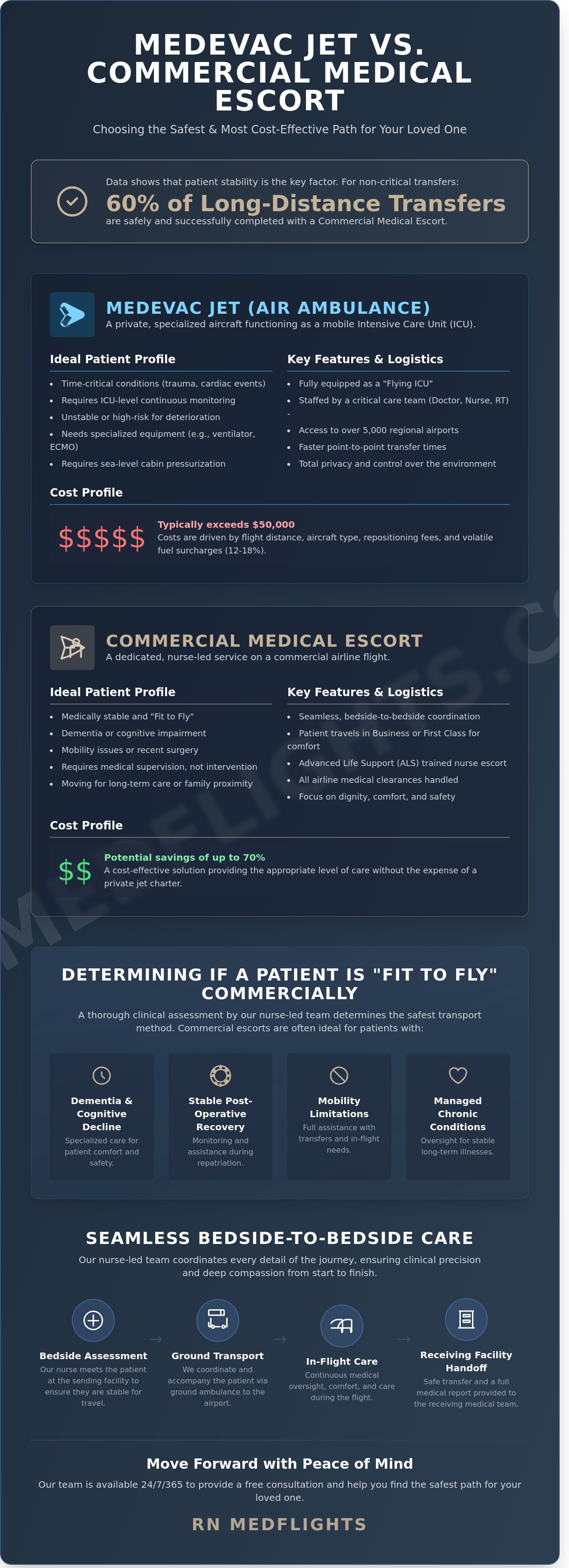
Medevac Jet vs. Commercial Medical Escort: A Side-by-Side Comparison
Choosing between a medevac jet and a commercial medical escort is a decision that balances clinical necessity with financial reality. A commercial medical escort involves a patient traveling on a scheduled airline, such as United or American Airlines, while accompanied by a specialized Flight RN. This service is designed specifically for patients who are stable but require professional clinical oversight. While a dedicated air ambulance operates as a mobile intensive care unit, a commercial escort provides high-level Advanced Life Support (ALS) in a traditional cabin environment. It's a sophisticated solution for those who don't require the invasive monitoring of a flying ICU but still need a nurse by their side.
For families, the most striking difference is the price. On average, commercial medical escorts save families between 50% and 75% compared to private air medical transport. In 2023, a domestic cross-country flight on a private medevac jet often exceeded $35,000. In contrast, a nurse-led commercial escort for the same route typically costs between $7,000 and $12,000. These savings don't come at the expense of comfort. While a private jet uses a narrow medical stretcher, commercial Business Class offers lie-flat seats and superior climate control. These amenities often result in lower patient fatigue and a more dignified experience during long-distance transfers.
Safety Standards and Clinical Oversight
Our Flight RNs maintain rigorous safety protocols throughout the entire journey. They manage everything from complex medication schedules to continuous pulse oximetry. Most major airlines allow portable oxygen concentrators (POCs) that are FAA-approved, ensuring the patient's respiratory needs are met without interruption. Clinical oversight remains high at every altitude. We follow strict internal safety benchmarks that align with the EMS.gov guidelines for patient transport and regulatory compliance. This ensures that even in a public cabin, the patient receives professional bedside-to-bedside care. Our nurses carry specialized medical kits equipped to handle cardiac monitoring and emergency interventions, providing a safety net that goes far beyond standard airline first aid.
Logistics and Speed: Which is Faster?
A private jet offers the advantage of an on-demand schedule, departing as soon as the crew and medical team are cleared. Commercial escorts rely on the fixed schedules of major airlines, which requires a different type of coordination. However, commercial travel often proves more reliable in terms of mechanical backup. If a commercial plane has a delay, the airline has an entire fleet to pull from, whereas a private jet mechanical issue can ground a mission for days. We typically deploy a medical escort team within 24 to 48 hours of the initial call. Our process includes:
Bedside-to-bedside coordination: We manage ground ambulance transport at both the origin and destination.
Medical clearance: Our coordinators work directly with airline medical desks to secure all necessary approvals.
Ticketing and logistics: We handle all seating arrangements to ensure the nurse is positioned directly next to the patient.
While the private jet is faster for immediate trauma or life-threatening emergencies, the commercial escort is a methodical, highly organized solution for planned repatriations or hospital transfers. It provides a steady, predictable rhythm that lowers the emotional temperature for the family. We ensure every detail is handled with clinical precision, allowing you to focus on your loved one's recovery rather than the logistics of the flight.
Is Your Loved One Fit for a Commercial Medical Flight?
Determining whether a patient is suitable for a commercial medical escort requires a rigorous clinical evaluation. This "Fit to Fly" assessment isn't a mere formality; it's the foundation of patient safety. While commercial transport offers significant cost savings, it's not a universal solution for every medical situation. We look for clinical stability, which typically means the patient has maintained consistent vital signs for at least 48 to 72 hours prior to the journey. Patients recovering from hip fractures, those with early-stage dementia, or individuals needing basic oxygen support often thrive in this setting. However, if a patient is intubated, requires a ventilator, or needs continuous advanced life support, a private medevac jet remains the only safe and viable option. The decision hinges on the level of intervention required during the 10 to 15 hours of a typical international transit.
The psychology of the journey is just as vital as the physical vitals. "Transfer trauma" is a documented phenomenon where the stress of relocation causes a sharp decline in a patient’s condition. Research indicates that up to 45% of elderly patients experience heightened confusion or "sundowning" during long-distance travel. Our flight nurses act as a stabilizing force, providing a familiar clinical presence that reduces cortisol levels and prevents the agitation often seen in unfamiliar environments. By maintaining a calm, authoritative demeanor, we ensure the patient feels like a person receiving care rather than a "case" being moved. This human-centric approach is what allows us to safely utilize commercial cabins for patients who might otherwise require a more expensive medevac jet transport.
The Pre-Flight Medical Clearance Process
Our nursing leadership conducts a comprehensive review of hospital records from the preceding 72 hours. We don't just rely on a standard physician's signature; we analyze arterial blood gas levels and recent cardiac telemetry to ensure the patient can tolerate a cabin altitude of 8,000 feet. If a patient's oxygen saturation fluctuates below 92% on room air, we develop a specific titration plan for the flight. This nursing-led assessment happens before any logistical arrangements are finalized, providing families with 100% clinical transparency. Our goal is to identify potential risks long before we reach the airport gate.
Managing Specialized Needs on Commercial Airlines
Commercial travel requires precise coordination of medical equipment and patient positioning. For post-stroke or orthopedic patients, our nurses implement a strict repositioning schedule every 60 minutes to prevent deep vein thrombosis and skin breakdown. We manage the logistics of FAA-approved Portable Oxygen Concentrators (POCs), ensuring battery life exceeds the flight duration by 150% to account for any ground delays. For patients with cognitive impairments, our specialized care includes:
Symptom Mitigation: Using non-pharmacological de-escalation techniques to manage anxiety during takeoff and landing.
Circulation Management: Utilizing compression therapy and assisted range-of-motion exercises in a standard or business class seat.
Nutritional Support: Monitoring fluid intake and specialized diets to prevent dehydration, which affects 30% of elderly travelers on long-haul flights.
At RN Medflights, we provide a seamless, bedside-to-bedside transition that prioritizes dignity and clinical integrity. If you're unsure which level of care your family member requires, our flight coordinators are available 24/7/365 to provide a professional consultation. Contact our clinical team today to begin your comprehensive "Fit to Fly" assessment and secure the safest path home.
Seamless Bed-to-Bed Care with RN MEDflights
RN MEDflights provides a complete medical journey rather than just a simple transport. Our nurse-led team manages the complex logistics of international repatriation with clinical precision, removing the administrative and emotional burden from the family. The Bed-to-Bed advantage ensures there are zero gaps in care; our team maintains constant supervision from the moment we enter the patient's current hospital room until they're safely settled at their final destination. This continuity of care is vital for maintaining physiological stability and psychological comfort during long-distance travel.
As a veteran-owned organization, we prioritize integrity and mission-focused execution. Our nurse-centric approach means that clinical outcomes drive every decision we make. While a dedicated medevac jet is sometimes necessary for critical ICU patients requiring mechanical ventilation, many stable patients thrive with our commercial escort service at a fraction of the cost. We provide a steady hand during a medical crisis, offering a sense of security that only comes from decades of frontline healthcare experience.
Our 5-Step Medical Transport Process
We follow a methodical, rhythmic process to ensure every detail is addressed. Our team is available 24/7/365 to begin this journey immediately. This structured approach reduces the cognitive load on families who are already experiencing significant stress.
Initial clinical consultation: We perform a comprehensive medical assessment and a cost-benefit analysis to ensure the patient is fit for commercial travel.
Full logistical coordination: Our coordinators handle airline bookings, ground ambulance synchronization, and the 15+ pages of medical clearances required by international carriers.
In-flight care: A Registered Flight Nurse with at least 10 years of ICU or ER experience remains at the patient's side, managing medications, monitoring vitals, and providing emotional support.
Final hand-off: We provide a detailed clinical report to the receiving facility and a debriefing for the family, ensuring a smooth transition of care.
Why Families Trust RN MEDflights Over Private Jet Brokers
Many families mistakenly contact aviation brokers when searching for medical transport. These brokers are sales agents, not clinicians. They often add 15% to 25% in hidden commissions and lack the medical expertise to assess patient safety. Choosing a commercial medical escort instead of a medevac jet through a broker can save families between $30,000 and $100,000 depending on the flight distance. Our pricing is transparent and all-inclusive, with no surprise aviation fees or fuel surcharges.
We believe in treating every patient with the dignity they deserve. Unlike the sterile environment of a broker-led transaction, our interactions are rooted in compassion. You'll speak directly with medical professionals who understand the nuances of the patient's condition. We don't just move cases; we care for people. This commitment to specialized, high-touch service has allowed us to maintain a 100% safety record across thousands of miles of travel. Our goal is to provide a stress-free experience that prioritizes the patient's health and the family's peace of mind above all else.
Request a transparent quote for your medical relocation today
Securing Your Loved One's Safe Return in 2026
Navigating the complexities of medical transport requires a balance of clinical necessity and financial reality. While a specialized medevac jet provides critical care for unstable patients, a commercial medical escort offers a sophisticated alternative for those who meet specific stability criteria. Choosing the commercial route often results in cost savings of 50% to 70% compared to private air ambulances. Since 2010, our veteran-owned and nurse-operated team has managed these transitions with uncompromising precision and integrity. We handle every detail of the comprehensive bed-to-bed logistics, ensuring clinical experts oversee each mile of the journey. This specialized approach prioritizes patient dignity while reducing the logistical burden on your family during a high-stress crisis. Our seamless process ensures that safety and peace of mind remain the top priorities.
You don't have to manage these medical logistics alone. Our flight coordinators are available 24/7/365 to evaluate your specific situation and provide a clear, safe path forward. We're ready to provide the expertise and empathy your family deserves. Get a Free Consultation with a Flight Coordinator to explore your options today. You can rest assured that your loved one is in the most capable hands.
Frequently Asked Questions
What is the main difference between a medevac jet and a medical escort?
The main difference is that a medevac jet is a private aircraft configured as a flying intensive care unit, while a medical escort provides clinical care on a scheduled commercial flight. Medevac jets provide total control over the environment for unstable patients. Commercial escorts offer a 70% cost reduction for stable patients who can sit or lie in a first-class seat. Our flight coordinators evaluate 12 clinical markers to determine which option ensures the highest level of safety for your loved one.
How much does a medevac jet cost for an international flight?
International flights on a medevac jet typically range from $50,000 to $200,000 depending on the distance and aircraft size. For example, a flight from London to New York often costs $85,000. These prices include the specialized flight crew, a two-person medical team, and all fuel surcharges. Choosing a commercial escort instead can lower these expenses to approximately $15,000 for the same route, providing significant financial relief to families during a crisis.
Can a patient fly on a commercial airline if they need oxygen?
Patients can fly on commercial airlines with oxygen, but they must use FAA-approved portable oxygen concentrators. Airlines like Delta or United require a medical clearance form submitted at least 48 hours before departure. Our registered nurses manage this entire process, ensuring the battery life exceeds the flight duration by 150%. We handle the logistics so the patient never experiences a gap in their respiratory support during the journey, maintaining clinical stability from takeoff to landing.
Does insurance cover the cost of a commercial medical escort?
Private insurance policies cover the cost of a commercial medical escort in approximately 40% of cases if the transport is deemed medically necessary. You'll need a letter of medical necessity from the attending physician to start the claim. While Medicare rarely pays for international repatriation, some premium travel insurance plans cover 100% of the expenses. Our team provides detailed documentation to help families maximize their reimbursement potential after the mission is complete.
How long does it take to arrange a medical repatriation flight?
We can typically arrange a medical repatriation flight within 24 to 72 hours of the initial call. Our 24/7/365 operations center begins the process by obtaining medical reports and coordinating with the receiving facility immediately. The timeline often depends on airline seat availability or the specific permits required for international airspace. We work quickly to minimize the time a patient spends in a foreign hospital, providing a seamless transition home to their local care team.
What medical equipment does a flight nurse bring on a commercial flight?
A flight nurse carries a specialized medical kit containing a portable heart monitor, pulse oximeter, and emergency medications. This equipment allows us to track vital signs every 15 minutes during the flight. We also bring automated external defibrillators and advanced life support supplies tailored to the patient's specific diagnosis. Every piece of technology is compact and approved for use in pressurized cabins to maintain clinical standards throughout the trip, ensuring we're prepared for any situation.
Is a medical escort safe for a patient with dementia?
Medical escorts are highly safe for patients with dementia, as a nurse provides the constant supervision required to prevent agitation. Statistics show that 95% of patients with cognitive impairments travel without incident when a clinical professional manages their environment. We use calming techniques and timed medication schedules to reduce the stress of crowded terminals. This specialized care ensures the patient maintains their dignity while moving through complex airport security and boarding processes without feeling overwhelmed.
What is "Bed-to-Bed" medical transport and why is it important?
Bed-to-bed medical transport is a comprehensive service where we maintain responsibility for the patient from their current hospital bed to their final destination. This continuity of care is vital because it eliminates the risks associated with hand-off errors during ground transfers. Our nurses stay with the patient in the ambulance, through the airport, and into the receiving facility. This peace of mind approach ensures that clinical monitoring never stops for even a single minute during the entire journey.