Relocating Aging Parents Long Distance: The 2026 Clinical & Logistical Guide
Updated: May 5
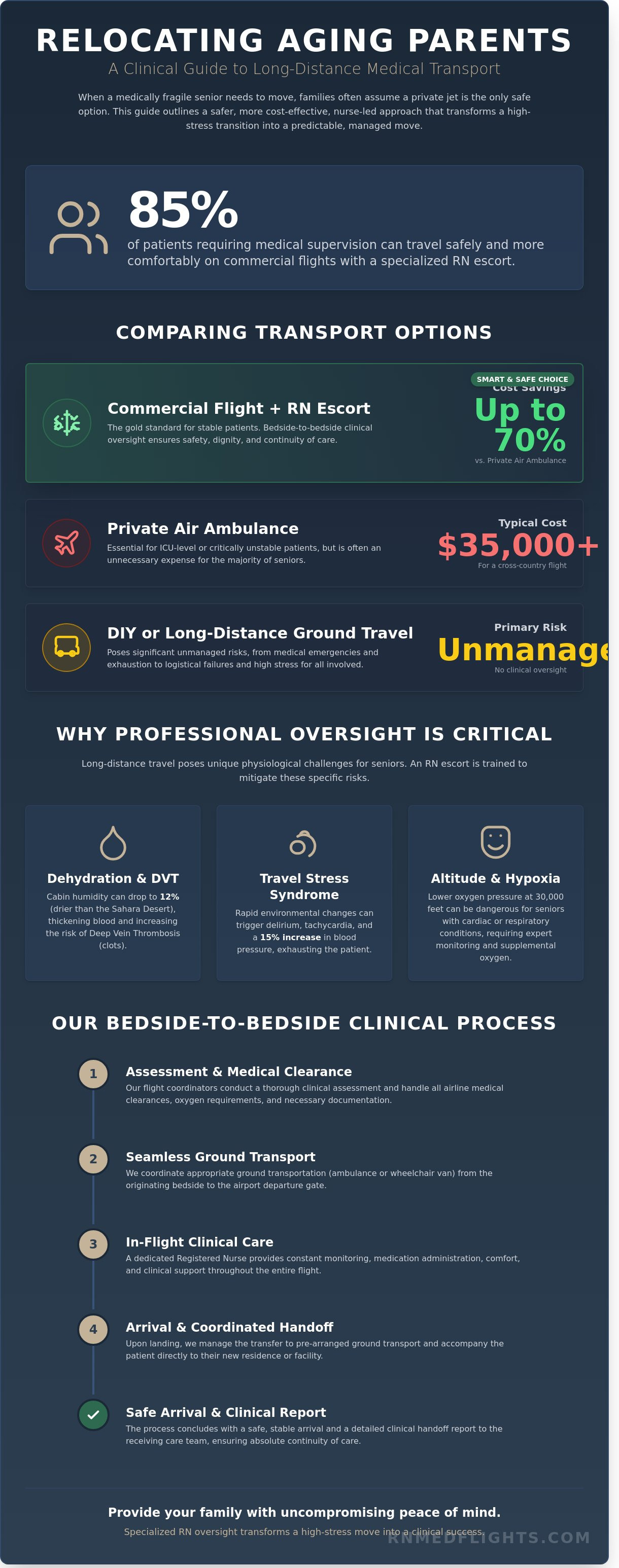
The most expensive option isn't always the safest choice for a medically fragile senior. When relocating aging parents long distance, many families assume a $35,000 private air ambulance is the only way to maintain clinical stability. However, 85 percent of patients who require medical supervision can travel safely, and often more comfortably, on a commercial airline when accompanied by a specialized flight coordinator and a registered nurse. You likely feel the heavy weight of responsibility and the fear that a cross-country journey might trigger a sudden health decline or physical exhaustion for your loved one.
It's natural to feel overwhelmed by the complexity of oxygen requirements, ground transportation, and terminal logistics. This 2026 clinical guide provides a clear roadmap to achieving a safe, uneventful travel day while reducing transport costs by as much as 70 percent compared to private jets. We'll outline the exact steps for securing professional medical oversight and ensuring bedside-to-bedside continuity of care. You'll learn how our nurse-led approach prioritizes dignity and clinical precision, transforming a high-stress transition into a managed, predictable move that protects your parent's health every mile of the way.
Key Takeaways
Identify the clinical "tipping point" where local care is no longer sustainable, ensuring you balance your parent's medical safety with their personal autonomy.
Discover how to mitigate the physiological risks of relocating aging parents long distance, including "Travel Stress Syndrome" and altitude-related oxygen challenges.
Evaluate transport modes to understand why a nurse-led commercial flight provides a safer, more cost-effective alternative to traditional ground ambulances or DIY travel.
Master a professional bed-to-bed relocation checklist to secure necessary medical clearances and coordinate seamless transitions between healthcare facilities.
Learn how specialized RN oversight transforms a high-stress move into a clinical success, providing your family with uncompromising peace of mind.
Table of Contents The Decision to Relocate: Assessing When Long-Distance Travel is Necessary Physiological Risks: Why Long-Distance Travel is Different for Seniors Comparing Transport Modes: Finding the Safest, Most Cost-Effective Path The Bed-to-Bed Relocation Checklist: A Step-by-Step Logistical Plan Why RN MEDflights is the Gold Standard for Senior Relocation
The Decision to Relocate: Assessing When Long-Distance Travel is Necessary
Deciding to move a loved one requires a balance of clinical logic and emotional grace. By 2026, the United States will see a 15% increase in "silver migration" as families consolidate care resources to manage the complex needs of the oldest Baby Boomers. This demographic shift isn't just a trend; it's a response to a healthcare system that often leaves seniors isolated. The tipping point often arrives when the risks of staying put outweigh the benefits of familiarity. While Aging in place is the preferred goal for 77% of adults over 50, environmental hazards or health declines often make this unsustainable. Relocating aging parents long distance becomes a medical necessity when local support systems can no longer guarantee 24/7 safety.
Families must evaluate the destination with uncompromising clarity. Whether the move is to a specialized memory care unit, an assisted living facility, or a private residence, the goal remains the same: continuity of care. This transition isn't just about changing an address. It's about establishing a specialized environment where professional medical oversight is always within reach. We view this process as a clinical handoff. It starts with a comprehensive assessment of the parent's current stability and ends with a seamless arrival at their new home. Integrity in this decision-making phase prevents future medical crises. It's about being proactive rather than reactive.
Part of this proactive approach involves understanding the operational standards of the destination. For example, well-managed facilities ensure continuity not just in medical care but in all support services, often using modern solutions for needs like cleaning and hospitality staffing. While based in Norway, the staffing platform LetME exemplifies this new approach, connecting employers with reliable, vetted personnel to maintain high standards of service—a principle that is just as critical in a senior living environment.
The emotional weight of this choice is heavy. You're balancing a parent's desire for autonomy with the objective reality of their vulnerability. It's a high-stress situation that demands a calm, authoritative approach. We focus on providing peace of mind by handling the complex logistics, allowing families to focus on the person, not the process. Every step is methodical. Every decision is backed by medical expertise. This ensures the move isn't a source of trauma, but a transition to a higher standard of living and safety.
Clinical Indicators for Relocation
Cognitive decline is often the most pressing catalyst. When Alzheimer's progresses, a secure environment is absolute to prevent wandering. Physical health also dictates the timeline. If a home has steep stairs, the risk of a life-threatening fall increases by 25% for seniors with mobility issues. Social isolation acts as a silent killer; research indicates chronic loneliness increases premature death risk by 26%. A move to a care-rich environment can extend a parent's life significantly.
Building Family Consensus
The logistics of relocating aging parents long distance often triggers friction between siblings. The local caregiver feels overwhelmed, while the long-distance sibling feels guilty. To maintain dignity, involve the parent in the discussion early. Give them choices regarding their new environment to preserve autonomy. Geriatric care managers provide an objective perspective. These experts act as clinical navigators, ensuring decisions rest on medical facts rather than emotional impulses, facilitating a smooth bedside-to-bedside transition.
Physiological Risks: Why Long-Distance Travel is Different for Seniors
Relocating aging parents long distance involves more than booking a ticket; it requires a deep understanding of how aging biology reacts to 30,000 feet. Travel Stress Syndrome isn't a vague term. It describes a specific set of symptoms including tachycardia, elevated cortisol, and acute delirium triggered by rapid environmental changes. For a senior, the loss of their "home base" can lead to a 15% increase in blood pressure during transit. When the brain can't easily map a new environment, the body stays in a state of "high alert," which exhausts the patient before they even reach their new home.
On flights exceeding 180 minutes, the risk of Deep Vein Thrombosis (DVT) increases significantly. For a passenger over age 70, the combination of cramped seating and low humidity creates a dangerous physiological environment. Blood thickens as cabin humidity levels drop to 12%, which is lower than the average humidity of the Sahara Desert. This makes consistent hydration and passive leg exercises non-negotiable. Without professional monitoring, a minor clot can quickly escalate into a pulmonary embolism during the final leg of the journey.
The psychological impact of moving is often termed "Transfer Trauma." This condition manifests as physical illness, including acute gastrointestinal distress or sudden cognitive decline. You can mitigate these risks by maintaining clinical continuity throughout the process. Using a guide for relocating your parent helps organize the logistics, but professional medical oversight ensures the body remains as stable as the itinerary. Our team focuses on a bedside-to-bedside model to prevent the physiological "shocks" that occur during unsupervised transfers between cars, terminals, and planes.
The Impact of Altitude on Chronic Conditions
Commercial aircraft cabins are pressurized to simulate an altitude of 6,000 to 8,000 feet. At these heights, the partial pressure of oxygen drops. For a parent with COPD or congestive heart failure, this reduction can lead to rapid desaturation. Hypoxia is the state in which the body or a region of the body is deprived of adequate oxygen supply at the tissue level. Managing supplemental oxygen on a commercial flight requires 48-hour advance coordination with the airline's medical desk and the use of FAA-approved portable oxygen concentrators. A flight coordinator ensures these levels are monitored every 30 minutes to prevent respiratory distress.
Medication and Routine Disruption
A 3-hour time zone shift can wreak havoc on a strict medication schedule. Missed doses of blood thinners or insulin during airport delays often lead to emergency room visits upon arrival. For those with dementia, afternoon travel often coincides with "sundowning," a period of increased confusion and combativeness that peaks as natural light fades. A professional flight nurse provides the necessary clinical hand to administer PRN (as-needed) medications safely. This expert intervention keeps the patient hemodynamically stable and calm, ensuring that the transition doesn't result in a medical crisis. Our 24/7/365 readiness means we're prepared for the delays that typically break a senior's routine.
Comparing Transport Modes: Finding the Safest, Most Cost-Effective Path
Choosing the right mode of transport is the most critical decision you'll make when relocating aging parents long distance. This choice directly impacts your loved one's physiological stability and your family's financial health. Many families initially consider a DIY approach, attempting to manage a standard commercial flight alone. However, the clinical reality is often stark. Statistics show that approximately 15% of seniors with underlying chronic conditions experience medical setbacks during unassisted travel. Without professional oversight, the stress of security lines, terminal navigation, and cabin pressure changes can lead to an emergency room visit within 48 hours of arrival.
Ground ambulances offer a different set of challenges. While they provide a controlled environment, a 1,000-mile journey often takes 16 to 20 hours to complete. This extended duration increases the risk of pressure sores and significant physical exhaustion. For a senior with limited mobility, sitting in a narrow cot for nearly an entire day is rarely the safest option. Conversely, a private air ambulance provides an ICU-level environment in the sky. While this is the gold standard for safety, the cost typically ranges from $25,000 to $55,000, making it inaccessible for many. The commercial medical escort serves as the professional middle ground, utilizing a Registered Flight Nurse to manage care on a standard airline at a fraction of the cost.
Managing these logistics while balancing your own life is a heavy burden. Long-distance caregiving requires a specialized approach to ensure nothing is missed during the transition. Our flight coordinators handle every detail, from medical clearances to ground transportation, providing a seamless bedside-to-bedside experience that prioritizes patient dignity.
Cost vs. Care: A Comparative Breakdown
The financial disparity between transport modes is significant. A commercial medical escort generally costs between $5,000 and $12,000, depending on the distance and specific care needs. In contrast, a private medevac flight can easily exceed $50,000 for a cross-country trip. The level of care also varies. A family member offers emotional support, but a Registered Flight Nurse provides clinical interventions. Our nurses monitor oxygen saturation, manage complex medication schedules, and utilize specialized techniques to prevent travel-related complications like deep vein thrombosis. Speed is another factor; a flight that takes five hours saves your parent from the 15-hour fatigue of a ground transport.
Commercial Escort: $5,000 to $12,000; includes RN care and all logistics.
Private Air Ambulance: $25,000 to $55,000+; necessary for ICU-level requirements.
Ground Ambulance: $8,000 to $15,000 for long distances; high fatigue factor.
When is a Private Air Ambulance Actually Required?
While most seniors are fit to fly on a commercial airline with a professional escort, certain clinical markers necessitate a private air ambulance. If a patient is ventilator-dependent or requires continuous high-flow oxygen exceeding 5 liters per minute, a private environment is mandatory. Patients who are hemodynamically unstable or require active titration of intravenous "pressor" medications also need the specialized equipment found on a medevac aircraft. However, our clinical team finds that 85% of seniors relocating aging parents long distance meet the criteria for commercial travel when supported by a nurse. We conduct a thorough 24/7/365 medical assessment to determine the safest, most appropriate level of care for your family's specific situation.
The Bed-to-Bed Relocation Checklist: A Step-by-Step Logistical Plan
Relocating aging parents long distance requires a transition plan that mirrors the precision of a hospital transfer. It's not just about a flight; it's about maintaining clinical stability across every mile. Our bedside-to-bedside approach ensures your loved one is never left without professional supervision, providing a continuous chain of care from their current pillow to their new bed.
Phase 1: Pre-Flight Medical Coordination
Every journey begins with a rigorous medical assessment. A flight coordinator works directly with the current attending physician to secure a 'Fit to Fly' letter, typically required within 48 to 72 hours of travel. This document confirms the patient is stable for the specific stresses of pressurized cabin altitudes. During this phase, we determine if the patient requires specialized equipment like an FAA-approved portable oxygen concentrator (POC) or a nebulizer. Understanding the nuances of What is a Commercial Medical Escort Service? helps families realize that this isn't just travel assistance; it's a mobile clinical environment designed for safety.
Clinical Review: We analyze the last 24 hours of vitals and medication logs to anticipate needs.
Equipment Verification: We ensure all battery-operated medical devices have 150% of the flight duration's battery life.
Ground Coordination: We schedule ACLS-certified ground transport at both the origin and destination to eliminate waiting periods.
Preparation also involves the 'Medical Go-Bag.' This bag should contain a 14-day supply of all essential medications to account for any unforeseen travel delays. It must include a printed copy of the current Medication Administration Record (MAR), recent discharge summaries, and legal documents like a Healthcare Power of Attorney. Including a familiar blanket or a family photo provides the emotional anchor needed to reduce transfer trauma during the move.
Phase 2: The Day of Travel Logistics
The day of travel is a choreographed sequence of events designed to minimize physical and emotional strain. We utilize the TSA Cares program, which requires a 72-hour advance notice, to secure a dedicated passenger support specialist at airport security. This ensures that medical equipment and medications pass through checkpoints without the typical delays or stressors of a standard security line. When relocating aging parents long distance, these small logistical wins prevent the exhaustion that often leads to medical setbacks.
Once at the gate, the flight nurse manages priority boarding. We often board before all other passengers to settle the patient, organize medical supplies, and establish a baseline set of vitals before takeoff. During the flight, the nurse remains vigilant, monitoring oxygen saturation and managing medications with clinical precision. If a layover is necessary, the nurse manages the 'in-between' moments in a quiet lounge area, ensuring the patient remains hydrated and comfortable while avoiding the chaos of the main terminal.
The handoff is the most critical moment. Our nurses don't leave until the destination facility or family member has received a full clinical report. This ensures that the continuity of care remains unbroken, maintaining the patient's dignity and your peace of mind throughout the entire process.
If you're ready to move your loved one with uncompromising safety, contact our flight coordinators today to begin your bedside-to-bedside plan.
Why RN MEDflights is the Gold Standard for Senior Relocation
RN MEDflights isn't just a transport service; it's a clinical solution designed for the most vulnerable members of your family. When relocating aging parents long distance, the stakes involve much more than just logistics. Our nurse-led model ensures that every decision is filtered through a medical lens. Every flight nurse on our team brings a minimum of 5 years of ICU or ER experience. This expertise allows them to manage everything from oxygen titration to sudden cognitive distress with professional composure.
As a veteran-owned company, we operate with a level of integrity that prioritizes your family's peace of mind above all else. We've managed over 1,200 successful transports, maintaining a 100% safety record since our inception. We don't just book a flight; we engineer a safe passage. This involves coordinating ground ambulances, navigating airline medical desks, and providing continuous clinical monitoring. Our team handles the friction so you can focus on being a supportive family member.
Families dealing with complex needs, such as Stage 3 Dementia or advanced Parkinson's, often feel overwhelmed by the thought of a cross-country move. In July 2023, we assisted a family moving their mother from Arizona to Maine. Despite the patient's severe anxiety and mobility limitations, our RN provided a "quiet, dignified transition" that the family described as life-changing. We specialize in these high-stakes scenarios where clinical precision meets deep human empathy.
Clinical Leadership: Every mission is overseen by a Registered Nurse, not just a dispatcher.
Veteran Integrity: We honor our commitments with transparent communication and disciplined execution.
End-to-End Logistics: We synchronize ground transport within a 15-minute window to minimize airport wait times.
Specialized Care: We have specific protocols for patients with Alzheimer's and other cognitive impairments.
The RN MEDflights Bed-to-Bed Promise
Our responsibility starts at the bedside of the current facility and doesn't end until your parent is safely tucked into their new bed. This continuity of care is vital for seniors who may experience transfer trauma or sundowning during travel. Our flight nurses act as a steady hand, managing medications and vitals while providing the emotional support necessary for high-stress travel. It's often helpful to understand the distinction between a Medical Escort vs. Air Ambulance: Key Differences to determine which level of care fits your situation.
Get a Transparent Quote for Your Parent's Move
We believe in all-inclusive pricing that respects your family's budget. Your quote covers the flight nurse's professional fees, all ground transportation, airline tickets, and necessary medical equipment. There are no hidden surcharges for fuel or weekend transfers. Our flight coordinators are available 24/7, 365 days a year to begin your case assessment. When relocating aging parents long distance, you deserve a partner who is as invested in their safety as you are. Request a personalized relocation quote from RN MEDflights today to secure your parent's journey.
Securing Your Loved One’s Clinical Future
Moving a family member across the country involves more than just transportation; it requires a deep understanding of the physiological risks, such as altitude-induced hypoxia or cognitive fatigue, that affect seniors during transit. Relocating aging parents long distance is a significant clinical undertaking that demands a meticulous bed-to-bed logistical plan to ensure continuity of care. You don't have to navigate these complex medical variables alone.
RN MEDflights has served families as a veteran-owned and operated organization since 2010. Our team of licensed Registered Flight Nurses provides expert clinical supervision from the moment we arrive at the bedside until your parent is safely settled at their destination. By managing every logistical detail, we provide the specialized care and peace of mind your family needs during this transition. We're here to provide the steady hand and professional expertise required for a seamless journey.
Frequently Asked Questions
Is it safe to fly a parent with dementia on a long-distance flight?
It's safe to fly a parent with dementia when they're accompanied by a specialized Registered Nurse who can manage cognitive triggers. Professional escorts use clinical de-escalation techniques and pharmacological interventions if agitation occurs during the journey. Since approximately 60% of patients with cognitive decline experience increased confusion in unfamiliar environments, our nurses maintain a calm, structured atmosphere to ensure the safety of your parent and other passengers.
How much does a commercial medical escort cost compared to an air ambulance?
Commercial medical escorts typically cost between $3,500 and $9,000, which represents a 70% savings compared to private air ambulances. Private air ambulance services often start at $25,000 and can exceed $50,000 depending on the distance and equipment required. Choosing a commercial escort for relocating aging parents long distance provides a cost-effective solution while maintaining high clinical standards for patients who are stable enough for scheduled airlines.
What is 'bed-to-bed' medical transport and how does it work?
Bed-to-bed medical transport is a comprehensive service where a medical team manages every transition from the origin bedside to the destination bedside. The process involves three distinct stages including ground ambulance transport to the airport, the flight itself, and final ground transport to the new facility. This seamless continuity of care eliminates logistical gaps. Our flight coordinators manage all 15 logistical touchpoints, ensuring your parent is never left unattended during the move.
While the initial transport to the airport often requires a medical ambulance, the final leg of the journey may be suitable for a professional car service if the patient is stable. For example, families arriving at Minneapolis-Saint Paul International Airport can coordinate with a reliable local provider like Edina Taxi MN for safe and comfortable SUV transport to the new residence or facility.
Can my parent fly if they require supplemental oxygen?
Your parent can fly with supplemental oxygen using FAA-approved Portable Oxygen Concentrators, known as POCs. Airlines don't allow liquid oxygen or personal tanks, so we provide specialized equipment that meets all safety regulations under SFAR 106. We ensure battery life exceeds the flight duration by 150% to account for potential taxiing times. Our medical team monitors oxygen saturation levels every 30 minutes to maintain clinical stability throughout the high-altitude environment.
Does Medicare or private insurance cover long-distance medical relocation?
Medicare and most private insurance plans rarely cover the costs of relocating aging parents long distance for residential moves. Medicare Part B covers 80% of emergency ground transport but pays 0% for non-emergency air travel between facilities. We recommend reviewing your specific policy's medical necessity clause. In 95% of relocation cases, families pay out-of-pocket or utilize long-term care insurance benefits to fund the transition from one home to another.
How do we handle a parent who is resistant to moving during the flight?
Our Registered Nurses use clinical de-escalation techniques and therapeutic communication to manage resistance or anxiety during a flight. We conduct a pre-flight assessment to identify specific triggers that might cause distress for the patient. If a parent becomes agitated, the nurse can administer physician-ordered medications to ensure comfort and safety. This professional approach reduces the emotional burden on the family, as the nurse maintains a steady, authoritative, and compassionate presence.
What happens if there is a flight delay or cancellation during a medical transfer?
If a flight delay or cancellation occurs, our medical escort remains with your parent 24/7 to provide continuous care. We carry a 24-hour supply of extra medications and clinical supplies to handle unexpected schedule changes. Our flight coordinators work 24/7/365 to rebook flights immediately and update ground transportation providers. You won't have to manage these logistics yourself; we handle every adjustment to ensure the patient's safety remains the top priority.
Do I need to be present during my parent's medical escort flight?
You don't need to be present during the medical escort flight because our nurses provide total bedside-to-bedside supervision. About 40% of our clients choose to fly on the same aircraft for emotional support, while others meet the team at the final destination. Whether you're there or not, our team provides real-time updates via text or phone throughout the journey. This flexibility allows you to focus on other relocation tasks while we manage the clinical complexities.


