How to Transport an Elderly Parent Long Distance by Air
Moving an elderly parent across a long distance raises questions that a standard travel plan does not answer. Mobility limits, medication schedules, and the risk of a health event in transit all require attention before a ticket is purchased. Families searching for how to transport an elderly parent long distance often weigh a dedicated air ambulance against unassisted commercial travel, and both options carry costs and gaps. This guide outlines a structured approach to safe air travel, including the role of a registered nurse (RN) escort on a commercial flight and the planning steps that determine whether the journey goes well.
Table of Contents
Quick Takeaways
Key Insight | Explanation |
|---|---|
Confirm fitness to fly first | Obtain a physician's review of the parent's condition, current medications, and any travel restrictions before any booking is made. |
Request airport assistance at every stop | Wheelchair assistance through check-in, security, and the gate reduces walking and fatigue. Request it at the time of booking and confirm it before departure. |
Keep medications and documents in hand | Medications should stay in original labeled containers, with written prescriptions and a medical summary in the carry-on bag. |
Choose lodging with step-free access | Elevator access and no steps between the elevator and the room reduce risk on every arrival day. |
Limit the number of destinations | Fewer stops with longer stays reduce the strain of repeated transfers. Avoid one- and two-night stays where possible. |
Match the escort level to clinical need | An RN escort suits a parent who needs clinical oversight in transit. A family companion may be sufficient for a stable parent who needs mobility support only. |
When an RN Escort on a Commercial Flight Makes Sense
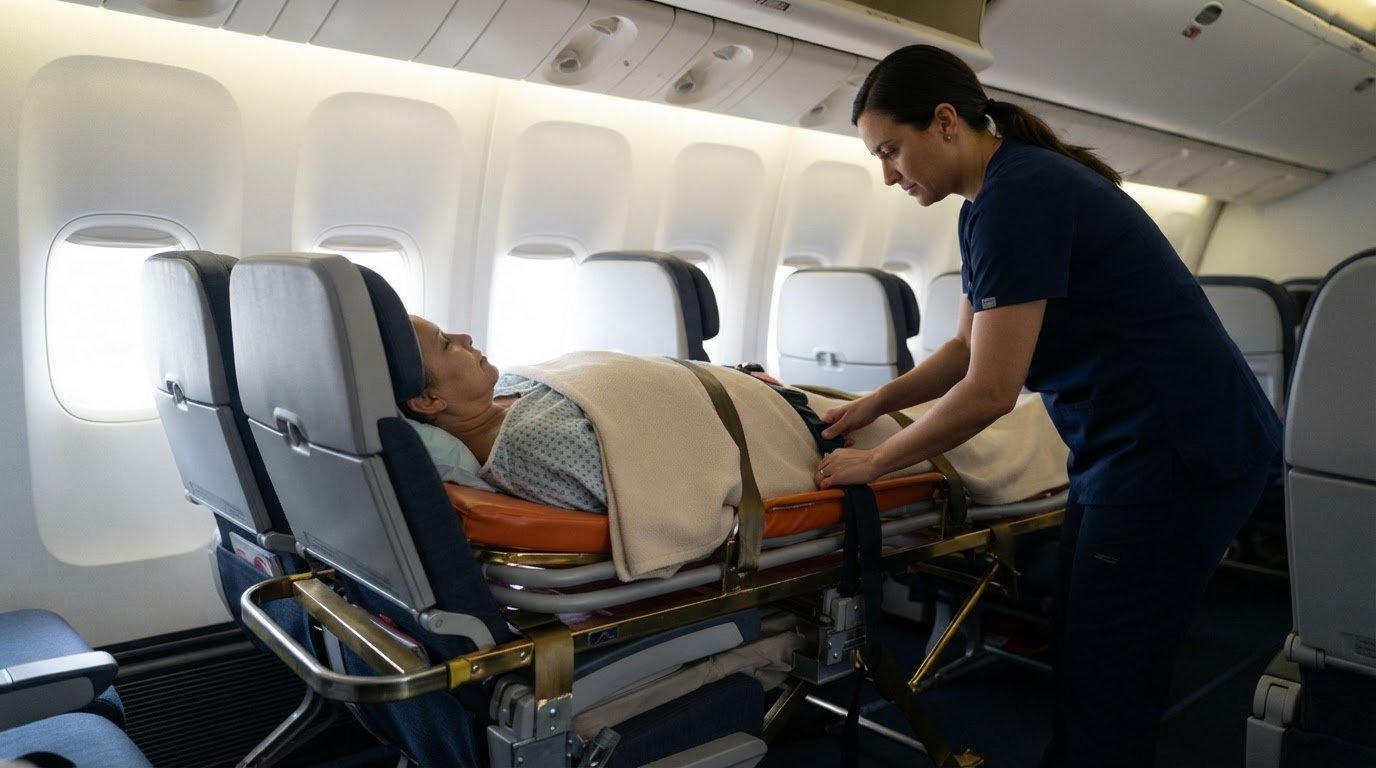
Air travel is a practical option for many older adults who can sit upright for the length of a flight and who do not require continuous monitoring. For some patients, however, the question is not whether the parent can board a plane but whether a clinically trained person should travel with them. RN MEDFLIGHTS provides licensed registered nurse escorts on commercial airlines, offering an air ambulance alternative for patients who need clinical supervision at a lower cost than a dedicated air ambulance.
The distinction matters during planning. A companion, such as an adult child, can provide physical help and emotional support. A registered nurse can assess changes in condition, manage scheduled medications, respond to a fall or a dizzy spell, and communicate with airline crew and receiving clinicians. These are different functions, and families often underestimate how often the second is needed.
Clinical Oversight Versus Companionship
Companionship addresses logistics such as carrying bags, navigating gates, and keeping the parent comfortable. Clinical oversight addresses risk. A parent who has recently been discharged from the hospital, who receives infusions, who has unstable blood pressure, or who has cognitive impairment that affects medication management may need more than a companion. The decision should be guided by the treating physician's recommendation rather than by assumptions about the parent's stamina.
Who Benefits Most From an RN Escort
Medical escorts are commonly arranged for patients recovering from surgery, patients with chronic conditions that require monitoring, and patients moving between hospitals or into a nursing home. A common mistake is to plan around the parent's best day rather than their typical day. Families should describe usual condition patterns, including fatigue, continence needs, and medication timing, when requesting a quote.
Because RN escorts are available for both domestic and international travel, the same planning framework applies whether the destination is in the same country or abroad. The escort level should match documented clinical need rather than the cost of the alternative alone.

Assessing Fitness to Fly Before Booking
Fitness to fly is a medical determination, and it should be made before any flight is booked. The decision affects which route, cabin, and level of support the family can use, as well as whether a clinical escort is needed. Families who skip this step often discover a restriction only after the fare has been paid.
Physician Review and Travel Clearance
The Road Scholar travel guide recommends scheduling a check-in with the doctor before a trip, especially when there are ongoing health conditions. For air travel, the appointment should cover oxygen needs, mobility limits, recent procedures, wound care, and any condition that could worsen with changes in cabin conditions, temperature, or time zones. Ask the physician to document the findings in writing so that the airline or escort provider can review them.
In practice, the most useful visit includes a discussion of the full itinerary. A short direct flight and a multi-leg route with long layovers present different risks. Families should share every leg of the journey with the physician rather than only the final destination.
Building a Medical Summary
A concise medical summary is one of the most useful documents on a long-distance trip. It should list diagnoses, allergies, current medications with doses and timing, implanted devices, recent hospitalizations, the primary physician's contact information, and the name of the family member who makes medical decisions. The Road Scholar guide advises keeping a simple medical summary and emergency contacts easily accessible, which applies equally to air travel.
Store the summary in two formats: a printed copy in the carry-on bag and a digital copy that a family member can access remotely. A summary written in plain language is easier for airport staff, escorts, and receiving facilities to use than a stack of discharge papers.
Airport Assistance, Seating, and Check-In
Airports involve more walking, waiting, and standing than most travelers expect. For an older parent, the cumulative distance from curbside to gate can exceed their daily tolerance before boarding begins. Arranging assistance in advance reduces that burden and gives the family a clearer timeline.
Requesting Wheelchair Assistance
A traveler who has made several long trips with an elderly mother recommends requesting wheelchair assistance at every airport, even when the parent walks reasonably well. The reasoning is practical. An assistant familiar with the airport can guide the passenger through check-in, security screening, and baggage claim, and the parent conserves energy for the parts of the trip that matter most. Request the service when the reservation is made, then confirm it at the airport, since staffing and timing vary.
Assistance requests should also note any need for seating near a restroom, extra time between connections, or help with boarding. Airlines generally handle these requests through their reservation or accessibility channels, and written confirmation reduces misunderstandings at the gate.
Luggage and Carry-On Planning
Luggage is a frequent source of strain on long journeys. The same traveler reported that after two trips with carry-on suitcases, they wished they had packed a single bag for the two of them. For a parent who needs assistance, one lightweight carry-on for essentials is usually more manageable than several bags. Medications, the medical summary, a change of clothing, and comfort items should travel in the carry-on, never in checked luggage.
Pro tip: Pack the carry-on so that medications and documents can be reached without opening the full bag at security. A small, clearly labeled pouch reduces delays and avoids searching under time pressure.
Door-to-Door Logistics From Home to Destination
A flight is only one segment of the journey. Transfers from the parent's home to the airport, from the arrival airport to lodging or a care facility, and from there to appointments often present more risk than the flight itself. Door-to-door planning treats each transfer as a separate task with its own timing and assistance needs.
Transfers tend to be where unplanned delays accumulate, so timing buffers should be generous. A plan that appears to allow a comfortable margin on paper often proves tight once the parent needs a restroom stop or additional time to stand and walk.
Ground Transport at Both Ends
Ground transport should be arranged for a passenger who may need help getting into a vehicle or who cannot manage curbs and stairs. Families sometimes rely on a ride-hailing app for convenience, but a standard car may not suit a parent who uses a wheelchair or walker. Official taxi services and ride-hailing apps can serve as useful backups. Checking both before departure gives the family more options if one is unavailable at the time of need.
Hospital-to-Hospital and Nursing Home Transfers
Transfers between facilities involve medical records, clinical handoffs, and continuity of medication orders. A hospital-to-hospital escort or a nursing home medical escort arrangement places a clinician at the handoff points, which is where information is most likely to be lost. Families should ask the discharging facility to send records and medication lists ahead of the trip, and ask the receiving facility to confirm readiness before departure.
When a parent is moving to a long-term setting, the family should confirm the accepting facility's admission requirements in advance. Documentation requirements, bed availability, and expected arrival times should be confirmed in writing.
Choosing Between Air Ambulance, RN Escort, and Family Travel
Three approaches are commonly considered for a long-distance flight with an older parent. Each carries a different level of clinical support, cost, and logistical complexity. The right choice depends on the parent's medical needs and on the family's ability to provide care during transit.
Comparing the Three Main Approaches
A dedicated air ambulance provides a stretcher and a medical crew on a chartered aircraft, which suits patients who cannot sit upright or who need intensive monitoring throughout transport. It is typically the most expensive option. An RN escort on a commercial flight provides clinical supervision for patients who can travel seated but need a licensed nurse for monitoring, medication management, and communication. A family member traveling alone provides companionship and physical help but no clinical training.
Option | Best suited for | Key considerations |
|---|---|---|
Dedicated air ambulance | Patients who require stretcher transport or intensive monitoring | Highest cost of the three options. Stretcher and medical crew are provided on a chartered aircraft. |
RN escort on a commercial flight | Patients who can travel seated but need licensed clinical oversight | Lower cost than a dedicated air ambulance. A registered nurse travels with the patient throughout the journey. |
Family member without a clinical escort | Stable, mobile patients with no active clinical needs in transit | Lowest direct cost. The family member must manage medications, emergencies, and airport logistics. |
Domestic and International Considerations
The approaches above apply to domestic and international travel alike. International journeys add documentation requirements, time zone changes, and questions about access to care at the destination. Medical repatriation, which returns a patient to their home country for ongoing treatment, involves a longer planning timeline and coordination among the hospital, insurer, case manager, and family.
Caregiver forum discussions reflect the same pattern. One post describes a spouse in a skilled nursing facility after a hip fracture whose family needed transport to a facility in Florida, and the central question was which transport options were realistic and what they would cost. Families comparing options can review the RN MEDFLIGHTS air ambulance service page for an overview of the available arrangements.
Medications, Prescriptions, and Travel Documents
Medication gaps are among the most preventable risks in travel with an older parent. Time zone changes, delays, and unfamiliar pharmacies can disrupt a dosing schedule. A structured approach to medications and documents reduces that risk considerably.
Carrying Medications Safely
The Road Scholar guide advises carrying medications in their original containers and packing extra in case of delays. Original labeling shows the prescribing physician, dosage, and pharmacy, which helps security staff and receiving clinicians verify contents. The travel forum contributor also recommended bringing written prescriptions from the doctor, in case a refill or explanation is needed during the trip.
Keep a dosing record that notes the time each medication was last taken. This matters most when the trip crosses several time zones. An RN escort can manage the schedule in transit, but families traveling without a clinical escort should set alarms and assign responsibility for each dose to a named person.
Passports, Records, and Emergency Contacts
Identity documents should be organized in a single folder with copies of the passport, insurance card, and medical summary. A parent who may need to communicate with strangers in an emergency can wear identification with an emergency contact. One traveler reported using a medical identification bracelet with an engraved plate that lists an emergency contact, a simple measure that requires no action from the wearer.
Families traveling internationally should also learn key phrases in the destination language, such as the words for doctor, hospital, and "I feel sick." This small step can shorten an urgent exchange considerably.
Pro tip: Store the medical summary both on paper and in a secure digital format, and confirm that a family member at home can access it. A shared copy with a trusted contact protects against lost bags and phone failures.
Pacing the Trip and Choosing Arrival Lodging
Fatigue accumulates over long travel days, and it can be difficult for an older parent to report. The pace of the itinerary often determines whether a trip is restful or exhausting. A plan that limits the number of destinations and allows regular rest is usually more successful than one that covers many locations in a short period.
Pacing Days and Building in Rest
Guidance from a family that traveled with an elderly mother in her late 80s recommends fewer destinations, longer stays, and avoiding one- or two-night stays where possible. Each relocation requires packing, transport, and check-in, all of which add physical load. Plan breaks throughout the day and keep the parent well hydrated. The same family noted that a parent may not announce tiredness, so caregivers should watch for signs and plan a return to lodging or a seated rest before fatigue becomes severe.
The goal isn't to see everything, but to go comfortably and in a way that everyone enjoys.
The Road Scholar guide makes the same point in its planning advice. A useful planning principle is to schedule the most demanding activity early in the day and leave the afternoon open. Seated activities, such as concerts, performances, and gardens with benches, allow a parent to participate without using the energy needed for the rest of the trip.
Lodging Choices That Reduce Strain
Lodging should be selected for access before amenities. Hotels with elevators and no steps between the elevator and the room reduce risk on every arrival. Many museums and attractions have elevators or accessible routes that are not obvious from the main entrance. Staff can usually identify them when asked, and the information is often listed on the attraction's website.
Location also matters. Accommodations with restaurants within one or two blocks reduce walking after dinner, when a parent may be most tired. A staffed front desk or an on-site host provides a point of contact for urgent needs, which is particularly useful for families who are unfamiliar with the city.

Frequently Asked Questions
How far in advance should a long-distance flight with an elderly parent be planned?
Planning should begin as soon as travel dates are considered, because physician review, assistance requests, and escort arrangements all require lead time. Families should not wait until a ticket is purchased to begin medical preparation. Each element should be confirmed in writing before departure.
Does a parent always need a medical escort to fly on a commercial airline?
No. A medical escort is generally appropriate when the parent's physician identifies a need for clinical oversight during transit. A stable, mobile parent may travel with a family companion. The decision should follow medical advice rather than assumptions about the parent's condition.
What is the difference between an RN escort and an air ambulance?
An air ambulance is a dedicated medical flight and is typically used for patients who need stretcher transport or intensive monitoring. An RN escort travels with the patient on a scheduled commercial flight and provides licensed nursing oversight while the patient travels seated or with assistance. The cost difference is substantial, and the appropriate choice depends on the patient's clinical needs.
Can an RN escort help with international travel?
Yes. RN MEDFLIGHTS offers medical escort services for international travel as well as domestic travel. International journeys require additional documentation, coordination with receiving facilities, and attention to time zone changes in medication schedules.
What should be in a carry-on bag for an older parent?
The carry-on should contain medications in original containers, a printed medical summary, written prescriptions, emergency contact information, and a change of clothing. Essential items should never be placed in checked luggage. The bag should be light enough for the family member or escort to manage through the airport.
How can families request a quote for an RN escort?
Families can request a free quote by phone. Have the parent's diagnosis summary, medication list, mobility status, origin, destination, and preferred travel dates available when calling, so that the quote reflects the actual clinical needs of the trip.
If you have arranged a long-distance flight for an older parent, we welcome your feedback and would value hearing which planning step made the greatest difference for your family.